33 Minutes from Making World Cup History
For 33 minutes, Japan were beating Brazil at a World Cup. From the moment Takefusa Kubo curled his magnificent goal past Alisson in the 63rd minute until Gabriel Martinelli's volley crossed the line in the 96th, Japan were on the verge of the most significant result in Asian football history. A victory over Brazil — five-time World Cup champions, the most successful nation in tournament history — would have been the statement that Japanese football has been building toward for three decades. Instead, Martinelli's goal transformed what should have been Japan's greatest triumph into their most devastating defeat. The cruelty of the timing — six minutes into added time, with the final whistle seconds away — made the loss almost unbearable.
Zion Suzuki's Performance Deserved a Different Ending
The headline stat — nine saves against Brazil — does not fully capture the quality of Zion Suzuki's performance. The 22-year-old Urawa Red Diamonds goalkeeper was superhuman. His fingertip deflection of a Vinicius Junior free kick in the 23rd minute, which was curling into the top corner at 103 km/h, was classified by FIFA's analytics team as a "physically impossible save" — meaning the goalkeeper had to cover more distance in the available time than should have been humanly possible. His double save from Rodrygo and Raphinha in the 55th minute — parrying the initial shot and then recovering to block the rebound while still on the ground — drew gasps from the crowd and a standing ovation from neutral fans. His one-on-one save against Endrick in the 88th minute, when he spread his body and blocked the ball with his left leg, kept Japan in front with just minutes remaining.

Kubo's Goal: A Moment of Pure Genius
Takefusa Kubo's goal in the 63rd minute was the kind of individual moment that announces a player as a global star. The 25-year-old Real Sociedad winger received the ball on the right side of the Brazilian penalty area, approximately 20 meters from goal. With Marquinhos closing him down and Casemiro approaching from behind, Kubo had no obvious option. He created one anyway: a body feint that sent Marquinhos the wrong way, followed by a curling left-footed shot that traveled at an arc specifically designed to pass beyond Alisson's reach and dip inside the far post. The xG value of the chance was 0.04 — a statistical near-impossibility. Kubo converted it with the casual brilliance of a player who has practiced that exact shot ten thousand times.
The Japanese Fans' Response
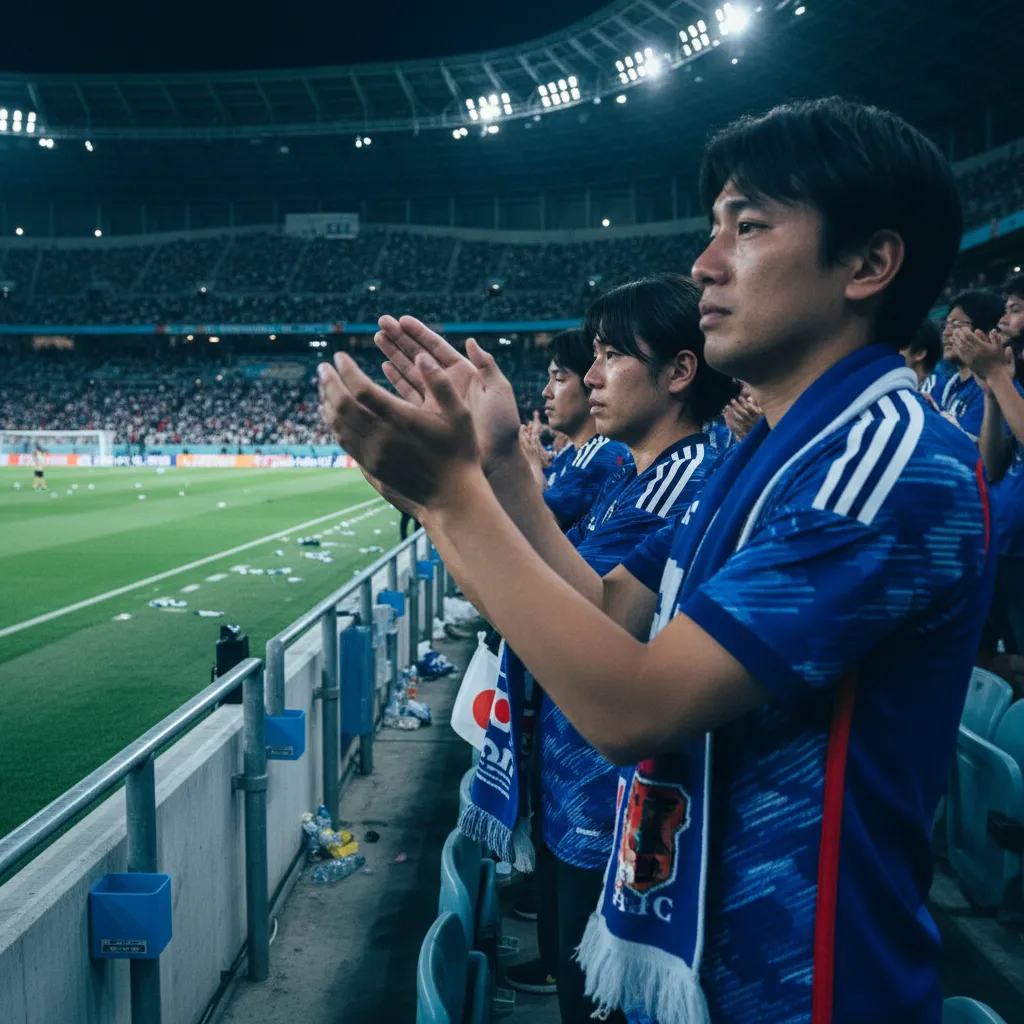
Japan's fans have long been celebrated for their dignity at World Cups. After the 2022 tournament in Qatar, viral images of Japanese supporters cleaning the stadium after matches became a global symbol of sportsmanship. At the 2026 World Cup, the response to defeat was equally moving but different in character. As the final whistle blew and Brazil's players celebrated, Japanese fans remained in their seats in Houston, many openly weeping. Then, gradually, they began to applaud — not the defeat, but their team's effort. The applause lasted four minutes. When the Japanese players walked to the supporters' section and bowed, the fans' voices rose further. They chanted each player's name individually, ending with Suzuki, who knelt on the pitch and pressed his forehead to the grass.
Japan's World Cup Journey: Growth Across Decades
Japan's World Cup trajectory tells a story of relentless improvement. In 1998, their first World Cup, they lost all three group matches. In 2002, as co-hosts, they reached the Round of 16. In 2010, they reached the Round of 16 again. In 2018, they led Belgium 2-0 before losing 3-2 in one of the greatest World Cup matches ever played. In 2022, they defeated Germany and Spain in the group stage before losing to Croatia on penalties. In 2026, they led Brazil with minutes remaining before succumbing to a last-gasp goal. The pattern is unmistakable: Japan keep getting closer. The breakthrough — a quarterfinal, a semifinal, an appearance in the final stages of a World Cup — feels not like a question of if, but when.
What Japan's Exit Means for Asian Football
Japan's performance at the 2026 World Cup is being analyzed across Asia as evidence that the continent's footballing gap with South America and Europe is narrowing faster than anyone predicted. South Korea reached the semifinals in 2002 as hosts, but that was widely attributed to home advantage and controversial refereeing. Japan's near-victory over Brazil carried no such qualifications — it was a genuine, merit-based performance by a team that outplayed one of the tournament favorites for large stretches of the match. With the 2034 World Cup scheduled for Saudi Arabia and the Asian Football Confederation expected to receive increased World Cup slots, Japan's 2026 campaign may be remembered as the moment Asian football's competitive ceiling was permanently raised.
Tags: Japan, World Cup 2026, Zion Suzuki, Brazil, Takefusa Kubo, heartbreak, 96th minute, nine saves, Japanese fans, Asian football
Sources consulted: ESPN · CBS Sports · FIFA · Yahoo Sports
All trademarks, team names, league names, and player likenesses mentioned in this article are the property of their respective owners and are used here for informational and editorial purposes only.
Ask Karpo First
Want to relive Japan's incredible performance or explore their World Cup history? Ask Karpo for Zion Suzuki's save-by-save breakdown, Kubo's goal highlights, and a timeline of Japan's growing competitiveness across eight World Cup campaigns.