A back-to-school week in NYC can make every loud search term feel urgent, and house of the dragon is no exception. The useful move is not to chase a rumor through group chats or assume there is a local tie-in. Treat the phrase as a prompt for a public, repeatable research route: what can you verify, which sources are primary, where can a student or caregiver work without buying anything, and what should be checked before leaving home? This plan uses official public resources available through The New York Public Library and keeps the claims modest. It does not promise appearances, special access, events, or endorsements. It gives you a city routine for checking facts, studying, and having a backup when a page, place, or plan changes.
Want a cleaner before-you-go checklist for a school-day research stop? Text Karpo with the topic, borough, time window, and whether you need quiet study, teen resources, or an event check.

Turn curiosity into a research question
Start by rewriting the search into something a student can actually answer. Instead of “What is happening with house of the dragon in NYC?” use questions that can be verified: What is the original source? Is there a public institution listing anything relevant? Is the claim about a book, show, actor, location, class assignment, or event? That small change protects you from turning a trending phrase into a scavenger hunt for unconfirmed local activity.
For a back-to-school household, the assignment can be practical. Ask the student to separate three categories: official sources, reporting, and opinion. Official sources are places like a library site, a city agency page, or a transit page. Reporting should identify where its facts came from. Opinion can be useful, but it should come last. If the topic is fantasy, adaptation, media literacy, or fandom, the goal is still the same: trace claims back to a source that can be checked.
Start with a reliable public resource
NYPL is the cleanest first stop because its public site points readers toward research tools rather than hype. The library highlights ways to explore its online catalog, start research, get a library card, use e-books and more, find learning resources for kids, teens, and educators, and get help through Ask NYPL. Those are exactly the tools a student needs when a pop-culture phrase becomes a research topic.
A useful NYC route is to begin online before going anywhere. Search the NYPL catalog, note possible books or e-books, and look at the library’s event listings only as official listings, not as evidence of anything beyond what the page says. The NYPL homepage also promotes free events and activities for all ages, author talks and conversations, exhibitions, kids and teens programming, and other events. Because listings can change, the important habit is to check the official page on the day you plan to use it.
If the student needs a broader reading bridge, NYPL’s own homepage offers examples of how to move from fandom into books: staff picks, book recommendations, teen reads, and current collection highlights. That is better than relying on a social post that may be mixing speculation, old information, and someone else’s wish list.

Compare primary reporting before opinions
Once NYPL gives you a starting point, compare the claim against other primary pages before reading reaction threads. For NYC logistics, that means checking the official source for the thing being claimed. If it is a library program, use the NYPL event page. If it is a city record or public document, use the relevant city page when it is accessible. If it involves getting across town, use the official transit source before trusting a screenshot.
There is a real-world lesson here: official pages are not always available at the exact moment you try them. In the source check for this article, the NYC Department of Records page and the MTA homepage returned access-denied messages. That does not prove anything about service, records, or availability. It simply means a reader should not build a school-day plan on one failed page load. Try again, use the official site directly, and do not substitute a random repost for a primary source.
For a class exercise, make students write down what each source can and cannot confirm. NYPL can confirm its own listed resources and events. A transit page, when accessible, can confirm current route information. A city page, when accessible, can confirm its own public records information. Opinion posts can explain why people care, but they cannot replace the source.
Choose a study stop that fits the task
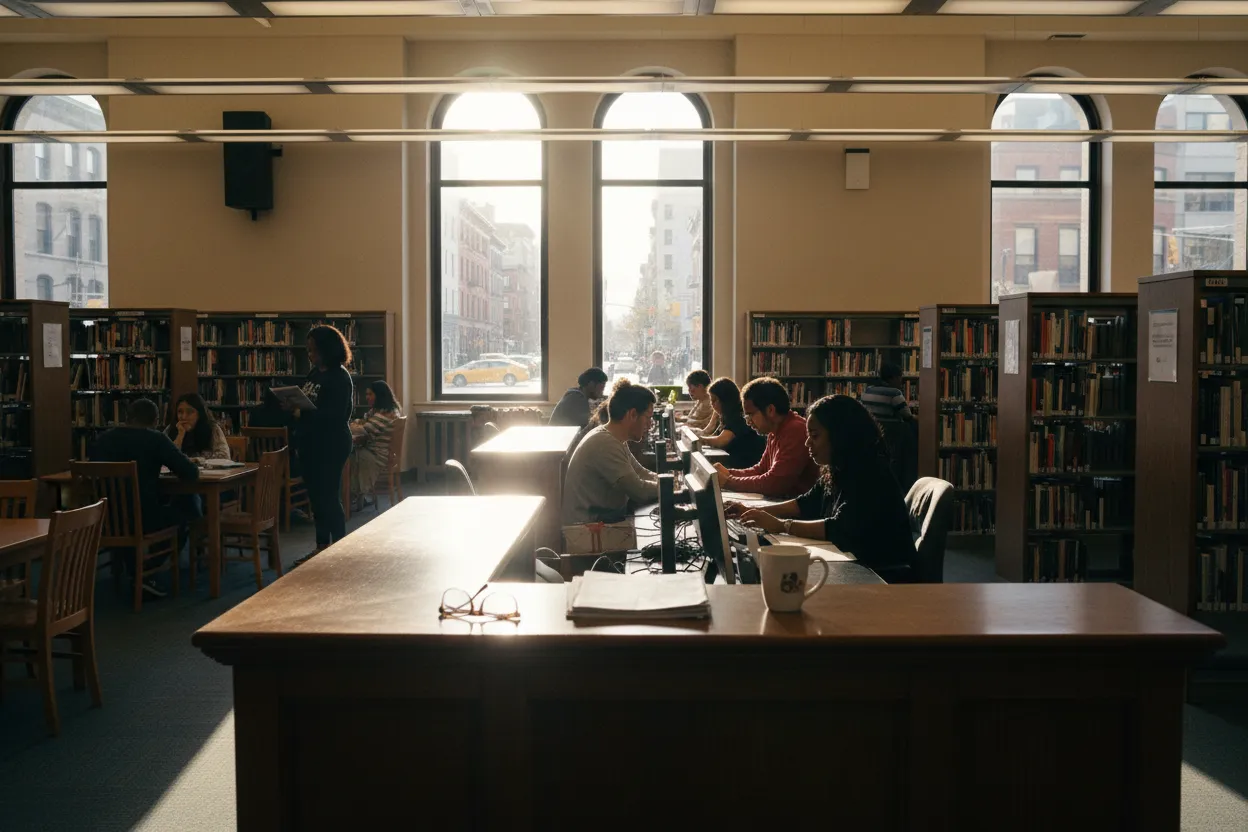
Match the location to the work. If the assignment is catalog research, reading, or getting started with a library card, use NYPL’s plan-your-visit and location information before leaving. The library’s public site specifically points readers to the flagship building of The New York Public Library, described as one of the world’s great libraries, and to services such as the online catalog, learning resources, accessible resources, and Ask NYPL.
If the task is event-based, do not assume every listing fits every student. NYPL’s homepage shows examples across the system, including a Big Summer Book Club Celebration with N.K. Jemisin listed for Monday, August 17 at 8 PM at the Delacorte Theater; an event at Inwood Library on Thursday, August 13 at 4:30 PM; a program at the Library for the Performing Arts on various dates; and a Tuesday, August 18, 6:30 PM program at Stavros Niarchos Foundation Library and online. Those examples show the range of formats and locations, not a guarantee that a seat, access condition, or detail will remain unchanged.
For timing, build in a buffer. A student who is going after school needs time to get from dismissal to transit, from transit to the building, and from the entrance to the right room or reading area. If a specific event matters, check the official listing again before departure and once more if you are delayed.
Add one low-cost reset nearby
The best NYC study plan includes a reset that does not depend on a purchase. NYPL’s site highlights free events and activities for all ages, book recommendations, exhibitions, e-books, multilingual resources, and accessible resources. That gives a caregiver or student a way to pivot if the original idea is too crowded, too loud, or not useful for the assignment.
A practical reset can be simple: browse staff picks, look for a teen read, ask for help through an official library channel, or switch from event mode to catalog mode. If the student came in because house of the dragon was the hook, the reset could be a short comparison list: fantasy novels, adaptation source material, city-based speculative fiction, or books about media literacy. Keep the output small enough to finish before dinner.
Crowd risk is part of the plan, not a surprise. Public buildings, author conversations, exhibitions, and back-to-school afternoons can draw people. Do not promise a quiet room to a student who needs silence; verify current access, consider an online resource when available, and keep a second task ready if the first space is busy.
Verify hours and access before leaving
The final check is the least glamorous and the most important. Before anyone leaves home or school, open the official NYPL page for the branch, building, event, or resource you plan to use. Confirm the date, time, location, format, and any access notes shown there. If the page points to online participation, confirm that too. If the page has changed, accept the change and revise the plan.
Do the same for transit. Because the official MTA page was not accessible during this source pull, this article cannot state route details, service status, or travel times. That is the point: verify current transit directly from an official source before you commit to a cross-borough trip, especially on a school night or when a student has a hard return time.
Your backup choice should be ready before the first plan fails. If the event is not workable, use the NYPL catalog, e-books and more, learning resources for kids, teens, and educators, or Ask NYPL. If the destination is too crowded, convert the outing into a shorter library-card, reading-list, or source-comparison stop. The win is not catching the trend; it is teaching a repeatable NYC verification habit.
Tags: #houseofthedragon #NYC #BackToSchool #AskKarpo #BeforeYouGo #NYPL #SourceChecking #MediaLiteracy #StudentLife #LibraryCard #NYCParents #StudyPlan #PublicResources #LocalLife
Sources consulted: nypl.org · nyc.gov · new.mta.info
All trademarks are the property of their respective owners.
Ask Karpo first
Ask Karpo first when a viral phrase turns into a real NYC errand. Send the topic, nearest cross streets, student age range, time window, and whether you need research help, quiet space, accessibility checks, or a backup plan before you go.