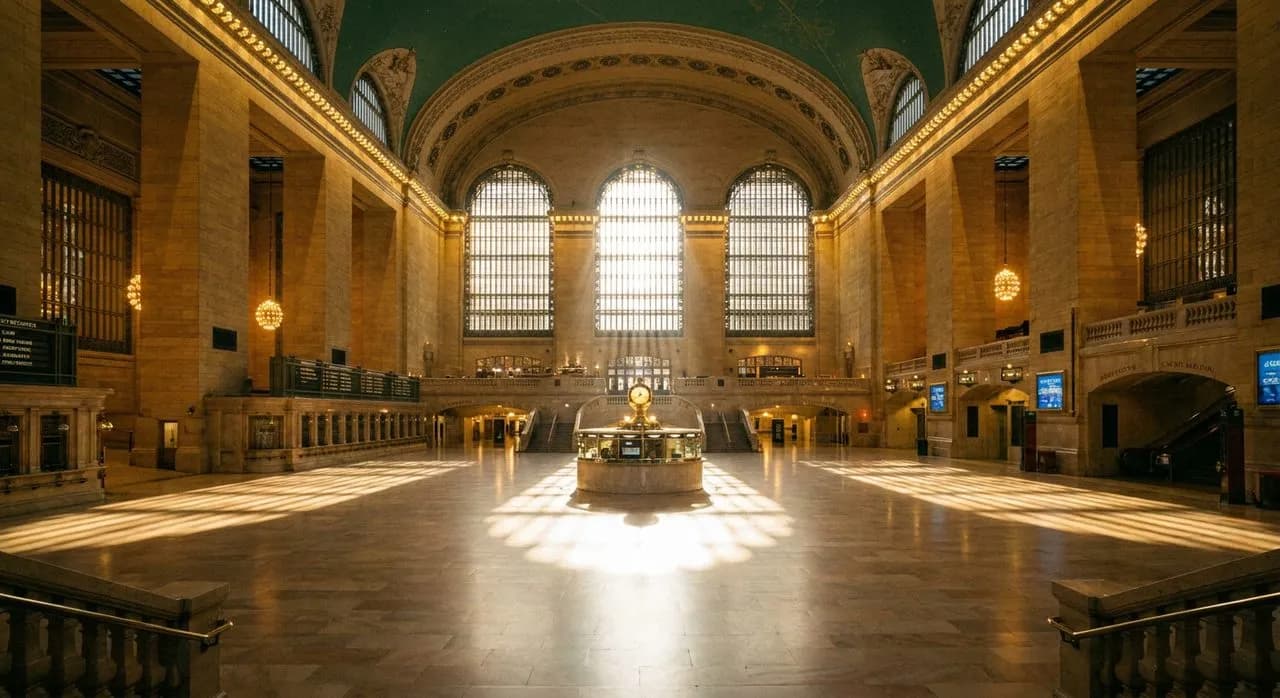
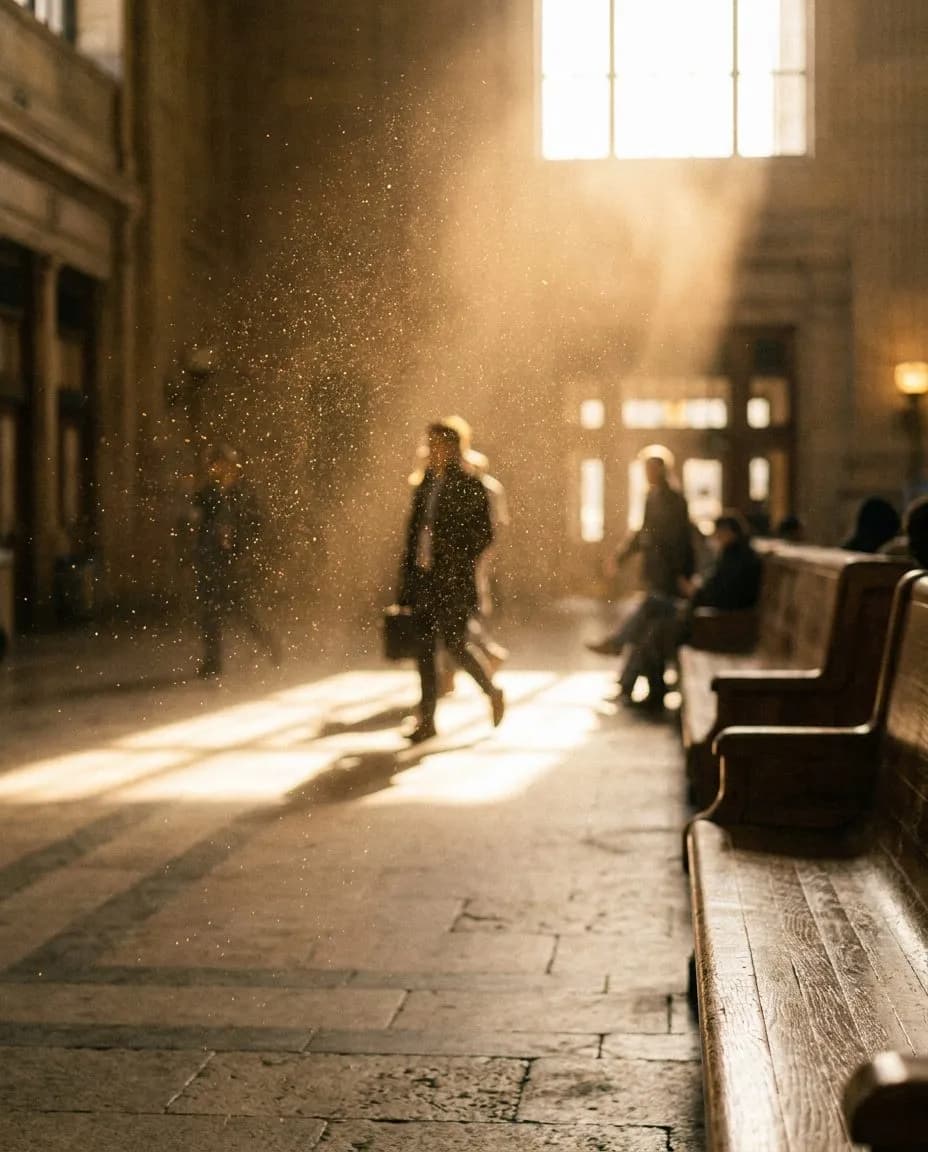
Most New Yorkers encounter Grand Central Terminal in a state of utilitarian rush—head down, MetroCard out, destination fixed. But arrive at the main concourse before 7:30 on a winter morning and the Beaux-Arts hall reveals a quieter choreography. Sunlight angles through the eastern clerestory windows in concentrated shafts, illuminating dust motes and marble in a way the overhead fixtures never manage. It's a brief atmospheric window, compressed between dawn and the morning commuter surge, and it costs nothing but an early alarm. The theatrical quality of the light transforms the concourse from transit hub into something closer to cathedral, all before most office workers have poured their first coffee.
The Physics of the Morning Window
The eastern clerestory windows align with sunrise during winter months—December through February—in a narrow bracket between 7:10 and 7:35am, when the sun's trajectory sits low enough to penetrate the arched glass without obstruction from neighboring buildings. Light penetration reaches the main floor most dramatically from 7:15 to 7:25am, a ten-minute span when the angle creates visible shafts that cut diagonally across the Tennessee marble. The effect depends on clear or partly cloudy skies; heavy overcast diffuses the shafts into general grayness, though the natural illumination still outperforms artificial lighting for revealing the stone's veining and the brass details of the central information booth.
By late February the sun climbs higher on the horizon and the window shifts earlier, losing some of its drama as the angle steepens. January offers the most reliable geometry, with sunrise occurring close enough to seven that early risers can witness the transition from pre-dawn blue to golden penetration without requiring a truly punishing wake-up call. The solstice itself—around December 21—marks the southernmost point of sunrise, creating the longest, most raking light paths across the floor.
Where to Stand (and Where to Climb)
The instinct is to plant yourself near the famous four-faced opal clock atop the central information booth, and during the light window that spot does offer an immersive experience—shafts descending around you, the zodiac ceiling illuminated overhead. Commuter volume remains below thirty percent capacity until 7:45am on weekdays, so the concourse floor near the information booth offers unobstructed standing room for viewing during the light window. You'll share the space with a handful of early arrivals nursing coffee and a few photographing the empty hall, but it's a fundamentally different population density than the elbow-to-elbow scrum that arrives forty-five minutes later.
For a less immersive but more compositional vantage point, the west balcony—accessible via staircases near the Lexington Avenue entrance—provides an elevated viewing angle for photographing the light shafts without obstruction. From here you can frame the entire width of the concourse, capturing the shafts as they stripe the floor and the commuters who drift through them, tiny and oblivious. The balcony also offers sightlines to the astronomical ceiling's constellations, which appear more legible in natural light than under the usual evening artificial glow. The gold-leaf stars and zodiac figures, painted in reverse (an error preserved as charm), catch the dawn light with a softer luminosity than the backlit drama of evening.
The Ceiling in Morning Context
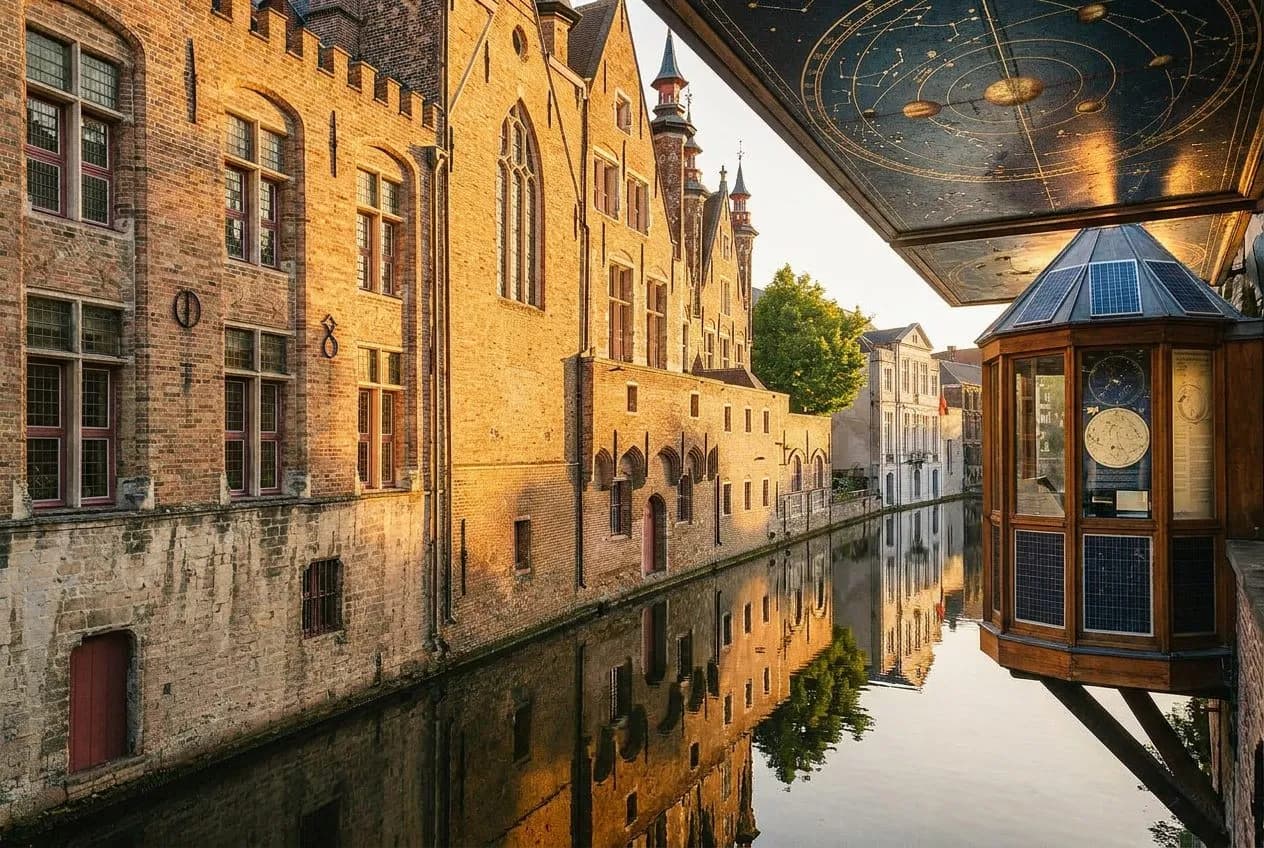
Paul César Helleu's ceiling mural—a Mediterranean-blue vault dotted with 2,500 stars representing sixty constellations—is Grand Central's most famous interior flourish, but it's typically photographed under artificial lighting or in the flat glare of midday. The early-morning natural wash changes the palette. The Prussian blue reads deeper, almost navy in the pre-commute dimness, and the fiber-optic stars (installed during a 1990s restoration) recede in prominence, allowing the gold-leaf painted stars to dominate. The overall effect is less sparkly spectacle, more hushed firmament. It's one of the few times the ceiling reads as genuinely celestial rather than theatrical.
The reversal of the constellations—Helleu worked from a medieval manuscript that depicted the heavens as God would see them, looking down—becomes an amusing footnote when you're standing beneath them at dawn, contemplating the cosmological perspective while checking your phone for the time. The mural survived decades of grime (cleaned during the terminal's late-1990s restoration to reveal colors most New Yorkers had never seen) and a 1990s proposal to demolish the terminal entirely. Now it presides over this daily ritual of light and movement, indifferent and immaculate.
Pre-Rush Acoustics and Atmosphere
Sound behaves differently in the concourse before the crowd arrives. The vaulted ceiling and hard surfaces that create the famous whispering gallery effect along the Oyster Bar ramp also amplify every footstep and rolling suitcase during low-occupancy hours. Conversations carry across the floor in fragments—a laugh from near the MetLife building passage, a phone conversation echoing from the Vanderbilt Avenue side. It's an unintentional ASMR experience, the concourse performing its acoustics without the damping effect of thousands of bodies absorbing sound waves. By 7:50am the ambient volume climbs to a low roar, individual voices subsumed into general crowd hum. The transition happens quickly.
The scent profile shifts too. Early morning brings the smell of soap and shampoo from freshly showered commuters, mingled with coffee from the market-level food vendors beginning their prep. It's a cleaner, less lived-in smell than the afternoon's layered funk of cologne, pretzels, and subway exhaust. The marble itself seems to smell cooler, less warmed by body heat and friction. These are small sensory details, easy to miss if you're focused solely on the light, but they contribute to the sense that you're witnessing the terminal in a transitional, half-private state.
Food Court Logistics and the Early Vendor Question
The lower-level dining concourse opens early, but individual vendor hours vary and should be verified directly. By seven most of the grab-and-go options are operational, though seated dining remains sparse. If you arrive for the light window, consider timing a coffee run for after the peak 7:15 to 7:25 shaft display—descending to the food court means missing the best moments, and returning with a hot cup in hand means you can linger near the information booth without feeling conspicuously idle. The lower level also offers restrooms that are mercifully under-trafficked before eight.
This qualifies as one of the city's more sublime free things to do, a reminder that infrastructure and beauty occasionally align without admission fees or velvet ropes. Grand Central rewards the investment of an early alarm with a experience that's equal parts architectural tour and light installation, all before the workday officially begins. Pair it with a walk through the surrounding neighborhood—Midtown in early morning is its own kind of spectacle, all delivery trucks and bleary-eyed dog walkers—and you've assembled a low-cost city guide moment that justifies the sleep deprivation.
Practical notes
Grand Central Terminal, 89 East 42nd Street at Park Avenue, Manhattan. Accessible via the 4, 5, 6, 7, and S subway lines (Grand Central–42nd Street station); Metro-North trains arrive at Grand Central Madison and Grand Central Terminal platforms. The main concourse is open daily, though the sunrise window applies only to winter months December through February. The west balcony staircases near Lexington Avenue are accessible during standard terminal hours. Bring a phone or camera; low-light performance matters if you're photographing the shafts. Dress warmly if walking surrounding blocks. Verify dining-concourse vendor hours directly. Fully wheelchair accessible via elevators near multiple entrances.
Tags: #GrandCentralTerminal #NYCMornings #BeauxArts #WinterLight #MidtownManhattan #ArchitecturalPhotography #FreeNYC #EarlyBird #NaturalLight #HistoricLandmarks #CityGuide #RightOnTime #NYCInteriors #CommuteCulture #GoldenHour
Please drink responsibly. Must be of legal drinking age.
Sources consulted: Grand Central Terminal - Wikipedia · Grand Central Terminal Official Site · MTA Grand Central Terminal · Clerestory Architecture - Wikipedia · NYC Tourism - Grand Central
All trademarks are the property of their respective owners.