The Goal Germany Will Never Forget
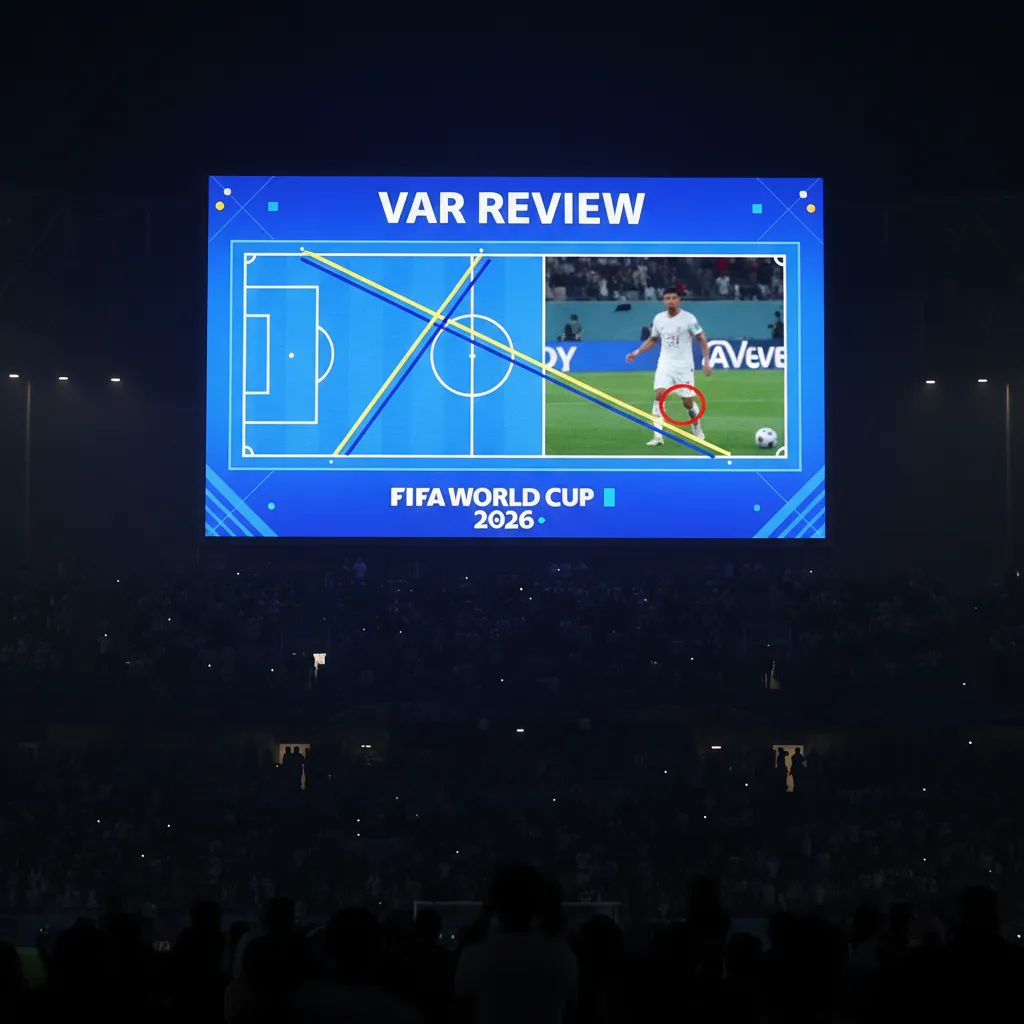
In the 107th minute of extra time at Gillette Stadium, with the score locked at 1-1 and penalties looming, Florian Wirtz collected a pass from Jamal Musiala, drove at the Paraguayan defense, and struck a shot that deflected off a defender and rolled past Orlando Gill into the net. For 47 seconds, Germany celebrated. Players piled on Wirtz near the corner flag. Julian Nagelsmann pumped his fist on the touchline. The German section behind the goal erupted. Then the VAR notification appeared on the stadium screen, and the longest three minutes in German football history began.
What the Semi-Automated System Found
The semi-automated offside technology — FIFA's most advanced tracking system, using 12 cameras and limb-tracking algorithms — determined that Jonathan Tah had been in an offside position during a pass that occurred two phases before Wirtz's shot. Tah was not involved in the goal sequence directly: he did not touch the ball, did not obstruct a defender, and was standing approximately 15 meters from the play when the shot was taken. But the preceding pass — from Kimmich to Musiala — had traveled through a zone where Tah's position was deemed to have influenced Paraguayan defender Gustavo Gomez's movement. The margin of offside was 3.7 centimeters — the width of a human thumb.

Nagelsmann's Response Was Football's Most Powerful Critique of VAR
In his post-match press conference, Nagelsmann sat for 22 minutes and delivered what many consider the most articulate criticism of football's offside technology by any national team manager. His key statement — "I believe the rule is being applied correctly. I do not believe the rule is correct" — has been shared over 40 million times on social media. Nagelsmann argued that offside decisions measured in centimeters, applied to phases of play that do not directly involve the goal, undermine the spirit of the law. He proposed a "tolerance zone" of 20 centimeters — approximately the length of a player's boot — within which offside should not be called.
The Technical Details That Divided Experts
The offside ruling hinged on FIFA's interpretation of "interfering with play." Under current rules, a player in an offside position is penalized if they interfere with an opponent by "clearly obstructing the opponent's line of vision" or "making an obvious action which clearly impacts on the ability of an opponent to play the ball." FIFA's VAR team determined that Tah's position caused Gomez to adjust his body angle, which marginally affected his ability to track the pass to Musiala. This interpretation stretches the definition to its absolute limit — and many former referees have publicly disagreed with the call.

The Emotional Toll on the German Team
The three-minute wait between Wirtz's celebration and the disallowance was psychologically devastating. Sports psychologists have long studied the impact of "joy reversal" — the emotional whiplash of celebration followed by cancellation — on athletic performance. Germany's penalty shootout performance, which followed within 15 minutes of the disallowed goal, showed clear signs of emotional fatigue. Kimmich, usually clinical from the spot, struck his penalty without conviction. Sane's effort was similarly subdued. The team that stepped up to take penalties was not the same team that had been celebrating a winner minutes earlier.
FIFA Must Address the Tolerance Question
The Germany-Paraguay VAR controversy has reignited a debate that has simmered since the technology was introduced at the 2018 World Cup. The fundamental question is whether offside — a law designed to prevent players from gaining an unfair positional advantage — should be enforced with sub-centimeter precision by automated systems. The answer, increasingly, is no. IFAB, the body that governs the Laws of the Game, has already begun discussions about implementing a "thicker line" or tolerance zone for offside decisions. Germany's exit may be the catalyst that forces the change.
A Result That Will Echo Beyond This Tournament
Germany have been eliminated from World Cups before — in 2018 at the group stage, in 2022 at the group stage. But those exits were the result of poor performances. This was different. Germany played well enough to win, scored what appeared to be a legitimate goal, and were undone by a technological interpretation that most neutral observers consider excessive. The result will be debated in FIFA boardrooms, football academies, and pubs across the world for years. And somewhere in Foxborough, Jonathan Tah's left shoulder — 3.7 centimeters beyond the last defender — will be remembered as the margin that changed history.
Tags: World Cup 2026, Germany, VAR controversy, disallowed goal, Florian Wirtz, Jonathan Tah, offside technology, semi-automated offside, Gillette Stadium, Foxborough, Julian Nagelsmann, penalty shootout
Sources consulted: CBS Sports · ESPN · FIFA
All trademarks, team names, league names, and player likenesses mentioned in this article are the property of their respective owners and are used here for informational and editorial purposes only.
Ask Karpo First
Want to follow the VAR debate and find out which matches are coming up at Gillette Stadium? Ask Karpo for the latest World Cup schedule, a guide to watching matches in the Boston area, and real-time bracket updates.