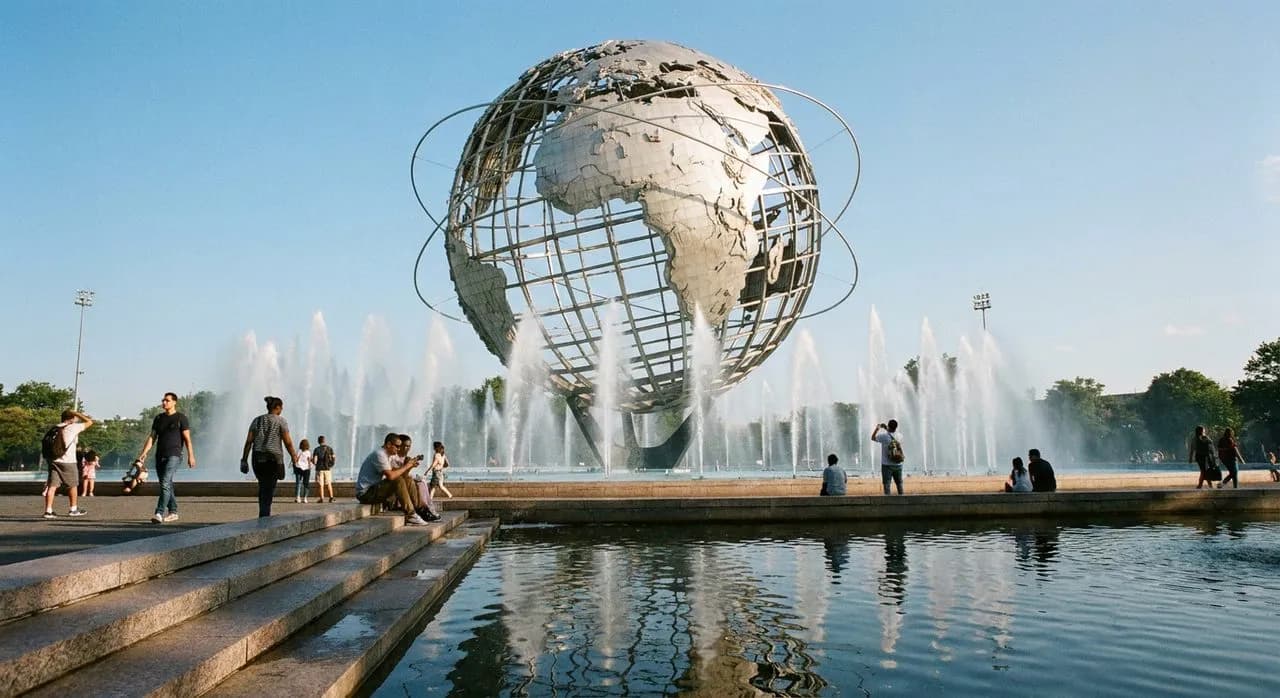
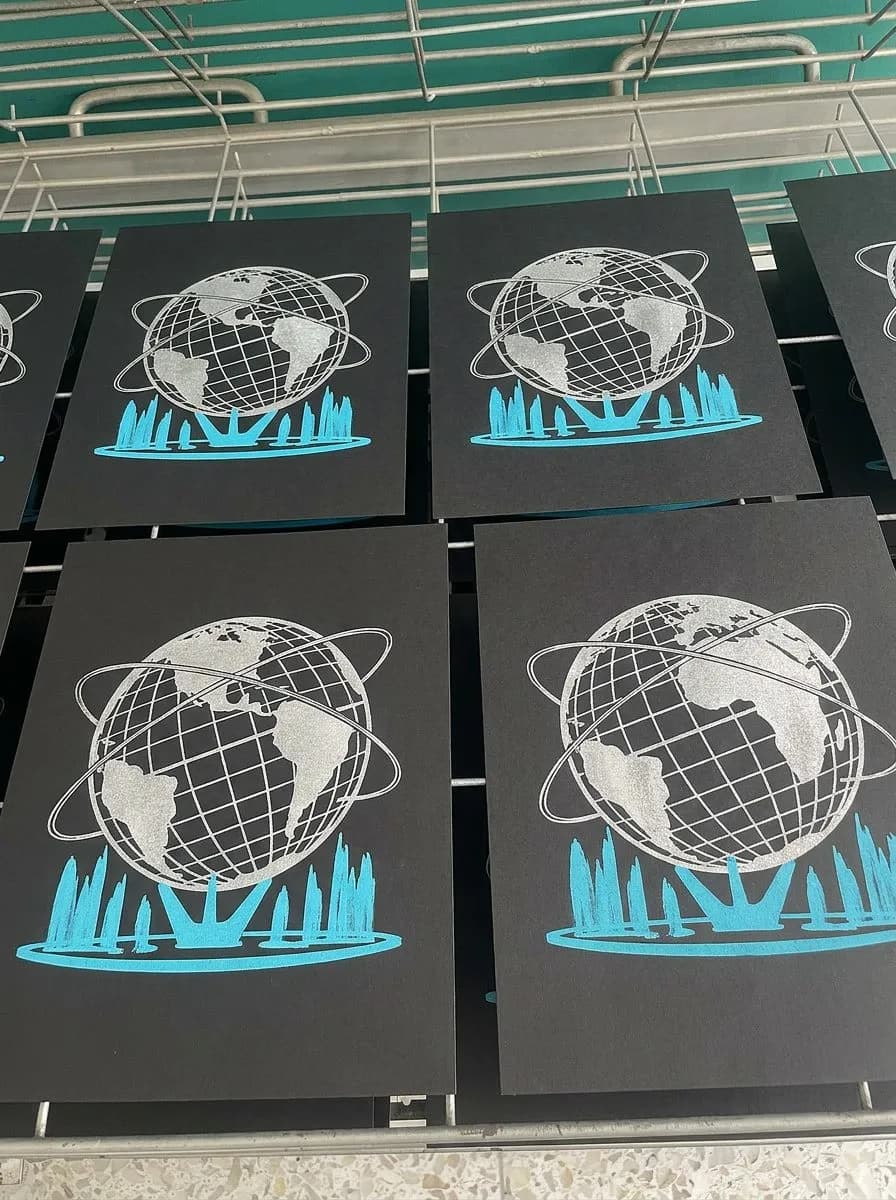
The Unisphere doesn't sneak up on you. Twelve stories of stainless steel meridian rings holding a tilted globe, surrounded by a 300-foot fountain basin—it announces itself from the Grand Central Parkway, from the 7 train windows, from the walking paths that thread through Flushing Meadows Corona Park. Up close, the scale shifts again. The plaza opens wide, the fountain jets trace arcs against the sky, and the eastern granite steps reveal themselves as something more than ornament: a makeshift amphitheater, a perch, a place to sit and watch the mechanics of public space unfold.
The plaza and its rhythms
The Unisphere plaza operates on overlapping schedules. typically operates seasonally; verify current NYC Parks hours before visiting, its 500 individually programmable jets cycling through sequences that range from polite to exuberant. remove the specific weekday 2pm test claim unless independently verified with twice the usual water volume—a midday crescendo that catches tourists mid-snapshot and sends a fine mist drifting across the pavement. It's one of those free things to do that requires no ticket, no reservation, just the willingness to linger long enough to notice the pattern.
Between the morning school groups and the late-afternoon family clusters, there's a weekday lull—call it 10:30am to noon—when the plaza exhales. A few solo visitors circle the perimeter. Pigeons work the fountain edge. The water show repeats on the hour, dependable as a metronome, and the eastern steps fill with people who've learned that sitting beats standing.

The eastern steps and their provenance
Those steps aren't new construction. The granite slabs underfoot are the same stone used in the base of the 1939 World's Fair Trylon and Perisphere, repurposed when the 1964 Fair remade the site. It's a quiet bit of material continuity—Depression-era optimism recycled into Space Age ambition—and the stone has aged well, its surface worn smooth in the traffic lanes, still crisp at the edges.
The steps face east toward the Queens Museum, its glass facade catching the sun across a wide lawn. The sightline is intentional, a holdover from the Fair's master plan, and it still works. From the top tier, you get the full amphitheater effect: the Unisphere as stage, the fountain as orchestra pit, the museum as backdrop. People spread out across the tiers—solo readers, lunch breakers, couples in the middle of long conversations—and the granite holds the warmth of the day well into evening.
October light and the meridian rings
Late October brings a specific gift: low sun that threads through the steel meridian rings and throws long, clean shadows across the basin. The stainless steel—weathered but still bright—catches the light in bands, and the whole structure reads differently than it does at noon in July. The air is cooler, the crowds thinner, and the fountain's last weeks of operation before the winter shutdown give the plaza a slightly elegiac tone.
This is when the Unisphere looks least like a relic and most like a working piece of public infrastructure. The light does some of it, but so does the season—the shift workers and the dog walkers, the people using the park as a shortcut rather than a destination. The globe tilts at 23.5 degrees, same as Earth's axis, and in October the angle feels right.
The early morning cohort
If you arrive at 6am, you'll find a different population entirely. Early morning runners use the Unisphere plaza as a mile-marker on the park's perimeter loop, and the crowd at that hour is mostly Flushing residents and hospital shift workers from nearby NewYork-Presbyterian or NYC Health + Hospitals/Elmhurst, finishing nights or gearing up for days. The fountain is off, the plaza quiet except for footfalls and the occasional dog. The globe looms dark against a brightening sky, and the whole scene has the stripped-down clarity of a stage before the performance.
By 7am the light has warmed, the first jogger-commuters have peeled off toward the subway, and the plaza begins its slow return to daytime programming. It's a short window, but it reminds you that this place never fully sleeps—it just changes registers.
The view axis and the museum
The Queens Museum sits a quarter-mile east across the lawn, its modernist glass front visible from the steps. Inside is the Panorama of the City of New York, a 9,335-square-foot scale model built for the 1964 Fair and still one of the park's hidden treasures. The museum's collection skews toward the Fairs, toward Queens history, toward the kind of civic ambition that built the Unisphere in the first place. The sightline between the two landmarks is deliberate, a visual handshake across the grass.
From the steps, you can watch visitors drift between the two sites, threading the paths that radiate out from the plaza like spokes. The park itself is enormous—1,255 acres, larger than Central Park—but the Unisphere anchors it, a fixed point in a landscape of ball fields, playgrounds, and wetlands. The axis to the museum gives the plaza a sense of orientation, a reason to face east rather than circle aimlessly.
What to watch for
The hourly fountain shows are the obvious event, but the in-between moments reward attention too. Watch how the crowd rearranges itself when the jets go live. Notice the photographers working the angles, trying to frame the globe without a dozen strangers in the shot. Listen for the shift in ambient sound when the water stops—the sudden prominence of traffic from the parkway, the rustle of plane trees along the perimeter.
Bring water, a hat if it's sunny, and low expectations. This isn't a curated experience; it's a public park with a very large piece of sculpture in the middle. Some days the light is perfect and the fountain cooperates and the steps feel like the best free seat in Queens. Other days it's windy and crowded and you'll wish you'd chosen differently. That's the bargain.
Practical notes
The Unisphere is located in Flushing Meadows Corona Park, Queens, accessible via the 7 train to Mets–Willets Point; walking time depends on the route and conditions. Street parking is available along park perimeter roads; lot parking near Meadow Lake and the Queens Museum. Fountain operates April through October, 10am–6pm daily, weather permitting; the plaza itself is open year-round. The site is fully accessible; the eastern steps have a ramped path on the southern end. Restrooms at the Queens Museum and near the Meadow Lake boathouse. No food vendors directly at the plaza; bring snacks or plan a stop in nearby Flushing for serious eating. Verify current fountain schedule via NYC Parks before visiting.
Tags: #UnisphereFountain #FlushingMeadowsCoronaPark #QueensNYC #FreeAndFine #WorldsFairLegacy #PublicArt #NYCParks #QueensMuseum #HiddenQueens #FallInNYC #OutdoorNYC #NYCLandmarks #CityCurious #AutumnLight #FreethingsToDo
Sources consulted: Wikipedia: Unisphere · NYC Parks: Flushing Meadows Corona Park · MTA: Getting There · Queens Museum
All trademarks are the property of their respective owners.