The mistake almost everyone makes with a New York weekend is looking on Friday. By Friday the calendar has already resolved: the lotteries have drawn, the timed-entry slots are gone, the good tables are booked and what remains is the residue. The people who consistently have interesting weekends in this city are not better informed about what is on — that information is public and abundant. They are simply operating on a different schedule, checking and committing midweek, when inventory is still open. Searching events near me in NYC this weekend is a reasonable thing to do on a Tuesday and a largely decorative one on a Saturday morning.
Karpo can pull what is actually still available this weekend in New York, flag which lotteries close tonight, and tell you what needs booking now.
The weekly rhythm that actually governs the calendar
New York's cultural calendar runs on a fairly consistent weekly cycle. Tickets for the following week tend to go on sale early in the week. Lottery entries for shows close a day or two before the performance. Museum timed-entry slots for a weekend fill from about Wednesday. And restaurant inventory for Friday and Saturday moves at the thirty-day mark and then again in the final forty-eight hours as cancellations appear.
So the productive checking pattern is twice: once on Monday or Tuesday to commit to the one thing you actually want, and once on Friday afternoon to pick up cancellations for everything else. Checking continuously in between produces anxiety rather than tickets.
Lotteries and rush, which are still genuinely good value
Digital lotteries remain the single best value in New York entertainment and they are barely used by residents. You enter for free, usually the day before, and if you win you buy seats at a fraction of face value. The economics only work if you enter repeatedly rather than once for the one show you want — treat it as a weekly habit with a low hit rate rather than a plan.
Rush and standing-room tickets are the in-person equivalent: a limited number released when the box office opens, sold cheaply, first come first served. They require getting up early and standing in a queue, which is exactly why they still exist. Both mechanisms are worth knowing because they are the only remaining route to expensive rooms at accessible prices.
Museums: timed entry changed the game
Most major New York museums now run timed entry, which means the relevant question is not whether they are open but whether there is a slot. Weekend slots go early, and the popular special exhibitions go earliest.
The residency rules are the other half of this and they are widely misunderstood. The Metropolitan Museum of Art operates pay-what-you-wish admission for New York State residents, and the American Museum of Natural History does the same. The Brooklyn Museum offers pay-what-you-wish general admission to everyone, with a suggested amount you are free to go below. What all three have in common is that you still need to book the slot — the price flexibility does not create capacity.
The free Friday evenings worth planning around
A cluster of institutions open free or near-free on Friday evenings, which makes Friday the most underrated cultural night of the New York week. MoMA is free to New York State residents on Friday evenings from 5:30pm to 8:30pm. The Whitney is free to everyone on Fridays from 5pm to 10pm. The Morgan Library is free on Fridays from 5pm to 8pm, with reservations required. The New-York Historical runs pay-what-you-wish on Fridays from 5pm to 8pm.
These fill, and several require booking a free ticket in advance rather than simply turning up. Reservations for a free Friday slot typically open earlier in the week and go quickly, which puts them back into the Tuesday checking habit.
Outdoor programming and the season problem
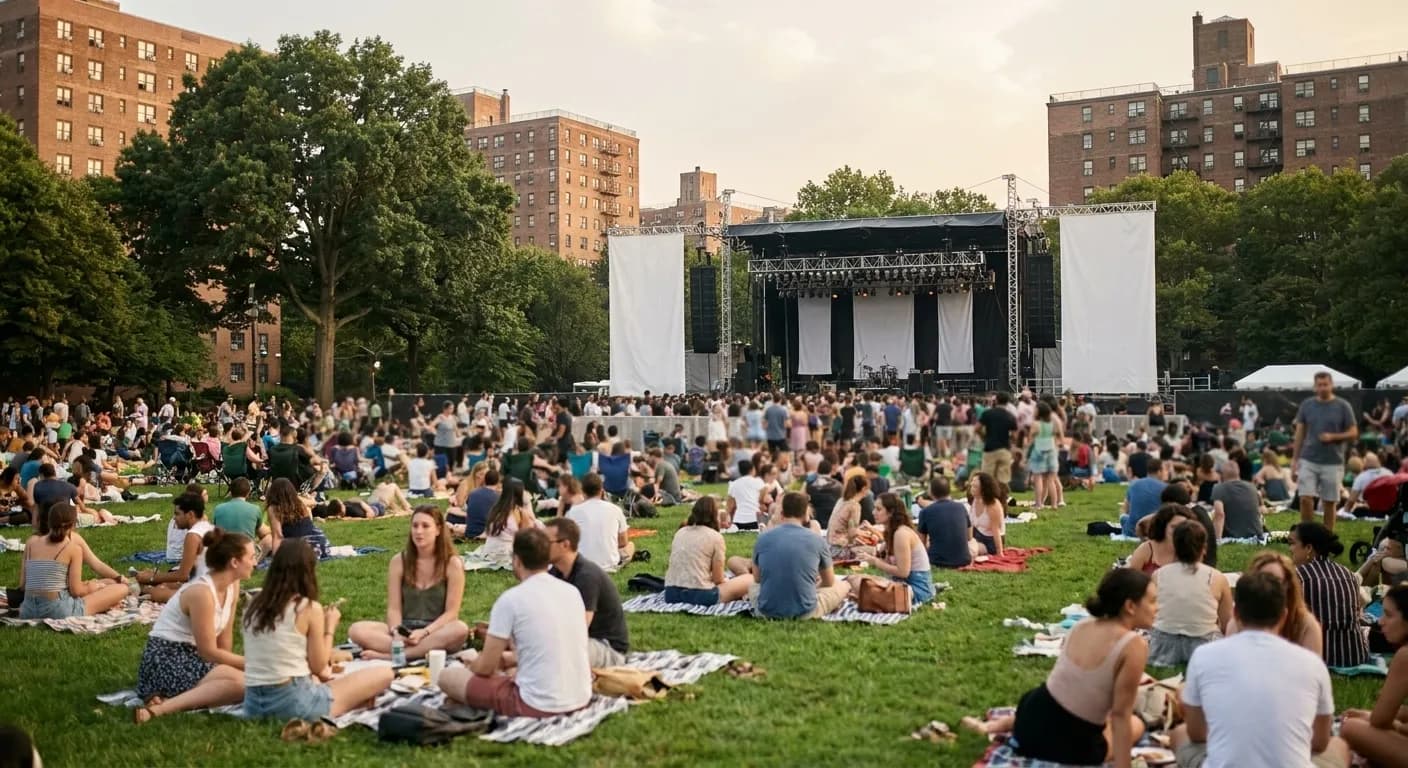
From late spring through early autumn, the parks carry a very large share of the city's free programming — concerts, film screenings, dance, festivals — and it is genuinely excellent. The complication is that outdoor events are weather-dependent and the cancellation decision is often made a few hours ahead.
Two habits handle this. Check the organiser's own social account on the day rather than the listing, because that is where cancellations appear first. And have an indoor alternative within a few blocks. New York's density means there almost always is one, and the difference between a wet evening and a good one is having decided what it is before the rain starts.
Building a weekend that survives contact with reality
Anchor the weekend on one booked thing and leave the rest loose. A single commitment — a show, a timed museum slot, one booked dinner — gives the weekend a shape, and everything else can be decided on the day. Two or three hard commitments across two days in New York is where weekends start to feel like a schedule rather than a break.
Build in the travel. Weekend subway service runs differently from weekday service, with planned works rerouting or suspending lines, and the change is announced but easy to miss. A twenty-minute weekday journey can be forty minutes on a Saturday. Checking that once, on Friday, prevents most of the weekend's avoidable frustration.
One last thing that transforms weekends here: pick a neighbourhood rather than an event. Deciding to spend Saturday afternoon in a specific part of the city — and then finding what is on there — produces better weekends than assembling a list of events scattered across three boroughs. New York rewards depth in one place far more than it rewards covering ground, and the travel between commitments is what makes an ambitious weekend feel like work.
Tags: #NYCEvents #WeekendPlans #EventsNearMe #NewYorkCity #Broadway #Museums #FreeFriday #NYCGuide #TimedEntry #Lottery #PayWhatYouWish #CentralPark #ThingsToDo #Manhattan
Please drink responsibly. Must be of legal drinking age.
All trademarks are the property of their respective owners.
Ask Karpo first
Want to know what is still bookable in New York this weekend, which free Friday slots are left, and what closes tonight? Ask Karpo before the inventory goes.