The six tennis courts at Mission Dolores Park don't charge admission, don't require a membership, and don't pretend to be anything other than what they are: public hard courts with skyline views, walk-on waits under an hour, and a playing surface that rivals what you'd find behind a club gate. As the US Open 2026 tournament approaches and hard-court tennis fills the sports calendar, these aquamarine rectangles in the Mission District offer a different value proposition—same surface, same game, zero ticket price. You show up, you wait your turn, you play. The courts unlock at 10 AM, the lights stay on until midnight, and the view of downtown San Francisco comes free with every baseline rally.
Karpo tracks real-time court availability windows across SF public parks and shows you the walk-on wait patterns by hour and day, so you know when to arrive with your racket instead of your patience.
Six courts that look like swimming pools from above
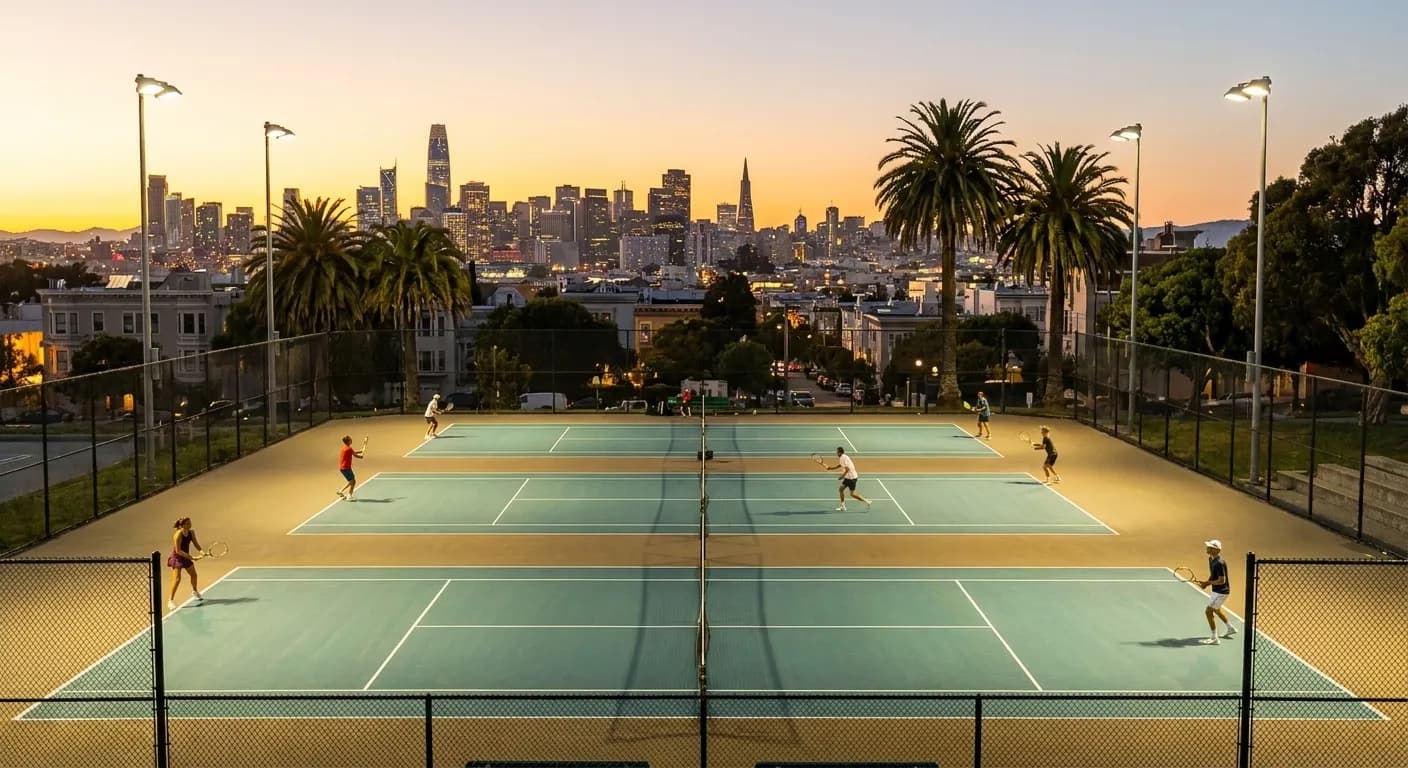
The aquamarine-green surface is the first thing you notice. From the hillside above, the six hard courts at Mission Dolores Park read less like a tennis facility and more like a grid of rectangular pools, their colour saturated against the brown dirt paths and palm-tree shadows. It's a visual accident that works: the courts feel both utilitarian and oddly cinematic, especially when the afternoon sun hits them at an angle and throws long racket-shaped shadows across the baseline.
The layout is straightforward. All six courts run parallel along 18th Street between Dolores and Church, fenced in and gated. Three courts accept reservations through the Spotery platform—specifically the court closest to Dolores Street—while the other five operate on walk-on etiquette. That means you arrive, check the wait list taped to the fence or ask whoever's rotating off, and settle in. On weekday mornings the wait hovers around fifteen minutes. Saturday afternoons push it closer to forty-five, sometimes an hour if a doubles group is slow to yield.
The surface quality surprises people. These are public courts, free to use, yet the hard court is well-maintained with only minor cracks near the net posts. The bounce is true, the lines are visible, and the playing experience rivals what you'd find at a club—at least during daylight hours. After sunset, the picture changes. The lighting system is functional but dim, and players consistently report that tracking the ball becomes a guessing game once natural light fades. If you're planning an evening session, finish before dusk or bring a tolerance for mishits.
Walk-on culture and the 10 AM unlock
The park itself opens at 6:00 AM, but the courts stay locked until 10:00 AM when a San Francisco Recreation and Park Department worker arrives to unlock the gates. This detail trips up early risers who show up at dawn expecting to play. The 10 AM unlock is consistent across weekdays and weekends, and it's the reason you'll see a small queue forming outside the fence around 9:45 AM on popular mornings.
Once inside, the protocol is informal but respected. Most players stick to one-hour blocks, especially when others are waiting. If you're playing singles and the courts are full, expect someone to ask if they can rotate in after your set. Doubles groups tend to claim a court for longer stretches, but even then, the norm is to check in with anyone waiting and offer to split time if demand is high. There's no formal reservation system for the five walk-on courts, no attendant, no clipboard—just eye contact and a willingness to share space.
The single reservable court—the one on the Dolores Street edge—books through Spotery, San Francisco's public court reservation platform. Slots open in one-hour increments, and weekend prime time (10 AM to 2 PM) fills up days in advance. If you want guaranteed court time and don't mind planning ahead, this is the move. If you prefer the spontaneity of walk-on play, the other five courts offer plenty of opportunity, provided you're flexible about wait times and willing to arrive mid-morning or late afternoon when turnover is faster.
Skyline views and the microclimate factor
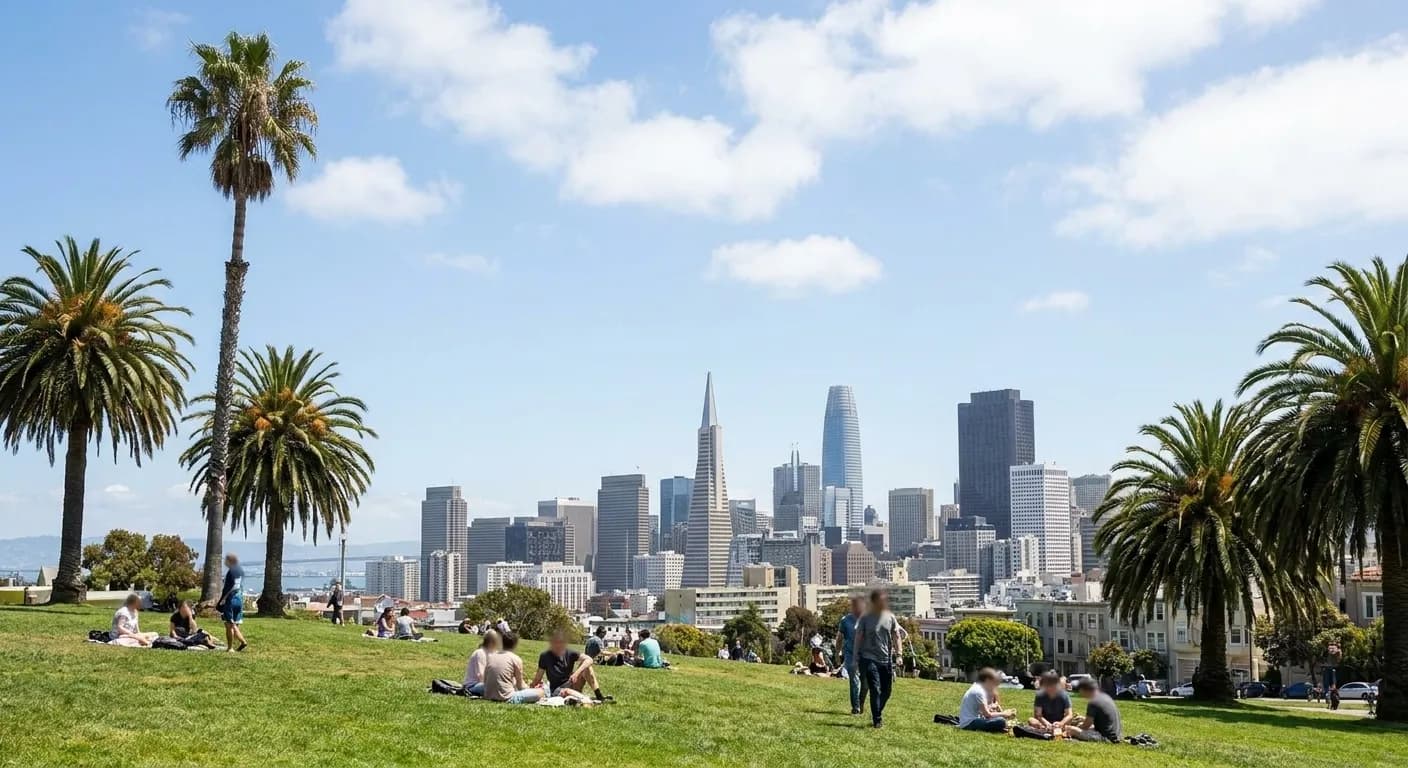
The courts sit at the northern edge of Mission Dolores Park, which means you're playing with a postcard backdrop: downtown San Francisco's skyline rises to the northeast, the Transamerica Pyramid and Salesforce Tower visible over the rooftops. On clear days, the view extends across the bay. On foggy mornings, the skyline disappears and you're hitting serves into a grey wall of marine layer. The visual drama shifts hour by hour, which is part of the appeal.
The microclimate here is colder than you'd expect. Even in August, the park's wind chill can drop the effective temperature by ten degrees or more. Locals layer up—hoodies, windbreakers, long sleeves under short sleeves—and peel off as they warm up. The courts are more exposed than the park's grassy slopes, so wind is a factor. If you're used to playing indoors or in warmer Bay Area microclimates, bring an extra layer and expect to adjust your toss on serve.
The surrounding scene adds texture. Dolores Park is one of San Francisco's busiest green spaces, and the courts are part of that ecosystem. People walk by with coffee cups from nearby cafes, dogs wander the off-leash areas just south of the courts, and on weekends the hillside fills with picnickers who occasionally stop to watch a rally. It's not a quiet, secluded tennis experience—it's tennis embedded in neighborhood life, with all the ambient noise and energy that implies.
US Open energy without the ticket price
The US Open 2026 tournament at Arthur Ashe Stadium will draw crowds paying hundreds of dollars per seat to watch hard-court tennis under lights. At Dolores Park, you're playing on the same surface type—DecoTurf or equivalent hard court—under the same sky, for zero dollars. The comparison isn't literal, but the psychological parallel holds: you're participating in the sport's grand-slam aesthetic without the gate fee, the membership dues, or the reservation anxiety that defines private clubs.
The courts see a mix of skill levels. You'll find beginners working on groundstrokes, intermediate players drilling volleys, and occasional advanced players running through match-play sets. The diversity keeps the atmosphere relaxed. No one's checking your USTA rating or judging your backhand form. If you want to hit for an hour, you hit for an hour. If you want to invite a friend who's never played, they're welcome. The accessibility is the point.
That said, the facility doesn't offer lessons, coaching, or clinics. A few private instructors use the courts for one-on-one sessions—TeachMe.To lists ten coaches who operate here, with rates starting around sixty-four dollars per lesson—but there's no on-site programming. You bring your own partner, your own balls, your own plan. The restrooms are on-site, functional, and cleaned regularly. There's no pro shop, no ball machine, no water fountain. It's tennis in its most stripped-down form: court, net, lines, you.
Post-match options within two blocks
The location rewards you after play. Tartine Bakery sits two blocks west on Guerrero Street, and the line for morning pastries often stretches out the door, but the almond croissants and bread pudding justify the wait. Bi-Rite Creamery is equally close, and the salted caramel ice cream makes a solid post-match recovery meal, even if nutritionists would disagree. Both spots are neighborhood institutions, and both are walkable from the courts in under five minutes.
If you want to stay in the park, the grassy slopes offer plenty of space to stretch, cool down, or just sit and watch the skyline. The southwest corner has picnic tables and shade under the palm trees. The off-leash dog areas are farther south, so you won't be dodging retrievers while you're trying to roll out your hamstrings. On weekends, the park hosts impromptu performances, pickup soccer games, and enough people-watching to fill an afternoon.
The J-Church Muni line runs along the western edge of the park on Church Street, connecting you to downtown or the Balboa Park BART station depending on direction. Street parking is metered and competitive, especially after 10 AM. If you're driving, arrive early or plan to circle. If you're biking, there's space to lock up near the courts, though the area sees occasional bike theft—use a U-lock and remove anything detachable.
Practical notes
Mission Dolores Park Tennis Courts are located at 3753 18th Street, San Francisco, CA 94114, at the northern edge of the park between Dolores and Church streets. Courts unlock at 10:00 AM daily and lights stay on until midnight, though visibility drops sharply after sunset. Five courts are walk-on (typical wait 15–45 minutes); one court is reservable via Spotery. Entry is free. Restrooms are on-site. No water fountain, no pro shop. The J-Church Muni line stops at 18th and Church. Paid street parking is limited. Bring layers—the microclimate runs cold even in summer. For current hours and any holiday closures, call San Francisco Recreation and Park at +1 415-831-2700.
Tags: #DoloresParkTennis #MissionDistrictSF #USOpenVibes #FreeTennisCourts #SanFranciscoTennis #WalkOnCourts #PublicCourtLife #SFSkylineViews #HardCourtTennis #MissionDoloresPark #SFRecPark #TennisWithoutMembership #CastroUpperMarket #SFHiddenGems #NeighborhoodTennis
All trademarks are the property of their respective owners.
Ask Karpo first
Ask Karpo which Dolores Park court has the shortest average wait right now, where to grab post-match coffee within two blocks, or how the microclimate shifts between the Dolores Street side and the 18th Street edge—then let it pull live weather, walk times, and cafe hours so you plan your session instead of circling the fence.