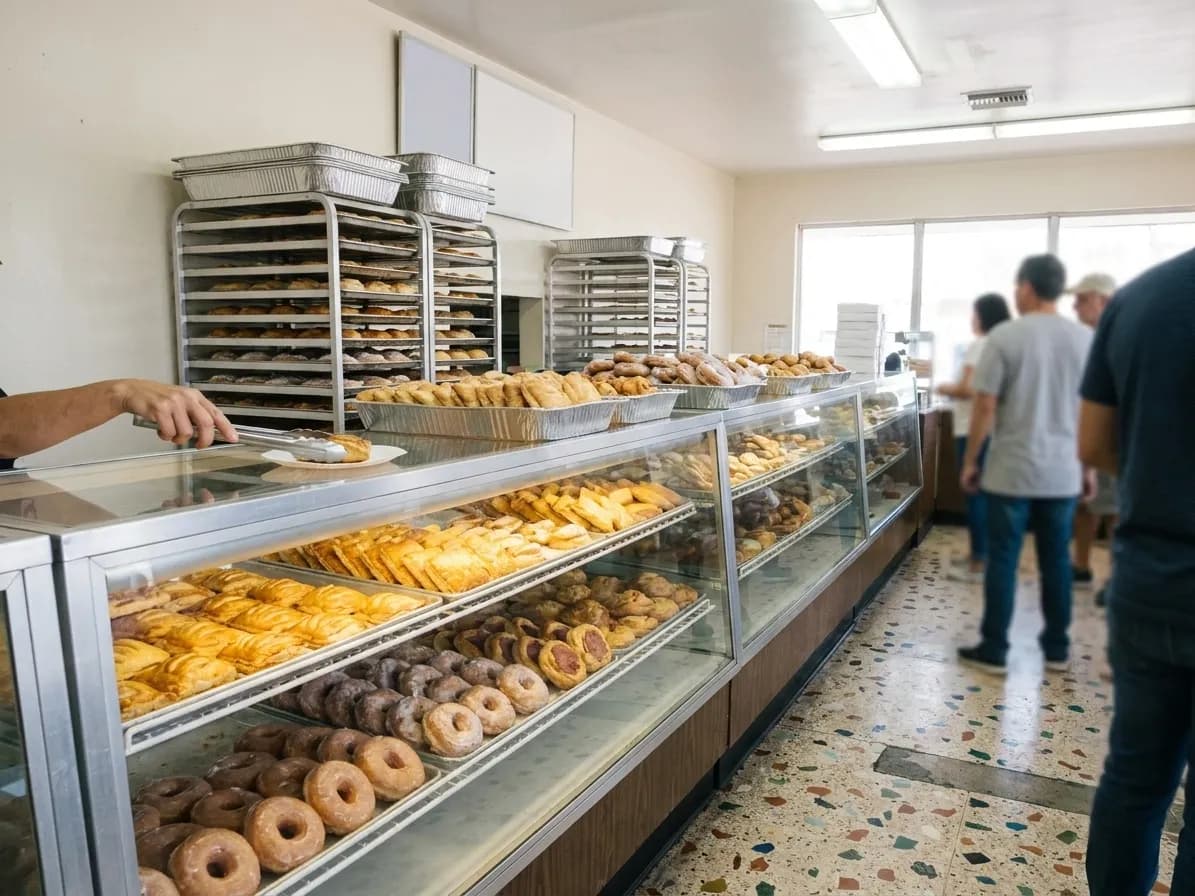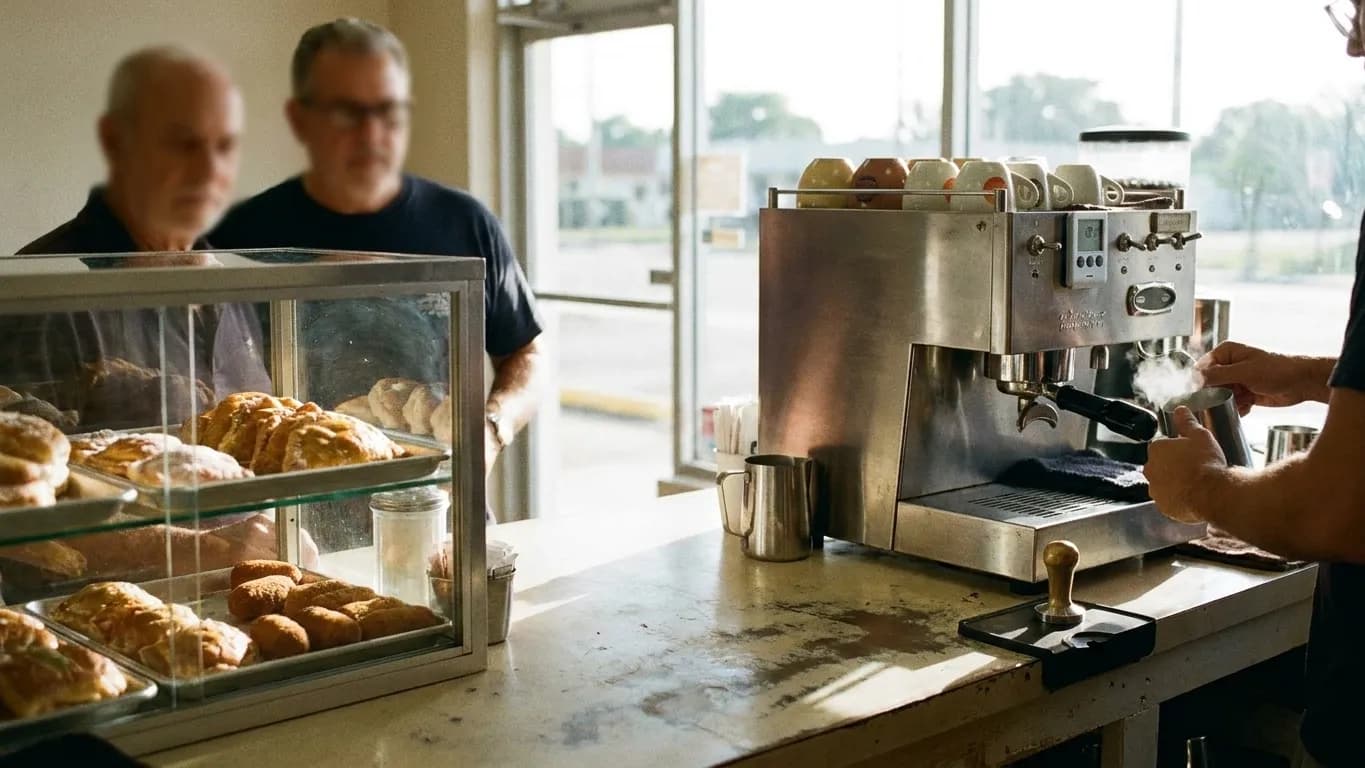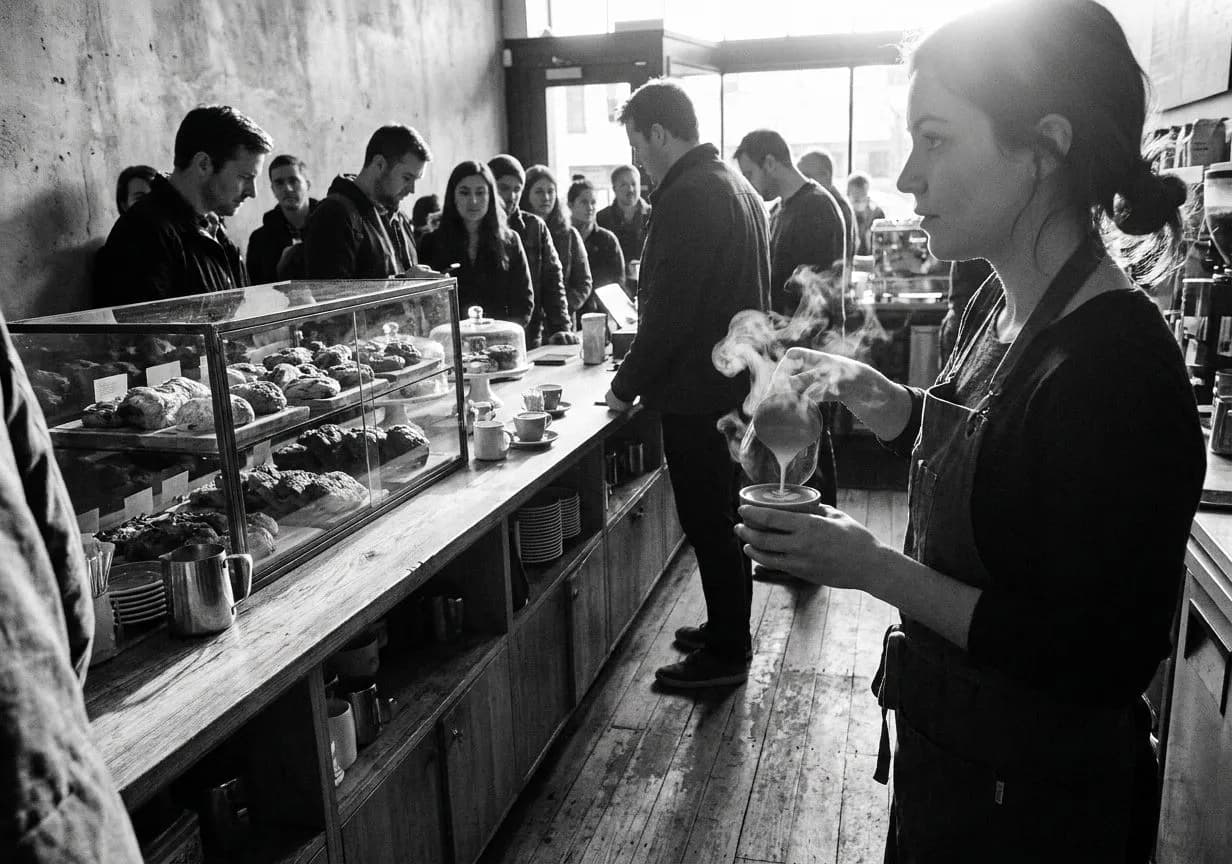
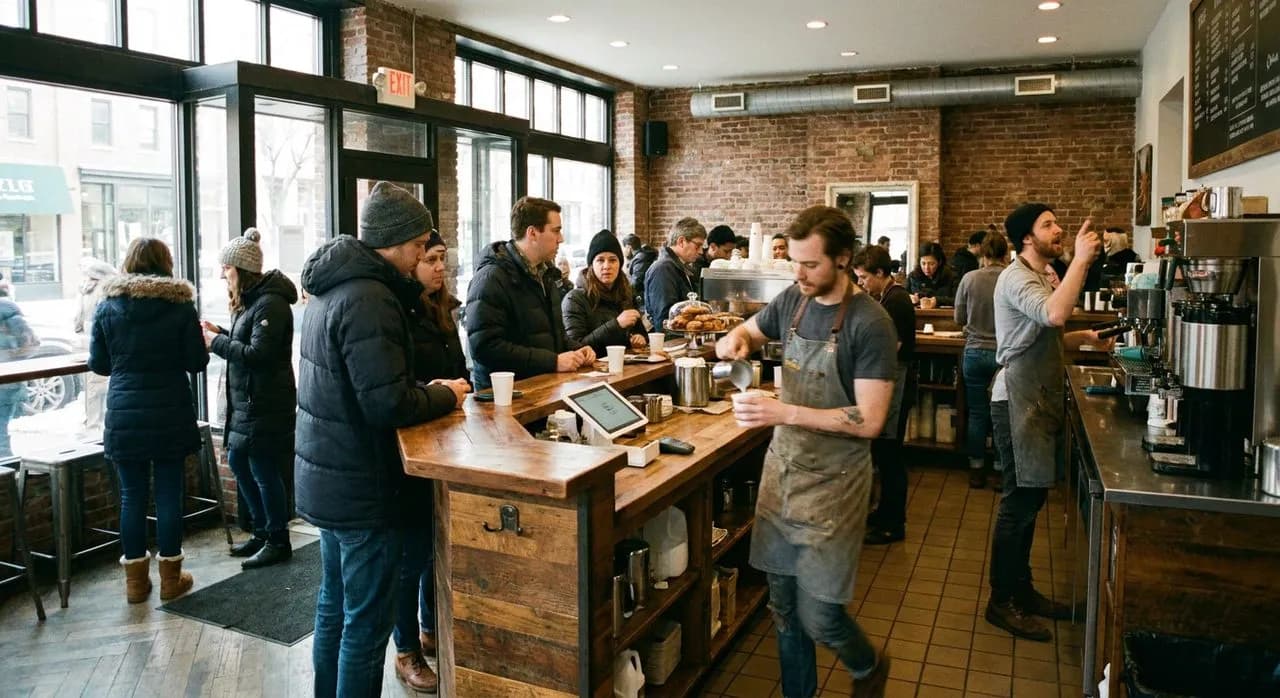
The counter at David's Cafe runs the length of the window facing the street, a narrow Formica ledge where you stand shoulder-to-shoulder with contractors still dusted with drywall and hotel staff between shifts. There are no stools. The setup discourages settling in, which is precisely the point. You order, you drink, you leave. The rhythm is established by the person working the espresso machine, whose pour—a continuous stream from stainless steel pot to small cup, held eight to ten inches apart—sets the tempo for everything else. This is not a place that traffics in leisure. It is a place that traffics in caffeine, fried dough, and the understanding that some of the best things in any city guide are consumed standing up.
The pour that mixes as it falls
The cortadito arrives already sweetened, the espresso and steamed milk combined mid-air as the server tips the pot and lets gravity do the work. The pour happens from eight to ten inches above the cup, a practiced motion that looks showy but serves a function: the fall aerates and blends without requiring a spoon. The result is a drink with a thin, tawny foam that settles almost immediately. You can request it stirred instead, but the request lands as slightly odd, a disruption to the choreography. Most people don't ask. They take the cup as it's handed over, the ceramic still warm enough to feel through the handle, and drink it in three or four long sips before the temperature drops.
The espresso itself is strong and sweet, cut just enough by the milk to soften the bitterness without diluting the kick. By late summer 2026, when the humidity turns the air outside into something you wade through, the contrast between the heat of the coffee and the blast of the AC inside becomes its own small pleasure. You finish your cortadito. You set the cup down. Someone behind you is already ordering theirs.
Croquetas that demand patience
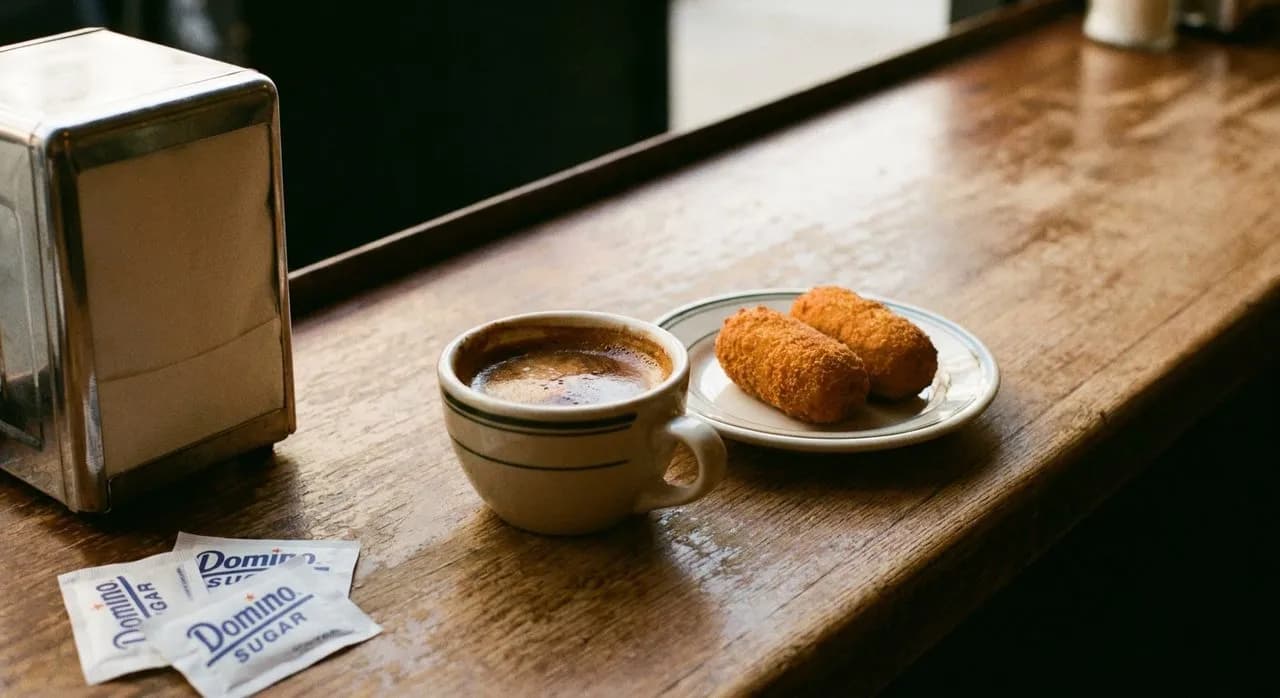
The ham croquetas come out of the fryer in batches, golden and hissing faintly as they hit the plate. They are served immediately, which means they are far too hot to eat. Bite into one right away and you'll burn the roof of your mouth on molten béchamel. Regulars know this. They order the croquetas first, then the cortadito, allowing approximately three to four minutes of cooling time while the coffee is poured and consumed. By the time you've drained your cup, the croquetas have dropped to a temperature that permits actual enjoyment rather than pain.
The timing is not written anywhere. You learn it by watching or by making the mistake once. The exterior is crisp enough to shatter, giving way to a creamy interior studded with bits of ham that have taken on a faint sweetness from the béchamel. Eating them at the counter means no napkin is quite sufficient. Your fingers will be greasy. This is fine. Everyone else's are too.
The morning rush and its unwritten rules
The busiest stretch runs from seven to nine on weekday mornings, when the counter fills with construction workers in steel-toed boots and cooks from nearby hotels grabbing breakfast before their shifts. Orders are delivered in rapid-fire Spanish, often compressed into a single word or two: 'cortadito,' 'croqueta,' 'tostada.' There is little room for hesitation. If you pause too long to consider the menu board, you'll feel the impatience radiating from the line behind you. After nine-thirty, the pace slows. The counter opens up. You can claim a spot without elbowing for position, and the person behind the register might even make eye contact long enough to acknowledge you're a human rather than an order number.
But the morning rush is worth experiencing at least once, if only to understand the efficiency that comes from repetition. Orders are called out, fulfilled, and paid for in under a minute. The espresso machine never stops hissing. Plates clatter. Someone behind you is peeling bills from a folded stack before they've even reached the counter. It is a system honed by decades of muscle memory, and you are either part of it or you are in the way.
What else fills the case
Beyond cortaditos and croquetas, the pastry case holds guava pastelitos with corners that flake onto your shirt, medianoche sandwiches pressed flat on the plancha, and occasionally a pan con lechón if you arrive early enough. The food is not revolutionary. It is reliable, which in this context is higher praise. The pastelitos are sweet enough to offset the bitterness of a second cortadito. The medianoche is salty, porky, balanced by a swipe of mustard and a slice of pickle that has softened under the weight of the press.
You will not find farm-to-table sourcing or house-made anything beyond what gets fried that morning. What you will find is consistency, the kind that comes from making the same things the same way for long enough that deviation would feel like betrayal. Some mornings, that is exactly what you want.
Why the counter matters
There are tables inside, tucked toward the back, but the counter is where the energy lives. Standing means you are part of the flow rather than an observer of it. You hear the hiss of the steamer, the clatter of plates, the overlapping voices ordering in a cadence that skips pleasantries. You smell the coffee and the frying oil and the faint sweetness of guava paste warming under the heat lamps. The counter is not comfortable. It is not designed to be. It is designed to get you in, fed, caffeinated, and back out into the Miami Beach morning with enough fuel to face whatever comes next.
By late 2026, when so much of urban dining has trended toward lingering—toward third-wave coffee and small plates meant to stretch across two hours—there is something clarifying about a place that operates on a different principle. You do not come here to be seen. You come here to eat and leave. The fact that the food is good, and the coffee strong, and the whole transaction executed with such unsentimental efficiency, is what makes it worth returning to.
Practical notes
David's Cafe has multiple locations across Miami; the Miami Beach location is on Collins Avenue (verify the exact address). Street parking is metered and competitive; a local shuttle stop may be nearby (verify transit stop location). The cafeteria opens early—verify current hours directly—and stays open into the evening, though verify hours directly as they shift seasonally. The counter is accessible, though narrow. Bring small bills; cash is preferred. Expect to stand. Expect to wait if you arrive between seven and nine on a weekday. Expect the croquetas to be hotter than you think.
Tags: #PullUpAChair #DavidsCafe #MiamiBeach #CortaditoCulture #CubanCoffeeMiami #CroquetasAndCafecito #CounterService #MiamiCityGuide #SummerInMiami #MiamiEats #StandUpCoffee #CollinAvenue #CafecitoCulture #MiamiMornings #Summer2026
Please drink responsibly. Must be of legal drinking age.
Sources consulted: Cortadito · Croquettes · Miami Beach Official Site · Cuban Cuisine · Miami Dining Guide
All trademarks are the property of their respective owners.