City Hall Park offers one of those rare urban performances that requires no ticket, no reservation, no insider handshake—just punctuality and a willingness to stand still while the city wakes around you. The fountain at its center activates daily at 8:00am from April through October, a clockwork ritual that transforms the plaza from a quiet early-morning commons into a crossroads for thousands of commuters within ninety minutes. This is not a place that reveals itself all at once. The sequence matters: the water, the light, the foot traffic, the brief window when the space is yours before it belongs to everyone. Spring 2026 brings the same cadence, the same predictable beauty, and if you know when to arrive, you can watch the whole thing unfold from the front row.
The Eight O'Clock Start
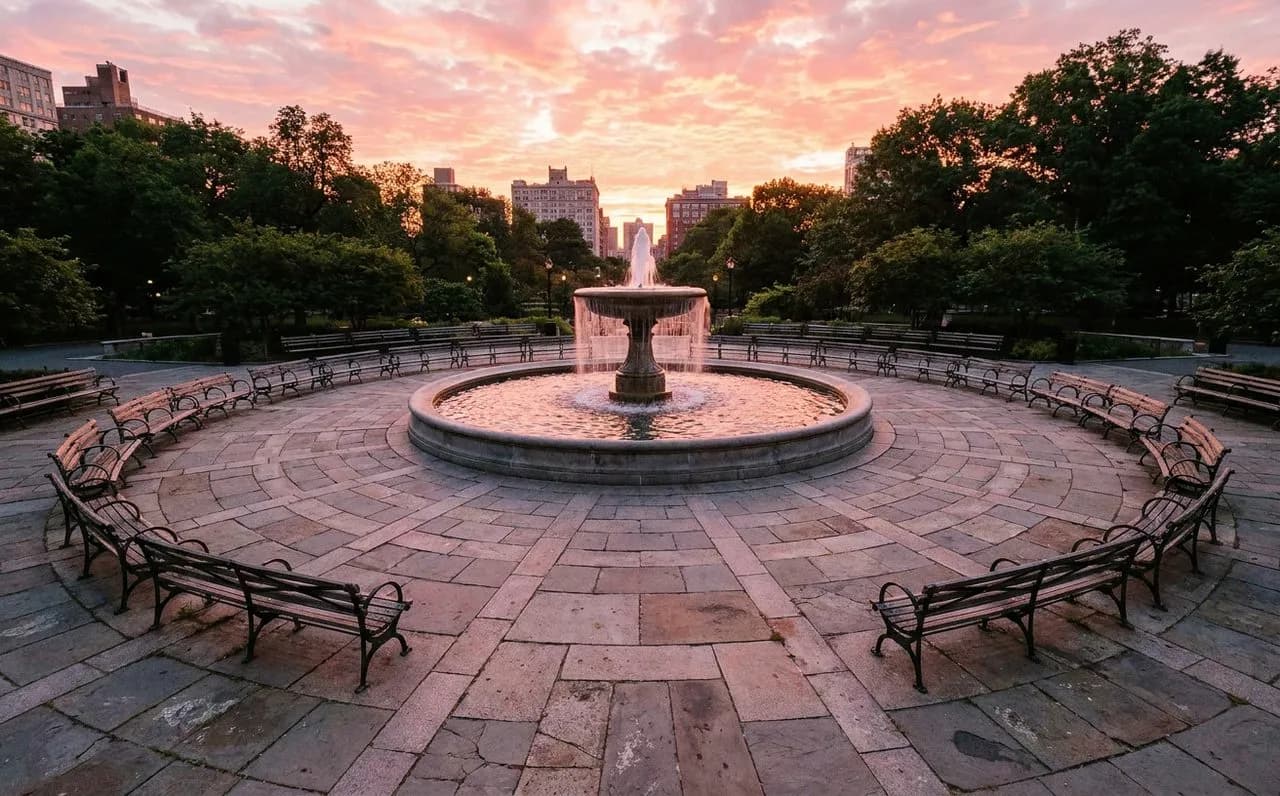
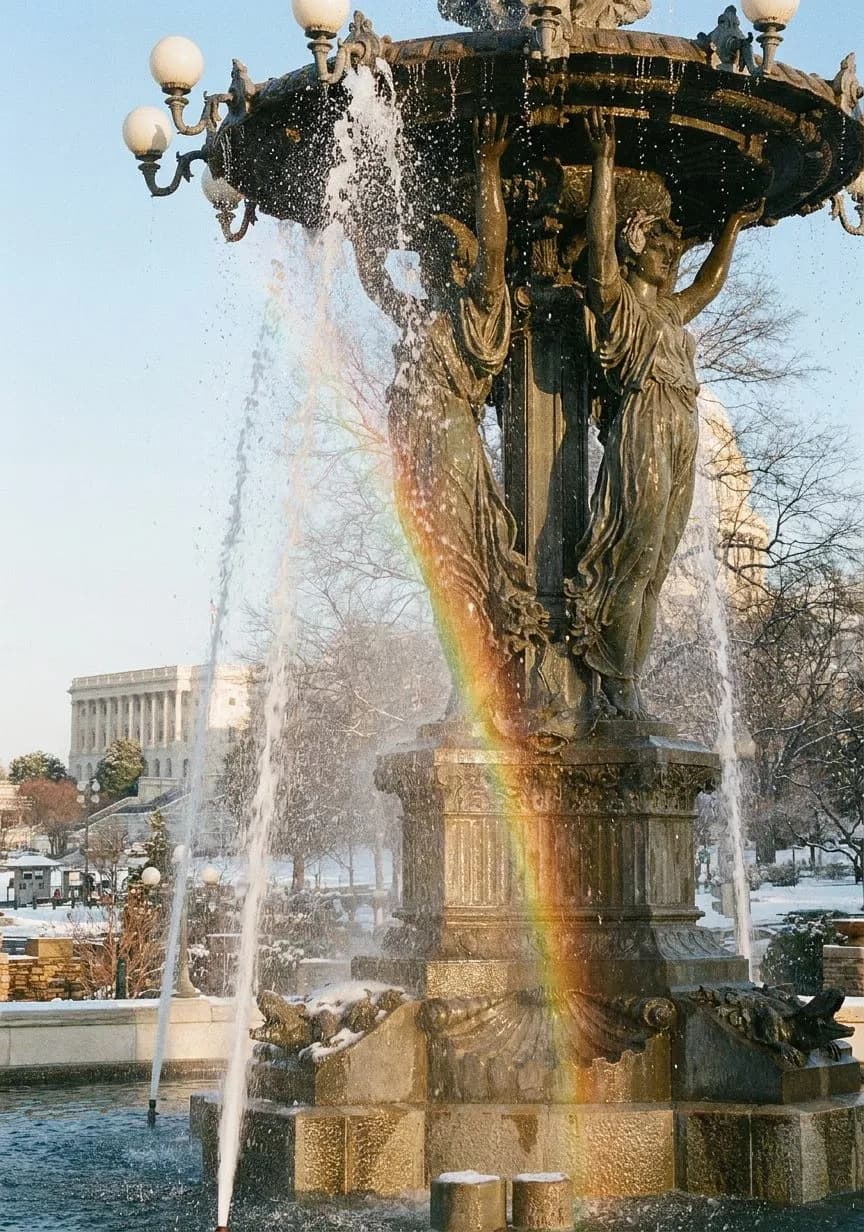
The fountain does not ease into its day. At precisely 8:00am, a low mechanical hum announces the pump's engagement—audible from the southern benches a full thirty seconds before the first water breaks the surface. It is a sound you feel as much as hear, a subsonic thrum that vibrates through the cast-iron bench slats and the flagstones beneath your feet. Then the water appears, not in a graceful arc but in stuttering bursts as air clears the lines, until the jets find their rhythm and the fountain settles into its daytime voice.
The sound changes everything. What was a static civic space—beautiful in its Federal-era bones, its mature London plane trees, its quiet dignity—becomes kinetic. Pigeons scatter. Early joggers slow to look. The air smells faintly of chlorine and wet stone. For fifteen minutes, maybe twenty, the fountain performs for an audience of half a dozen people, most of them holding coffee in paper cups, most of them not tourists. This is the window when City Hall Park still feels like a secret, one of the city's best free things to do if you are willing to set an alarm.
The Empty Interlude
Between 8:00 and 8:30am, the plaza exists in a state of suspended animation. A few early risers claim benches. A parks worker empties trash cans with practiced efficiency. Delivery trucks rumble past on Broadway. The fountain runs, the trees sway, and Lower Manhattan holds its breath before the flood.
This half-hour grace period is the park's gift to anyone who understands urban timing. The light is still soft, the benches still available, the pathways still navigable without the defensive shoulder work that will soon be required. You can walk the perimeter without dodging strollers or tour groups. You can sit facing the fountain and hear individual droplets hitting the basin. The plaza remains relatively empty until 8:30am, when the first major wave of subway commuters exits at the Brooklyn Bridge-City Hall station, and the park's character shifts irrevocably.
The Morning Surge
At 8:30, the floodgates open. The 4, 5, and 6 trains disgorge their morning loads at the Brooklyn Bridge-City Hall stop, and the park becomes a pedestrian highway. The flow is not chaotic—New Yorkers are too practiced for that—but it is relentless. Thousands of commuters pour through the pathways in diagonal vectors, most headed northwest toward the courthouses and municipal buildings, some peeling off toward the Financial District, a few pausing at the fountain to check their phones or adjust their bags before the final push to their desks.
Foot traffic peaks between 8:45 and 9:15am, a thirty-minute window when the park operates at maximum capacity. The benches fill. The pathways narrow to single-file in places. The fountain, which twenty minutes earlier felt like a private amenity, now serves as a landmark, a meeting point, a piece of infrastructure around which the human tide flows. Watch long enough and patterns emerge: the coffee drinkers who pause at the west-side benches, the fast walkers who cut diagonally across the lawn despite the signs, the small clusters of colleagues who converge and continue together toward the same office towers.
Sun and Shade Choreography
Not all benches are created equal, and the regulars know it. The fountain's east-side benches stay in shade until 9:30am, making them less desirable on cool spring mornings when the early sun is still a luxury. Morning coffee drinkers favor the west-side benches that catch early sun starting at 8:15am, their backs to the fountain, faces tilted toward the light that slants between the buildings. By mid-morning the advantage reverses—the east benches offer respite from direct glare—but at 8:15 the west is prime real estate.
The play of light across the plaza is one of those details you notice only after multiple visits. The fountain itself catches the sun around 8:45, when the water begins to sparkle and the whole structure glows against the darker backdrop of the Municipal Building. Photographers know this moment. So do the office workers who time their arrivals to coincide with it, stealing an extra three minutes of beauty before the elevator ride and the fluorescent hum.
Why This Ritual Matters
City Hall Park is not unique in its morning rhythms—every urban plaza performs some version of this daily transformation. But the precision of the fountain activation, the compressed timeline of the commuter surge, and the park's layered history give the ritual a particular resonance. This is one of the city's oldest public spaces, redesigned and replanted and re-imagined a dozen times, and yet the basic script remains unchanged: water flows, people gather, the city gets to work.
There is something reassuring in the predictability. In a city that changes faster than most of us can track, where storefronts turn over and neighborhoods rebrand themselves every eighteen months, the 8:00am fountain start feels like a promise kept. Show up, and it will happen. Show up early, and you will have it mostly to yourself. Show up with your eyes open, and you will see the city assemble itself in real time, one commuter at a time, until the plaza hums with the particular energy that only Lower Manhattan on a weekday morning can generate.
Practical Notes
City Hall Park is generally bordered by Broadway, Park Row, Chambers Street, and Centre Street in Lower Manhattan. The nearest subway stop is Brooklyn Bridge–City Hall (4, 5, 6 trains); J and Z trains use the Chambers Street station nearby. The fountain operates seasonally from April through October, with hours that should be verified with NYC Parks. schedule may vary slightly depending on maintenance. The park is fully accessible; pathways are paved and benches plentiful, though competition for seating is intense after 8:30am. Bring coffee, wear comfortable shoes, and consider earbuds if you plan to linger—the fountain is lovely, but the surrounding street noise is persistent. Verify seasonal hours and any closures via NYC Parks before planning a special trip.
Tags: #CityHallPark #LowerManhattan #NYCParks #MorningRituals #FountainActivation #UrbanChoreography #SubwayCulture #CommuterPatterns #RightOnTime #NYCSpring #Spring2026 #FreeThingsToDo #PublicSpaces #ManhattanMornings #CivicBeauty
Sources consulted: City Hall Park - Wikipedia · NYC Parks - City Hall Park · MTA - Brooklyn Bridge-City Hall Station · NYC Planning - Lower Manhattan
All trademarks are the property of their respective owners.