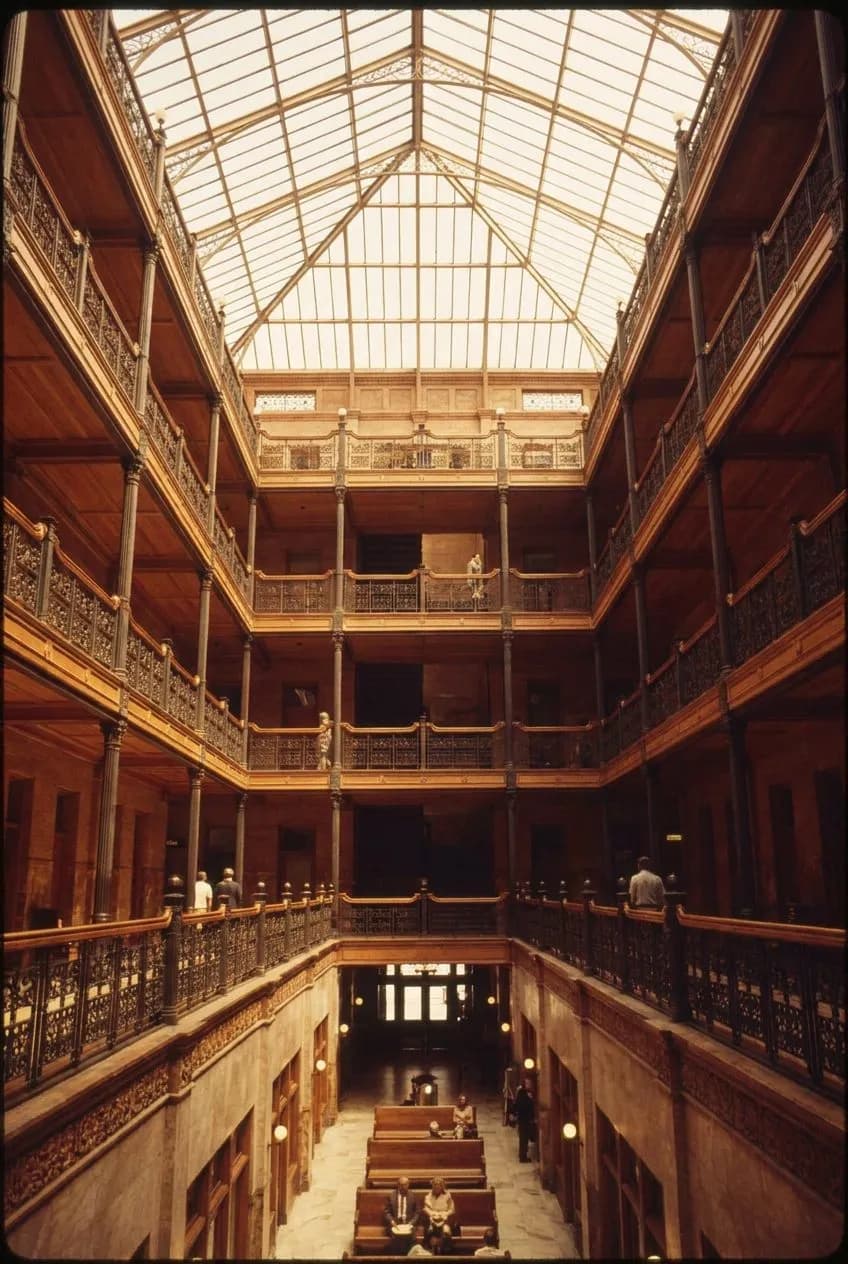
Most of downtown LA's best interiors hide behind velvet ropes or membership dues. The Bradbury Building gives you its entire atrium for nothing. Walk in from Broadway during business hours and you're standing in an 1893 wrought-iron cathedral: five stories of open galleries, caged elevators suspended on cables, and a vaulted skylight that filters the city into geometry and hush. Ridley Scott shot Blade Runner here. You need only step through the door.
The iron and light show
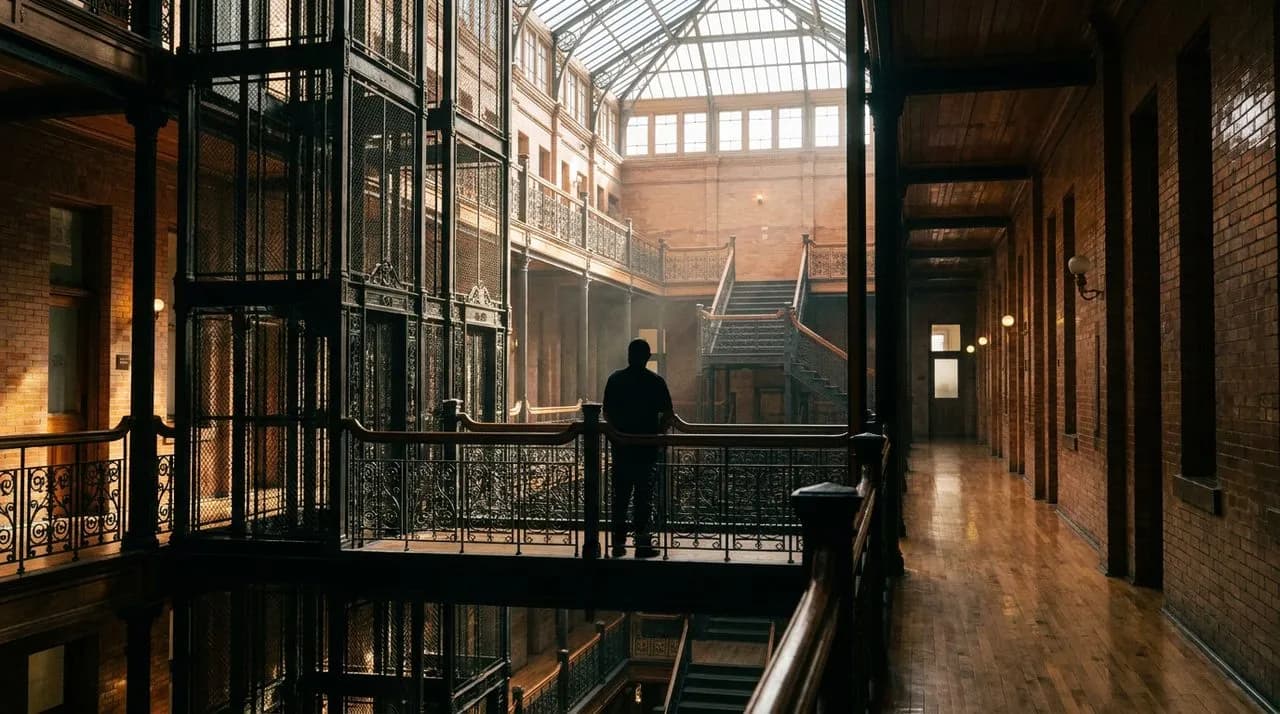
The atrium is all vertical theater. Wrought-iron railings climb in lace-like tiers, each balcony connected by open staircases that zigzag upward in a rhythm that feels more Paris than Los Angeles. The walls are terracotta brick, warm and unpolished, their texture catching light at odd angles throughout the day. Above, the skylight vaults in a double-pitched canopy of glass and steel, flooding the space with diffused daylight that changes character by the hour—amber in early morning, stark white at noon, honey-gold in late afternoon.
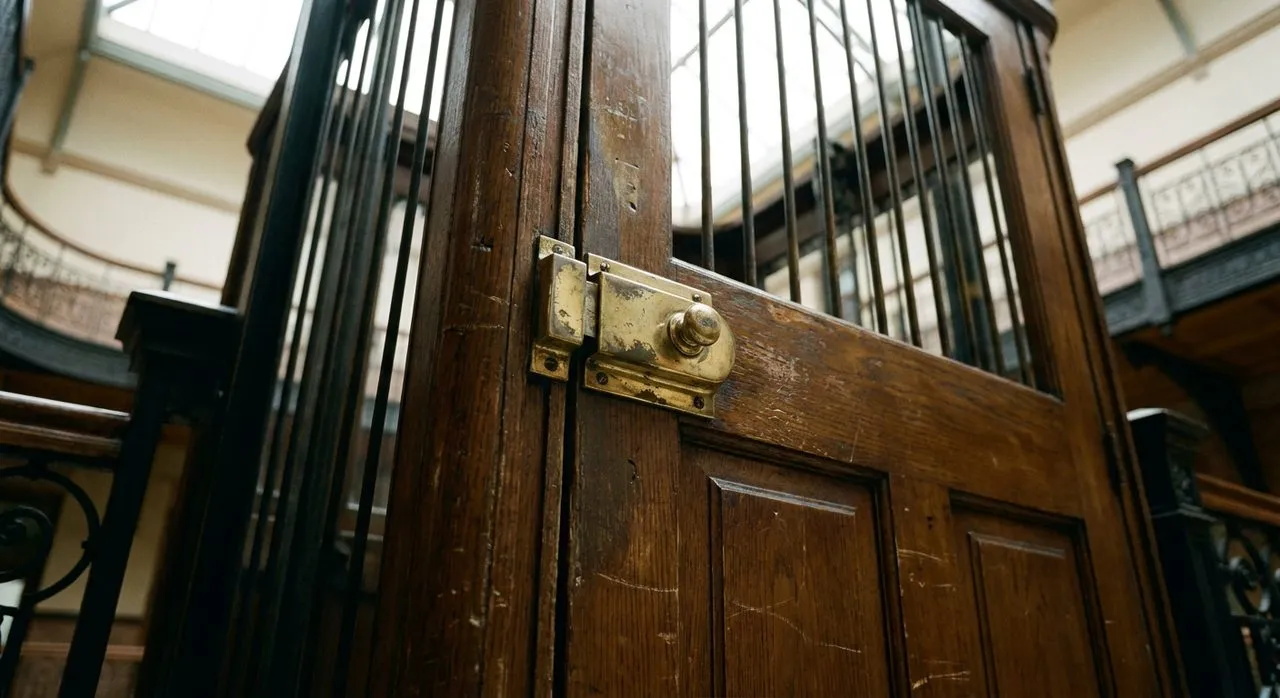
This is civic interiors at their most generous—a working office building that never locked its beauty behind a tenant list. The marble floors are worn smooth by a century of foot traffic, the kind of patina you can't fake. Stand in the center and look up: the geometry multiplies, iron upon iron, until the skylight crowns it all in white light. The oak trim along the staircases still glows with its original finish, darkened now to the color of strong tea, and the elevator cages hang like iron birdcages suspended in cathedral space.
The atrium is generally open to the public on weekdays during business hours. Building tenants may ask your business when you walk in, but public access to the ground floor and mezzanine is protected by the building's landmark status. You're entitled to be there. Walk slowly.
When the light gets geometric
Timing matters here. The atrium fills with office workers at lunch, voices bouncing off iron and brick in a low hum that never quite becomes noise. But the quietest hour lands between 2 and 3pm, once the lunch crowd clears and the afternoon settles in. That's also when the light angles through the east skylight in geometric blocks—hard-edged shadows that frame the railings and cage elevators in sharp relief.
Summer 2026 will give you long, late light through that glass ceiling, the kind that holds until nearly seven. But the midafternoon window is when the atrium feels most like a film set: still, staged, waiting for someone to walk through with purpose. You'll understand why directors keep coming back.
The elevators still run
The real surprise is auditory. You hear the elevators before you see them move—an iron clank, then the slow mechanical grind of cable and pulley. The original 1893 elevators are still a notable historic feature, but access and operation are not guaranteed for visitors. If you hear 'going up,' you can ride to the fifth floor for free. The cages are open ironwork, no enclosed cabin, just you and the operator and the atrium sliding past in vertical slices.
It's a thirty-second ride that collapses a century. The mechanism is original, the brass fittings unrestored, the whole apparatus a working artifact. Most visitors don't realize they can ask to ride. You can.
The Blade Runner question
Yes, this is the building. The 1982 film used the atrium for J.F. Sebastian's apartment scenes—those iron galleries backlit in blue and smoke. Chinatown shot here. (500) Days of Summer. The building's been film architecture shorthand for 'Los Angeles has history' since the silent era, a piece of Victorian craftsmanship that refuses to read as purely nostalgic.
What the films never quite convey is the silence. On screen, the Bradbury is all drama and shadow. In person, it's contemplative, almost library-quiet. The skylight swallows the Broadway traffic; inside, you get the creak of iron, the scuff of shoes on marble, nothing else. The acoustic quality is unintentional but perfect—brick and iron absorb just enough sound to create a pocket of calm in the middle of downtown's relentless hum.
What you're really looking at
The building's origin story is famous in preservation circles: developer Lewis Bradbury commissioned architect Sumner Hunt, then replaced him mid-project with draftsman George Wyman, who'd never designed a building before. Wyman delivered this. The wrought iron came from a local foundry, the oak paneling from the Pacific Northwest, the marble from Italy. It was cutting-edge in 1893 and it still looks better than most of what downtown has built since.
The atrium was designed as a light well, a way to bring natural illumination into interior offices before electric lighting became reliable. That utilitarian mandate produced something transcendent—a vertical courtyard that democratized daylight and gave every tenant a view of iron lace and sky. The economic logic was simple: more light meant higher rents. The aesthetic result was accidental genius, a functional skylight transformed into soaring architecture through Wyman's instinct for proportion and the foundry workers' skill with ornamental iron.
The Broadway corridor context
The Bradbury makes more sense when you understand what Broadway used to be. In the 1920s and 30s, this stretch was LA's premiere entertainment corridor—a solid mile of movie palaces, vaudeville houses, and department stores that drew crowds from across the region. The Million Dollar Theatre, the Orpheum, the Palace—they all sit within a few blocks, their marquees still intact even if most of the interiors are dark. The Bradbury predates that golden age by three decades, but it shares the same architectural confidence: the belief that civic buildings should inspire, not just function.
Walk north from the Bradbury and the theater facades tell the story—terracotta ornament, glazed tile, neon ghosts. Most are awaiting restoration or adaptive reuse, caught in that liminal state between historic landmark and functional venue. The neighborhood has been on the verge of revival for twenty years, which means it retains a gritty authenticity that more polished districts have lost. The Bradbury stands as proof that grandeur doesn't require gentrification—it just requires maintenance and open doors.
What to pair it with
The Bradbury sits in the middle of downtown's Broadway corridor, a stretch that rewards slow walking. Grand Central Market is two blocks north—good for coffee or a full meal depending on your schedule. The neighborhood skews civic rather than polished; this is not the Arts District or Silver Lake. It's downtown in its working, ungentrified register, which makes the Bradbury's elegance feel even more unlikely.
Give yourself ten minutes inside, longer if the elevators are running and you want the ride. Then walk north along Broadway and notice the theater marquees—this was LA's movie palace row in the 1920s. Most are shuttered now, but the bones remain, and the Bradbury suddenly makes more sense as part of a city that used to build for grandeur as a matter of course.
Practical notes
The Bradbury Building is located at 304 S Broadway, downtown Los Angeles. Nearest Metro stop is Pershing Square (Red/Purple lines), a three-minute walk west. Street parking is metered and competitive; the Joe Grand garage at 312 W 3rd offers hourly rates. The atrium is open weekdays 9am–5pm; verify hours directly if visiting on a holiday. The ground floor is wheelchair accessible via the Broadway entrance; upper galleries require stairs or the historic elevators. Bring a camera if you want stills, but skip the tripod—this is a working building. No admission fee.
Tags: #BradburyBuilding #DowntownLA #FreeLA #LAArchitecture #VictorianLA #FilmArchitecture #CivicInteriors #BladRunner #HistoricLA #LALandmarks #HiddenLA #FreeAndFine #SummerLA #LAWalking #BroadwayCorridor
Sources consulted: Bradbury Building - Wikipedia · LA Conservancy - Bradbury Building · Blade Runner - Wikipedia · Time Out Los Angeles - Downtown
All trademarks are the property of their respective owners.