 Desert 5 Spot Country Bar, Brooklyn: Wednesday Line Dancing
Bars & Nights Out
Best Wine Tasting Experiences to Book Around NYC This Summer
Most wine tasting plans fall apart when the room is full or the train transfer takes forty minutes. Here's a route that holds.
You book a wine tasting slot in the West Village for seven-thirty on a Saturday, then realize the room only holds twelve people and your confirmation email says nothing about whether your party of four gets a table or stools along a counter. You arrive to find it's standing-room around a single high-top, wedged between strangers who showed up for the same pour time. The experience itself might be excellent—knowledgeable staff, interesting small producers—but if you can't hear the person across from you and there's nowhere to set down a glass between pours, the evening tips into endurance.
Karpo checks which tasting rooms still have openings tonight, maps the actual subway timing between stops, and holds a backup bar if your first choice is at capacity. Text it before you commit to a neighborhood.
The reservation you can't count on
The mistake is treating wine tasting like dinner: assuming a reservation means a defined space and a predictable two hours. Most tasting rooms in New York City run on tight intervals with flexible capacity. They'll honor your slot, but the setup changes depending on how many walk-ins arrived before you. If the room is small and the night is warm, you're contending with sidewalk overflow, which means you're tasting Chenin Blanc while delivery bikes squeeze past your elbow. It's not unpleasant if you expect it, but it derails a plan built around sitting down and lingering.
The better approach is to map a route with at least two tasting stops that don't require reservations, or that let you shift your arrival window by thirty minutes without penalty. Bushwick and the Lower East Side both have clusters of wine bars that operate as tasting rooms—they pour flights, they sell bottles to take home, and they don't penalize you for showing up at eight instead of seven-thirty. The key is knowing which venues run structured tastings with a host and which ones simply pour a flight and leave you to it. Both are valid, but they set different expectations for how much you'll learn and how long you'll stay.
A route that survives schedule drift
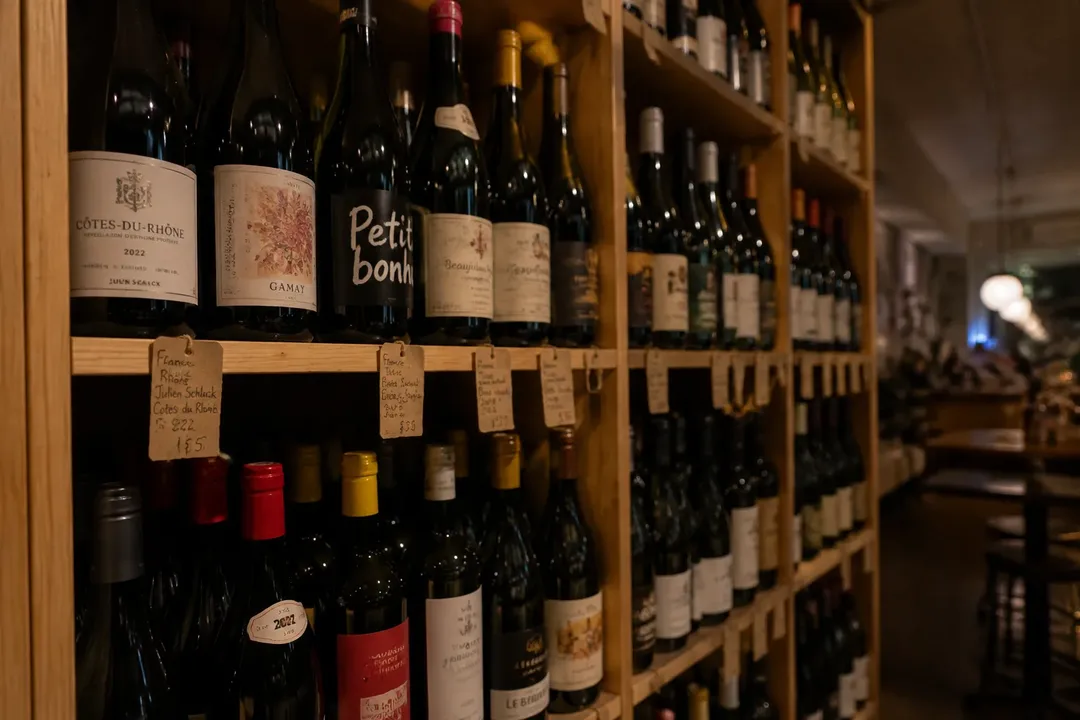
Start in Bushwick at a wine bar that doubles as a bottle shop. These places typically open by six and don't require advance booking for flights. You'll find natural wine selections that rotate weekly, and staff who can walk you through regions without the formal cadence of a hosted tasting. The advantage here is flexibility: if you want to spend an hour, you can; if the vibe feels off or the room is too loud, you're out in twenty minutes with no penalty. The L train from Manhattan puts you at Morgan Avenue or Jefferson Street, and the walk from either stop is flat and well-lit, even after dark.
From there, take the L back toward Manhattan and get off at Bedford Avenue in Williamsburg. There are at least three wine-focused bars within a five-minute walk of that station, all of which offer tasting flights and none of which require reservations for parties under six. The risk here is crowds after eight on weekends—these rooms are small, and once the bar fills, you're standing. Arrive before seven-thirty and you'll have seating; arrive at nine and you're in a scrum. The wine tasting itself remains solid regardless, but your ability to have a conversation drops sharply once the room hits capacity.
If you want a third stop, head south on the L to First Avenue and walk to the Lower East Side. The blocks around Orchard and Ludlow have several wine bars that lean toward Italian and French producers, often with charcuterie pairings available without advance notice. These spots tend to be quieter than Williamsburg equivalents, partly because they're farther from the Bedford Avenue foot traffic and partly because they skew slightly older. The trade-off is that they close earlier—often by eleven on weekends, midnight at the latest—so if you're planning a long night, this should be your second stop, not your third. The F train from Second Avenue gets you back to midtown or Brooklyn without a transfer, which matters more at eleven-thirty than it does at eight.
Who should skip this plan
If you want a guided tasting with a sommelier who walks you through soil types and vintage variation, this route won't deliver that consistently. Some of the Bushwick and Williamsburg spots have staff who can talk terroir in detail, but it's not a formal presentation—you're asking questions as they pour, and the depth of the answer depends on who's working that night. For a structured educational experience, you're better off booking a seated tasting at a dedicated wine school or a shop that runs evening classes. Those require advance planning and usually cost more, but you'll leave with notes and a clear sense of what you tasted.
This also isn't the right plan if you want to avoid crowds entirely. Wine tasting in New York City during summer weekends means sharing space, especially in neighborhoods where bar density is high and outdoor seating is limited. Bushwick and Williamsburg both get busy after eight, and the Lower East Side isn't far behind. If you need elbow room and guaranteed seating, go on a weeknight or start your route at five-thirty instead of seven. The wine selection won't change, but the room dynamics will.
Finally, if you're planning to taste more than four or five wines across multiple stops, factor in a long night and a reliable ride home. Wine tasting is still drinking, and even small pours add up over three hours. The L train runs late, but service slows after midnight, and weekend nights sometimes bring unexpected delays. If you're coming from outer Brooklyn or Queens, check the posted service advisories before you leave, and know which late-night bus lines can substitute if the train stalls.
What to confirm the day you go
Check whether the wine bar you're targeting is hosting a private event. Many of the smaller Bushwick and Williamsburg spots rent out their back rooms or entire spaces for tastings, and those bookings sometimes appear on their Instagram stories but not on their main website. If you show up and half the room is closed, your seating options shrink fast. A quick look at their social media the morning of your visit usually clarifies whether it's a normal night or a buyout.
Verify subway timing, especially if you're planning to move between Brooklyn and Manhattan. The L train is reliable most nights, but summer construction and weekend maintenance can add ten or fifteen minutes to a trip that normally takes twelve. If you're trying to hit three stops in three hours, an unexpected transfer or a stalled train will compress your schedule. Build in buffer time, or plan your route so that all your stops are within walking distance of a single subway line.
Look at the weather. Most wine bars in these neighborhoods have limited or no outdoor seating, and when it's hot, the indoor rooms get stuffy quickly. If the forecast shows temperatures above eighty-five and the venue doesn't have air conditioning—common in older Bushwick spaces—your tasting experience will tilt toward uncomfortable. Some places open their garage doors or have back patios, but that's not universal. If heat is a problem for you, pick venues with confirmed climate control or plan your route for earlier in the evening when temperatures drop.
Finally, know what you're paying before you sit down. Tasting flights in New York City typically run between twenty and forty dollars for three to five pours, but pricing isn't always posted on the wall or the menu. Some places charge by the glass and let you build your own flight; others offer a set menu. If you're planning multiple stops, that cost stacks quickly. Asking about pricing when you walk in isn't awkward—it's standard, and staff expect it.
Practical notes
- Most wine bars in Bushwick and Williamsburg don't take reservations for flights; arrive before 7:30 PM on weekends for seating.
- The L train is your primary line for this route; check weekend service advisories the day you go, especially after 10 PM.
- Tasting flights typically cost $20–$40 for three to five pours; budget accordingly if you're hitting multiple stops.
- Summer heat makes small indoor rooms uncomfortable; confirm air conditioning or plan for early-evening visits.
- Drink responsibly and plan a safe ride home—Uber, Lyft, or a late-night subway route you've confirmed in advance.
- Bring a light jacket; some venues open garage doors or have back patios that cool down quickly after dark.
Tags: #karpo #nycwine #winetasting #bushwickbars #williamsburgwine #nycnightlife #nycbars #lowereastsidenyc #naturalwine #brooklynwine #nycnights #newyorkcitywine #winetastingnyc #summernights #nycdrinks
Sources consulted: MTA Service Status · NYC Wine Bars Overview
Please drink responsibly. Must be of legal drinking age.
All trademarks are the property of their respective owners.
Ask Karpo first
Before you head out, text Karpo to confirm which wine bars are open tonight, whether they're running private events, and the current L train timing between your planned stops. It'll map a route that accounts for real subway schedules and hold a backup option if your first choice is at capacity.
Ask Karpo for more information.
Keep reading
- Desert 5 Spot Country Bar, Brooklyn: Wednesday Line Dancing
 Hill Country Boot Bar: Flatiron Country Bar With a New Stage
 Skinny Dennis Country Bar in Williamsburg: Bands Every Night