There is almost no Vietnamese food in San Francisco's Chinatown, and the reason is the same as for every other cuisine: the neighbourhood's commercial ground floor is fully occupied by businesses serving its own residents, and those businesses are Cantonese. But this particular search has something the others do not - a real historical thread. Vietnam had a substantial ethnic Chinese population, much of it Cantonese-speaking, concentrated in Cholon in Saigon, and a great deal of what Americans think of as Vietnamese restaurant food came to the United States through that community.
Chinatown's kitchens run early and the nearest Vietnamese cluster is a short walk with a different clock. Tell Karpo the hour and where you are.
The Cholon connection
Cholon was, and remains, the largest Chinatown in Vietnam - a Cantonese-speaking district of Saigon with its own restaurants, temples, schools and trading networks going back centuries. After 1975 a very large share of the Vietnamese refugees who reached the United States were from that community, and many opened restaurants. That is why so many American Vietnamese restaurants also serve wonton noodle soup, why some menus carry both pho and Cantonese roast meats, and why the family running your local pho shop may speak Cantonese at home.
It also explains some of the food itself. Hu tieu, the southern Vietnamese noodle soup that sits alongside pho on most menus, is Chinese-descended - clear pork broth, a choice of noodles including egg noodles, and often served dry with the broth on the side. It is closer to a Cantonese noodle soup than to pho, and it is frequently the more interesting order.
What Chinatown does that rhymes
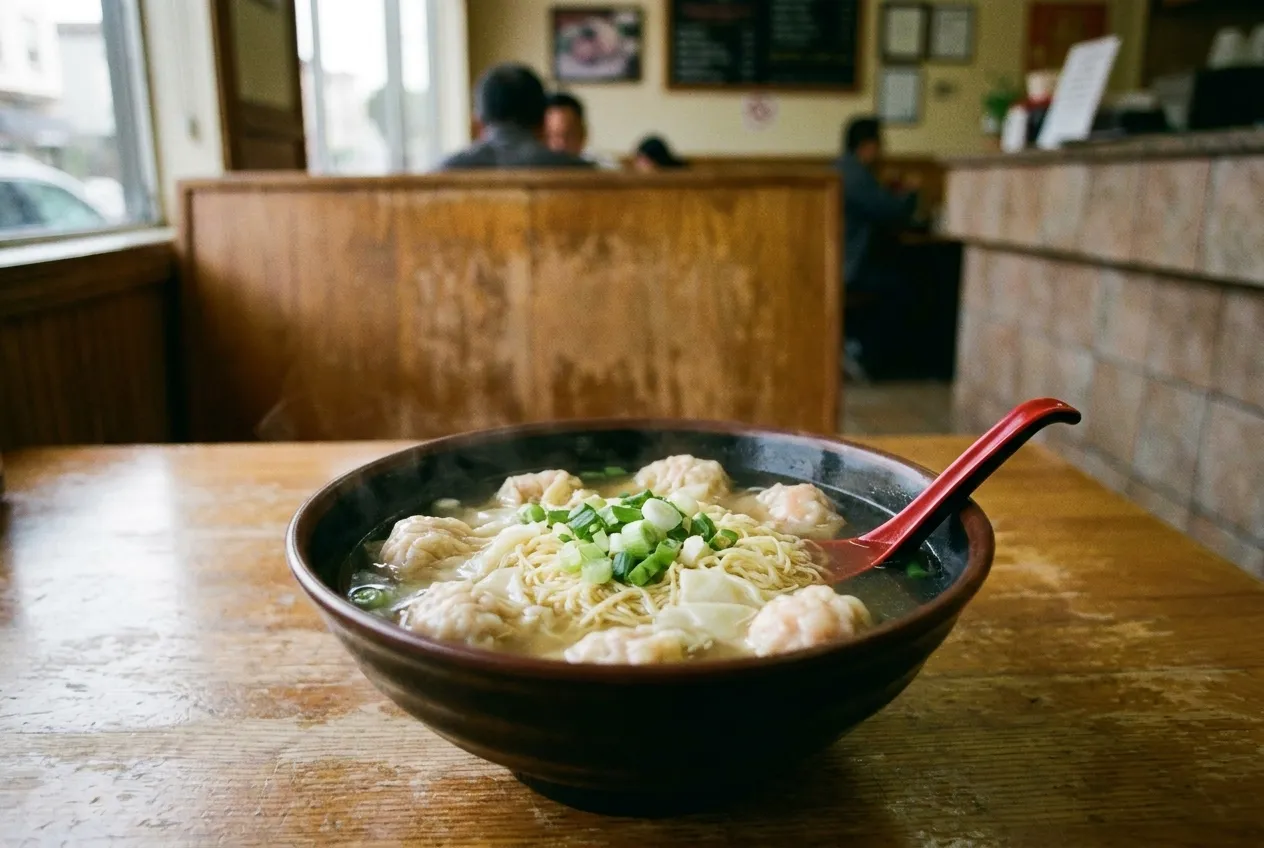
The direct Chinatown analogue is wonton noodle soup - clear broth, thin springy egg noodles, wontons of prawn and pork. The judging criteria are almost identical to pho: the broth should be clear, aromatic and taste of what it was made from rather than of salt, and the noodles should have bite rather than being soft. A bowl that arrives with the noodles already swollen has been sitting.
Order it with the noodles on the side if that is offered - lo mein style rather than tong mein - because egg noodles keep cooking in the broth and go soft within minutes. That is exactly the same problem pho has, solved the same way. Beef brisket noodle soup, congee, and the roast meat windows are the other three things Chinatown does that occupy the same emotional slot as a bowl of pho: hot, restorative, cheap, fast.
Where the Vietnamese food actually is
The nearest real cluster is the Tenderloin, particularly around Larkin Street, which is San Francisco's historic Vietnamese district and about a fifteen to twenty minute walk south-west from Chinatown, or a few minutes on Muni. It is dense, cheap and unglamorous - restaurants, sandwich counters and grocers serving the community that settled there - and it is the best Vietnamese food in the city proper.
The second cluster is the Richmond along Clement Street, twenty-five to thirty-five minutes out on the 38 Geary, where Vietnamese restaurants sit alongside Chinese, Burmese and Russian ones at prices lower than anywhere east of Van Ness. And the deepest supply in the region is across the bay in Oakland, about fifteen minutes on BART from Embarcadero, which is the easiest food trip in Northern California and one almost no visitor makes.
How to judge a bowl of pho when you get there
The broth is the whole dish. Clear rather than cloudy - cloudiness means it was boiled too hard rather than simmered. It should smell strongly of star anise, cinnamon and charred ginger and onion before you taste it, and it should taste of beef rather than of salt. Order pho tai, with rare beef added raw so it cooks in the bowl, which tests both the broth temperature and the meat at once.
Taste it before adding anything. Hoisin and sriracha are a southern Vietnamese-American convention and most restaurants here expect you to use them, but a good broth needs neither. Add the herb plate a handful at a time so the soup stays hot, tear the basil rather than adding it whole, and eat reasonably quickly because the noodles keep cooking.
Making a walk of it
The genuinely good version of this is to treat the border as the point. Chinatown between seven and ten in the morning is doing its own shopping - produce stacked on Stockton Street, live fish, queues at the bakeries - and it is a completely different neighbourhood from the afternoon version. Eat there early: a bowl of congee or wonton noodles, or dim sum from a counter eaten in Portsmouth Square.
Then walk south-west into the Tenderloin later in the day for a banh mi or a bowl of pho, and you will have eaten two closely related noodle traditions three-quarters of a mile apart, in two neighbourhoods that share a great deal more history than their reputations suggest. It costs under twenty-five dollars for both.
Practical notes
Chinatown runs early - bakeries and counters open in the morning and wind down by mid-afternoon, kitchens mostly finish by nine or half past. The Tenderloin's Vietnamese cluster around Larkin Street is fifteen to twenty minutes on foot from Chinatown. Clement Street is twenty-five to thirty-five minutes on the 38 Geary; Oakland is about fifteen minutes on BART from Embarcadero. Prices: wonton noodle soup ten to fourteen dollars, pho thirteen to eighteen, banh mi eight to twelve. Cash is smoothest at Chinatown counters. Ask for noodles on the side if the option exists. And order hu tieu if you see it - it is where the two traditions in this article meet.
Tags: #BestVietnameseFood #Chinatown #SanFrancisco #Pho #HuTieu #WontonNoodleSoup #Cholon #Tenderloin #LarkinStreet #ClementStreet #BanhMi #HiddenGems #SFEats #PortsmouthSquare
All trademarks are the property of their respective owners.
Ask Karpo first
The answer to this one is a short walk in a direction most people do not think to go. Ask Karpo which Chinatown counters are serving noodle soup at the hour you are asking, how long it takes to walk to the Larkin Street cluster, and which of the two is the better bowl right now.