The four things everyone does in San Francisco — the bridge, the cable car, the wharf, the island — take about a day and a half between them and are all fine. The problem is that they crowd out a city that is genuinely strange and considerably more interesting than its own marketing. The best things to do in San Francisco, if you have already seen the postcards or simply do not care about them, are mostly free, mostly outdoors and almost entirely unvisited.
Half of these have no opening hours and half close at four. Ask Karpo what is open near you right now.
The staircases, which are a whole category
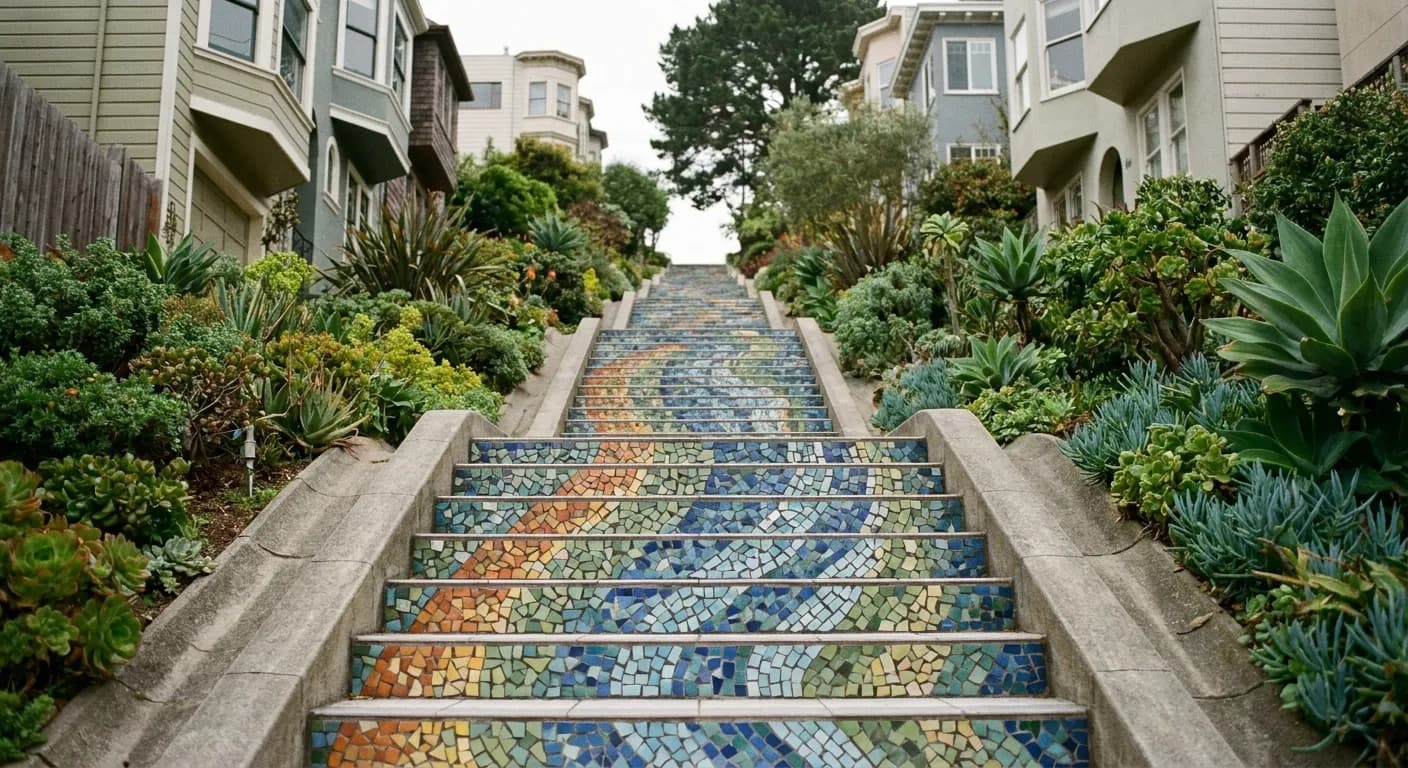
This city has hundreds of public staircases connecting streets that a grid could not otherwise join, and a subset of them have been turned into elaborate community art projects. The tiled steps in the Sunset and on Hidden Garden Street are the famous ones, mosaicked riser by riser over years by neighbourhood volunteers, and climbing them is free and takes ten minutes.
Beyond the decorated ones there is a whole network of ordinary staircases that function as the city's secret pedestrian layer — the Filbert Steps up Telegraph Hill through gardens and wooden cottages, the Lyon Street steps, the Vulcan and Saturn stairways in the Castro hills. Walking a staircase route is the single best way to understand how this city is actually built.
The working machinery
The Cable Car Museum on Nob Hill is free and is not a museum in the usual sense — it is the actual powerhouse, with the enormous winding wheels that pull the cables under the streets running while you stand above them. It is loud, greasy, entirely real, and considerably more interesting than riding the thing.

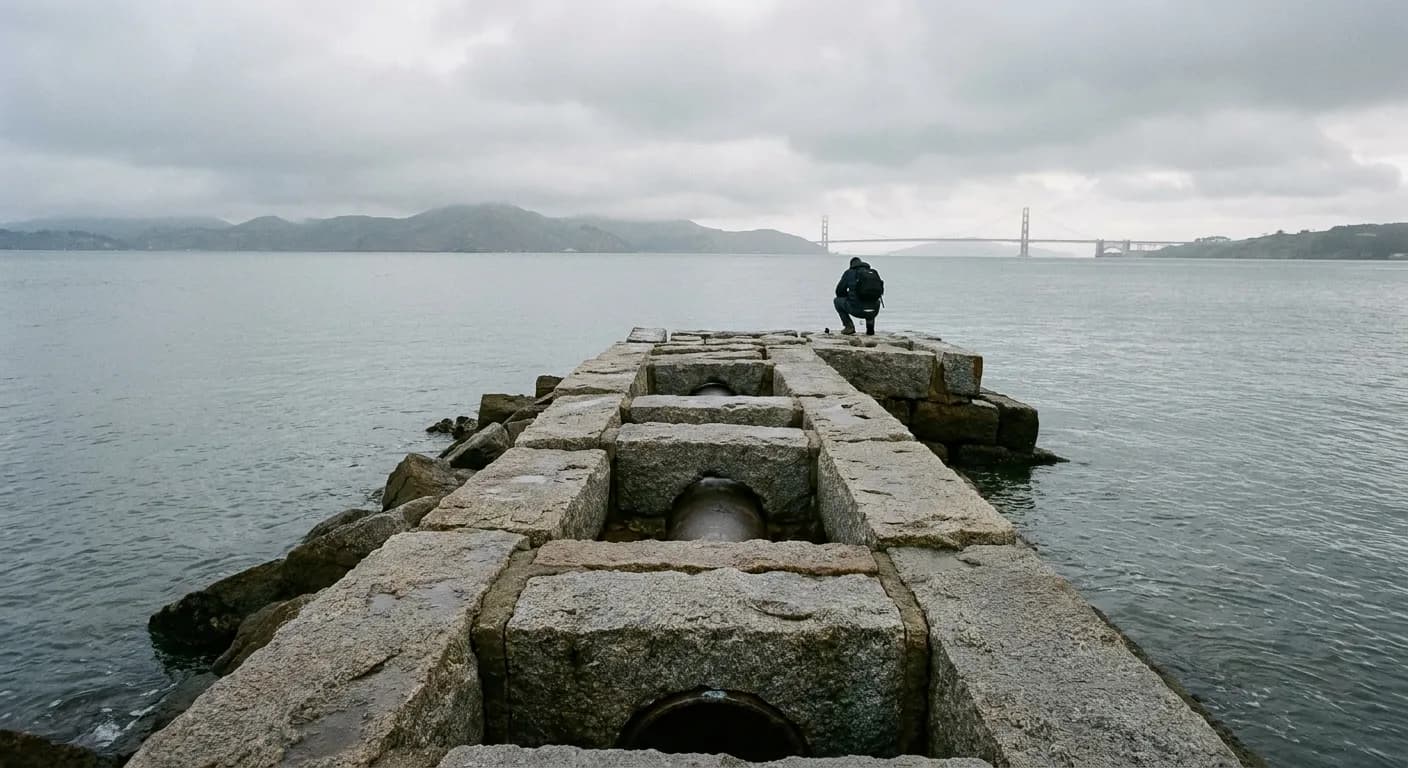
In the same category: the Wave Organ, a wave-activated acoustic sculpture built from demolished cemetery marble on a jetty near the Marina, which works properly only at high tide and is worth timing. And the Camera Obscura beside the old Cliff House site, a Victorian optical device projecting a live image of the seal rocks onto a disc in a dark room.
The ruins and the western edge
The Sutro Baths ruins at Lands End are the best thing in the city and are simply free to walk around. What is left is the concrete footprint of an enormous Victorian swimming complex that burned in the sixties, now flooded, sitting below a cliff with the Pacific breaking beyond it. The trail from there east along the headland is one of the great urban coastal walks anywhere.
Further along, the Labyrinth at Lands End and the ruins of a shipwreck visible at very low tide on Ocean Beach are the sort of thing that never appears on a list because it depends on the tide table. Checking one before a coastal walk here changes what you see.
The small and specific museums
The Musée Mécanique down at the wharf is an enormous collection of working antique arcade machines that you operate with actual coins, and it is free to enter. The Beat Museum in North Beach, the Museum of Craft and Design in the Dogpatch, the Randall Museum up on Corona Heights, the Chinese Historical Society and the various small institutions attached to universities are all specific, small, cheap and largely empty.
The Conservatory of Flowers and the botanical garden in Golden Gate Park deserve inclusion too. Both are quiet, both are beautiful, and the botanical garden in particular has a redwood grove and a cloud forest section that are startling to find in the middle of a city. Both charge very little and both are free to city residents on production of an address.
The odd institutions and the very small
A few places in this city defy categorisation entirely. The Institute of Illegal Images, a private collection of many thousands of blotter-acid sheets in a Mission apartment, is viewable by appointment. The Prelinger Library, a privately assembled research collection organised by geography rather than subject, opens to the public on limited days and lets anyone take books off the shelf. The Vulcan and Saturn steps have front gardens that residents deliberately maintain as a public amenity.
These are all free or nearly free, all run by individuals rather than institutions, and all require checking before you go because the hours depend on whether someone is around. That unreliability is precisely why they stay uncrowded, and it is worth building a bit of slack into a day if you want to see one.
The neighbourhoods themselves
The most underrated thing to do here is to spend an afternoon in a neighbourhood with no attraction in it. The Outer Richmond along Clement, Bernal Heights around Cortland, the Excelsior, the Portola, Visitacion Valley. These are ordinary residential districts with good food, no visitors and a much clearer picture of what living in this city is actually like.
If you only do one thing from this entire list, walk from the Sutro Baths east along the Lands End trail, up through the Presidio, and down into the Marina. It takes a few hours, costs nothing, includes the bridge without requiring you to stand under it with a coach party, and ends somewhere you can get a drink. It is the walk locals take visitors on when they actually want them to like the place.
Tags: #SanFrancisco #HiddenGems #ThingsToDoSF #TiledSteps #SutroBaths #LandsEnd #CableCarMuseum #WaveOrgan #MuseeMecanique #OffbeatSF #FreeThingsSF #BayArea #CityWalks
All trademarks are the property of their respective owners.
Ask Karpo first
Ask Karpo which of the odder places near you in San Francisco are open right now, whether the tide matters for any of them, and how far the walk is between them.