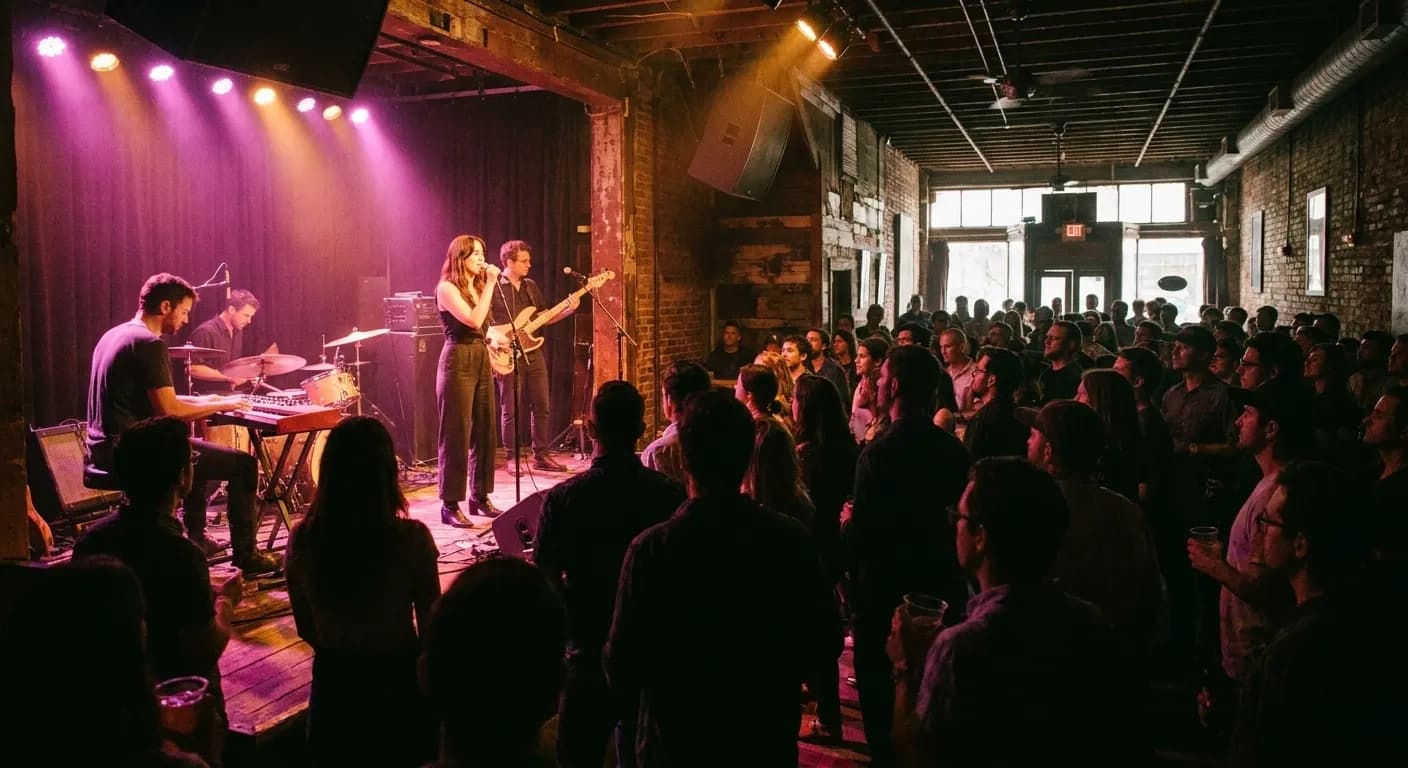
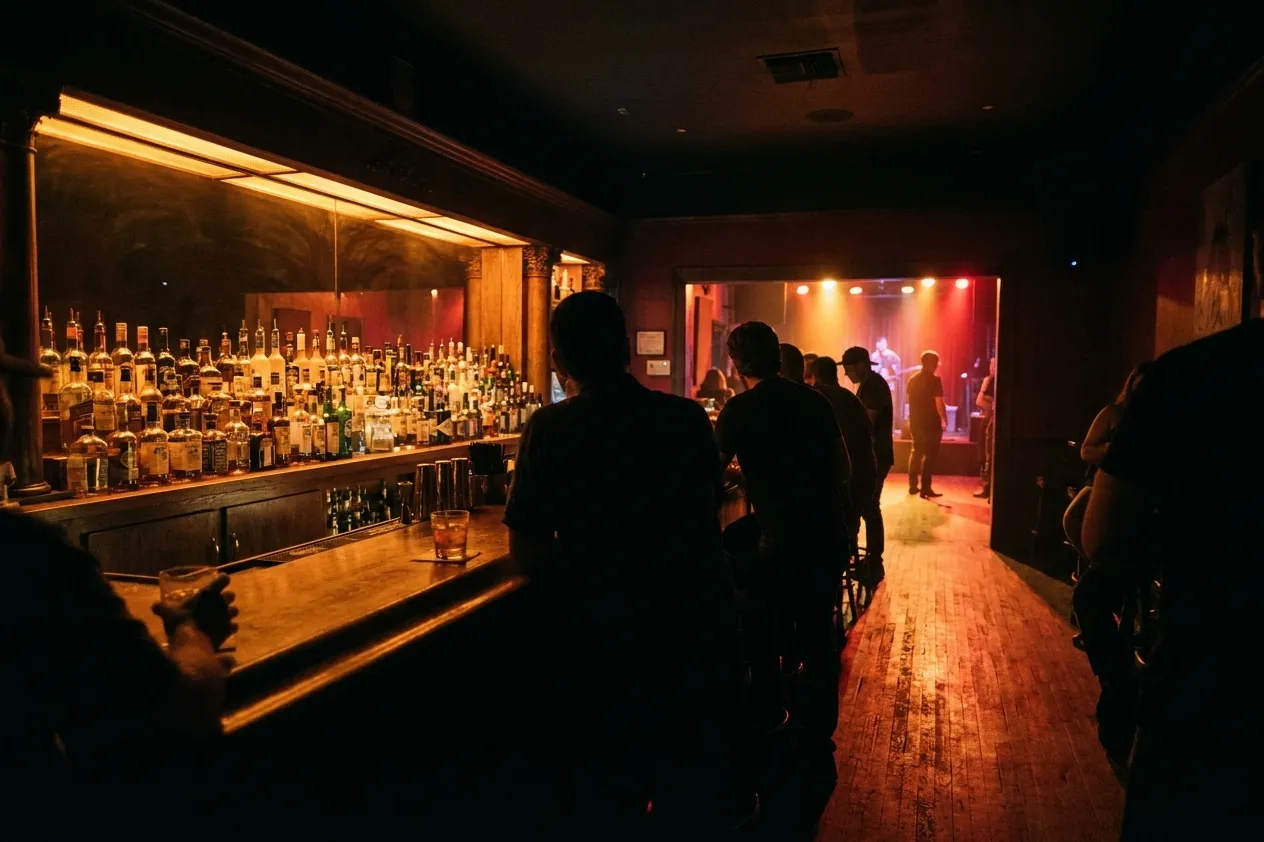
Concerts in Los Angeles at arena scale are expensive, badly parked and largely interchangeable with the same tour in any other city. The interesting version of live music here happens in rooms holding between one and five hundred people, spread across the eastside and East Hollywood, where a ticket costs less than the parking at Crypto.com Arena and you can hear the amps rather than a PA.
Small venue calendars are scattered and half the good shows never get promoted. Ask Karpo what is playing near you this week under thirty dollars.
The rooms worth knowing
Zebulon in Frogtown is the most consistently interesting booking in the city — a room that programmes experimental music, jazz, international acts, poetry and film alongside straightforward gigs, with a mix of free shows and tickets that top out around thirty-five dollars. Gold Diggers on Santa Monica Boulevard is a venue, bar, hotel and recording studio in one building, with a room holding roughly a hundred and fifty standing and a booking policy that leans indie, psych, Americana and singer-songwriter.
Beyond those, the eastside carries most of the load: the Echo and Echoplex in Echo Park, the Lodge Room in Highland Park, Permanent Records Roadhouse in Cypress Park, and a scattering of bar-venues in Silver Lake and Frogtown. Further out, Alex's Bar in Long Beach and the Paramount in Boyle Heights both regularly run shows for twenty dollars or less.
One correction worth making
Bootleg Theater, a 1930s warehouse conversion in Westlake that hosted small indie bands for years, is closed. It still appears on a striking number of current guides to Los Angeles music venues, which is a good illustration of how badly this category is served by search results. If you are working from a list of LA venues written more than a couple of years ago, assume at least one entry on it no longer exists — the small-venue landscape in this city turns over faster than almost any other kind of business.
Why the ceiling is thirty dollars
The economics are simple and they favour you. A room holding two hundred people with a twenty-dollar ticket does not need a national promoter, a dynamic pricing engine or a layered fee structure to cover its costs, so the number you see is close to the number you pay. Above about five hundred capacity all of that machinery arrives and the final price detaches from the listed one. This is why a twenty-dollar show genuinely costs twenty dollars while an eighty-dollar show costs a hundred and twenty.
How to actually find the shows
The discovery problem is real, because these venues do not advertise and the aggregators cover them inconsistently. The method that works is to pick four or five rooms whose taste you trust and check their own calendars directly every couple of weeks. Booking is curation — a venue that has put on three bands you liked will put on a fourth, and that is a far higher hit rate than following individual artists.
The second technique is to turn up for the support acts. At this scale the openers are where you see bands two years before they are expensive, and it costs nothing extra because it is the same ticket. Most people arrive forty minutes late and miss the part that makes small venues worth going to.
Genres and where they live
The eastside rooms lean indie, psych, experimental and singer-songwriter. East Hollywood and the Santa Monica Boulevard corridor skew slightly more polished and industry-adjacent, which is a consequence of proximity to the studios and labels. Long Beach and the southeast carry more punk, hardcore and metal than the rest of the county combined. And there is a substantial Latin alternative and cumbia scene running through Boyle Heights and the eastside that operates on its own circuit and is largely invisible to the English-language listings.
That last point is worth dwelling on. A meaningful share of the most interesting live music in Los Angeles on any given night is promoted entirely in Spanish, on social media, to an audience that does not need an aggregator to find it. If your sense of the city's music scene comes from English-language listings, you are seeing maybe half of what is actually happening.
Practical notes
Buy from the venue where possible, both because the fees are lower and because the money stays in the building. Many of these rooms sell at the door for shows that have not sold out. Check the age policy — a number of LA small venues are bar-first and therefore over twenty-one only. Think about parking before you go, because street parking around Echo Park, Silver Lake and Highland Park on a weekend night is genuinely difficult and a rideshare each way can exceed the ticket price. And spend money at the bar: at this scale, bar takings rather than ticket sales are what keeps the room open next year.
Finally, go on weeknights. Tuesday and Wednesday bills at this scale are frequently the most interesting of the week, because touring bands routing between bigger weekend shows fill their off nights in small rooms. The room is half as full, the ticket is often cheaper, and you will be considerably closer to the stage for the same money. It is the single easiest adjustment anyone can make to how they see live music in this city.
Tags: #LosAngeles #ConcertsLA #LiveMusicLA #SmallVenues #Zebulon #GoldDiggers #EchoPark #HighlandPark #Frogtown #IndieMusic #LANightlife #CheapConcerts #GigGuide #SupportLocal #ThingsToDoLA
All trademarks are the property of their respective owners.
Ask Karpo first
Ask Karpo which small venues near you in Los Angeles have shows this week, what the door price is, and whether parking nearby is going to be a problem.