Poke went from a Hawaiian staple to an American lunch format in about five years, and most of what that produced was bad: sweet sauces, too many toppings, cubes of fish that had been sitting in a case since morning. Poke Origin is one of the San Francisco counters that did not go that way, and understanding why is the most useful thing you can learn before ordering a bowl anywhere.
Fish quality at a poke counter changes through the day and between locations, and midday is not the same as five o'clock. Ask Karpo which counter is turning over fastest near you right now.
What poke is supposed to be
In Hawaii, poke is cubed raw fish seasoned simply — sea salt, seaweed, sometimes kukui nut, sometimes soy and sesame — and eaten as a side or a snack, often bought by weight from a counter or a supermarket. It is not a salad and it is not built around a base of rice with fifteen additions.
The mainland format changed that into a build-your-own bowl, which is a legitimate adaptation and also the source of everything that goes wrong. Once the customer is choosing eight toppings, the fish stops being the point, and a counter can hide mediocre tuna under mango, crispy onions and three sauces.
How to judge a counter
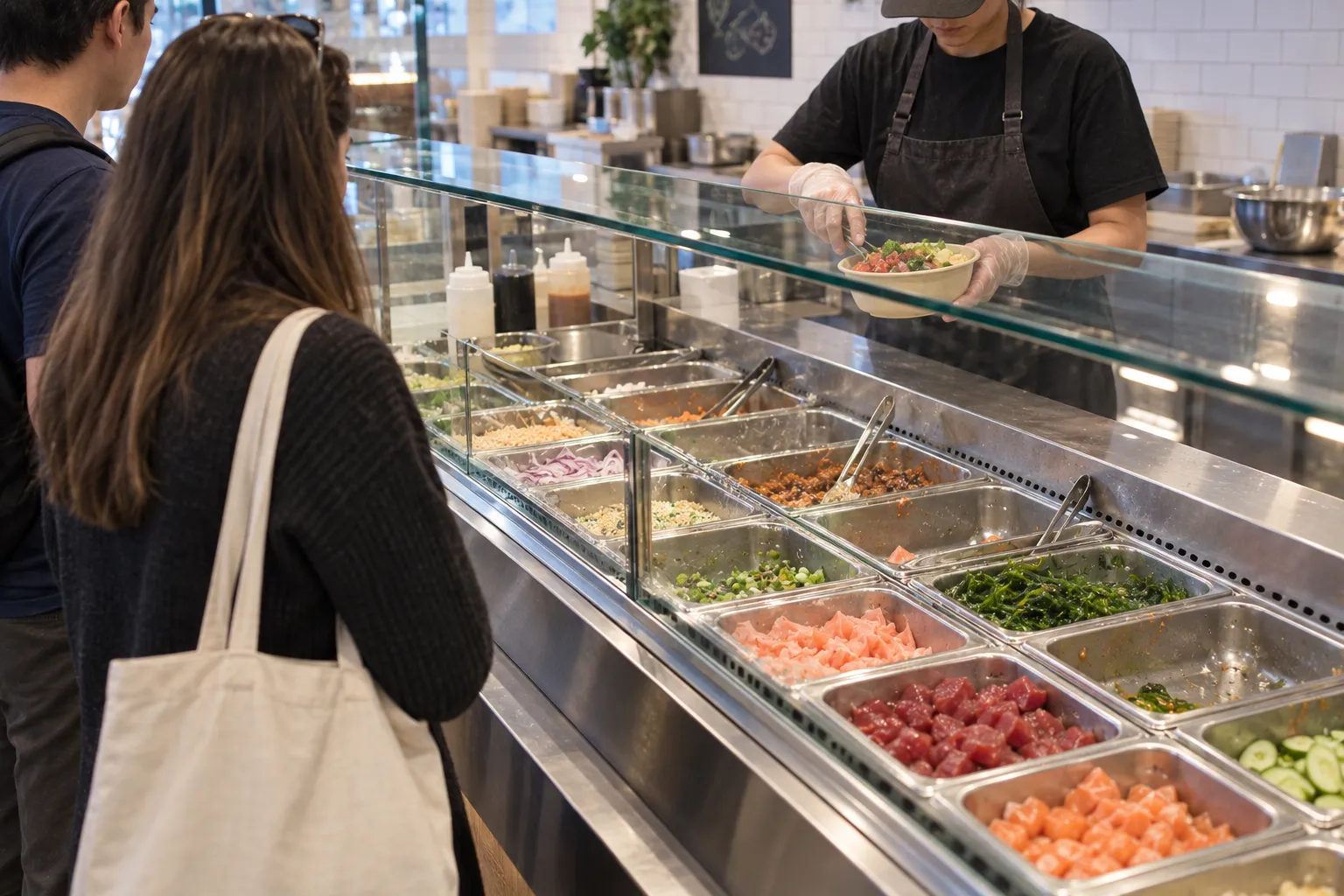
Look at the fish before you look at the menu. Good tuna is deep red to nearly purple with a slight translucency and clean-cut edges; fish that has been sitting looks dull, brownish at the edges and slightly dry at the surface. This is visible from the other side of the glass and it takes two seconds.
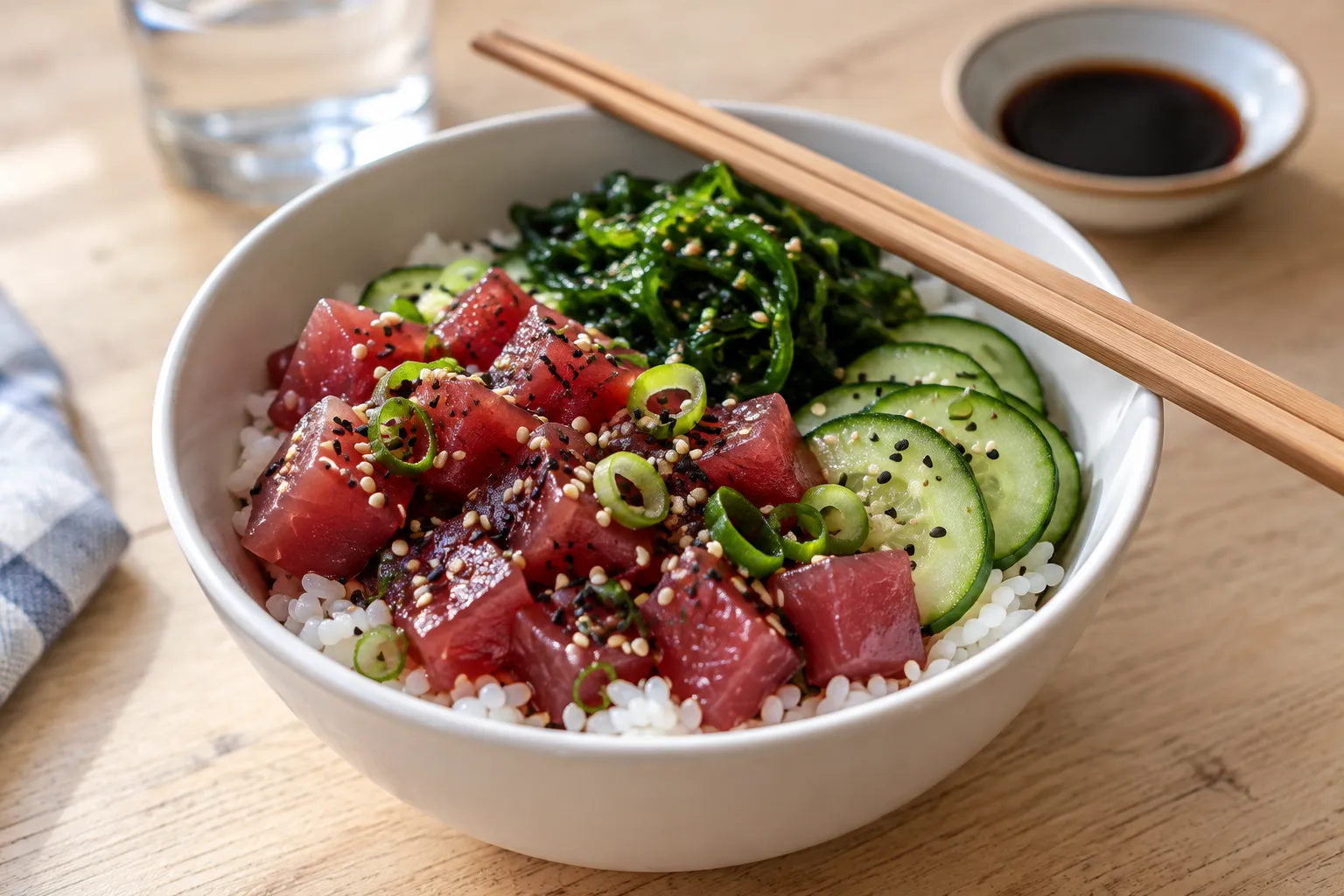
Then look at the turnover. A counter that is refilling trays through the lunch rush is serving fish that has been cut recently. A counter with full trays and no queue at one o'clock is serving fish that was cut at eleven. This single observation matters more than any review.
How to build a bowl properly
Restraint is the whole technique. Choose one fish, one sauce, and two or three toppings that add texture or acidity rather than sweetness — cucumber, seaweed salad, pickled ginger, scallion, sesame. That is a bowl that tastes of fish.
The things to avoid are the sweet creamy sauces in quantity, the fried onions, the mango and the corn. Each of them individually is defensible; together they produce something that would taste identical with any protein in it, which is a strange outcome for a dish whose entire premise is the quality of the raw fish.
On the base: white rice is traditional and correct, brown rice is fine, and a salad base changes the dish into something else. Half rice and half greens is a reasonable compromise that a lot of counters will do without being asked twice.
What to order here
Start with the plainest thing on the menu — a shoyu or classic tuna bowl with minimal additions. That is the test order at any poke counter, and if it is good, everything else is likely to be. If it is not, no amount of topping selection will fix the evening.
Salmon is generally the safer order at a counter you do not know, because the fat content is more forgiving of an hour in the case. Tuna is the better order at a counter you trust. That asymmetry is worth remembering across the whole category.
When to go
Lunch, and specifically the middle of the lunch rush rather than the edges. This is counterintuitive — nobody enjoys a queue — but it is when the fish has most recently been cut and when the trays are turning over fastest. Twenty past twelve is a better bowl than half past two.
Late afternoon is the weakest window at any poke counter anywhere. If that is when you are hungry, the honest advice is to eat something else and come back tomorrow at lunch.
Where it fits in San Francisco
San Francisco has a genuine advantage in this category: a serious Japanese-American food culture, real fish supply and a large enough Hawaiian and Pacific Islander community that the reference point for what poke should taste like is not theoretical. The counters that are good here are very good.
It also means the price ceiling is high and the floor is low. A bowl can cost anywhere from a cheap lunch to something approaching a restaurant main, and the correlation between price and fish quality is real but not linear — some of the most expensive bowls in the city are the most over-decorated.
Poke and the price of good fish
The reason a cheap bowl is usually a worse bowl is not margin but sourcing: sashimi-grade fish costs what it costs, and a counter selling a large bowl for very little is either buying lower grade or cutting the portion with rice and vegetables. Neither is dishonest, but it is worth knowing which trade you are making.
The reasonable position is to treat a good poke bowl as a proper lunch at a proper price rather than as fast food. Once a week at a counter you trust beats three times a week at whichever one is closest to the office, and the difference in what arrives is not subtle.
Eating it right away
Poke does not keep. The seasoning starts curing the surface of the fish within minutes and a bowl that sits for half an hour in a bag has a noticeably different texture from one eaten at the counter. Takeaway is fine if you are going straight somewhere; it is not fine as a lunch bought at eleven for one o'clock.
If you are taking it away, ask for the sauce on the side. That one adjustment preserves most of the texture and costs nothing, and any counter that knows what it is doing will do it without comment.
Practical notes
Poke Origin is one of the San Francisco counters keeping to the plainer end of the poke spectrum. Judge any counter by the colour of the fish in the case — deep red and translucent rather than dull and brown-edged — and by whether the trays are being refilled. Order one fish, one sauce and two or three savoury toppings; skip the sweet sauces, mango, corn and fried onions. White rice is the correct base. Order a plain shoyu tuna bowl the first time as a test. Salmon is the safer choice at an unfamiliar counter. Go during the middle of the lunch rush, not late afternoon.
Tags: #SanFrancisco #PokeOrigin #PokeNearMe #HiddenGems #SFEats #PokeBowl #SFFoodGuide #HawaiianFood #SFLunch #RawFish #SFRestaurants #BayAreaEats #SFCounters #PokeSF
All trademarks are the property of their respective owners.
Ask Karpo first
Want to know which counter near you is busiest right now and what to build into the bowl? Ask Karpo for a live read before you join the queue.