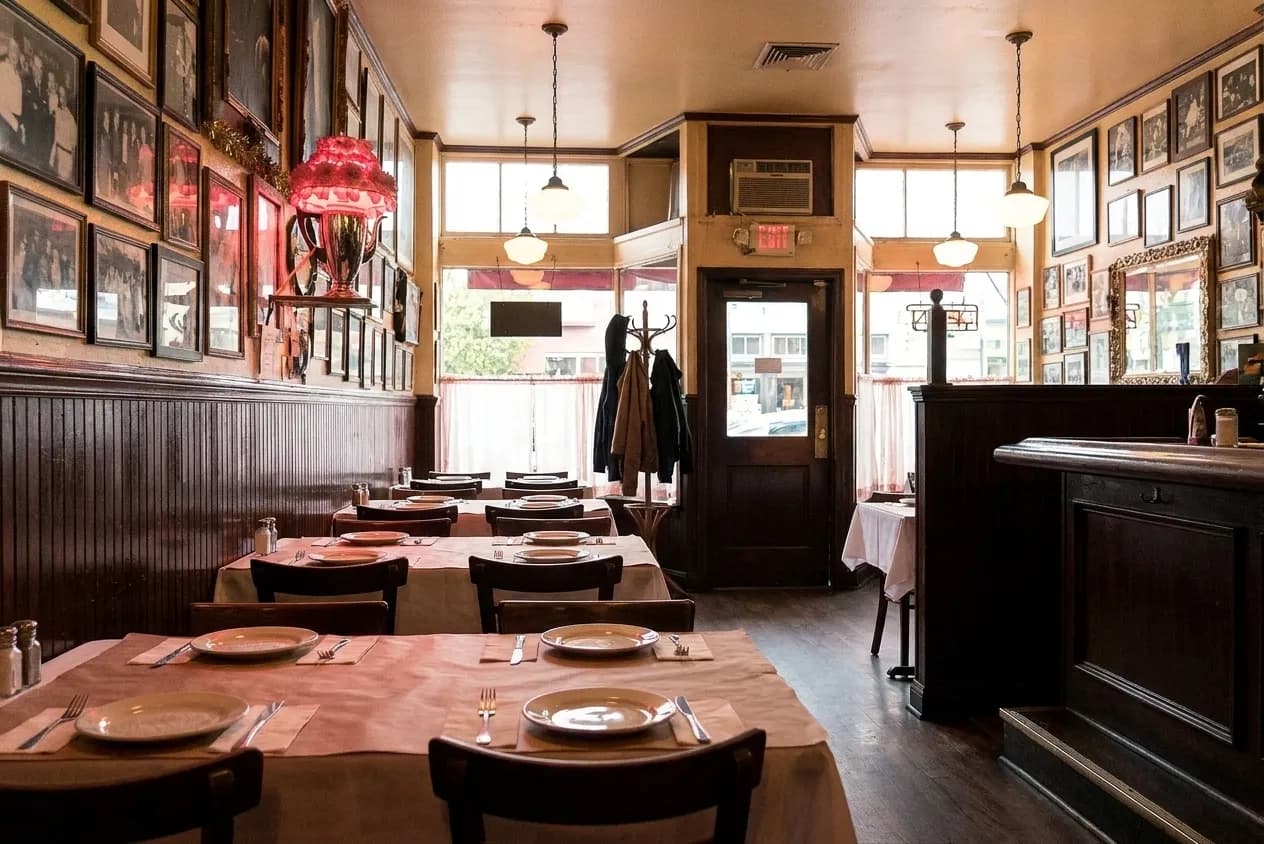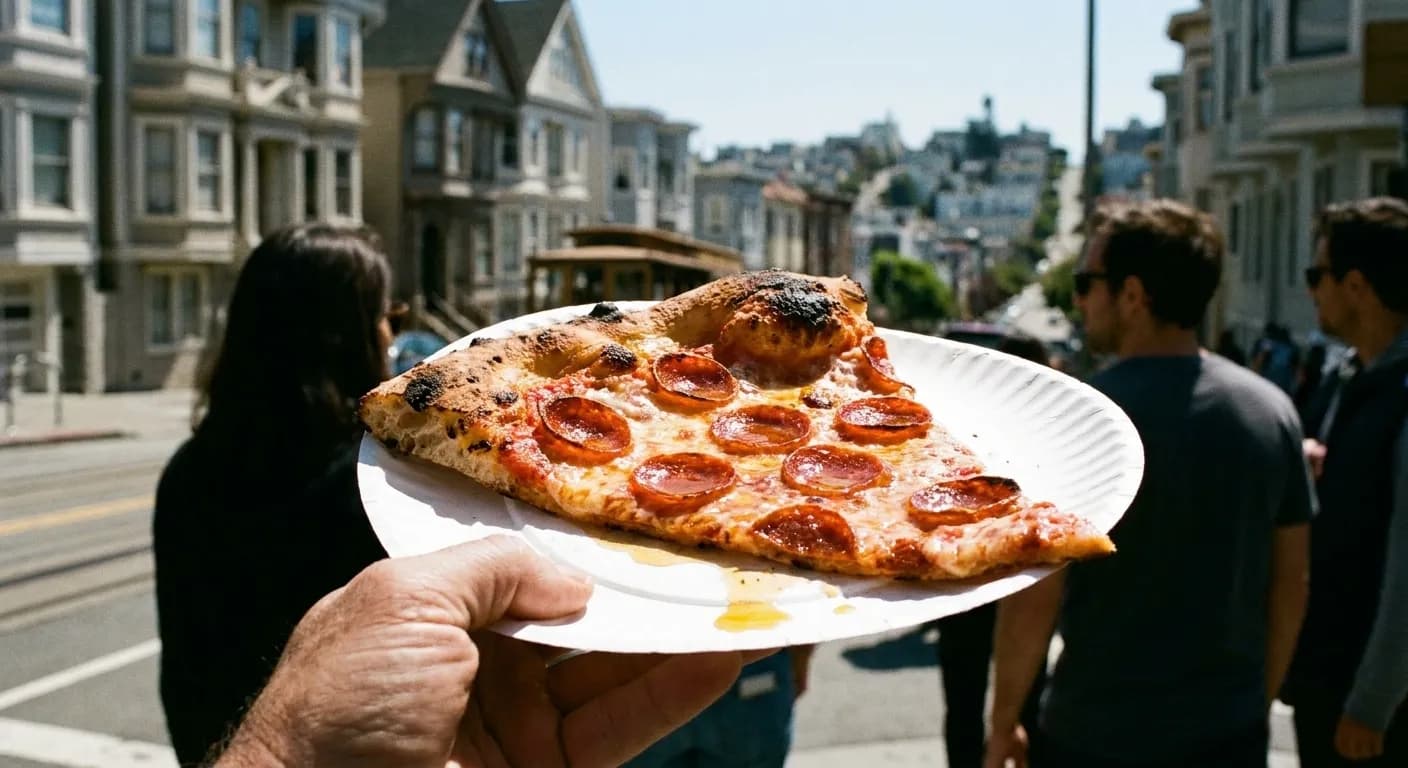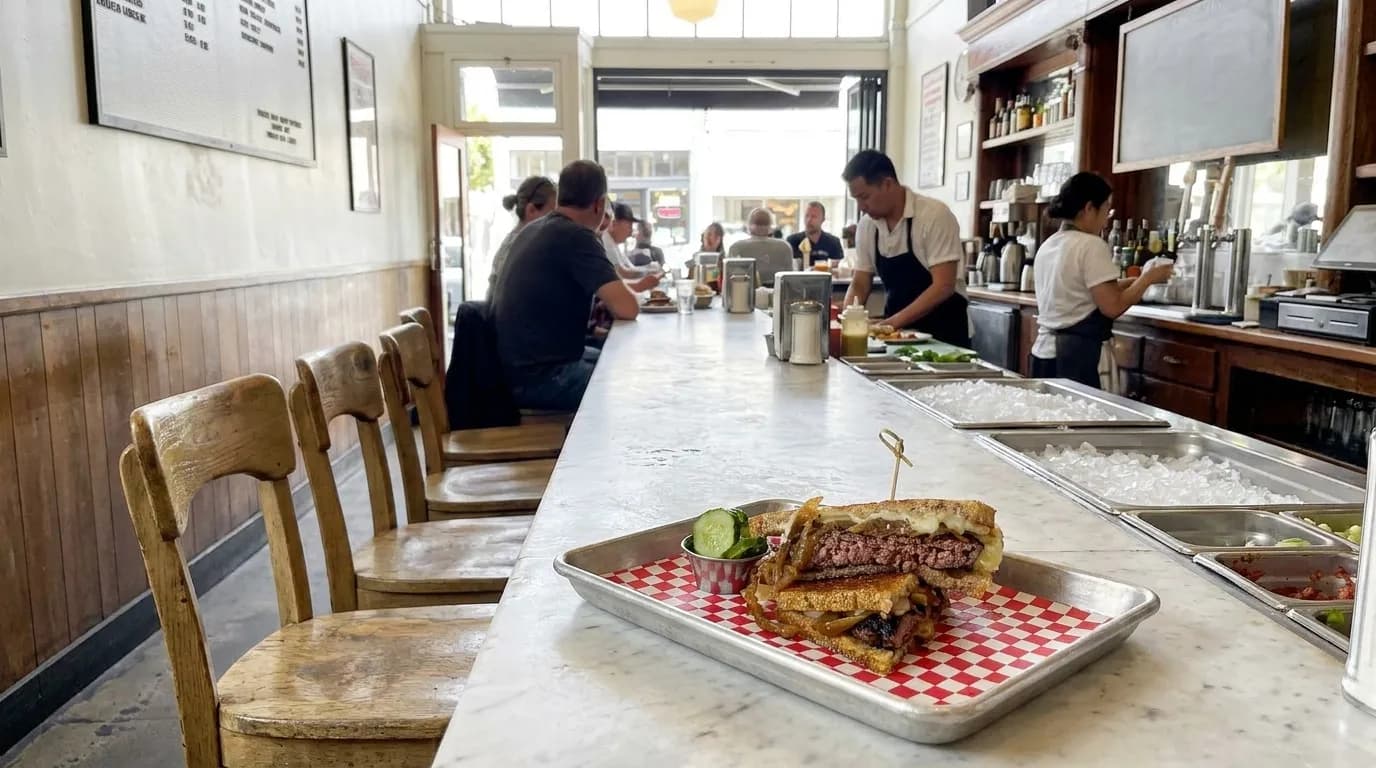
The best lunch in San Francisco is not served in restaurants. It is served over counters, in rooms with fewer seats than a city bus, by people who have been doing the same thing for decades. And it comes with a queue, which almost every guide describes as a sign of quality and almost none of them explains correctly.
Counter capacity, not popularity, decides how long you wait — and it swings hard by the quarter hour. Ask Karpo what the wait looks like near you before you join the back of a line.
Swan Oyster Depot: eighteen stools, no tables
Swan Oyster Depot on Polk Street is the definitive version. Locals and tourists queue on the pavement for one of eighteen stools at the marble counter — that is the entire seating plan. No tables, no second room, no reservations. Anthony Bourdain called it his happy zone and it has been on best-of lists for as long as those lists have existed, but the queue is not really about fame. Eighteen seats against a lunch rush produces a line by simple arithmetic.
Which means the wait is predictable in a way that a restaurant wait is not. A queue of eighteen people is roughly one full turn of the counter. A queue of forty is two and a bit, and at a counter where people sit and eat properly rather than grabbing something, a turn is not fast. Count the queue, divide by eighteen, and you have a genuine estimate — which is more than the door staff at most restaurants will give you.

Sam's in North Beach: a corridor with a flat-top
Sam's is the smallest room on this page and the one people underestimate. It is an almost-too-tight setup — a skinny space with a few bar stools down one side and burgers going on the flat-top more or less continuously. The food is excellent and completely unfussy. The capacity is single digits at any given moment, which is a different order of constraint from eighteen.
Practically, that means Sam's does not work for groups at lunch, at all. Two people is fine, three is optimistic, six is a fantasy. It also means the queue moves in small increments — one or two seats at a time — so a line of ten looks short and is not. If you are on a lunch hour with a hard end, this is the highest-variance choice on the list.
Yamo in the Mission: small, but fast
Yamo is the counterexample that proves the rule. It is small, Burmese, cheap and located in the middle of the Mission, and it does not develop the same kind of queue — because the turnover is quick. Food arrives fast, people eat fast, the seats recycle. The lesson is that seat count alone does not determine the wait; seat count divided by dwell time does, and a tiny room with a fifteen minute average is more available than a slightly larger room where people sit for an hour.
This is the useful heuristic when you are standing in front of an unfamiliar counter trying to decide whether to join. Look at what people are eating rather than how many are waiting. Plates that take twenty minutes to work through mean a slow line; bowls that are finished in ten mean a fast one, however long it looks.
Why the format survives
An eighteen-seat counter with no reservations is, on paper, a terrible business. It caps revenue at a hard ceiling, it turns away money every day, and it cannot scale. What it buys in return is the thing these rooms actually sell: one person cooking or shucking in front of you, no service layer in between, and a menu narrow enough to be executed identically every time for forty years.
That is also why they are hard to replace. A new restaurant can copy the food and cannot copy the arrangement, because the arrangement only makes sense if the rent was fixed decades ago or the owner is standing behind the counter. When one of these rooms closes in San Francisco it does not get replaced by another one — it gets replaced by something with tables and a booking system, which is a different proposition entirely.
How to actually beat the queue
Go at the edges. The lunch rush in San Francisco is tighter than in most cities because so much of it is driven by fixed office hours — the crush is roughly twelve to half past one, and it is dramatic rather than gradual. Arriving at half past eleven or after two o'clock at any of these counters is frequently the difference between walking in and waiting forty minutes for identical food.
Go alone or in twos. Every counter on this list seats parties by splitting them, and a group of four waits for four adjacent stools rather than four stools, which can take several turns. Two people will routinely be seated ahead of a group that arrived before them, and nobody is doing anything unfair — it is just how a single row of seats works.
And go on a weekday if the room is office-adjacent, or a weekday if it is not, for opposite reasons. Polk Street and North Beach counters are busiest when the surrounding blocks are working; a Mission room is busiest at the weekend. Matching your visit to the wrong rhythm is the most avoidable mistake here.
Practical notes
Swan Oyster Depot: Polk Street, eighteen stools, no tables, no reservations — count the queue and divide. Sam's: North Beach, a handful of stools and a flat-top, effectively solo or pairs only. Yamo: Mission, small but fast, the best odds of walking straight in. Across all three, arrive before half past eleven or after two, keep the party to two, and expect cash to be welcome even where cards are taken.
Tags: #SanFrancisco #SFLunch #SwanOysterDepot #PolkStreet #NorthBeach #MissionDistrict #LunchCounter #SFEats #HiddenGems #BestLunchSF #BayArea #SFFood #NoReservations #LocalSF
All trademarks are the property of their respective owners.
Ask Karpo first
Want a great San Francisco lunch without losing an hour to a queue? Ask Karpo which counters near you are past their rush, how many seats they actually have, and where to go instead if the line is already round the corner.