Every ranking of the best food in NYC eventually arrives at the same corner, and most people arrive there wrong. Katz's Delicatessen sits at 205 East Houston Street, on the southwest corner of Houston and Ludlow, and the business behind it dates to 1888. The sandwich that made it famous now costs $28.95. That is a real number to weigh in a city full of $18 lunches, and the honest answer is that it earns it exactly once per visit — provided you understand what you are buying and how the room works before you walk through the door.
The room is really three rooms, and they are three different meals at three different speeds: the carving counter, the waiter section at the back, and the take-out line. Pick wrong and you have queued twenty minutes for the version you did not want. Text Karpo before you head downtown for which door to use tonight, what the wait actually looks like, and what else on the Lower East Side is open around it.
What a month of work tastes like
The pastrami is not expensive because of the address. It starts with brisket navel — the fatty middle cut that fifth-generation owner Jake Dell keeps using as much for tradition as for the texture of the finished slice. That goes into a proprietary brine with pink salt and sits for about three weeks. It is then rubbed with spice, smoked for roughly three days, boiled for about three hours, and held in steam tables at the carving stations until somebody orders it. Start to finish, a single piece of meat is close to a month old before it reaches a plate.
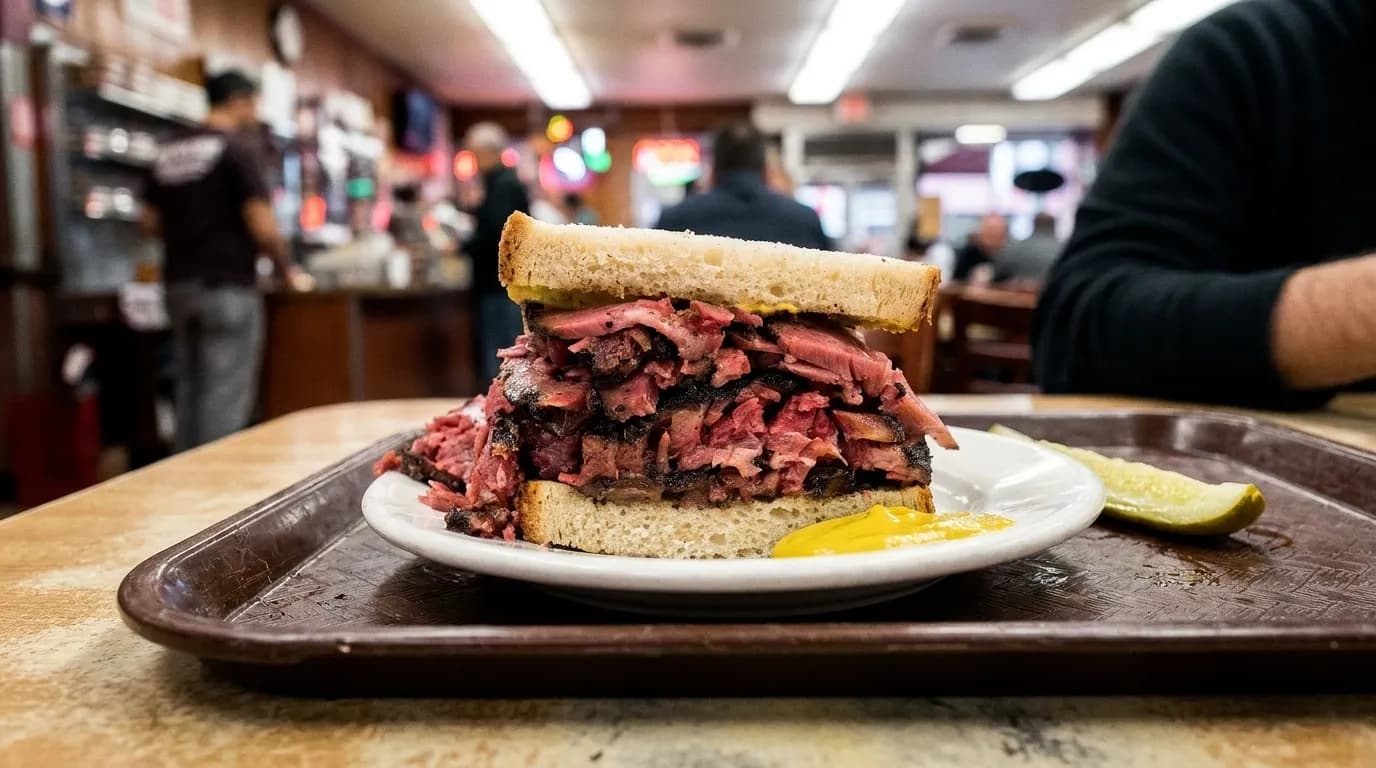
That process is why the slices look wrong if you have only eaten machine-cut deli meat. They are irregular and hand-cut, and they collapse under the bread rather than lying flat in it. The bark is black with pepper and coriander; the middle is rose-coloured and visibly wet. It is not subtle food and it is not designed to be shared politely. The kitchen moves roughly 15,000 pounds of pastrami, 8,000 pounds of corned beef, 2,000 pounds of salami and 4,000 hot dogs in a normal week, which is the other reason the meat is good: nothing sits long enough to dry out.
The ticket is the entire system
Someone hands you a small numbered paper ticket as you come in. It is not a queue number — it is your bill. Every station in the room writes on it: each carver, the drinks counter, the fry station. You hand it to the cashier on the way out. Lose it and the surcharge is $50. Management has been straightforward about the reasoning, which is that a flat penalty removes any incentive to quietly pick up a stranger's low ticket off the floor and pay that instead.
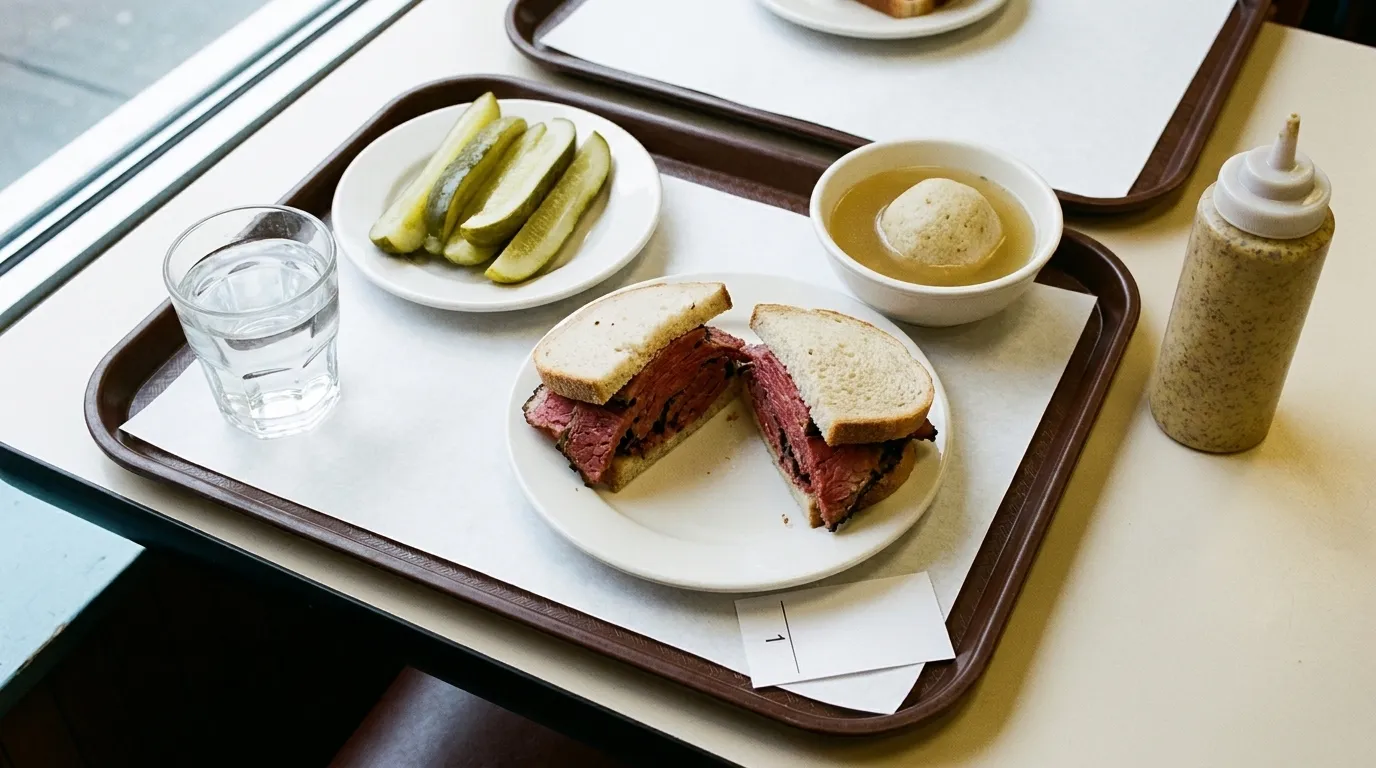
There are three ways to eat here and they are genuinely different experiences. Bear left into the carving counters and you order face to face from a cutter, carry your own tray, and sit at a communal table. Bear right into the back and a waiter takes the order at a table with full service. Or use the separate take-out line, which is the fastest and the only sensible option if you are eating in a park. Decide before you are inside; the room is loud and the decision point comes at you within about four steps.
Choose your cutter, then tip him
Each carver runs his own line, and the line closest to the entrance is almost always the longest, purely because most people join the first one they see. Walk down to the far-left lanes. They move noticeably faster for no reason other than geometry, and the difference at a busy hour is not marginal.
The second move is to put a dollar or two in the cutter's tip jar before he starts building your sandwich rather than after. This is not superstition, it is the accepted transaction, and the standard return is a warm slice handed straight to you off the knife while the rest of the order is assembled. It is the best bite of the meal, it is free, and it settles the pastrami-or-corned-beef argument before you have committed $28.95 to either.
What to order, and what to order instead
Pastrami on rye at $28.95 is the default and the correct first answer. The Reuben is $29.95; corned beef, turkey and brisket sandwiches run $27.95; the combo is the most expensive thing on the board at $30.95. If there are two of you and you are not starving, one sandwich genuinely feeds both — the standard split is one sandwich, one bowl of matzo ball soup at $9.95, and the plate of pickles that arrives whether or not you asked for it.
The half-sandwich with soup or salad at $24.95 is the option most people overlook and the one that makes the bill behave. And the frankfurter at $5.95 is the cheapest honest thing in the building: an all-beef griddled hot dog eaten standing at the counter, which is what this neighbourhood actually ate here for decades before the sandwich became a landmark.
The salamis hanging over the counter are not set dressing either. "Send a Salami to Your Boy in the Army" was coined by Rose Tarowsky during the Second World War, when the owners' sons were serving — hers was a bomber pilot in the South Pacific — and the shop still ships them out.
When to actually go
Weekdays open at 8am and close at 11pm, which makes an early breakfast the quietest hour in the building and by far the easiest time to talk to a cutter. The weekend is the outlier: Saturday runs effectively around the clock, and Sunday closes at 11pm. So a 1am Saturday sandwich is a real option and a 1am Tuesday one is not. Check the specific day before you plan a late one, because the schedule shifts more than most landmarks do.
The other thing worth knowing is that this is a working deli and a film location at the same time. The table used for the When Harry Met Sally scene is marked with a sign and there is usually a small queue of people photographing it. Sit somewhere else. The communal seats nearest the carving counters are louder, warmer and considerably better.
Practical notes
205 East Houston Street, southwest corner of Houston and Ludlow on the Lower East Side; the F at Second Avenue is the nearest stop. Take the ticket at the door and put it somewhere you will not lose it — the replacement charge is $50. Cards are fine, but carry small bills for the cutter's jar. Weekdays run 8am to 11pm; the weekend runs far later, with Saturday effectively continuous and Sunday ending at 11pm. Counter and take-out are self-seated and fast; the back section is table service and the better call for four or more. Budget 15 to 40 minutes on the counter line at weekend peak, and close to nothing at 8:30 on a Tuesday morning.
Tags: #katzsdelicatessen #bestfoodinnyc #nycpastrami #lowereastside #nycdeli #pastramionrye #nyceats #foodnearme #nycrestaurants #jewishdeli #newyorkfood #nycfoodguide #houstonstreet #lesnyc
All trademarks are the property of their respective owners.
Ask Karpo first
The Lower East Side changes by the hour — the counter line at Katz's is twenty minutes at ten in the morning and an hour at two on a Saturday, and half the block around it keeps its own strange schedule. Ask Karpo what the wait looks like right now, whether the counter or the back room suits the group you are actually with, and what is worth walking to afterwards on Ludlow and Orchard.