The honest answer to this search is that there is no Cuban food in San Francisco's Chinatown, and there never has been. But the search itself is interesting, because what people usually want when they want vaca frita is quite specific and is not exclusive to Cuban cooking: meat that has been cooked slowly until it gives up, then cooked again fast until parts of it crisp, then cut through with acid. Chinatown is full of dishes built on exactly that logic, and they are three minutes from wherever in the neighbourhood you are standing.
Chinatown runs on an early clock and the roast meat windows sell the good cuts first. Tell Karpo when you can get there and get the counters that will still have what you want.
What vaca frita actually is, technically
Worth stating precisely, because it is the thing being substituted. Beef - usually flank or skirt - is simmered with aromatics for two or three hours until the muscle fibres separate and it shreds. Then the shredded meat is drained, dried, and pressed onto a very hot pan with sliced onion and a lot of lime until the edges brown and crisp. Two cooking stages, opposite in character: long and wet, then short and dry, with acid added at the end.
The pleasure of the dish comes from the contrast that produces - some strands crisp, some soft, salt and fat cut by sharp citrus. Once you describe it that way rather than by nationality, the Chinese equivalents become obvious, because the twice-cooked principle is one of the foundations of Cantonese and Sichuan cooking and has been for considerably longer than it has been Cuban.
Twice-cooked pork, which is the direct analogue
Hui guo rou - literally 'returned to the pot meat' - is the closest thing on any Chinatown menu. Pork belly is first simmered whole with ginger and spring onion until cooked through, then cooled, sliced thin, and returned to a very hot wok with fermented broad bean paste, leeks or peppers, until the edges of each slice curl and brown and the fat renders out.
It is the same architecture as vaca frita: long wet cook, then a fast dry one that creates crisp edges. The acid arrives differently - from fermented bean paste and vinegar rather than lime - but the balance it performs is identical. If you liked vaca frita for the texture contrast rather than for the lime specifically, this is not a substitute, it is the same idea in a different accent.
The roast meat window
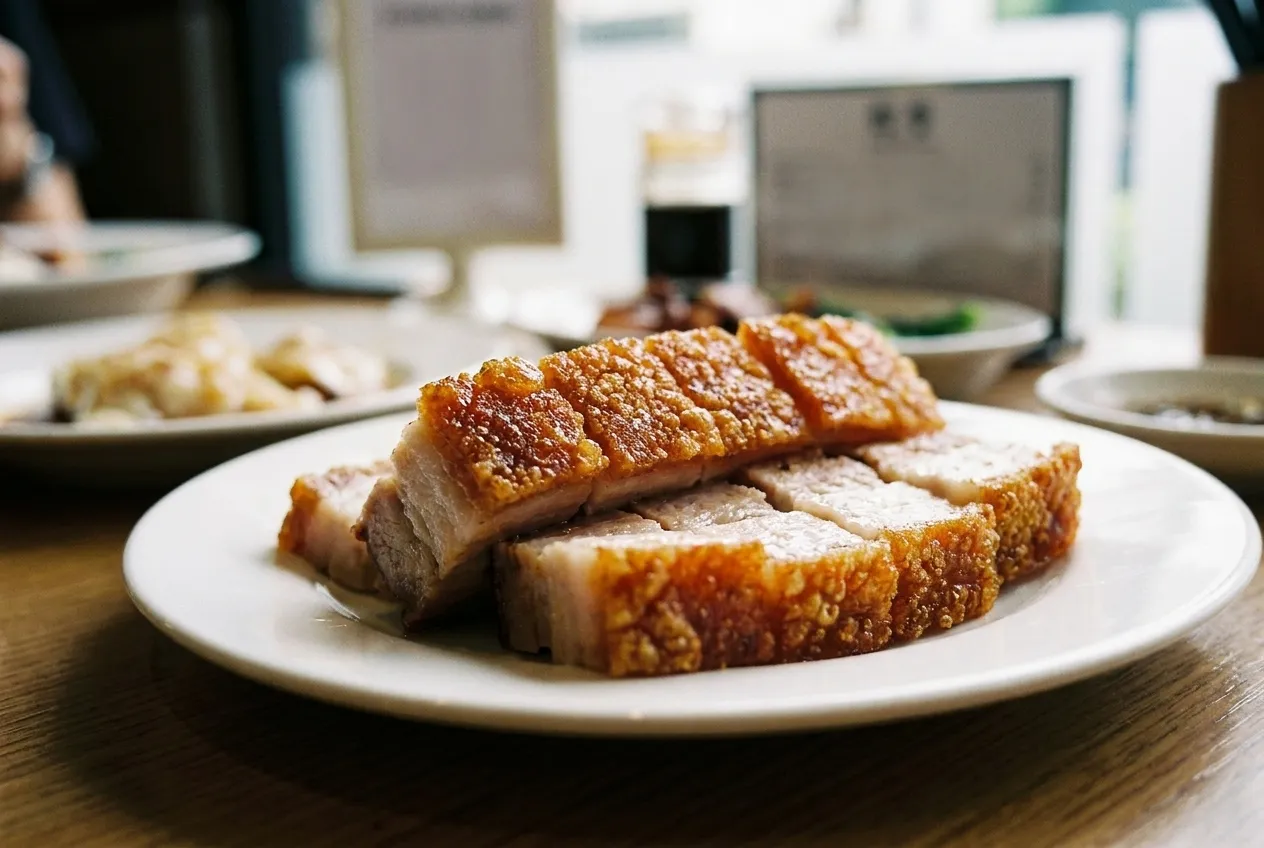
The other answer is the siu mei counter - the window with duck, pork and soy chicken hanging on hooks, chopped to order. Char siu is pork marinated in maltose, soy and five spice and roasted until the outside caramelises and blackens at the edges. Siu yuk is pork belly with the skin scored, salted and roasted until it blisters into crackling that shatters. Roast duck is lacquered and hung so the skin dries before it goes into the oven.
All three are versions of the same trick: something is prepared slowly so that a final blast of heat can produce a crisp surface against a soft interior. Ordered over rice with a little of the pan juices, any of them costs ten to thirteen dollars and is a complete meal. The crackling on a good siu yuk does exactly what the crisped edges of vaca frita do, and it is arguably more dramatic.
Where the acid comes from
This is the one component that transfers least directly, and it is worth knowing what to ask for. Chinese cooking gets its sourness mostly from vinegar - Chinkiang black vinegar in particular, which is malty and complex rather than sharp - and from pickled vegetables served alongside. Pickled mustard greens, preserved radish and pickled ginger all appear on the table for exactly the reason pikliz or lime does in Caribbean cooking.
If a dish arrives rich and you want it cut, ask for vinegar, and specifically for the black vinegar rather than the white. It is standard, nobody will find it a strange request, and it changes a plate of roast pork considerably. Chilli oil wontons - boiled wontons dressed in chilli oil, black vinegar, garlic and a little sugar - are the dish that shows this balance most clearly and are one of the best things on any Chinatown menu.
If you actually want the Cuban thing
Chinatown will not give it to you, and the honest map points elsewhere. San Francisco's Cuban restaurants are few and scattered rather than clustered, mostly single independent rooms in the Mission, the Richmond and across the bay in Oakland and Berkeley. The reason is straightforward: Cuban migration to the United States concentrated in South Florida and the New York area, and very little of it came to Northern California, so there was never a community here to build the restaurants.
The Mission is the more useful redirect. Its Latin American food is Mexican, Salvadoran, Guatemalan and Nicaraguan rather than Cuban, and the dish that does the vaca-frita job there is carnitas - pork confited slowly in its own fat, then crisped on a griddle before serving, with lime and pickled onion alongside. Same two stages, same acid at the end, twelve minutes away on BART.
Practical notes
Chinatown runs early: bakeries and dim sum counters open in the morning and wind down by mid-afternoon, restaurants mostly finish by nine or half past. Roast meat windows sell the best cuts first, so go before one o'clock if you want a choice. Cash is still the smoothest payment at the counters. Prices: ten to thirteen dollars for roast meat over rice, a couple of dollars for bakery items, fifteen to twenty for a twice-cooked pork plate to share. Ask for black vinegar if a dish is too rich. Parking is very difficult - use the Portsmouth Square garage or arrive on foot from North Beach. And if it is Cuban food specifically you want, take BART to the Mission rather than walking around Chinatown hoping.
Tags: #BestCubanFood #VacaFrita #Chinatown #SanFrancisco #TwiceCookedPork #CharSiu #SiuYuk #RoastDuck #ChinkiangVinegar #Carnitas #MissionDistrict #SFEats #HiddenGems #OddFinds
All trademarks are the property of their respective owners.
Ask Karpo first
Sometimes the useful answer is that the thing you searched for is not here and something better is. Ask Karpo which Chinatown counters still have roast pork at the hour you will be there, which nearby room does a proper twice-cooked pork, and whether it is worth taking BART to the Mission for the Cuban version instead.