You are looking at a map with eight beach options between Malibu and the South Bay, and the real question is not which sand is better. The real question is whether you will pay twelve dollars to park four blocks inland or zero dollars to park nine blocks inland with a two-hour limit you will certainly exceed. The beach is free in Los Angeles. Getting to it is not. The parking decision quietly determines what kind of day you have.
Before you circle another block looking for a spot, open the Karpo app. It knows which lots are full right now and where the residential streets still have space.
There is a real price ladder here. Free residential streets with time limits and a long walk. Metered blocks that turn over. Flat-rate county lots that fill by ten on a hot Saturday. The paid valet-adjacent options near the piers. Each tier buys you something different in walking distance and stress, and the marine layer and the afternoon wind change which stretch is worth it.
Free residential streets: the two-hour lottery
Every beach neighborhood in Los Angeles has residential streets within walking distance of the sand. Most of them have two-hour limits on weekends and some weekdays. A few do not. The ones without limits fill first, and locals know exactly where they are.
In Santa Monica, the blocks north of Montana Avenue and east of Seventh Street are residential permit zones during the week but open on weekends. You are looking at a ten-to-fifteen-minute walk to the sand. The same pattern repeats in Venice on the blocks east of Pacific Avenue and south of Rose. In Manhattan Beach, the streets east of Highland Avenue and south of Manhattan Beach Boulevard are a solid twenty-minute walk to the water, but they are free and they do not fill until mid-morning on summer Saturdays.
The two-hour limit is the trade. If you are coming for a swim and lunch, two hours works. If you are coming to sit, you will move your car or risk a ticket. The ticket is seventy-three dollars in most beach cities. Enforcement is consistent. The calculation is whether the walk plus the time limit plus the risk is worth zero dollars. On a seventy-degree January Tuesday, it is. On a Fourth of July Saturday, it is not.
The marine layer matters here. If the coast is socked in until noon, the free residential streets stay open longer. If it burns off early, they fill by nine-thirty. The layer is predictable: it sits heaviest in June and July, and it clears earlier as you move south. Manhattan Beach and Hermosa Beach burn off faster than Santa Monica and Venice. That thirty-minute difference changes when you need to arrive to claim a free spot.
Metered blocks and small city lots: four to eight dollars
The metered blocks are the middle option. In Santa Monica, the meters along Ocean Avenue and the numbered streets west of Ocean charge between three and four dollars an hour depending on the block and the day. Maximum stay is usually three or four hours. You are paying twelve to sixteen dollars for a spot that puts you five to seven blocks from the sand.
In Venice, the metered blocks along Pacific Avenue and the side streets near Windward charge similar rates. The meters here reset at six in the evening, which matters if you are coming for a sunset session. In Manhattan Beach, the metered blocks along Manhattan Beach Boulevard and the streets near the pier run about the same. The advantage is turnover. If you arrive at one in the afternoon, you will find a metered spot. You will not find a free residential spot.
The small city-operated surface lots fall into this tier as well. Santa Monica has several along the beach bike path north of the pier. They charge a flat rate that hovers around eight to twelve dollars depending on the season and the day of the week. They fill later than the big county lots but earlier than the meters. If you arrive by ten-thirty on a Saturday in July, you will usually get in. If you arrive at eleven-thirty, you will not.
The afternoon wind is the variable that changes the value here. The westerly wind picks up between one and three in the afternoon on most summer days. It is stronger in the South Bay than in Santa Monica, and it is stronger on the exposed stretches than near the piers. If you are paying for four hours on a meter and the wind starts whipping sand at two, you have overpaid. If you know the wind is coming and you plan to leave by one-thirty, the meter is the right call.
County beach lots: twelve to twenty dollars, gone by ten
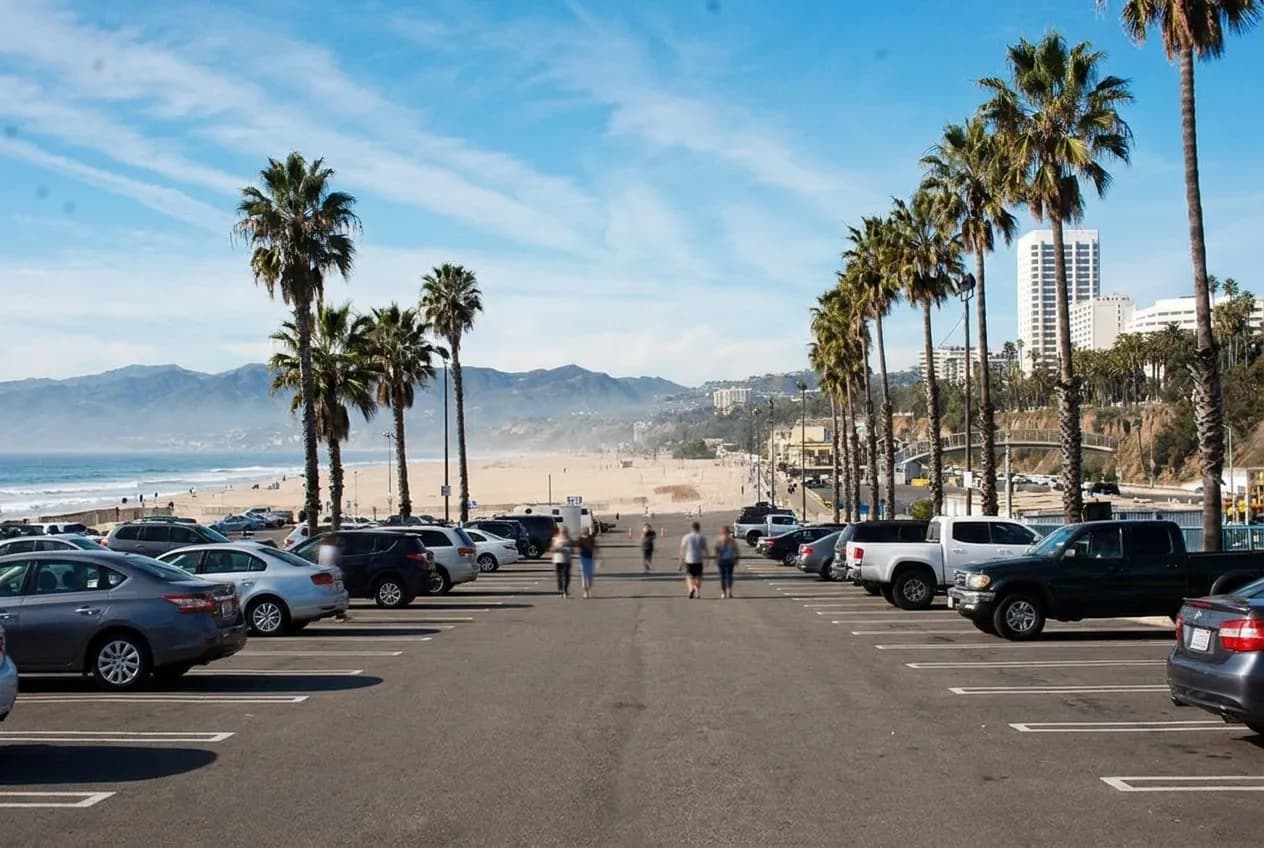
The large county-operated beach lots are the default for most people. They charge a flat rate that ranges from twelve dollars on weekdays to twenty dollars on summer weekends. They put you directly on the sand or one block away. They fill early.
In Santa Monica, the big lots are south of the pier along the beach. In Venice, the lot at Washington Boulevard is the largest and fills first. In Manhattan Beach, the lot at the end of Manhattan Beach Boulevard is the main option. In Hermosa Beach, the lot at the end of Pier Avenue is the only real lot, and it fills by nine-thirty on holiday weekends.
The value proposition here is certainty and proximity. If you arrive by nine or nine-thirty on a Saturday, you will get a spot in one of these lots. You will walk less than three minutes to the sand. You will not move your car. You will not watch the time. You are paying for that.
The failure mode is arriving at ten-fifteen and finding the lot full. At that point, you are back to hunting for a metered spot or a residential street, except now you are doing it in the middle of the arrival wave. The lot attendants do not take reservations and they do not hold spots. The lot is full when it is full. The signs at the entrance tell you. The line of cars circling tells you.
If you are coming with small children or a lot of gear, the county lot is worth the early arrival. If you are coming solo or with one other person and you can walk ten blocks, the county lot is probably not worth twenty dollars on a weekend.
Valet and private structures: twenty to thirty-five dollars
The top tier is valet parking near the piers and private structures in the commercial zones. In Santa Monica, the structures along Second and Fourth streets charge between fifteen and thirty dollars depending on how close you are to the pier. Valet at the hotels and restaurants near the beach runs twenty-five to thirty-five dollars. In Manhattan Beach, the private lots near the pier charge similar rates.
This tier does not fill. You will get a spot at noon. You will get a spot at two. You are paying for guaranteed access and you are paying for proximity to bathrooms, food and shade. If you are meeting a group and you do not want to coordinate arrival times, this is the option. If you are coming for three hours on a random Thursday, this is too much.
The structures also matter when the marine layer lingers. If the coast is grey and damp until one in the afternoon, the free and cheap options stay available longer. But if you committed to a beach day and the weather is marginal, the ability to park in a structure and walk to a café while you wait for the sun is worth the extra cost. The valet option near the Santa Monica pier makes sense if you are combining the beach with a meal or a ride on the pier. It does not make sense if you are just coming for the water.
The private lots near the Venice boardwalk charge in this range as well. They are worth it on weekends when the street parking is gone and the county lot is full. They are not worth it on a Tuesday morning in February when you can park for free six blocks away.
The calculation is always the same. Free parking buys you a walk and a time limit. Cheap parking buys you less walk and more time. Expensive parking buys you certainty. The beach is the same in all three cases. The question is what the logistics are worth to you on this specific day, in this specific weather, with this specific group. Most people overpay because they do not think about the marine layer or the afternoon wind or the difference between a Saturday in July and a Tuesday in October. The people who underpay are the ones who arrive at eleven on a summer Saturday expecting to find a free spot three blocks from the Venice pier. Neither group is making the trade consciously.
The trade-off worth accepting is the walk. If you will walk ten blocks, you will almost always find free or cheap parking in Los Angeles. If you will not walk ten blocks, you will pay fifteen to thirty dollars or you will arrive before nine-thirty. There is no third option that works consistently. The beach is free. The sand does not care how you got there.
Tags: #BeachNearMe #LosAngelesBeaches #SantaMonicaBeach #VeniceBeach #ManhattanBeach #HermosaBeach #BeachParking #FreeThingsToDoLA #LosAngeles #SoCalBeaches #BeachDay #LAParking #CaliforniaCoast #SouthBay #LAWeekend
All trademarks are the property of their respective owners.
Ask Karpo first
Open the Karpo app before you leave to see which beach lots have space right now and where the residential streets are still clear. Karpo knows the arrival pattern for today's weather and can route you to the tier that makes sense. It is faster than circling.