At four thirty on a Saturday afternoon in July, the northbound lanes of the Pacific Coast Highway between Manhattan Beach and Malibu slow to a stop-and-crawl. The southbound side is still moving. Everyone leaving the beach right now will sit in traffic for forty minutes. Everyone who stays another hour will drive home in twelve. The difference between those two experiences is the reason you need to understand all three clocks that govern an LA beach evening: when the sun goes down, when the lot gates close, and when the commute turns into a slog.
Before you load the cooler, ask Karpo which beach lots are still open, when sunset hits tonight, and whether the PCH is moving or stalled.
The Fire Ring Question and Arrival Time
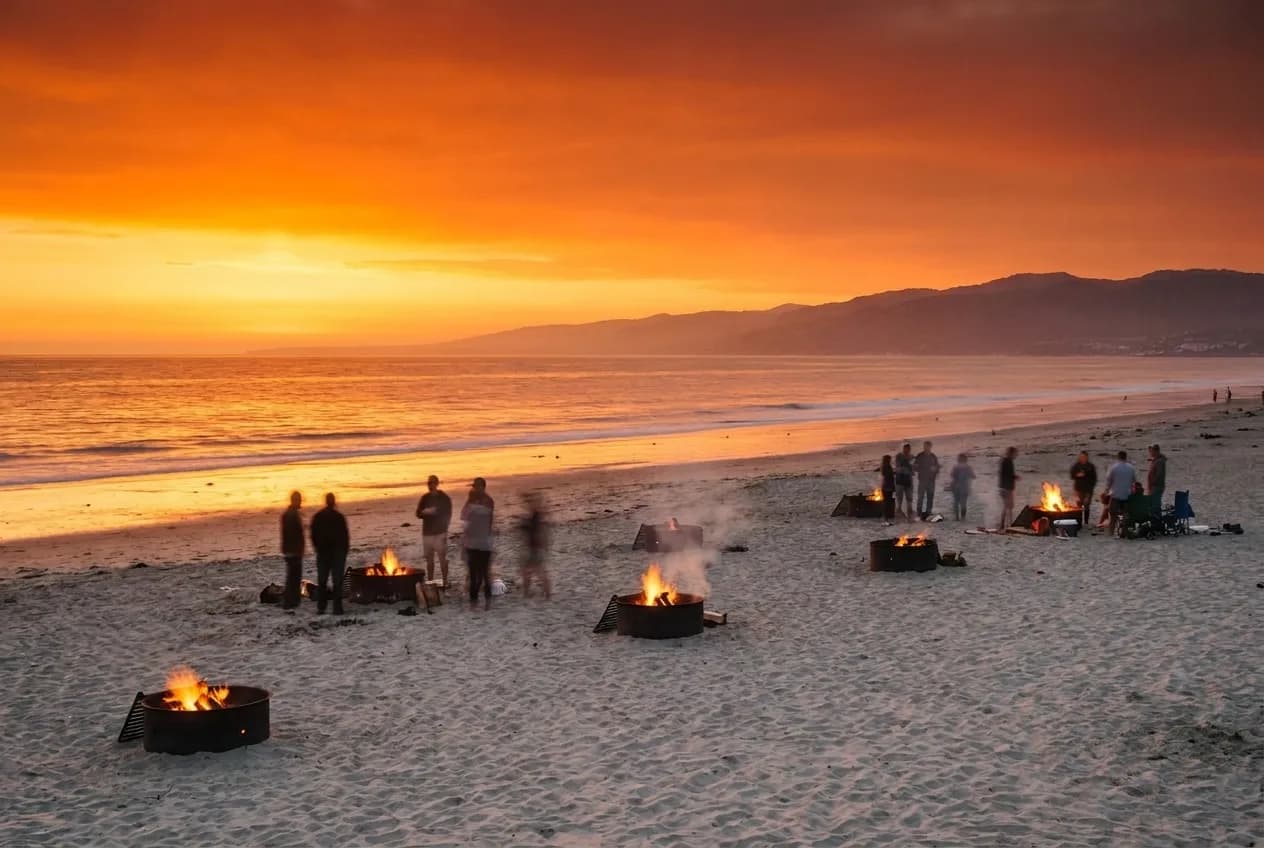
If you want a fire ring, you need to arrive before two in the afternoon on a weekend between May and September. The beaches that still allow fires—Dockweiler, Cabrillo in San Pedro, and a handful of rings at Bolsa Chica down in Orange County—operate on a first-come system with no reservations. Dockweiler has the largest concentration of rings, more than sixty of them spread along the sand south of the Hyperion treatment plant, and on a summer Saturday they are all claimed by noon. Weekdays outside of July and August give you until three or four, sometimes later.
The fire itself is not the hard part. Bringing your own wood is legal and expected. Bundles are sold at gas stations and corner markets within a mile of any beach, usually eight to twelve dollars for enough to burn for three hours. The rings are steel and set into the sand, about three feet across. You are allowed to cook directly over the flame. The wind is the variable. On a typical evening the onshore breeze picks up around five and does not quit until well after dark. Bringing a windbreak—a tarp, a popup canopy weighted with sand, even a circle of beach chairs—makes the difference between a fire you can sit near and a fire you have to stand upwind of.
If fire rings are full or you are not interested in managing a fire, the calculation changes. You can show up later. The parking lots at Santa Monica, Venice, Manhattan Beach, Hermosa, and Redondo do not fill to capacity on weekdays outside of summer. On weekends they do, but the turnover begins around four when families with small children start packing up. Arriving at four thirty or five gets you a spot without the early commitment, and you are still on the sand in time for the best light.
Sunset Timing and the Marine Layer
Sunset time in Los Angeles moves by about a minute per day through most of the year, faster near the solstices. In June it happens around eight. In December it happens around five. The marine layer—low cloud cover that rolls in from the ocean—appears on about half of all evenings between May and July, and when it does, the visible sunset is canceled. The sky goes from bright to gray to dim without the color show. This is not predictable more than a few hours in advance. If you are planning an evening around sunset and the morning started overcast, the odds are poor.
When the marine layer is absent, the best light starts about forty minutes before the sun touches the horizon and lasts for twenty minutes after it drops. The color peaks in the ten minutes right around the moment of sunset. If you are timing your arrival to catch this, you want to be on the sand an hour before the listed sunset time. That gives you time to park, walk to the water, and settle in before the light turns. The beaches with west-northwest exposure—Zuma, El Matador, the stretches of Malibu north of Point Dume—get the longest view of the sun dropping into the ocean. The beaches that face more directly west or southwest lose the sun behind the coastal hills earlier, but the sky still lights up.
Bring layers. The air temperature drops faster than you expect once the sun is down, and the wind does not stop. A sweatshirt that feels unnecessary at seven will be necessary by eight. If you are staying past dark, a blanket is not optional.
When the Lots Actually Close
The posted closing time for most LA County beach parking lots is ten during the summer and earlier in winter, but enforcement is inconsistent. At Dockweiler, where the fire rings create an incentive to stay late, the lots remain accessible until eleven or later on weekends, and the gates do not physically close until the last cars leave. At Venice and Santa Monica, the lots close closer to the posted time, but you will not be towed if you are still inside at ten fifteen. The risk is getting locked in, not getting ticketed. If the gate is closed when you walk back to your car, you are stuck until morning or until you can reach someone to open it.
The safer assumption is that you need to be walking back to your car by nine thirty if the lot closes at ten. Beach parking enforcement in LA is stricter than it used to be, and the window for casual overstays has narrowed. State beach lots—Leo Carrillo, Point Dume, Bolsa Chica—close earlier and lock their gates more reliably. If you are parked at a state beach, treat the posted time as real.
Street parking near the beach follows different rules. In residential neighborhoods adjacent to the sand—the streets east of the Strand in Manhattan and Hermosa, the blocks north of Rose in Venice—parking is restricted to residents after six or eight in the evening, depending on the block. Meters along commercial strips and the PCH itself run until eight or ten and then go free. If you are willing to park a quarter mile from the sand and walk, you can often avoid the lot entirely and leave on your own schedule.
The Drive Home and When to Leave
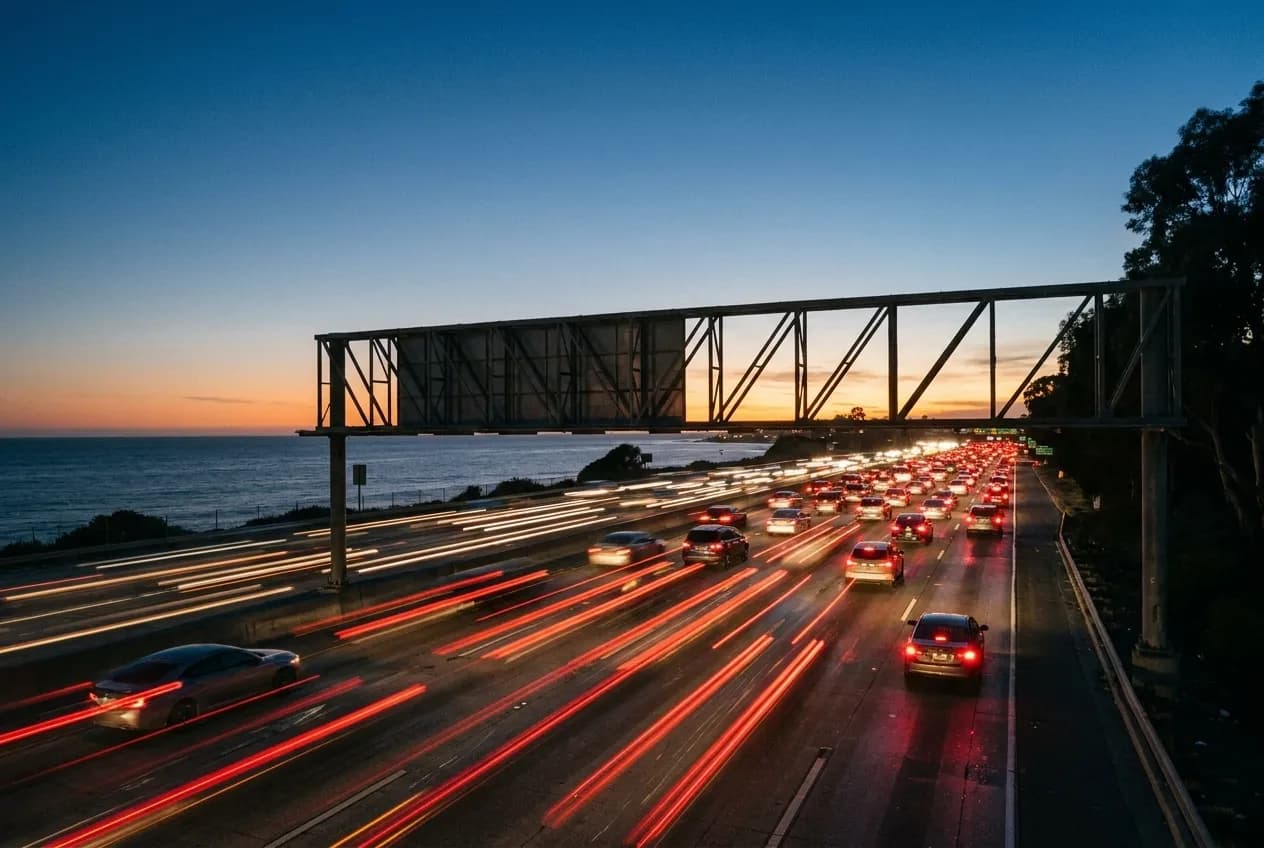
The worst traffic leaving the beach happens between four thirty and six thirty on weekends and between five and seven on weekday evenings in summer. The PCH southbound from Malibu to Santa Monica backs up during this window. The 405 southbound from the 10 is slow until eight. The 110 southbound from the 105 stays jammed until seven. If you are driving back to the Eastside, the Valley, or anywhere that requires the 10 or the 405, leaving at four or leaving at seven makes the difference between a twenty-minute drive and an hour-plus crawl.
The breakpoint is around six forty-five. If you leave the beach after seven, the drive is usually clear. If you leave between four and six, you are in it. The middle option is to stay through the worst of it and leave at eight, after the fire has burned down and the sky is fully dark. This works if you are at a beach with later lot hours and if you have brought enough to keep you occupied. Bringing food that does not require much setup—sandwiches, fruit, chips, something you can eat without needing a table or a grill—means you can stay through dinner and skip the drive-through stop that adds another fifteen minutes to the trip home.
The return trip is also the moment when you realize what you should have brought and did not. Wet towels, sandy shoes, and a cooler full of melted ice all go in the car with you. A plastic bin or a large trash bag for wet and sandy items keeps the mess contained. If you drove in someone else's car, bringing your own bag for your own wet things is the move.
The habit that makes this repeatable is checking the drive time before you pack up. The Karpo app will tell you how long the route is running right now, not what it is supposed to be. If the drive is forty minutes and you are not ready to leave, you wait another hour. If the drive is fifteen minutes and you are debating one more swim, you leave. The lot closing time and the sunset time are fixed, but the traffic window is the one that decides whether the evening ends well or badly.
Tags: #BeachNearMe #LosAngelesBeaches #LABeachGuide #DockweilerBeach #SantaMonicaBeach #VeniceBeach #MalibuBeaches #BeachFirePits #LASunset #WeekendPlans #LATraffic #SoCalBeaches #BeachEvening #PacificCoastHighway #LAWeekend
All trademarks are the property of their respective owners.
Ask Karpo first
Before you leave for the beach, open the Karpo app and ask which lots are open right now, when sunset is tonight, and whether the drive home is moving. Karpo will also tell you if the marine layer is sitting offshore and whether the fire rings at Dockweiler are still available.