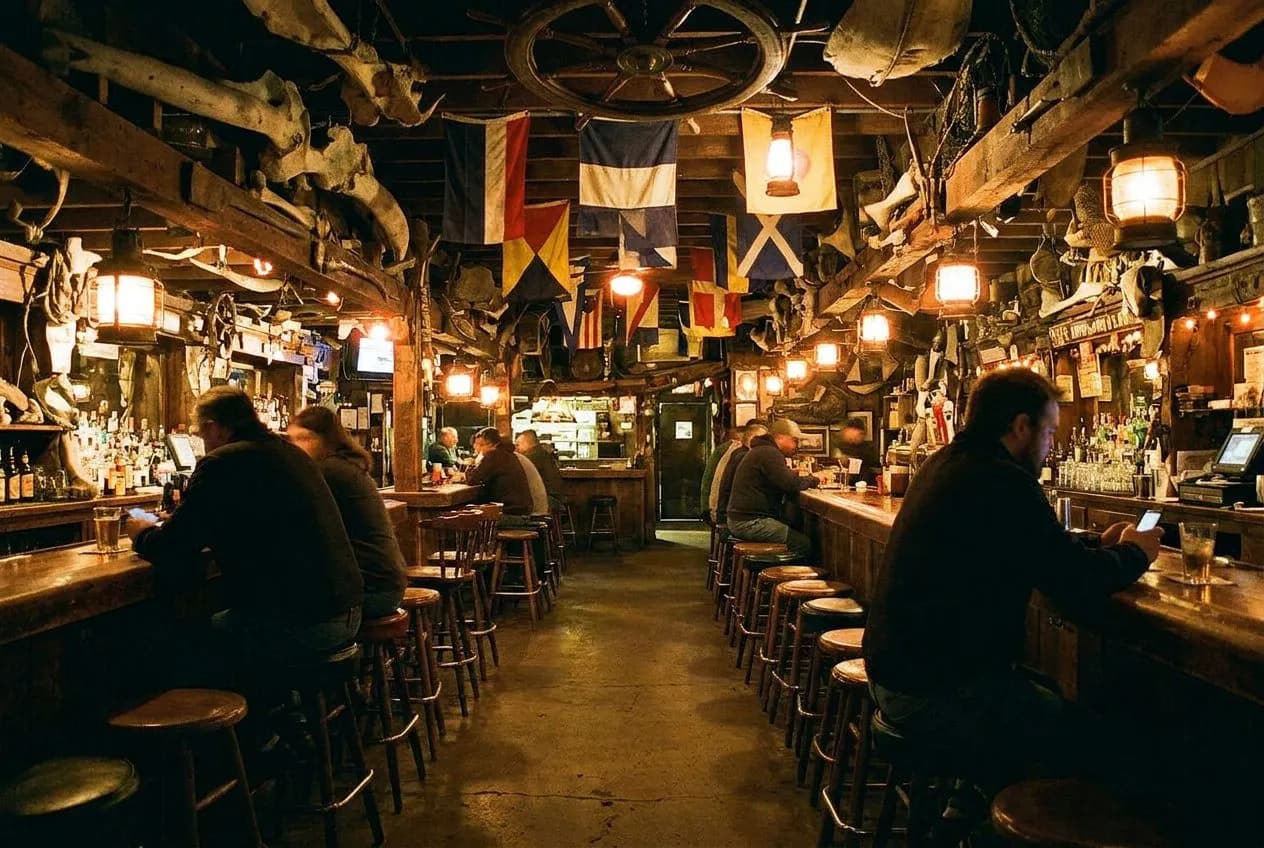
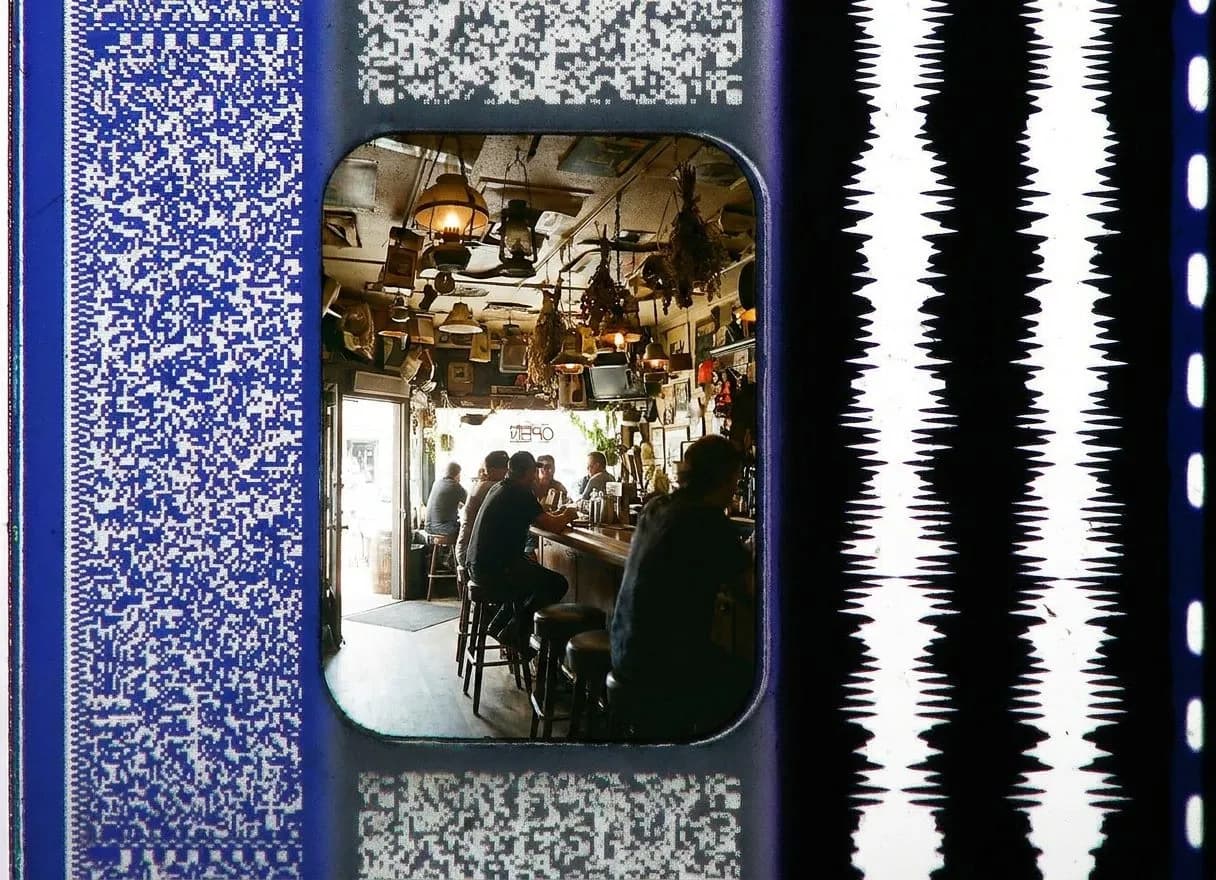
The bar stools at Specs' Twelve Adler Museum Café don't match because they were never meant to. One wobbles slightly on its chrome base. Another is upholstered in cracked red vinyl that might predate the Carter administration. A third sports a wooden seat worn smooth by decades of sailor elbows and poet knees. They line a dark wooden bar in a narrow North Beach room where the ceiling disappears into maritime salvage—whale vertebrae, ship wheels, faded naval flags, merchant marine photographs—and the only light comes from a few amber bulbs that make everything look like a daguerreotype. This is not a bar designed for summer travel influencers. This is a bar designed for people who know what a bosun's chair is.
The back corner seat and its sightline
The best vantage point is the back corner stool on the right side, which offers the widest sightline of the ceiling collection. Regulars understand this geography instinctively. If you walk in looking up—head tilted, eyes tracing the organized chaos above—they'll quietly yield that corner perch without ceremony or explanation. It's dive bar semiotics, a courtesy extended to first-time visitors who appear genuinely interested in studying the artifacts rather than Instagramming them.
From that corner seat, the entire cabinet of curiosities unfolds. Naval signal flags drape like bunting. A ship's wheel the size of a manhole cover hangs at an angle suggesting it was torn rather than removed. Photographs curl at their edges: merchant mariners squinting into Pacific sun, cargo ships listing in fog, dockworkers in Dungarees. The collection has its own internal logic, an archival system known only to the bar itself.
The whale vertebra and its provenance
Above the cash register hangs a whale vertebra the size of a dinner plate, bone gone yellow with age and bar smoke. It was reportedly salvaged from Angel Island in 1972, hauled across the bay by a sailor with enough affection for this place to donate a piece of cetacean spine. A faded index card is tucked behind the bone, visible if you lean forward on your stool and squint. The card includes the date and the initials of the sailor who brought it in, written in ballpoint that's faded to ghost ink.
The vertebra isn't alone. Specs' operates on a philosophy of accumulation: nothing leaves, everything gets pinned or hung or wedged into the remaining square inches of wall and ceiling. The effect is less curated museum than geological record, sedimentary layers of nautical detritus compressed by time and gravity and the occasional earthquake.
The Specs pour and its foam cap
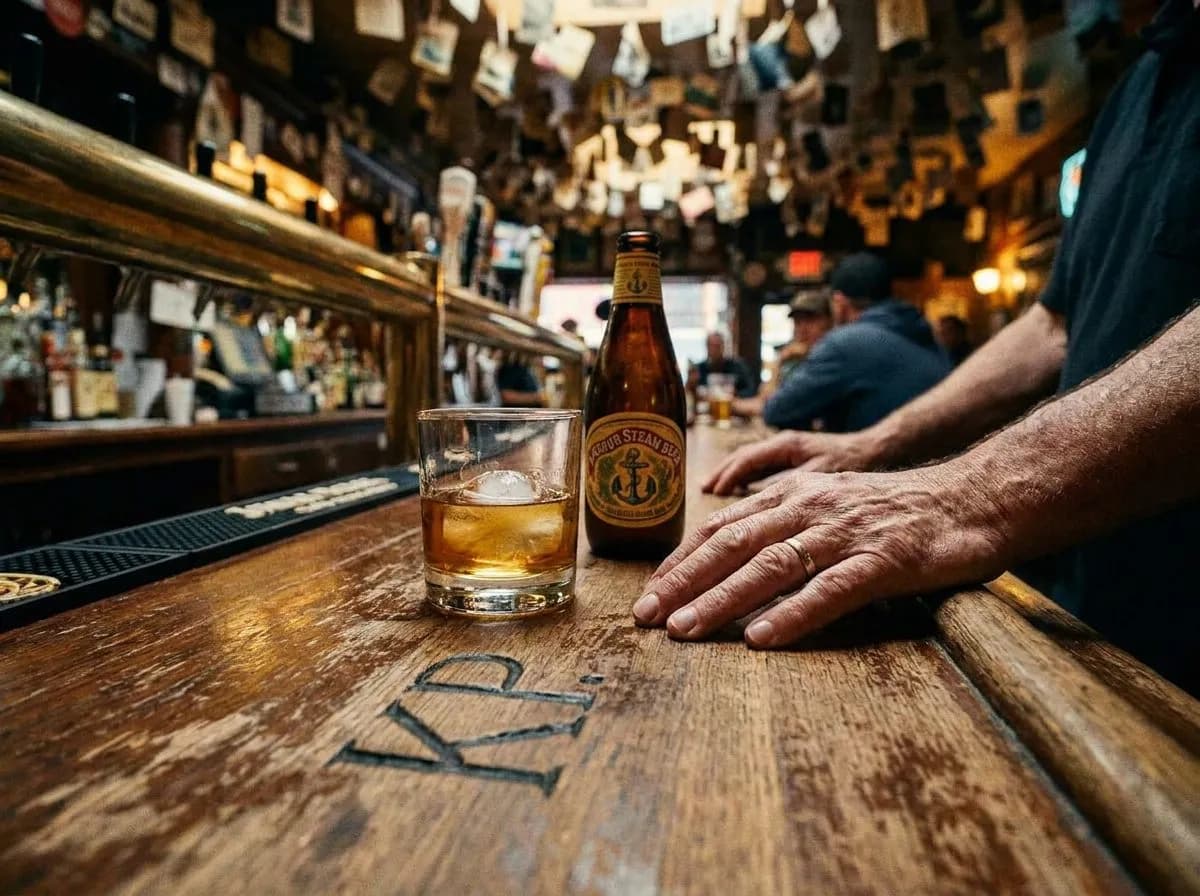
The bartender pours Anchor Steam directly from the bottle into a glass without tilting the glass, a technique unchanged since the bar's 1967 opening. The beer hits the bottom straight on, foam erupting in a specific cap that regulars call 'the Specs pour.' It's not elegant. It's not craft-beer ceremony. It's a pour that says the beer will taste the same whether you approve of the foam or not.
Well whiskey follows the same no-frills logic: a generous slug in a rocks glass, no muddled herbs or house-made bitters. The bar trades in reliability, not innovation. You order an Anchor Steam or a whiskey because those are the house standards, and because ordering a French 75 here would require explaining what a French 75 is, and nobody wants that conversation.
The cash-only etiquette and regular crowd
Specs' is cash only, a policy enforced not by signage but by the absence of a card reader and the bartender's patient, bemused expression when you ask. There's an ATM two blocks away. You'll figure it out. The regulars—merchant marines on shore leave, North Beach old-timers, writers nursing a single beer across two hours—carry folded bills and know the drill.
Dive bar etiquette here is unspoken but absolute. You don't touch the artifacts. You don't take flash photography. You don't conduct a loud phone call beneath the whale bones. The room enforces its own decorum through dim light and the collective attention of people who've been coming here longer than you've been alive. It's not unfriendly. It's simply that the bar has standards, and the standards predate Yelp.
The museum without a curator
Calling Specs' a museum feels too formal, but calling it just a bar undersells the archive. This is a cabinet of curiosities with a liquor license, a place where maritime history is stored not in climate-controlled vitrines but nailed to the ceiling above spilled beer and cigarette ash—back when cigarette ash was still legal. The collection has no wall text, no docent, no suggested donation. You learn by looking, by asking the person on the next stool, by returning often enough that the objects begin to tell their own stories.
By late 2026, the bar will have been accumulating this junk for nearly six decades. Whale bones. Ship wheels. Flags from merchant fleets that no longer exist. Photographs of men whose names nobody remembers but whose faces remain pinned to the wall, permanent as saints in a chapel. The chaos is the point. The clutter is the collection.
Why the mismatched stools matter
The bar stools don't match because Specs' has never cared about matching. Uniformity would betray the ethos. Each stool arrived on its own timeline, salvaged or donated or simply left behind, and each one stayed. They're as much part of the collection as the whale vertebra or the naval flags. You don't sit on museum-quality furniture. You sit on whatever holds your weight and offers a view of the ceiling, and you're grateful for both.
This is North Beach before venture capital, before the neighborhood became a backdrop for summer travel listicles about San Francisco authenticity. Specs' isn't authentic because it's trying. It's authentic because it never stopped being exactly what it was in 1968: a narrow room full of sailor junk, cheap beer, and bar stools that don't match. Pull up whichever one's free. Tilt your head back. The ceiling will still be there.
Practical notes
Specs' Twelve Adler Museum Café is located at 12 Adler Place, a narrow alley off Grant Avenue in North Beach. Nearest transit: the Powell-Mason cable car line or Muni bus lines along Columbus. Street parking is scarce; the Portsmouth Square garage is a short walk. Hours vary; verify directly before visiting. The bar is cash only. The narrow layout and single-step entry make wheelchair access difficult. Bring small bills, a appreciation for maritime ephemera, and no expectations of craft cocktails or natural light.
Tags: #PullUpAChair #SpecsTwelveAdler #NorthBeachSF #SFDiveBars #MaritimeHistory #CabinetOfCuriosities #AnchorSteam #SanFranciscoBars #SFNightlife #HiddenSF #SailorBar #VintageNorthBeach #SFBarStools #AuthenticSF #SFLocal
Please drink responsibly. Must be of legal drinking age.
Sources consulted: North Beach, San Francisco · Dive bar · San Francisco Travel - North Beach · SF Chronicle Bars & Drinking
All trademarks are the property of their respective owners.