A Bar That Got Its Name Before the Beats Got Theirs
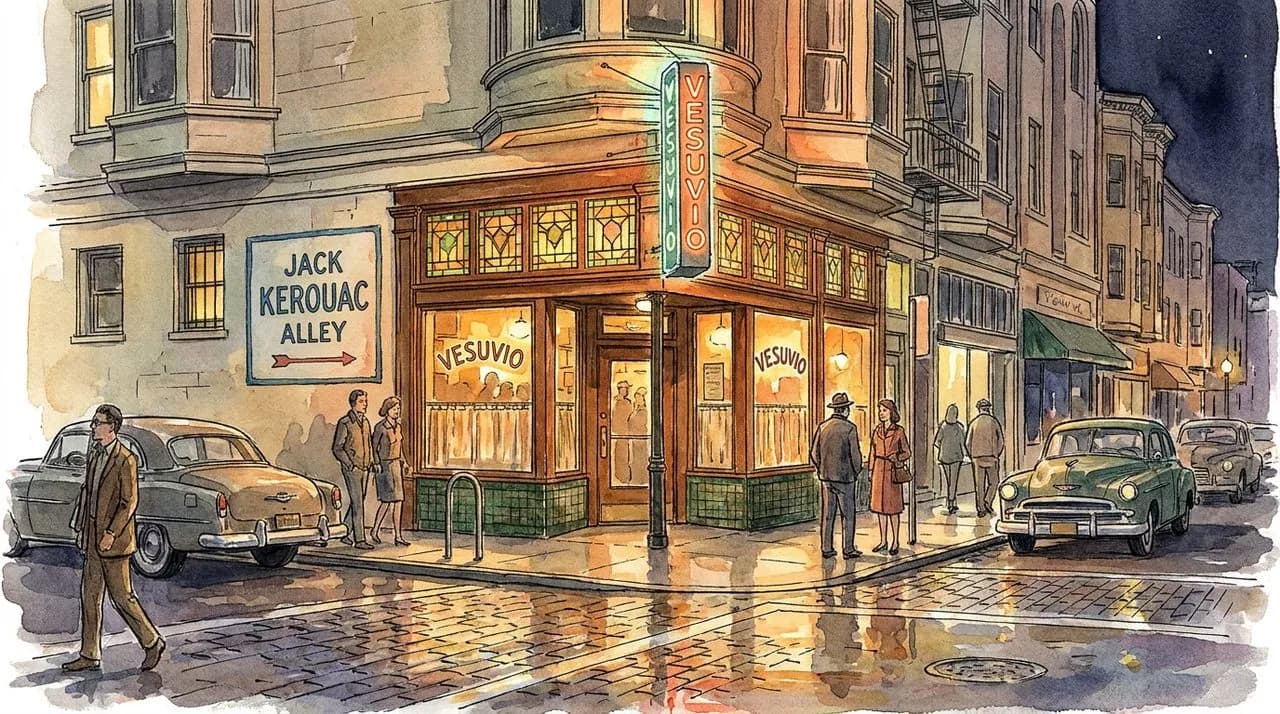
Vesuvio Cafe opened in 1948 at 255 Columbus Avenue, in the wedge-shaped Italian neighborhood at the foot of Telegraph Hill. The founder, Henri Lenoir, was a French-Swiss bohemian and art-lover who had spent the war years in the city and decided to open a bar where he could host the writers, painters, and "anybody odd, anybody interesting" he had been collecting friendships with.
The building was older than the bar. Designed in 1913 by the Italian architect Italo Zanolini and remodeled in 1918, it had been a series of saloons before Lenoir took it over. He hung framed paintings on every available wall, installed lamps from a theatrical supply company, and stocked the bar with the kind of broad list — wine, beer, simple cocktails — that did not require a tradition.
By the early 1950s, the bar had its first wave of regulars. Among them, by 1955, were Jack Kerouac, Allen Ginsberg, Neal Cassady, and Lawrence Ferlinghetti — the last of whom had just opened City Lights Bookstore across the alley. The Six Gallery reading where Ginsberg first performed "Howl" was held on October 7, 1955, and the after-party spilled into Vesuvio. The bar has been part of that lineage ever since.
What's Above the Bar
The second floor is the part most first-timers miss. A narrow staircase at the back of the ground floor leads up to a smaller room with a balcony that overhangs the bar below. The balcony is the best seat in the bar — five tables, low lighting, the same lamps Lenoir hung in the 1950s. The view down at the bar floor is the angle from which every Beat-era photograph of the room was taken.
The walls upstairs hold the bar's permanent collection of Beat-adjacent art: original posters from City Lights events, framed letters, a small painting by Lenoir himself, a hand-typed poem by Ferlinghetti on a bar napkin. None of it is roped off. You can stand close.
The ground floor is the working bar — long mahogany counter, a row of windows onto Columbus, the kind of mismatched seating that fills a bar slowly over seven decades. The Pacific paintings on the wall are by the late artist Jacopo Mezzini, hung by Lenoir himself.
The Drinks
The drink list is short. Beer on tap — Anchor Steam, Lagunitas, a rotating IPA — at around $7 a pint in 2026. House cocktails at $11 to $14. The signature is the Jack Kerouac — rum, tequila, orange juice, cranberry, lime — created in the 1990s by then-owner Janet Clyde, who was a Beat scholar and wrote the bar's commemorative pamphlet.
The wine list is unfussy California and Italian. The whiskey shelf is deeper than it looks — a couple of dozen bottles, mostly American, some Scottish. There is no craft cocktail program. There has never been one.
The bar food is olives, peanuts, and the occasional pretzel. People do not come to Vesuvio to eat. They come to drink slowly in a room that has been a room for seventy-seven years.
The Kerouac Alley
In 1988, the small alley between Vesuvio and City Lights — formerly Adler Alley, formerly nothing — was renamed Jack Kerouac Alley by the city. In 2007 the alley was repaved and embedded with quotation tiles: lines from Kerouac, Ferlinghetti, John Steinbeck, Maya Angelou, Confucius, Chinese poets translated by the Beats. The tiles are at foot level. Most people walk past them.
The alley is a one-block urban gesture and one of the only car-free stretches in North Beach. On a typical Friday night, the alley is lit by the bar's exterior lamps and a small string of City Lights's windows. Couples photograph each other on the cobblestones. Tourists holding paperbacks read the tiles.
The walk from Vesuvio's door to City Lights's door takes about twenty seconds. It is the shortest legitimate bar-to-bookstore commute in the western hemisphere.
What Time to Show Up
The bar opens at 11:00 a.m. and runs through to 1:00 a.m. Sunday through Thursday, 2:00 a.m. Friday and Saturday. The early hours are quiet — a handful of regulars, the older North Beach contingent, a writer or two with a laptop. The crowd builds slowly through the evening.
The best window for the upstairs balcony is between 7:00 and 9:00 p.m. The lighting is at its best, the noise is at the right level, and you can still find a table. After 10:00 the balcony fills up and the wait stretches.
After midnight, the bar is mostly local. Tourists tend to leave by 11:30. The post-midnight crowd is North Beach residents, City Lights staff, regulars from forty years ago and from last spring. The conversations get longer. The pace slows.
What to Pair It With
Dinner first at one of the older North Beach Italian places: Sotto Mare on Green Street, U.S. Restaurant on Columbus, Tony's on Stockton Street. All within a five-minute walk. After Vesuvio, a slice of cheesecake at Caffe Trieste two blocks south is the standard closer — Trieste was a Beat hangout too, and stays open later than most cafés.
For the alternative night, the route is reversed: opening espresso at Caffe Trieste in the late morning, lunch at U.S. Restaurant, an afternoon at City Lights, dinner at Sotto Mare, drinks at Vesuvio until close. A complete North Beach day for under $200, exclusive of dinner.
For the truncated version — one stop only — sit at the balcony, order one drink, read whatever paperback you have on you. Forty minutes. That is enough.
Why It Still Matters
The Beat Generation's actual San Francisco — the cheap rooming houses, the working-class Italian and Chinese restaurants, the bohemian apartment blocks of North Beach — is gone or mostly gone. The neighborhood today is half-tourist, half-residential, with rents that would have made Kerouac laugh.
Vesuvio is one of the few places where the actual building, the actual room, the actual lamps Lenoir hung are still in place. The bar is not a museum — it is a working bar. People go to drink, not to take pictures.
But the room has weight. The room is what it was. There are not many rooms left in San Francisco that can say that.
The Argument for One More Drink
City Lights closes at 10:00 p.m. on weeknights and 11:00 p.m. on weekends. Vesuvio runs three more hours. The argument for one more drink, after the bookstore has closed and the alley has gone quiet, is that there are perhaps a hundred bars in any major American city that can say what Vesuvio can say. Not many of them are still open at one in the morning.
This one is. The lamps will still be on. The Kerouac cocktail will still cost $13. The balcony table by the window, if it is open, will still be the best seat in the bar.
Practical notes
- Address: 255 Columbus Avenue, San Francisco, CA 94133.
- Getting there: Walk from Union Square (15 minutes) or BART Embarcadero (20 minutes). Cab is fine.
- Hours: 11 a.m. to 1 a.m. Sunday–Thursday, 11 a.m. to 2 a.m. Friday–Saturday.
- Drinks: $7 pints, $11–$14 cocktails. The Jack Kerouac is the house signature.
- Don't miss: The upstairs balcony, the Jack Kerouac Alley tile poems, the small painting by Lenoir.
- Pairs well with: Dinner at Sotto Mare or Tony's, an evening at City Lights, dessert at Caffe Trieste.
#vesuviocafe #northbeachsf #sanfranciscobars #beatgeneration #citylightsbookstore #sfnightlife #afterdark #jackkerouacalley #sfdrinks #karpofinds #sflocalknowledge #hiddensf #weekendsf #sanfranciscohistory #sfcafes
Sources consulted: Vesuvio Cafe · National Trust for Historic Preservation · FoundSF · The New York Times · Time Out San Francisco
All trademarks are the property of their respective owners.