The Green and Gold Renaissance
Australia entered the 2026 World Cup ranked 27th in the world and with minimal expectations. The Socceroos' qualification had been achieved through the intercontinental playoff — the hardest route to the World Cup — and their squad contained just five players based in Europe's top five leagues. Pre-tournament predictions from ESPN, The Guardian, and FiveThirtyEight gave Australia less than a 15 percent chance of advancing from a group that included France and Denmark. Three matches later, Australia had proved every prediction wrong.
Following the Socceroos' run? Text Karpo for Australia's journey, player highlights, and what their World Cup means for Asian football.
The Group Stage Campaign
Australia's group-stage campaign was built on tactical discipline and clinical finishing. A 1-0 victory over Denmark — secured by Jackson Irvine's 78th-minute header — provided the platform. A 0-3 defeat to France was expected and accepted. The decisive match — a 2-1 victory over Saudi Arabia — was the Socceroos' most complete performance, with goals from Jamie Maclaren and Craig Goodwin securing second place in the group. Australia finished on 6 points, level with France but behind on goal difference, and ahead of Denmark and Saudi Arabia. The result was described by Football Australia CEO James Johnson as "the greatest achievement in Australian football since the 2006 World Cup."
The A-League Core
The most remarkable aspect of Australia's World Cup squad is its reliance on A-League talent. Fifteen of the 26 players are contracted to A-League clubs, a proportion that is significantly higher than any other team at the tournament. The A-League's growing quality — driven by increased investment, improved coaching, and better youth development — has produced a generation of players who can compete at World Cup level without needing European experience. Jamie Maclaren (Melbourne City), Craig Goodwin (Adelaide United), and Nathaniel Atkinson (Heart of Midlothian) were among the squad's standout performers, demonstrating that the A-League is no longer a retirement league but a genuine development pathway.
Coach Tony Popovic's Defensive System
Tony Popovic's tactical approach — a 3-5-2 formation that prioritized defensive structure and counter-attacking speed — was perfectly calibrated for a squad that lacks the individual quality to dominate possession against elite opponents. The system required all 10 outfield players to contribute defensively, with the three center-backs (Harry Souttar, Kye Rowles, Trent Sainsbury) forming a physical wall that opponents struggled to penetrate. Australia conceded just four goals in three group-stage matches — the same number as Germany — and created more counter-attacking chances per match (4.2) than any team in their group.

The Fan Experience in America
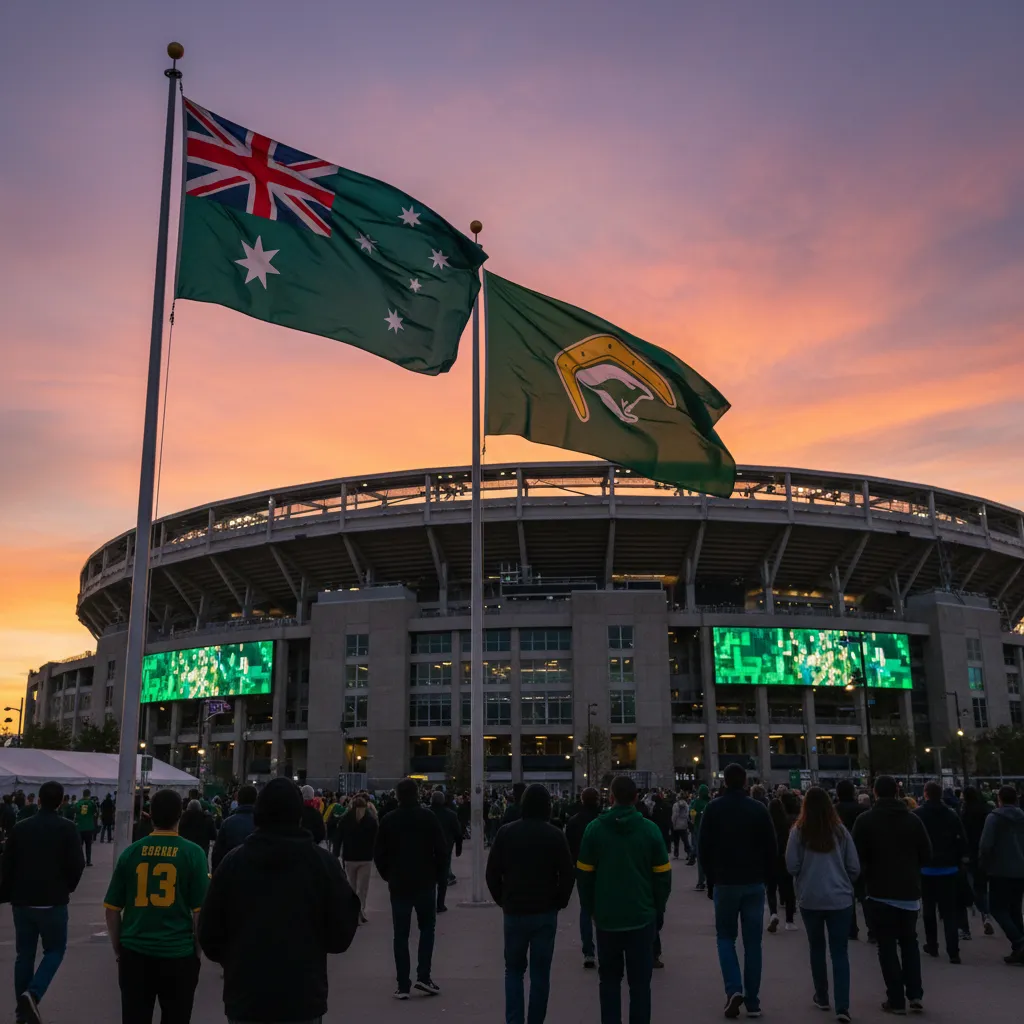
An estimated 25,000 Australian fans traveled to the United States for the World Cup, creating one of the tournament's most enthusiastic and visible fan communities. The "Green and Gold Army" established unofficial headquarters in bars and restaurants near each venue, where pre-match gatherings featured Australian-themed entertainment including meat pie eating contests, Vegemite taste tests for non-Australian fans, and communal viewings of NRL (rugby league) matches on secondary screens. The cultural exchange between Australian fans and their American hosts produced some of the tournament's most heartwarming social media content.
The Round of 32 Exit
Australia's Round of 32 match against Belgium — a 3-0 defeat at MetLife Stadium — was a step too far for a squad that had overperformed expectations across three group-stage matches. Belgium's quality in the attacking third, led by Kevin De Bruyne and Romelu Lukaku, exposed the limitations of Popovic's defensive system when faced with opponents who can play through rather than around a low block. The Socceroos' players received a standing ovation from both Australian and Belgian supporters at the final whistle — recognition that their World Cup campaign, while brief, had been conducted with maximum effort and minimum cynicism.
Legacy: The Next Generation
Australia's 2026 World Cup campaign has generated a surge of interest in football across the country. Football Australia reported a 45 percent increase in youth registration inquiries during the tournament's first two weeks, the highest spike since the 2006 World Cup campaign led by Tim Cahill, Harry Kewell, and Mark Viduka. The timing is significant: Australia will co-host the 2029 Club World Cup and has expressed interest in bidding for the 2034 World Cup. The Socceroos' performance at the 2026 tournament — competitive, spirited, and underpinned by A-League talent — provides the foundation for a football culture that is finally competing with rugby league and Australian rules football for the nation's sporting attention.
Tags: Australia, Socceroos, World Cup 2026, Round of 32, A-League, Popovic, surprise run, Green and Gold Army, group stage, Danish
Sources consulted: ESPN · The Guardian · Football Australia · BBC Sport
All trademarks, team names, league names, and player likenesses mentioned in this article are the property of their respective owners and are used here for informational and editorial purposes only.
Ask Karpo First
Following the Socceroos' journey? Ask Karpo for Australia's complete World Cup 2026 results, the best A-League players at the tournament, and how Australian football development compares to other emerging football nations.