 Haaland Has Seven Goals and Norway Runs Entirely Through Him
⚽️2026 FIFA WORLD CUP

Argentina’s Low Block Nearly Forced a World Cup Shootout
Spain's late goal ended Argentina's defensive masterclass at MetLife Stadium. Emiliano Martínez's 12 saves highlighted both the promise and peril of retreating for an entire match.
Argentina's commitment to defending deep nearly secured a penalty shootout at MetLife Stadium in East Rutherford, but Ferran Torres's 106th-minute strike broke the deadlock in a final that remained scoreless through 90 minutes. Emiliano Martínez produced 12 saves as Argentina absorbed relentless pressure, demonstrating both the resilience and vulnerability inherent in parking the bus against elite opposition. The approach came within 14 minutes of forcing spot kicks before Spain's persistence finally paid dividends in extra time.
Text Karpo to explore tactical breakdowns of Argentina's defensive system and discover how low-block strategies succeed or fail at the highest level of international competition.
The Architecture of a Low Block
A low block compresses defensive space by positioning most outfield players behind the ball and close to their own penalty area. This forces attacking teams to probe patiently rather than exploit space in behind, neutralizing pace advantages and requiring intricate passing combinations to create chances. Argentina's implementation kept Spain outside dangerous areas for extended periods, funneling attempts toward areas where Martínez could make saves or defenders could block shots.
The tactical logic rewards discipline and concentration, transforming individual defenders into components of a collective shield. By surrendering territory, the defending team gains numerical superiority in the final third, making penetration exponentially more difficult. Argentina's willingness to cede possession and field position reflected confidence in their organizational structure and goalkeeper, betting that Spain would run out of ideas before they ran out of energy.
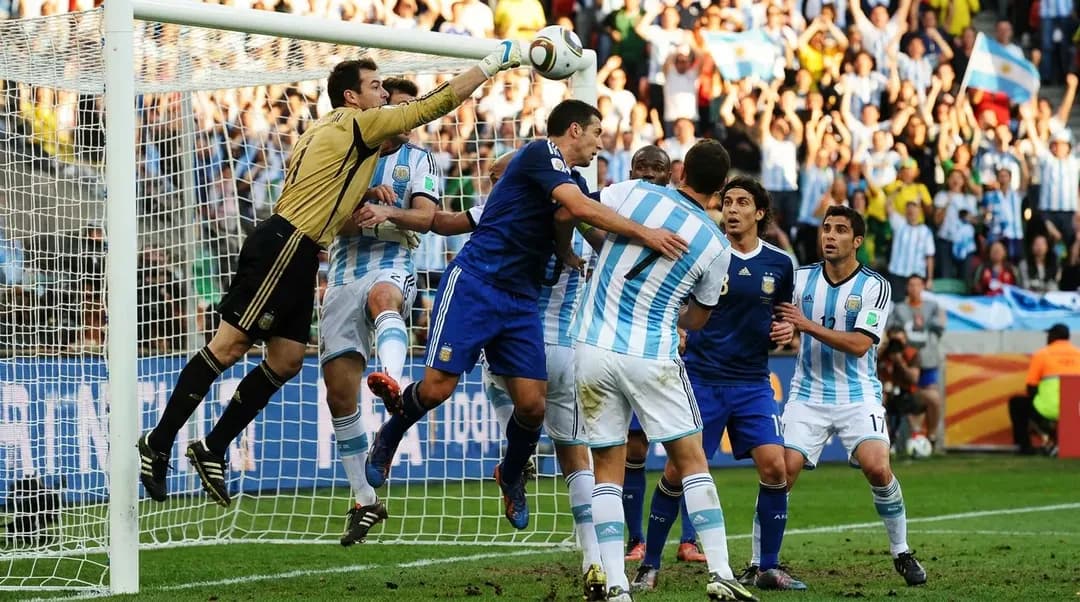
Martínez's Workload and Heroics
Twelve saves represents an exceptional individual performance that kept Argentina competitive throughout regulation and into extra time. Martínez faced a constant barrage, required to read trajectories, command his area, and make reflex stops while his defenders worked to minimize clean looks at goal. Each save reinforced the tactical plan, giving teammates renewed belief that the strategy could deliver a shootout where Argentina's goalkeeper has historically excelled.
Yet the volume of saves also reveals the trade-off embedded in deep defending: sustainable only when goalkeeping reaches elite levels. A single lapse in concentration or a deflection beating the keeper unravels hours of collective effort. Martínez's performance delayed the inevitable questions about whether Argentina could have controlled more possession or pressed higher, but it couldn't ultimately prevent Spain from finding the breakthrough that his teammates couldn't manufacture at the other end.
The Scoreless 90 Minutes
Reaching the end of regulation at 0-0 represented a tactical victory for Argentina's defensive approach, demonstrating that elite attackers can be frustrated through collective organization. The absence of goals through the opening 90 minutes validated the risk calculus, proving that Spain's technical superiority didn't automatically translate into finishing efficiency when faced with massed ranks of defenders. Argentina survived the regulation period exactly as planned, forcing the match into a phase where one mistake or moment of brilliance would decide the outcome.
However, a scoreless draw also meant Argentina had generated no attacking threat of their own, creating no margin for error once extra time began. The defensive shell protected the goal but offered no pathway to winning within the run of play. This passivity placed all pressure on maintaining perfection for another 30 minutes, a sustainable proposition only if Spain's fatigue matched Argentina's or if spot kicks arrived before defensive concentration wavered.

The 106th-Minute Collapse
Ferran Torres's goal in the 106th minute exposed the fragility lurking within every low-block strategy: defenders cannot maintain peak concentration indefinitely, and attackers need only one successful sequence to render hours of resistance meaningless. The timing, deep into extra time when legs grow heavy and focus drifts, illustrated how defensive approaches become increasingly precarious as matches extend. Spain's breakthrough came not from tactical inadequacy but from the inevitable erosion that accompanies defending under constant pressure.
The goal's proximity to a potential shootout makes the moment particularly cruel from Argentina's perspective. Having successfully defended for more than 105 minutes and positioned themselves within touching distance of penalties, the defensive structure finally cracked when the finish line appeared closest. This underscores the binary nature of defensive football: perfection earns nothing more than survival, while a single mistake eliminates all accumulated progress.
When Deep Defending Works
Low blocks succeed when they combine organizational discipline with clinical finishing on rare attacking opportunities, turning opponent possession into a trap rather than an advantage. Teams employing this strategy effectively must score from limited chances, whether through set pieces, counterattacks, or individual brilliance. Argentina's inability to find even a single goal meant their defensive excellence existed without offensive complement, creating a scenario where Spain could probe indefinitely without existential risk.
The approach also thrives when it forces opponents into frustration and rushed decisions, generating turnovers in dangerous areas or drawing fouls that disrupt rhythm. Argentina successfully frustrated Spain for extended periods, but couldn't convert that frustration into tangible attacking moments that would make Spain defend with the same desperation. Without that balance, the low block becomes a delaying tactic rather than a winning formula, sustainable only until the opposition's quality eventually tells.
The Limits of Organized Resistance
Argentina's experience demonstrates that even world-class defensive execution cannot indefinitely withstand sustained pressure from elite attackers. The low block bought time and created the possibility of an upset, but required perfection across more than 100 minutes against opponents who needed only one moment of inspiration or fortune. As extra time progressed, the mathematical probabilities shifted decisively against the defending team, with each additional minute creating fresh opportunities for breakdown.
The strategic choice reflects a calculated gamble about relative strengths: Argentina believed their defensive organization and goalkeeper gave them better odds than competing for midfield control or engaging in open exchanges. The narrow margin separating success from failure—14 minutes from a shootout where anything could happen—suggests the calculation wasn't obviously wrong, even if the outcome proved disappointing. Deep defending remains a viable strategy for particular matchups and tournament contexts, but this final illustrated its ultimate vulnerability when not paired with offensive solutions.
Tags: #ArgentinaFootball #TacticalAnalysis #LowBlock #EmilianoMartinez #WorldCupFinal #DefensiveStrategy #SpainArgentina #MetLifeStadium #FootballTactics
All trademarks are the property of their respective owners.
Ask Karpo First
Understanding when to employ a low block and when to seek greater possession requires analyzing opponent strengths, tournament context, and squad capabilities. Karpo helps you explore the tactical decisions that separate defensive resilience from mere survival, examining how teams balance risk and reward across different competitive scenarios.
Ask Karpo for more information.
Keep reading
- Haaland Has Seven Goals and Norway Runs Entirely Through Him
 World Cup Trophy Ceremony Timing Medals and Postmatch Celebrations
 Olise and France's Attack: The Semifinal Tactical Question