Culture / Venue
Every Seat Starts Under The Towers
Queens Theatre is not a black box dropped into a park. It is a working room inside a World’s Fair afterlife, and the approach is part of the ticket.
 Jonah Brooks
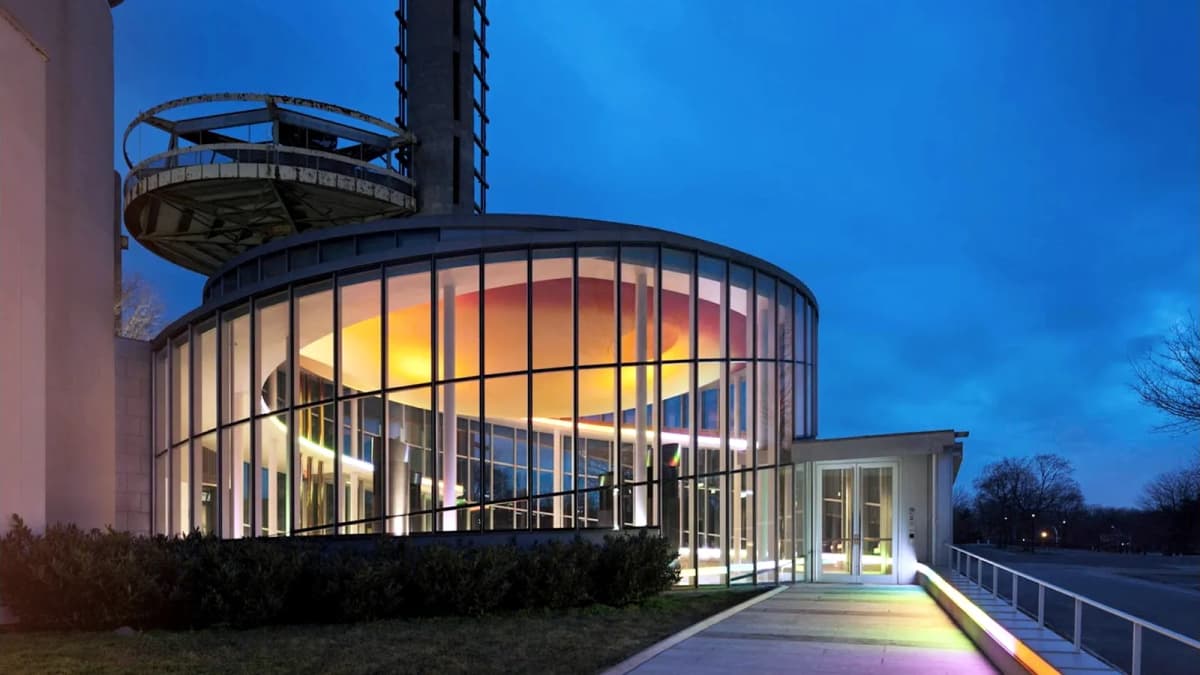
Queens Theatre glows beneath the Pavilion towers before the room starts asking for tickets.
The first review happens before you sit down.
You come off the 7 at Mets-Willets Point, cross the park infrastructure, pass the Unisphere, and keep walking toward the towers. The building does not arrive as a marquee. It arrives as a glass curve under concrete disks, with the old New York State Pavilion standing above it like a future that never learned how to leave.
That is the useful way to read Queens Theatre. Not as a smaller Broadway substitute. Not as a cultural errand you do because the borough deserves support. Read it as a room with an approach, a lobby with a memory, and a stage that asks you to give the park twenty honest minutes before curtain.
If you want a chandelier lobby, dinner reservation, and taxi line, this is not your cleanest plan. If you want a theatre night where the building explains itself before the show begins, Queens Theatre has a better argument.
The Room Is Not The Landmark. The Landmark Is The Pressure.
Queens Theatre sits at 14 United Nations Avenue South in Flushing Meadows Corona Park, directly under the observation towers of the New York State Pavilion. That sounds like a location note. It is actually the whole condition of the room.
The Pavilion began as New York State’s contribution to the 1964-65 World’s Fair. Philip Johnson’s complex had three main parts: the open-air Tent of Tomorrow, the three Astro-View observation towers, and the cylindrical Theaterama. The Theaterama was the enclosed piece, built for a 360-degree image experience and wrapped in the fair’s taste for spectacle, pop art, and space-age optimism.
That enclosed piece is the ancestor Queens Theatre lives inside.
The old fairground makes the theatre better when the theatre stops pretending to be neutral. The towers are not scenery. They change the walk, the photos people take before going in, the scale of the lobby, and the way a simple performance night feels attached to civic residue. You are not entering from a restaurant row. You are entering from a park that has hosted two World’s Fairs, baseball crowds, tennis crowds, museum visitors, zoo visitors, and people who came only to sit by the Unisphere.
That mix keeps the room from becoming precious.
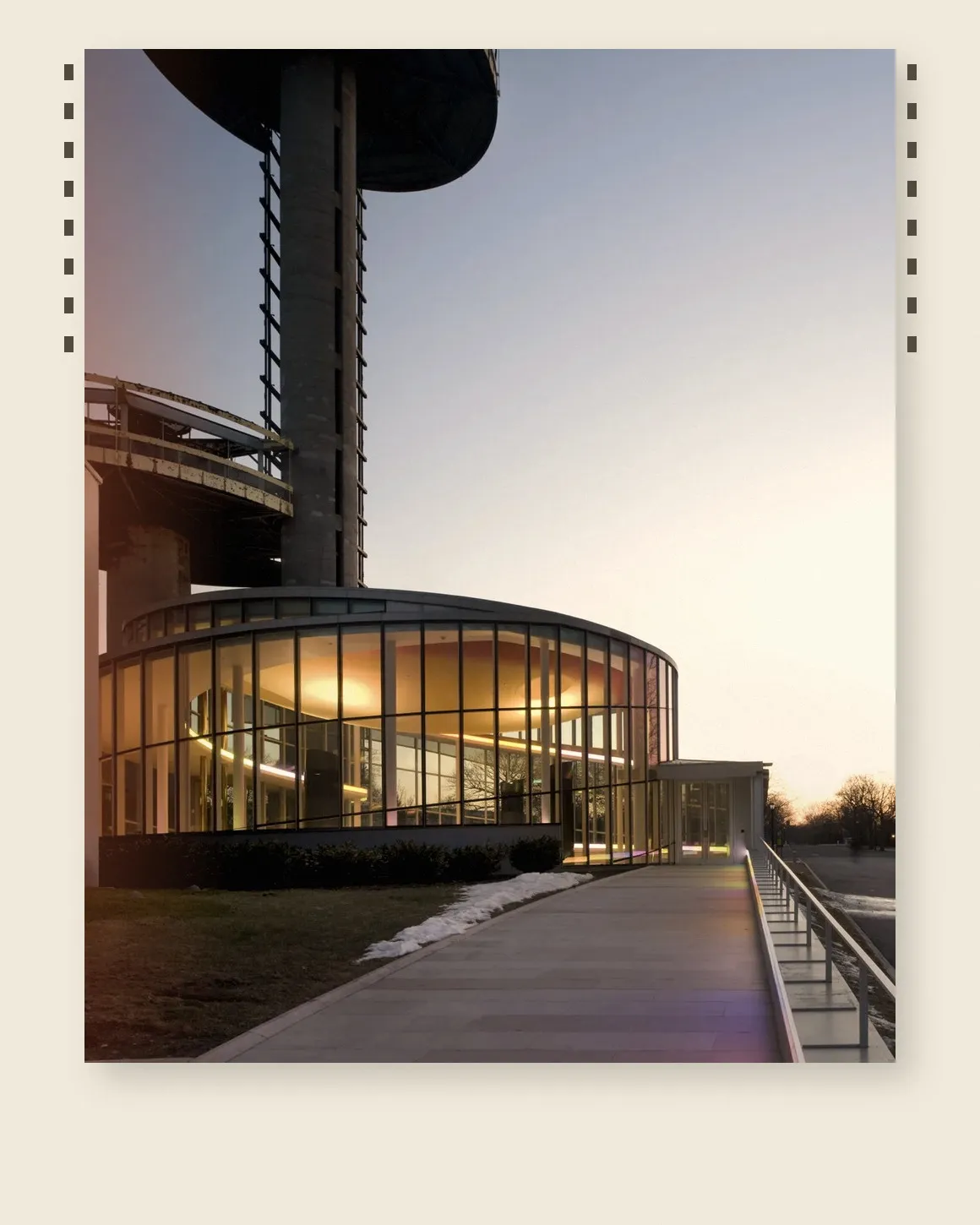
The approach keeps the old structures in view before the entrance fully resolves.
The Approach Is A Built-In Filter
The closest subway stop is Mets-Willets Point on the 7. The walk through Flushing Meadows Corona Park runs about 15 to 20 minutes. That number matters. It is not a footnote for people who enjoy logistics. It is the difference between arriving as an audience member and arriving as an apology.
The 7 also likes to remind New Yorkers that weekends and nights are not guaranteed by sentiment. Service changes are common enough that the venue sends you to the MTA planned-work page before you travel. Good. A theatre that requires a park walk should not lie about the train.
There is a free shuttle between the Mets-Willets Point 7 station and the theatre, beginning one hour before curtain for Queens Theatre Presents shows. Do not turn that into a universal promise. Visiting Presenter performances do not get the shuttle unless the event page says so. The LIRR Port Washington Line can also bring you to Mets-Willets Point from Penn Station, Grand Central, or Woodside, but that station is separate from the subway station, the shuttle is not accessible from the LIRR side, and the walk is listed at 10 to 15 minutes.
The best arrival window is boring and correct: get there early enough that the park is not stealing your first act.
If you are meeting someone, make the Unisphere the emotional checkpoint and the box office the practical one. The route sends you down from the station, across the boardwalk, past Dinkins Circle, along the Tennis Center, around the Unisphere, and toward the towers. The final entrance is the box office entrance under the scaffold. That is more instruction than most theatres need. It is also why this place rewards people who like a plan.
The worst position at Queens Theatre is not a bad chair. It is being outside, twenty minutes from curtain, still treating the park like a lobby.
The Glass Lobby Does The Translation
The early-2010s Caples Jefferson addition is the part that makes the old fairground usable without embalming it. The project added a large glass reception room around the circular theatre volume, reusing existing space and materials where it could. It did not try to out-weird the Pavilion. It borrowed the old language of circles, columns, ramps, and tensile forms, then turned it into a moving path for present-day audiences.
That is why the lobby matters.
The Rotunda Lobby gives you park views instead of a sealed pre-show chamber. In a Manhattan theatre, the lobby often compresses: line, bar, restroom, stairs, seat. Here the glass slows the room down. You can see the weather. You can see people arriving late from the park. You can understand why the building is round before someone says anything about architecture.
The room is most honest in the hour before curtain, when the shuttle window has started, the lobby has not yet hardened into a crowd, and the towers still feel like part of the event instead of a photo you forgot to take.
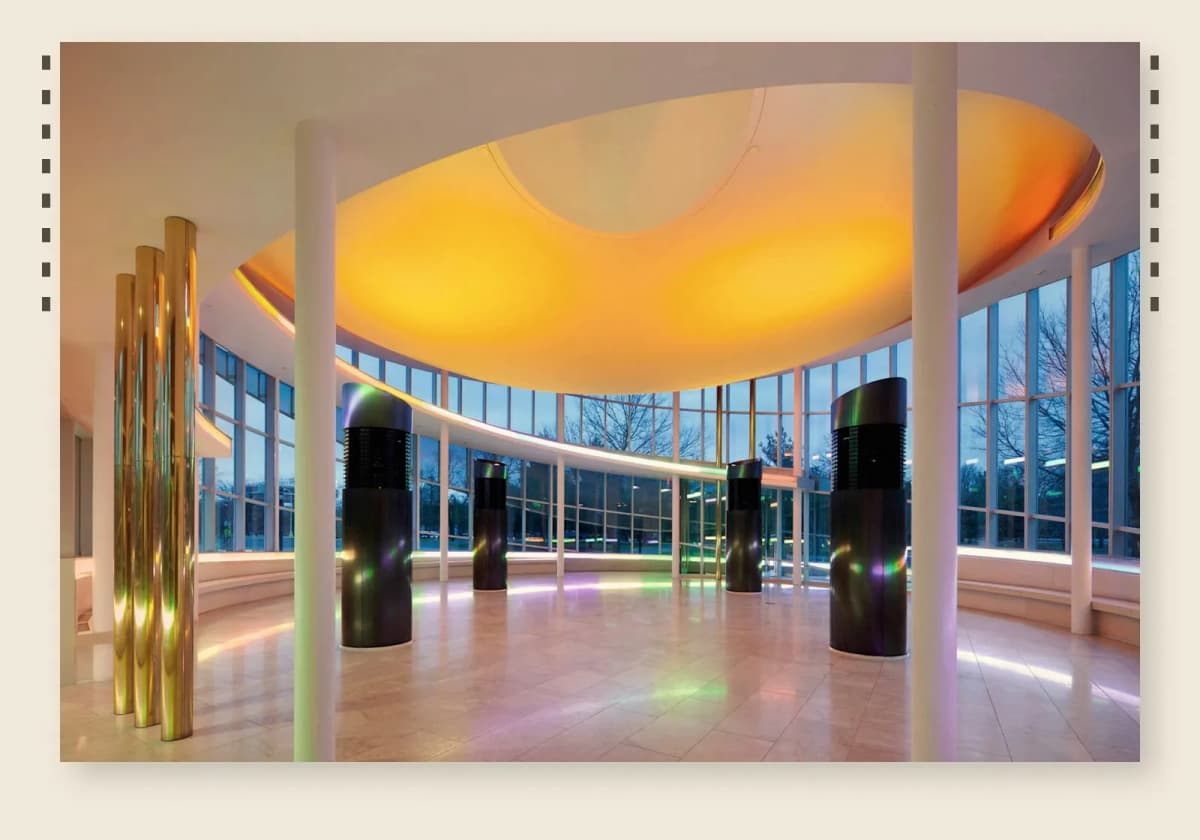
The Rotunda Lobby is the translator between park, fairground, and stage.
What The Theatre Actually Holds
Queens Theatre presents more than 200 performances a year, across theatre, dance, concerts, family programming, cultural work, and visiting presenters. The useful number is not the annual count. The useful numbers are the rooms: a 472-seat Mainstage, a 90-seat Studio Theatre, and a 70-seat Cabaret.
That range changes how you should choose the night.
The Mainstage can carry a proper audience without turning the event into a stadium. The Studio and Cabaret are small enough that late arrival, seat choice, and room behavior become visible. In a 70-seat space, you do not disappear. That can be generous if you came for proximity. It can be punishing if you came to hide.
Best bet on the Mainstage: choose the center third and sit a few rows back from the front lip, especially if the staging is visual or dance-heavy. You want the stage picture, not just the first row’s knees. In the Studio or Cabaret, pick the seat that lets you see both the playing area and the room’s main movement path. The best small-room seat is rarely the one closest to the performer. It is the one that keeps you inside the room without making you the room’s obstacle.
Worst bet: an edge seat chosen in panic after a tight train transfer. At Queens Theatre, lateness has already cost you the walk. Do not let it choose your sightline too.
Assistive listening and wheelchair access are part of the venue’s baseline, which should be treated as planning information, not a nice afterthought. If access needs shape your night, confirm the exact performance setup before you go; room size and presenter type can change the experience more than the building name does.
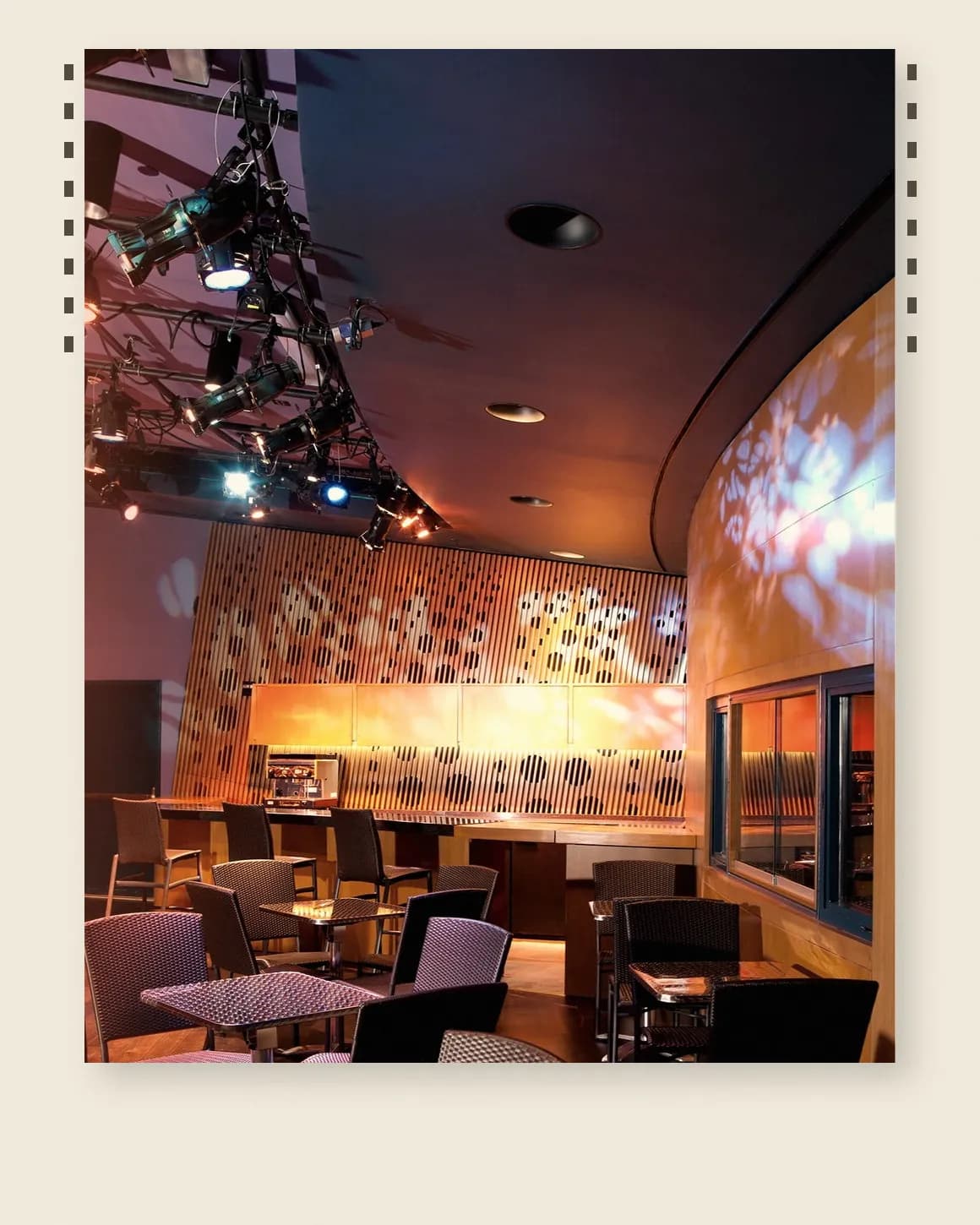
Small rooms make seat choice and late arrival visible.
The Pavilion Keeps The Night From Becoming Generic
There is a reason this venue is stronger when the Pavilion stays in the frame.
A normal theatre listing can tell you what is onstage, when doors open, and what the ticket costs. Queens Theatre needs one more layer: what this corner of the park does to your attention. The New York State Pavilion was built as a fairground statement about future, scale, optimism, and state pride. Decades later, the towers remain above the theatre, no longer functioning as fair attractions, still too large to become background.
That friction is the point.
Theatre usually asks the outside world to turn off. Queens Theatre cannot fully do that. The outside world is made of concrete towers, old fair maps, tennis crowds, baseball traffic, park paths, and people who wandered over from another agenda. The room has to negotiate with all of it.
For some nights, that may be too much. A delicate show can feel oddly small under the Pavilion’s leftover ambition. A visiting presenter can inherit a building whose logistics are more specific than the event itself. A family matinee may work beautifully because the park turns waiting into motion. A dance program may benefit from the rotunda, where bodies in a circular lobby already prepare you to read movement.
This is the part a listing cannot solve for you. The room is not neutral. Choose the kind of performance that can survive a strong room.
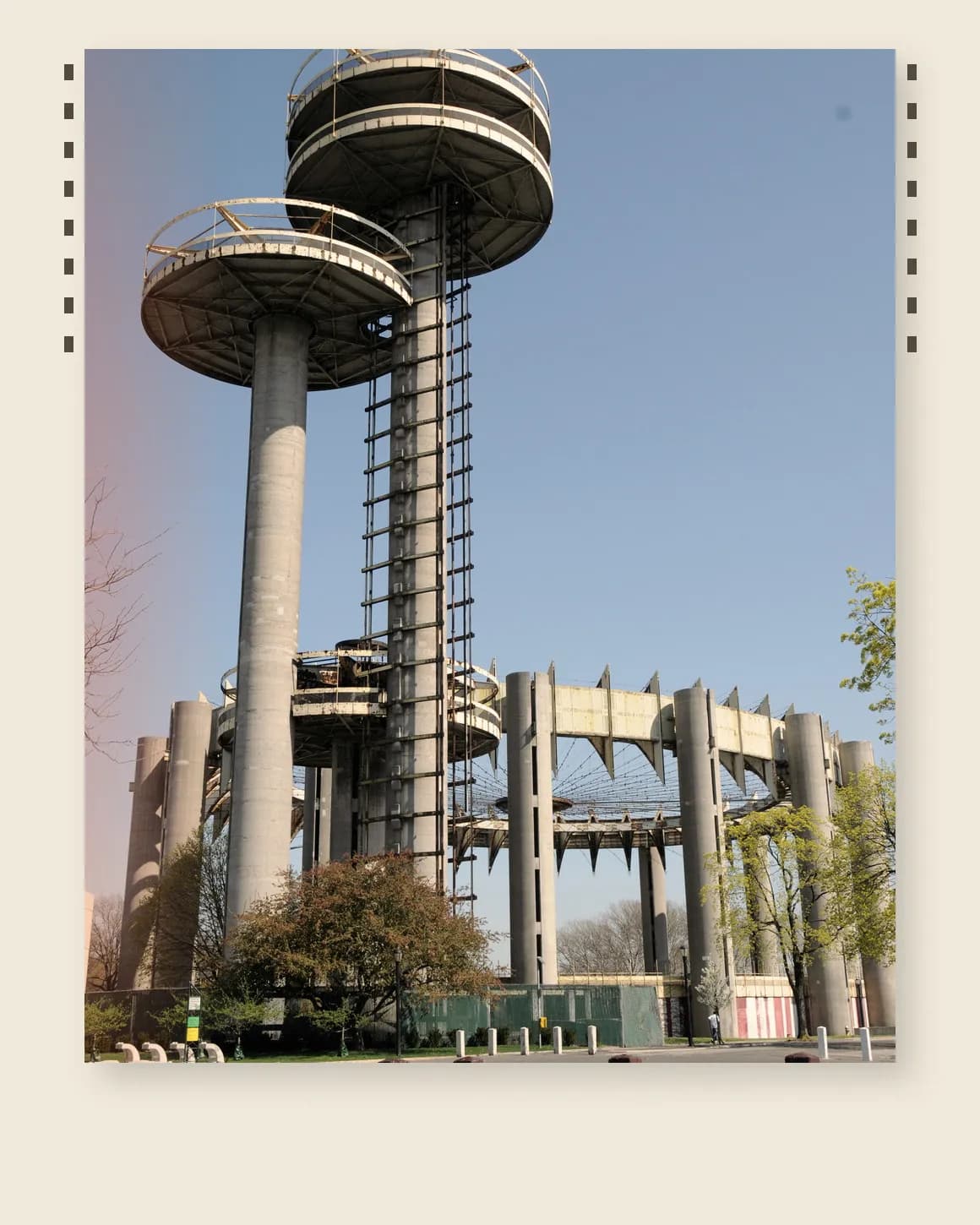
The State Pavilion is not background. It is the pressure above the night.
Who This Room Treats Well
Queens Theatre is kind to people who arrive early, like a walk with a reason, and do not need their culture wrapped in Midtown efficiency. It is good for architecture people who still buy tickets, Queens loyalists who are tired of leaving the borough for every serious night out, families who can turn the park into pre-show oxygen, and solo visitors who would rather enter through landscape than a narrow lobby line.
It is less kind to anyone trying to stack a tight dinner, a late train, and a hard curtain. It is not ideal for people who want the theatre to erase the trip. The trip is part of the theatre here.
Box office hours: Tuesday to Friday, noon to 6pm, and two hours before most ticketed events. That is a practical sentence with a Jonah ending: if you need a human being, do not invent one at 9pm because your phone screen failed.
The clean plan is simple. Check the event page for presenter type and shuttle status. Check the 7 train. Leave enough time for the park. Use the Unisphere as your mental halfway mark. Choose a seat like the room matters. Then let the towers do what they do best: make a small night feel attached to a larger city memory without asking you to applaud the architecture.
Queens Theatre works because it does not fully escape the fairground. It performs inside it.
2 places