Sport / Collection
Full Throttle, No Planes: Riding the Ghost Runways of Floyd Bennett Field
New York's first municipal airport went quiet decades ago. What it left behind is the closest thing Brooklyn has to open wilderness — a mile of empty concrete, a model-plane squadron, a campground named after record-setters, and wind that does not care about your schedule.
 Matthew Crane
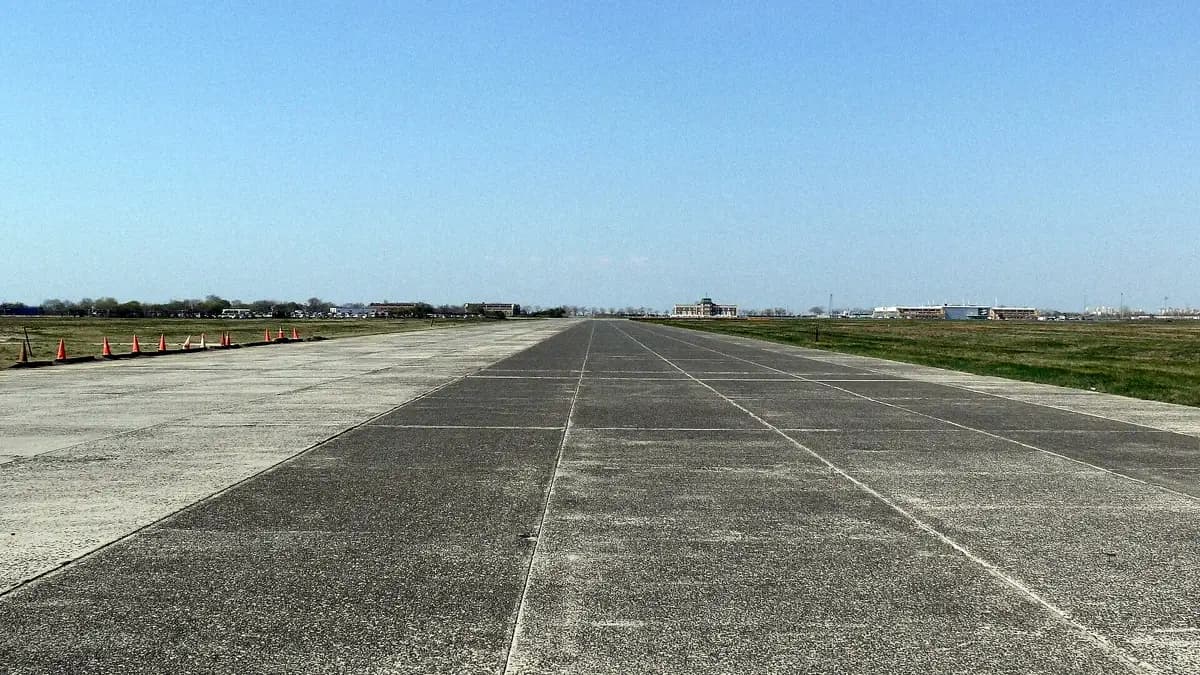
Picture this. You're standing on the centerline of a runway. Concrete slabs run out ahead of you until they blur into heat shimmer. Grass hisses on both sides. Somewhere behind you, a grown man is flying a model P-51 in slow, showy circles. There is no fence, no terminal announcement, no plane.
You are still inside New York City.
I keep a short list of places where the city forgets to act like a city. Floyd Bennett Field, hanging off the bottom of Brooklyn where Flatbush Avenue finally gives up and runs into Jamaica Bay, sits at the top of that list. It is a dead airport that refuses to be sad about it. And the best way to take it in — the only way that really makes sense — is on a bike, riding runways that once launched the most famous pilots on Earth.
How I Ended Up on a Runway With No Plane
Blame a headwind. A few summers back I was grinding down Flatbush Avenue toward the Rockaways, already regretting my life choices, when I saw a brown national park sign where no national park had any business being. I turned in to look. I didn't make the beach that day.
What I found was more than 1,300 acres of grassland, salt marsh, cracked taxiways, and hangars in every state of dignity — all of it managed by the National Park Service as part of Gateway National Recreation Area. Open 6 am to 9 pm daily. No entrance fee. Twenty-odd minutes from the end of the 2 train, and most New Yorkers I know have never set a wheel in it.
Getting there is refreshingly simple for somewhere that feels this remote. Ride the 2 or 5 to Flatbush Av–Brooklyn College and catch the Q35 bus toward the Rockaways; it stops by the park's main entrance. On a bike, just follow Flatbush Avenue south until the buildings quit. Drivers take the Belt Parkway to Exit 11S. However you arrive, the transition is the same: city, city, city — then sky.
A Garbage Island That Learned to Fly
Here's the part that gets me every time I ride the main runway: this whole place is a dare that worked.
In the late 1920s, New York was losing the aviation race. Commercial traffic ran out of Newark, and the city wanted a flagship airport of its own. So it picked the least promising real estate imaginable — Barren Island, a marshy scrap of the Jamaica Bay shoreline that had spent decades hosting the city's rendering plants and garbage heaps — and pumped millions of cubic yards of sand out of the bay to raise a flat, dry airfield out of the muck. Concrete runways. Brick hangars. An elegant terminal with columns out front. Floyd Bennett Field was dedicated in May 1931 as New York City's first municipal airport, named for the Brooklyn-based naval aviator who had flown Richard Byrd toward the North Pole in 1926 and died young in 1928.
The federal inspectors gave it an A-1-A rating — the highest classification going. The airlines mostly shrugged and stayed in Newark, which sat closer to Manhattan and held the airmail contracts. As a business, the field flopped.
As a stage, it was unbeatable.
Because the field had first-rate runways and no crowd of scheduled airliners to dodge, every record-chaser of the 1930s came here. Twenty-six transatlantic or round-the-world flights started or ended on this concrete between 1931 and 1939. Wiley Post launched from here in July 1933 and became the first person to fly around the world solo — 15,957 miles in under eight days, in a Lockheed Vega called the Winnie Mae, with a patch over one eye.
"There were hours when I was forced to fly absolutely blind or above the clouds." — Wiley Post, after his 1933 solo flight around the world
Howard Hughes did the lap in July 1938 in under four days. Jacqueline Cochran set a west-to-east women's transcontinental record into the field that September, and Laura Ingalls had claimed her own coast-to-coast mark here in 1935. A few days after Hughes, a broke mechanic named Douglas Corrigan took off supposedly for California and landed in Dublin twenty-eight hours later, blaming a faulty compass with a straight face. "Wrong Way" Corrigan left from this field. So, much later, did a Marine test pilot named John Glenn, who ended the first supersonic transcontinental flight here in July 1957 — Los Angeles to Brooklyn in three hours and twenty-three minutes.
When LaGuardia opened in 1939, the city sold the field to the Navy, which ran it as Naval Air Station New York through World War II and the Cold War until 1971. A year later it folded into Gateway, one of the country's first big experiments in urban national parkland. The planes left. The sky stayed.
The Loop: How to Ride a Ghost Airport
You could wander aimlessly — honestly, it suits the place — but here's the loop I ride, and the one I'd hand to a friend doing it for the first time.
Start: the terminal that time kept
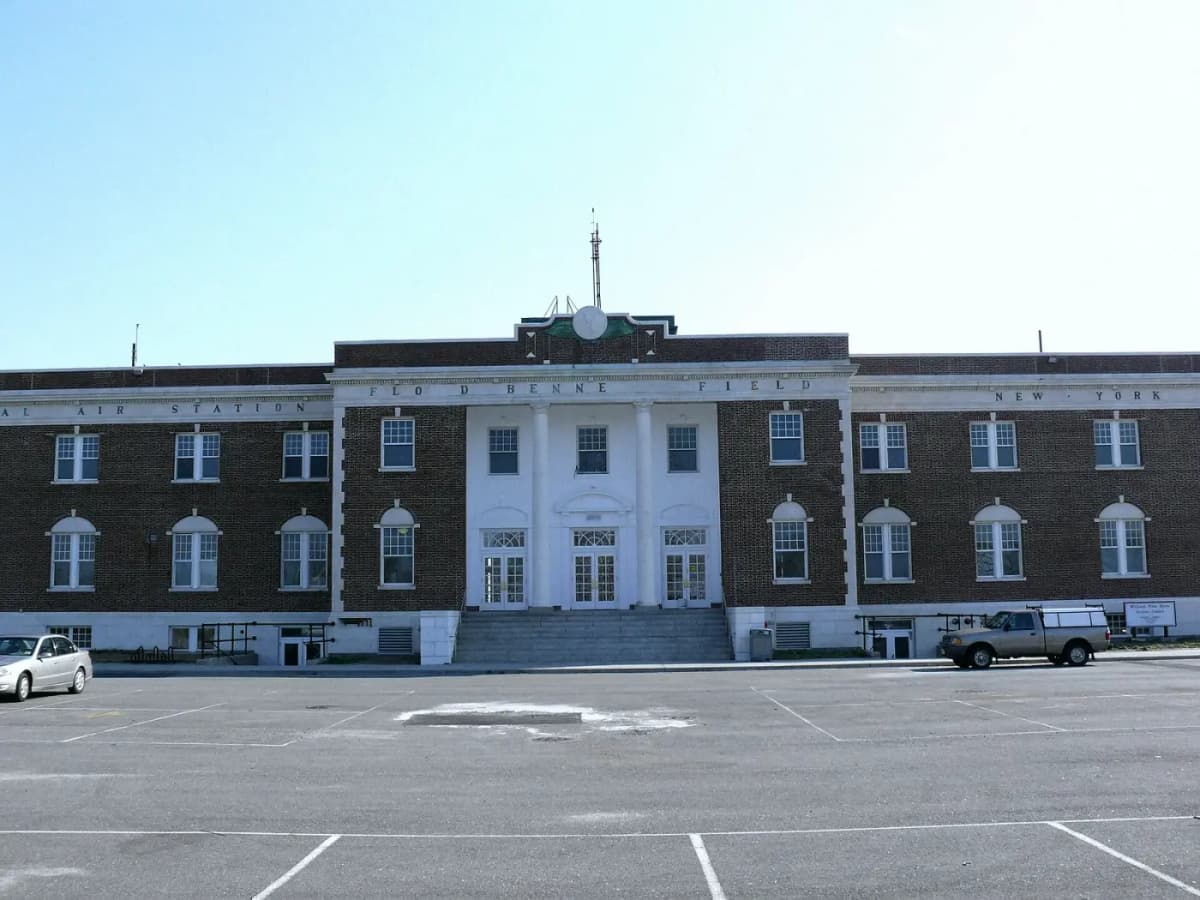
Roll in from the main entrance off Flatbush and you hit the William Fitts Ryan Visitor Center — the original 1931 Administration Building, restored, columns and all, with the old control tower on the roof. When it's open you can walk the airy ticket hall where record-setters once shoved past reporters. Even from outside, it sets the tone: this was somebody's idea of the future, and the future moved to Queens.
The main event: the runways
Behind the terminal, the field opens up and the rules of Brooklyn geometry stop applying. The runways are absurd — wider than most avenues, dead flat, seamed concrete running for what feels like forever. Nothing between you and the far tree line but grass and a windsock's worth of weather. You can hold a straight line for a full mile without touching your brakes, which I can't do anywhere else in this city, including my own hallway.
Spin out to the field's edges and you'll find the ruins that give the place its ghost-airport reputation: hangars with trees growing where roofs used to be, faded Navy paint, cracked aprons dissolving into meadow. Look, don't climb. The decay is the exhibit.
Detour: the model-plane air force
Follow the noise — a sound like furious sewing machines — to the end of Runway 19, where the Pennsylvania Avenue Radio Control Society keeps New York's most charming air traffic. The club field runs sunrise to sunset year-round, weather permitting, with a paved pit area, windsocks, and spectators welcome. The only full-size aircraft you're likely to see are NYPD helicopters lifting off from their own fenced corner of the field. Everything else in the sky here fits in a hatchback, and the pilots fly like it's 1938 anyway.
Quiet: the North Forty
On the bay side of the field, the North Forty Natural Area trades concrete for trails — scrubby woods, a freshwater pond, and a memorial bird blind where the grassland and marsh birds get on with their lives as if the five boroughs were a rumor. The park manages big swaths of the old airfield as grassland habitat, which is why the middle of the loop feels less like a park lawn and more like a prairie with opinions. Walk the bikes here. The birds were here first.
Finish: Hangar B
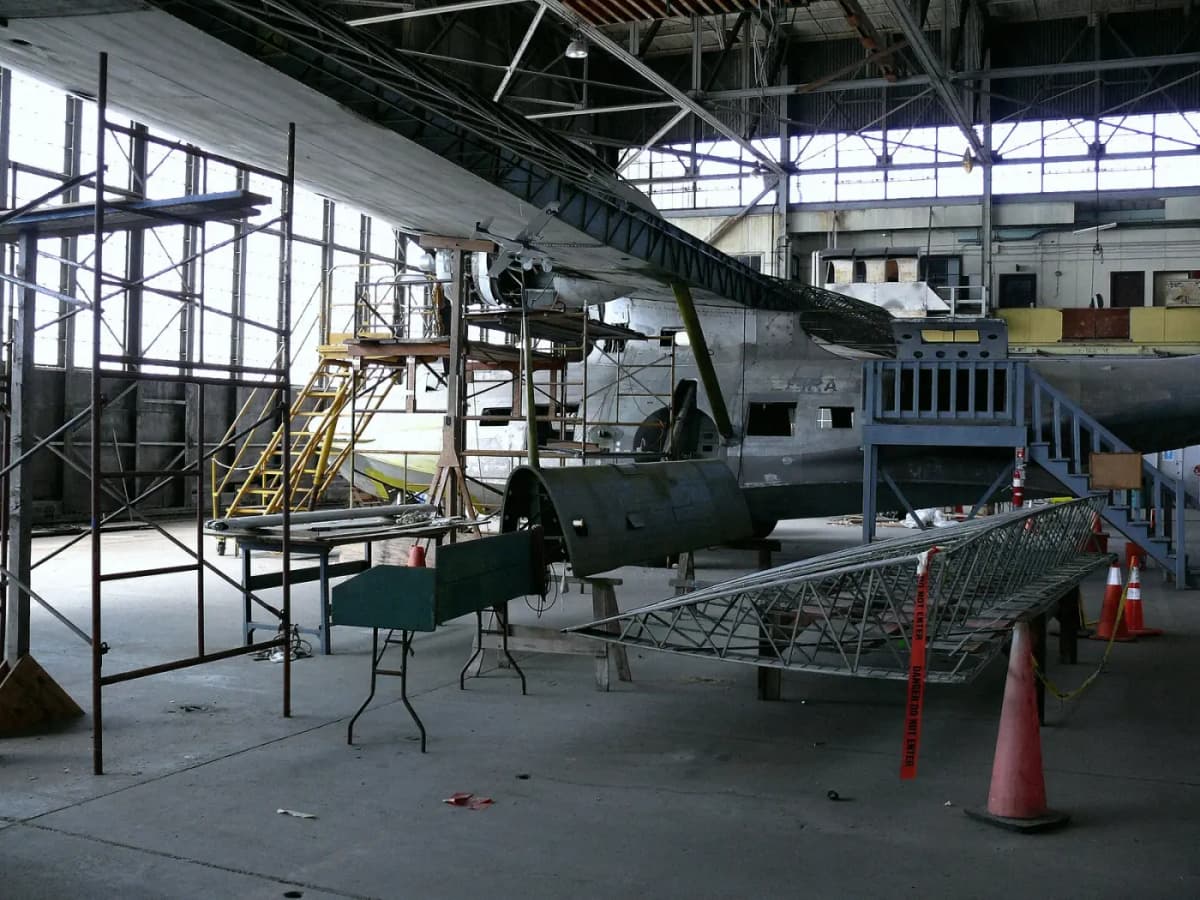
End at Hangar B on the marina side, where volunteers with the Historic Aircraft Restoration Project spend their retirements putting vintage aircraft back together — among them a PBY Catalina flying boat of the type that patrolled from this very station. Open days vary with the volunteer schedule, so check the park calendar before promising anyone airplanes. When the doors are open, it smells like metal and patience.
The Part Where It Goes Sideways
Full disclosure: the field will humble you at least once per visit. It's tradition.
The wind is the main character out here. There's nothing taller than a shrub between you and the Atlantic, and the same openness that makes the riding glorious in one direction makes the return leg feel like pedaling through wet cement. My first lap, I hit the turnaround grinning at 20 miles an hour and came back at a speed best described as "walking, but seated." Local bike racers hold weeknight events on these runways precisely because the wind and the rough slabs make honest riders out of everyone.
The concrete itself is vintage 1931-and-onward, and it rides like it: expansion seams every few yards, the odd pothole with genuine ambition. Fatter tires help. So does looking up occasionally, which the scenery will force you to do anyway.
And there is no shade. None. In July the runways bake like a griddle, and the nearest cold drink can feel very theoretical. Carry more water than you think you need.
Every place that's worth writing about has a toll booth. Here the currency is headwind, and the exact toll is decided at the turnaround.
The Practical Part
Getting in: The park is open 6 am to 9 pm daily, and there's no entrance fee. Transit: 2/5 train to Flatbush Av–Brooklyn College, then the Q35 bus to the park entrance. Bikes: straight down Flatbush Avenue. Cars: Belt Parkway, Exit 11S.
Riding: Any bike works; something with 32 mm tires or wider works happily. The runways are shared with walkers, skaters, land-sailors, and the occasional event — keep your head up. Helmet, wind layer, spare tube, water. There are long stretches with no services at all, which is the whole point and also occasionally the problem.
Camping: Yes, really — you can legally sleep in a tent in Brooklyn. Camp Gateway–Brooklyn sits on the field's quieter side, with tent loops named for Wiley Post and Goldenrod and an RV loop named for Amelia Earhart, which might be the most quietly perfect naming decision in the park system. The season generally runs April through October, reservations go through Recreation.gov, stays cap out at 14 nights, and the primary camper must be 18 or older with photo ID. Operations at the field have shifted between partners in recent years, so confirm the listing is live before you haul gear across the borough.
Model planes: The club field at the end of Runway 19 operates sunrise to sunset, year-round, weather permitting. Spectating is free and better than it has any right to be.
Hangar B and the visitor center: Hours for both depend on staffing and volunteer schedules — check the Gateway National Recreation Area site or call ahead rather than trusting luck.
So, Is It Worth It?
If you measure destinations by amenities, no. There's no espresso at the turnaround. The wind will audit your fitness and publish the results.
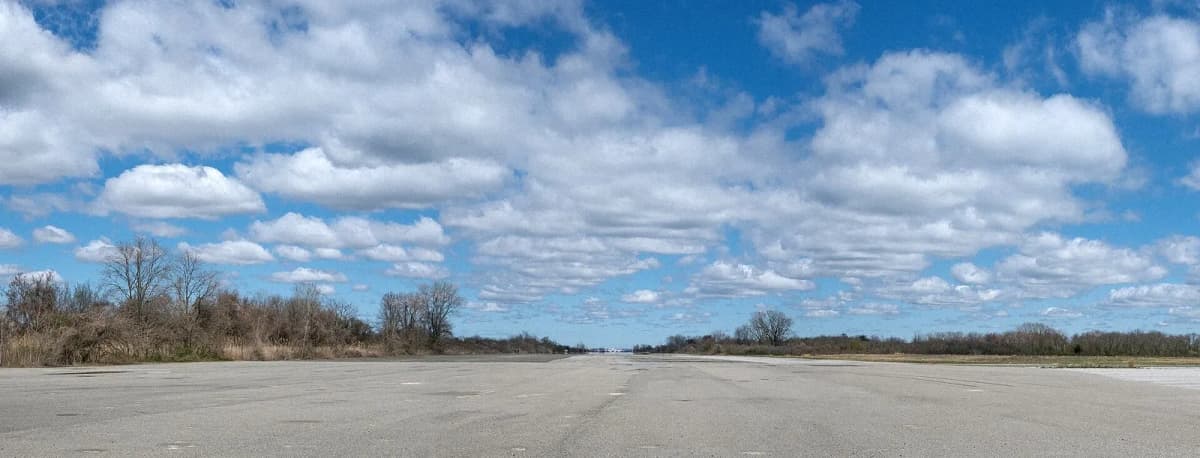
But if what you're after is the feeling of scale — real, horizon-to-horizon scale, the kind New York supposedly can't offer without a bus ticket — this is the cheapest wilderness in the city. You get a mile of concrete that once threw Wiley Post around the planet, a prairie's worth of birdsong, a hangar full of patient people rebuilding flying boats, and the specific, rare silence of a place built for noise.
Ride it on a clear morning. Let the wind decide your route home. Save this one for the day the city feels too small — the runway will still be there, pointed at the horizon, waiting for somebody to take off.
Places in this guide
Floyd Bennett Field, 50 Aviation Road (3159 Flatbush Ave), Brooklyn, NY 11234