Wine tasting in San Francisco is usually treated as a synonym for driving to Napa, and that is a shame, because the city has a genuine wine culture of its own that requires no car, no appointment and no full day. There are working wineries inside the city limits, bottle shops that pour whatever they are excited about, and a density of wine bars that would be notable in a European capital.
Tasting-room hours here are short and mostly weekend-weighted. Ask Karpo what is pouring near you today.
The urban wineries, which are real
There is a cluster of working wineries in the Dogpatch, Bayview and the industrial stretches south of Market — grapes trucked in from Sonoma, Napa, the Sierra foothills and further, then crushed, fermented and aged in warehouses inside the city. The tasting rooms are attached to the production space, which means you are standing among the barrels rather than in a purpose-built visitor centre.
This is a genuinely better experience than most Napa tasting rooms for the simple reason that the person pouring is frequently the person who made it. Fees are modest by wine-country standards and are usually waived against a bottle purchase. The catch is hours: most open Thursday to Sunday only, and several close by five.
Treasure Island has its own small cluster, which is worth a mention because you can walk between several of them and the view back at the city is one of the best available anywhere.
Bottle shops that pour
The most underused wine format in the city is the shop with a licence to pour. You buy a glass or a taste of whatever is open, at retail-adjacent pricing rather than restaurant markup, and you can buy the bottle afterwards. Several shops in the Mission, Hayes Valley, North Beach and the Richmond operate this way, and the selection tends to be sharper than at a bar because a shop lives or dies on what it stocks.

The staff at these places are the real resource. A shop that pours is staffed by people who taste constantly and have no incentive to steer you toward the expensive bottle, because their business is repeat custom rather than a single evening. Telling them what you liked last time is a more efficient route to a good glass than reading a list.
The wine bars
San Francisco's wine bars split roughly into three types. The classical ones, with a long list organised by region and a serious approach to Burgundy and Bordeaux. The California-focused ones, which is what you would hope for given the geography, with deep lists of Sonoma Coast, Anderson Valley and Santa Cruz Mountains producers. And the natural wine bars, concentrated in the Mission and along Divisadero, which are the newest layer and the most divisive.
On the natural wine question: the good ones are genuinely good and the category has matured well past the early phase where everything tasted like cider. The useful signal is whether the bar also stocks conventional wine. A list that is exclusively natural is making a statement; a list that includes both is making choices.
Tasting without spending much
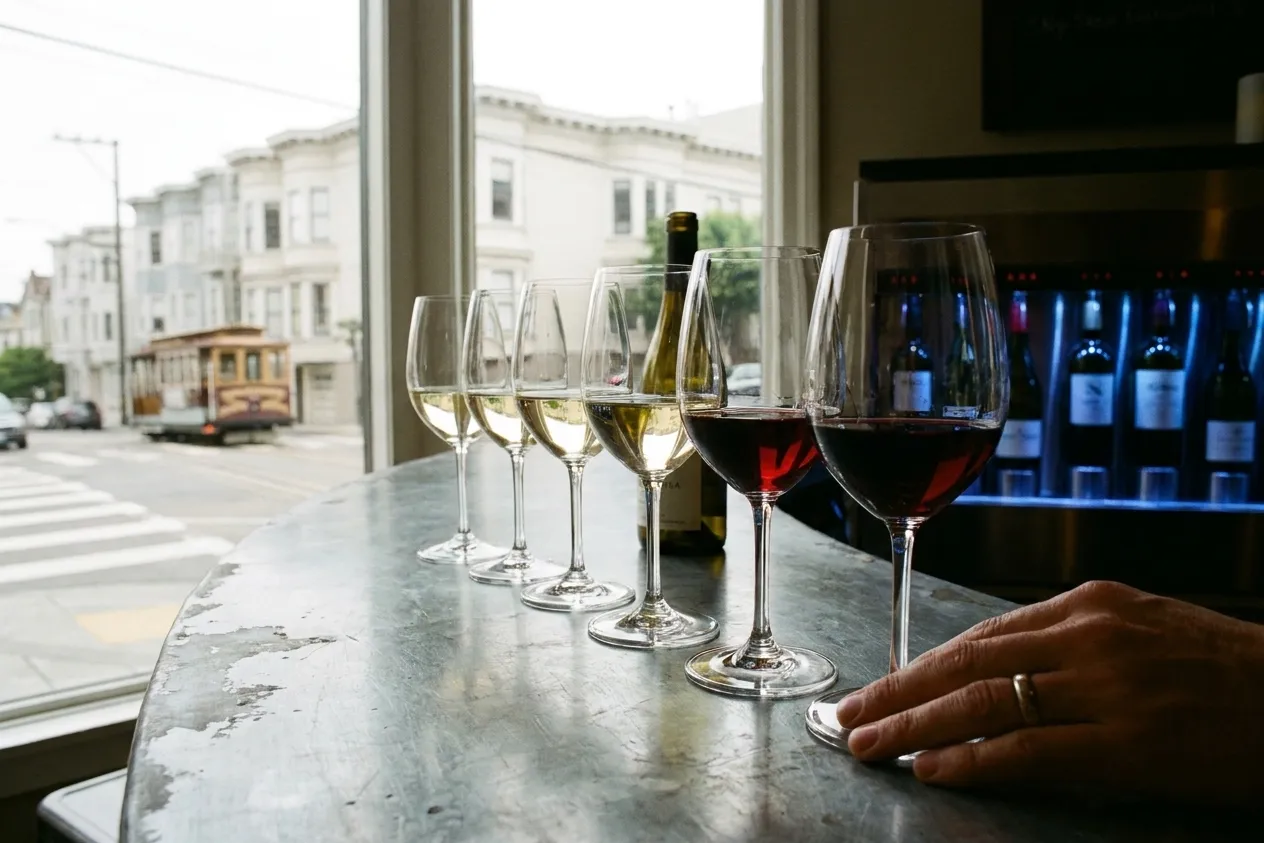
Three levers. Order by the glass at a bottle shop rather than a bar. Look for the flight format, which almost every wine bar in the city offers and which gets you three or four tastes for the price of a glass and a half. And go on a weekday evening, when several bars run by-the-glass promotions to fill the room.
The larger structural point is that wine here is not the luxury purchase it is in most American cities, because the supply is local. A very good bottle of California wine at a shop in this city costs less than a mediocre glass in a restaurant, and drinking well on a budget is mostly a matter of buying rather than being served.
Learning something rather than just drinking
Several shops and bars in the city run regular tasting classes and themed flights that are genuinely educational rather than a marketing exercise — a evening on Burgundy village wines, a comparison of the same grape across three regions, a blind tasting session. These usually cost thirty to fifty dollars, include a substantial amount of wine, and are considerably better value than the equivalent number of glasses ordered individually.
The wine-adjacent thing worth knowing is that San Francisco has an unusually high concentration of certified sommeliers working in ordinary restaurants, because the region trains a lot of them. Asking the person with the list for a recommendation under a certain price is not an imposition, and in this city the answer is usually very good.
If you do want to leave the city
Sonoma is closer and considerably more relaxed than Napa, and it is reachable without a car — the ferry to Larkspur or Vallejo connects to buses that reach the wine towns, and a day out that way is a genuine alternative to driving. Livermore, to the east, is reachable on BART plus a short ride and is the most underrated wine region in the Bay Area, with far lower tasting fees and no crowds.
But the honest recommendation is to try the city first. An afternoon in the Dogpatch tasting rooms, or an evening working through a flight at a shop in the Mission, gets you most of what a wine-country day gives you without three hours of driving attached to it.
Tags: #SanFrancisco #WineTasting #UrbanWinery #Dogpatch #TreasureIsland #NaturalWine #WineBar #HayesValley #MissionDistrict #BottleShop #BayArea #SFNights #Sonoma
All trademarks are the property of their respective owners.
Ask Karpo first
Ask Karpo which tasting rooms and wine bars near you in San Francisco are open right now, what a flight costs, and whether the fee comes off a bottle.