There's a gap between drinking wine often and knowing what you're tasting, and no amount of Tuesday-night pinot closes it on its own. What closes it is structure: wines poured side by side, someone naming what's in the glass while it's still on your tongue, and a method you can repeat without them. That's what a real wine class sells, and San Francisco — a city that treats wine as a subject, not just a beverage — has an unusually complete ladder of them.
This guide sorts the local options by commitment level, from a single fun evening to certificate programs with actual exams, so you can pick the rung that matches how far down this hole you intend to go.
Guided Tasting vs. Actual Class: Know What You're Buying
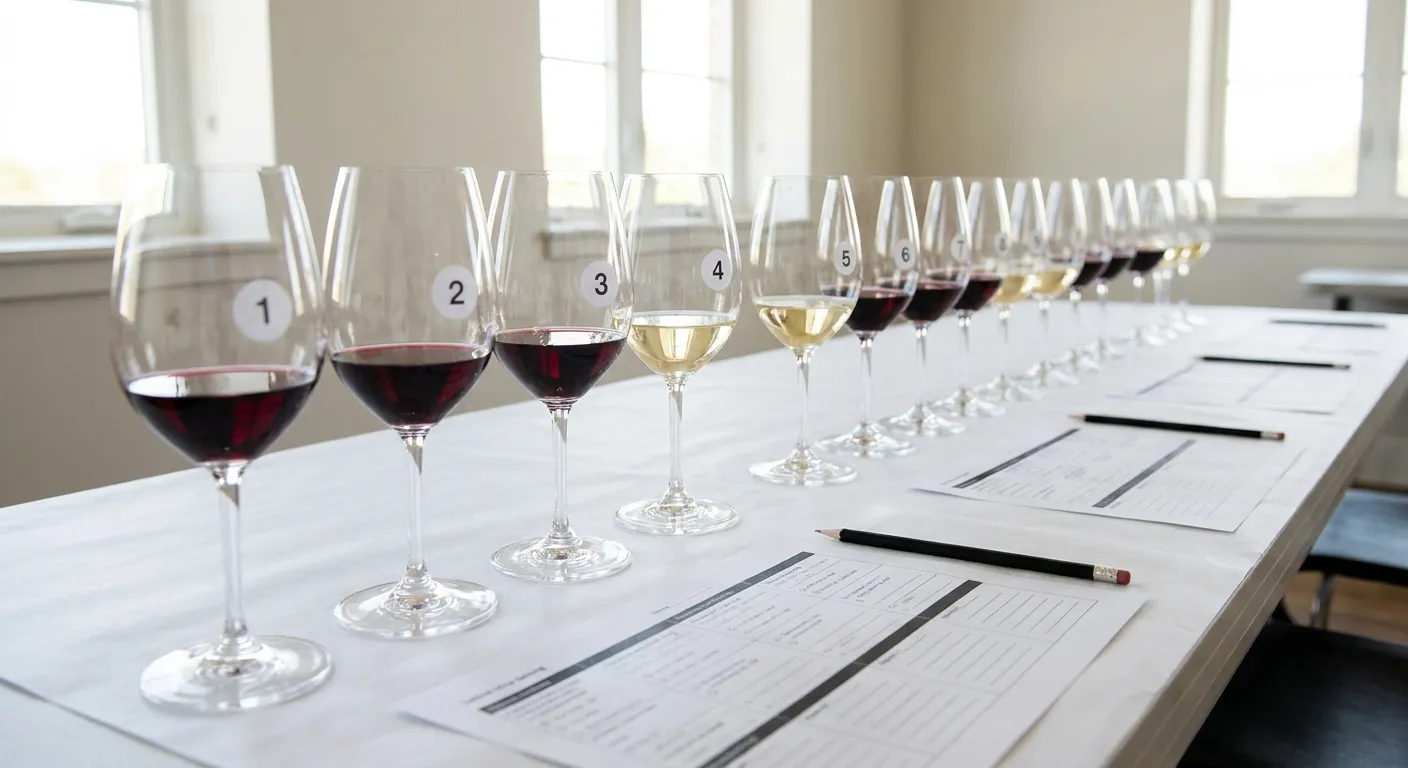
Three formats get sold under the word 'class.' A guided tasting is someone pouring and talking — pleasant, zero homework, you'll remember two facts. A single-evening seminar has a theme, a structured lineup, and tasting sheets; you leave with a framework. A certification course has a curriculum, required tastings, and an exam at the end; you leave with a credential and, more usefully, a trained palate. None of these is better — they're different tools. The mistake is expecting seminar-level learning from a happy-hour pour, or signing up for an exam track when what you wanted was a nice Thursday.
One-Night Wonders: Seminars and Blind Tastings in the City
For a first taste of structured learning, start inside city limits. Ungrafted in Dogpatch — a wine bar and restaurant owned by sommeliers, one of them a Master Sommelier — runs a calendar of classes and blind-tasting events where the point is exactly this kind of palate training, in a room where questions are the house sport. Blind tasting is the fastest teacher in wine: with the label gone, you have nothing to go on but what's actually in the glass, which is the whole skill.
In the Mission, 18 Reasons — the community food education nonprofit on 18th Street — folds wine into its class calendar with evening tasting seminars, like its French wine and cheese pairing sessions, generally priced in the low-hundreds-per-seat range with member discounts. And at Ghirardelli Square, The Cheese School of San Francisco runs tasting and pairing workshops where wine shares the syllabus with its favorite companion; classes regularly sell out, so book ahead rather than assuming a walk-in seat.
San Francisco Wine School: The Deep End
When you're ready to get serious, the region's heavyweight is San Francisco Wine School, founded in 2011 by David Glancy — a Master Sommelier and Certified Wine Educator, a combination only about a dozen people in the world hold. Based in South San Francisco, a short ride down the Caltrain line, it stacks the industry's major credentials under one roof: intro classes and food-pairing labs for enthusiasts, plus certificate tracks like the California Wine Appellation Specialist, Italian Wine Scholar, WSET courses, and sommelier exam prep for people pointing at the trade. Many classes run in person or online with tasting kits shipped to you, which means the 'I can't make it to class' excuse has been formally retired.
The WSET Track: The Credential That Travels
WSET — the Wine & Spirits Education Trust — is the closest thing wine has to a universal transcript, and the Bay Area has real access to it. Commonwealth Wine School runs in-person WSET courses and exams at a wine education center in South San Francisco, alongside online options, covering the first three levels. The shape of the ladder: Level 1 is a one-day, true-beginner foundation in how to taste and talk about wine. Level 2 adds real breadth — grapes, regions, label literacy — over multiple sessions. Level 3 is the serious one: deeper theory, a structured blind-tasting component, and an exam that people actually study for. Pick your level honestly; skipping ahead sounds efficient right up until the tasting exam.
What Every Good Class Actually Teaches
Strip away the branding and every serious program teaches the same core move: systematic tasting. Look at the wine and register what the color tells you. Smell before you sip, and name what you find — fruit first, then everything that isn't fruit. Taste, and separate the structural elements: acid, tannin, sweetness, alcohol, body. Then conclude something. The vocabulary matters less than the sequence; the sequence is what turns 'I like this' into 'I like this because,' and 'because' is transferable to every bottle you'll ever meet.
The reason a class beats solo practice isn't secret knowledge — it's calibration. Tasting a high-acid and a low-acid wine side by side, with someone confirming which is which, fixes the reference points in an evening that might take you a year of dinners to find alone.
Practicing Between Classes Without Going Broke
The class gives you the method; repetition makes it yours. Cheap ways to keep the training going:
- Always taste two wines side by side. Comparison is the entire trick — one glass alone has nothing to be measured against.
- Use the city's walk-in tasting rooms as homework: a multi-winery counter like Winery Collective at Fisherman's Wharf lets you compare a dozen producers in one sitting.
- Write a note on every glass, even a bad note. 'Tart, cherry-ish, made me want pizza' is a real tasting note.
- Have someone bag a bottle and pour it blind. Guessing wrong in your kitchen is free.
- Smell everything at the farmers market. Blind tasting is mostly scent memory, and scent memory is built in produce aisles, not seminars.
Wine Class FAQs
Do I need a certification just to enjoy wine more?
No. If the goal is ordering confidently and enjoying what's in your glass, a couple of one-night seminars plus deliberate practice will get you most of the way there. Certifications earn their cost when you want externally imposed structure, a credential for work, or an excuse to taste dozens of benchmark wines you'd never buy on your own.
How much do wine classes in SF cost?
Single-evening tastings and seminars generally land from under a hundred dollars to the mid-hundreds depending on what's being poured, while multi-session certificate courses run well beyond that — WSET tuition scales steeply with level. Prices shift year to year, so check the current calendar before budgeting, and note that nonprofits like 18 Reasons discount for members.
What's the fastest way to get better at blind tasting?
Volume and honesty. Taste structured flights often, commit to a guess out loud before the reveal, and keep notes on your misses — being confidently wrong is how the calibration happens. A standing blind-tasting night does more for your palate than a shelf of wine books. Ask Karpo to point you at what's pouring near you this week, and treat it as tuition.