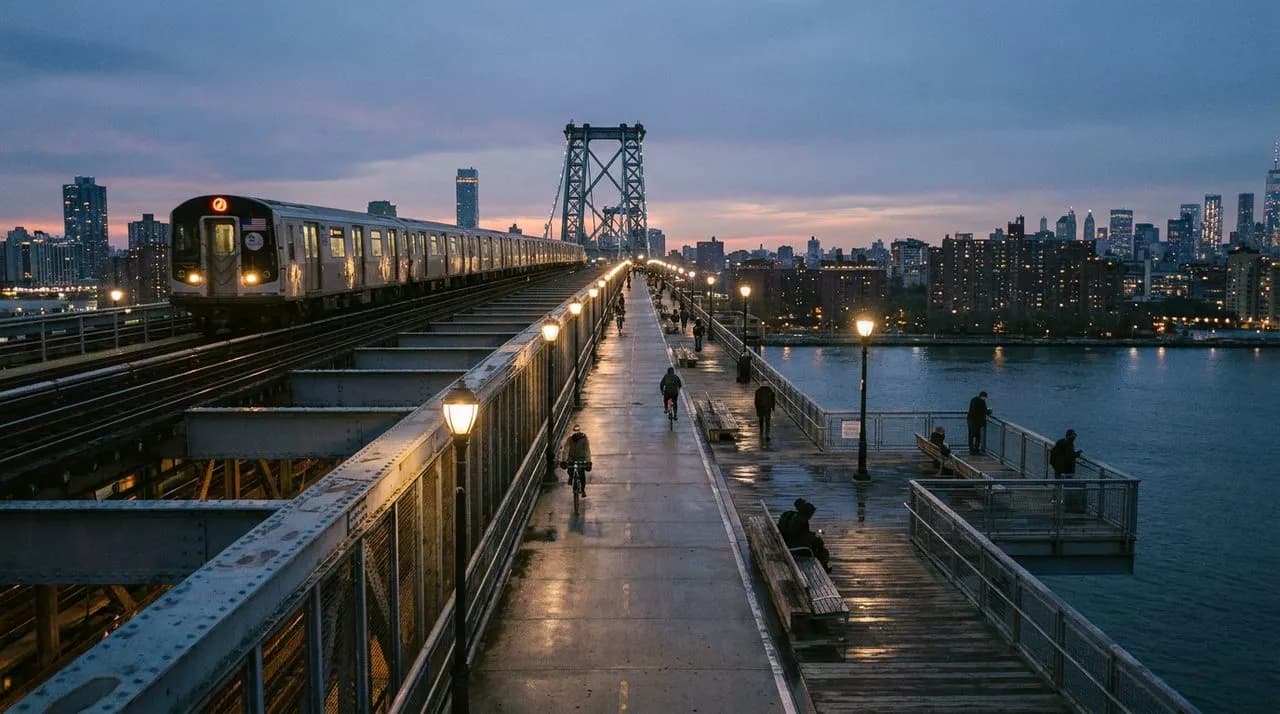
The Williamsburg Bridge doesn't announce itself with the Brooklyn Bridge's Gothic flourish or the Manhattan Bridge's Beaux-Arts gateway. It's a working-class crossing, all riveted steel and crisscrossed girders, painted robin's-egg blue and cantilevered 135 feet above the East River. The pedestrian path runs 1.4 miles between Delancey Street and Bedford Avenue, threading walkers between the roadway below and the elevated J/M/Z tracks above. Every six minutes a train rattles past, shaking the deck gently underfoot—a rhythmic reminder that this bridge is less monument than machine, still earning its keep a century after it opened.
Two paths, one choice
The bridge offers two pedestrian routes: a north path shared with cyclists and a south path that's quieter, wider, and marked with faded blue paint along the handrails. The south path is smoother and less bike-trafficked than the north, especially on weekday mornings before 9 AM when commuters favor the northern lane and the deck belongs mostly to early walkers and the occasional runner. The difference is tactile—fewer bell rings, more room to pause and look without stepping aside.
The choice matters less at midspan, where both paths converge in feel if not in layout, but on the approach and descent the south side offers a more contemplative rhythm. The steel latticework frames the skyline in geometric slices, and the slower foot traffic means you can stop to adjust a jacket or pull out a phone without causing a pileup. It's one of the city's genuinely free things to do, and the south path makes the most of it.
Midspan benches and skyline geometry
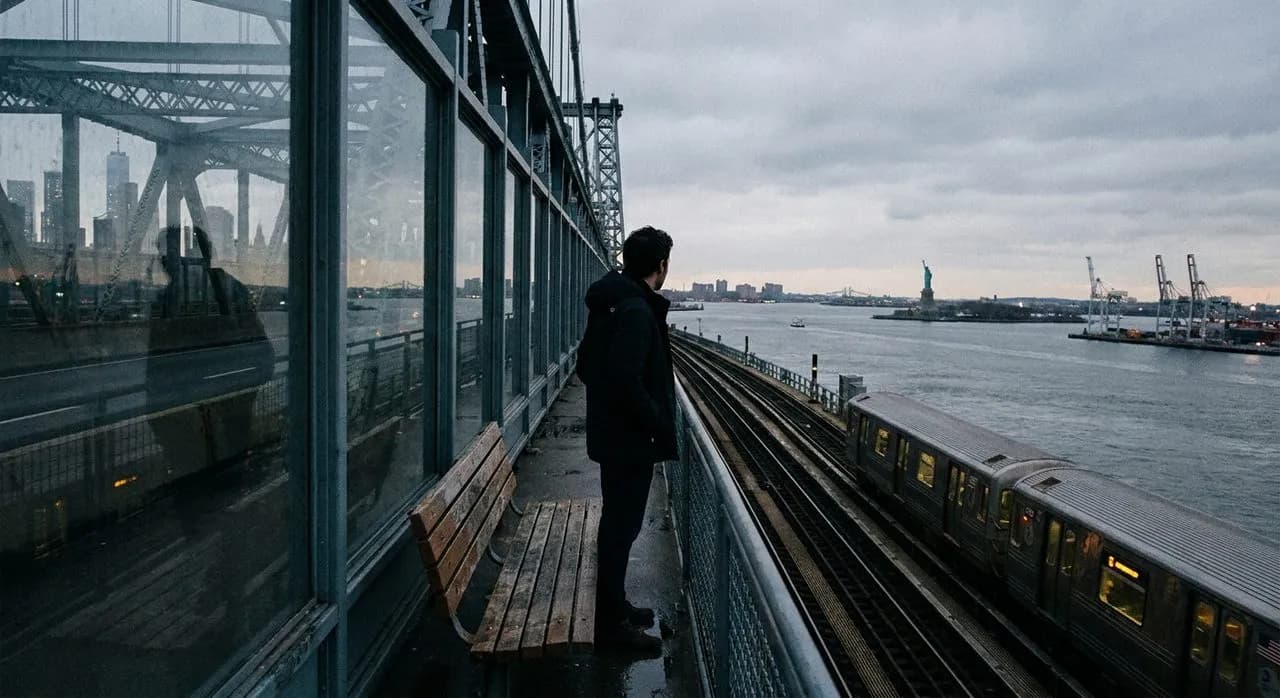
Approximately 0.6 miles from the Manhattan entrance, a pair of benches interrupts the walkway—steel-slatted, bolted to the deck, angled to face southwest. They're positioned to frame the Empire State Building and One World Trade through the bridge's steel crossbeams, a composition that shifts with every step but locks into alignment when you sit. The lattice acts as both scaffold and lens, breaking the skyline into triangular segments that reassemble as you tilt your head.
The benches are narrow and unforgiving, designed more for momentary rest than lingering, but they serve their purpose. On early evenings in late spring the light comes in low and gold, catching the glass towers and throwing long shadows across the deck. By blue hour the city softens, the hard edges of steel and concrete blurring into silhouette. A train passes overhead, the vibration traveling through the bench frame and into your spine, and for thirty seconds the river and the skyline and the hum of traffic below all compress into a single sensory note.
The time trade-off
The walk takes 25 to 30 minutes at a steady pace, compared to 12 minutes on the J train—but the bridge path is free and open 24 hours, no MetroCard required, no turnstile to swipe. The math matters less than the quality of the crossing. The subway burrows under the river in a fluorescent tunnel; the bridge suspends you above it, wind in your face, the water visible through the deck grates in flashes of gray-green chop.
It's a different kind of commute, one that builds in time for decompression or anticipation depending on which direction you're headed. Manhattanbound in the morning, the skyline grows incrementally, tower by tower. Brooklynbound in the evening, the low-rise sprawl of Williamsburg unfolds in rooftop increments, water towers and fire escapes catching the last light. The bridge doesn't shortcut the journey—it makes the journey the point.
Steel and rivet details
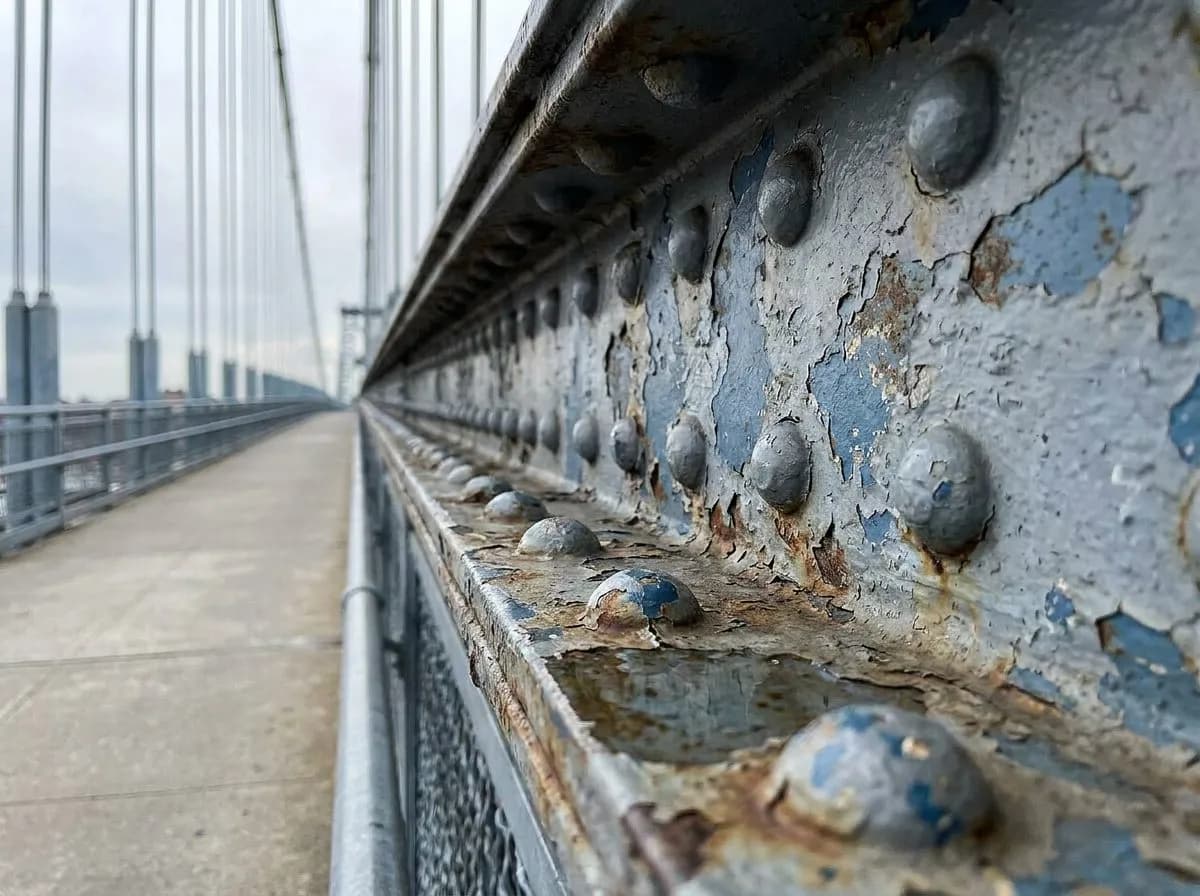
The Williamsburg Bridge wears its age plainly. The steel is pocked and weathered, paint peeling in patches to reveal rust and older coats of gray and green beneath the current blue. Rivets the size of fists dot every beam and crossmember, hand-driven more than a century ago and still holding fast. The structure is loud—visually, acoustically—none of the sleek minimalism of newer spans.
Up close the bridge reads as an archive of municipal maintenance: fresh welds next to century-old iron, new cable housings alongside original fittings. Graffiti tags climb the lower girders on the Brooklyn side, layered and fading, a palimpsest of neighborhood names and throw-ups. The deck itself is a patchwork of concrete and steel grating, the grates offering glimpses of the roadway twenty feet below and, through gaps in the traffic, slivers of river beyond. It's not pretty in any conventional sense, but it's forthright, built to last and still lasting.
Blue hour and train rhythm
Early evening is the bridge's best hour. The light goes soft and diffuse, the harsh midday glare replaced by a gradient wash that flatters even the most utilitarian surfaces. The river picks up the sky's color, shifting from gray to violet to indigo as the sun drops behind New Jersey. Traffic noise from the roadway below becomes a steady drone, less intrusive than ambient, and the pedestrian flow thins to a scatter of solitary walkers and couples moving at their own pace.
The trains continue their six-minute intervals, a metronomic pulse that organizes the experience into chapters. You hear each train before you see it—a rising clatter on the tracks overhead, then the bright blur of lit windows, then the fade as it curves away toward the next stop. The deck shakes, a brief seismic flutter, then settles. It's easy to time your walk by the trains, counting crossings, using them as landmarks in the absence of mileposts. By the time you reach the far side you've felt a dozen pass, each one a small reminder that the city is still moving, still working, still here.
Practical notes
The Manhattan entrance is at Delancey Street near Clinton Street; the Brooklyn entrance is at Bedford Avenue near South 5th Street. Nearest subway: J/M/Z to Delancey–Essex (Manhattan) or Marcy Avenue (Brooklyn); F to Delancey–Essex. Street parking is scarce on both sides. The pedestrian path is open 24 hours, unsheltered and fully exposed to weather. Bring layers in spring; wind on the bridge is stronger than at street level. The path is ADA-accessible with gradual inclines, though the steel grating and uneven surfaces may challenge some mobility devices. No restrooms on the bridge; plan accordingly.
Tags: #WilliamsburgBridge #TheLongWayHome #NYCWalks #EastRiver #LowerEastSide #WilliamsburgBrooklyn #BridgeWalks #BlueHour #FreeNYC #PedestrianPath #SteelAndRivets #SpringInTheCity #UrbanCrossing #CityViews #ManhattanSkyline
Sources consulted: Williamsburg Bridge - Wikipedia · NYC DOT - Williamsburg Bridge · MTA - New York City Transit · Time Out New York · The New York Times - New York
All trademarks are the property of their respective owners.