The honest starting point is that San Francisco is not a late-night eating city, and the people who tell you otherwise are remembering 2013. Last call is two, kitchens that once ran to three now stop at midnight, and the search for food open now in San Francisco after the bars empty has got materially harder in the last five years. What is left is a real map, but it is a smaller one than the reputation suggests, and knowing its shape is the difference between eating and giving up.
The late map changes faster than any listing does. Ask Karpo which kitchens near you are still taking orders tonight.
The two-o'clock cliff is real
Almost everything that serves food in this city stops in a narrow window between one thirty and two, because the liquor licence ends at two and a kitchen without a bar attached rarely makes the maths work alone. What survives past that point falls into three categories: the taquerias, a handful of Chinese restaurants, and the small number of places that exist specifically to catch people leaving bars.
This is why the standard advice to just head to the Mission is broadly right and slightly lazy. It is right because the Mission has the highest density of genuinely late kitchens in the city. It is lazy because the Mission's late-night capacity is concentrated on two streets and gets overwhelmed at exactly the hour everyone arrives, which is the same reason the queue is thirty deep at two fifteen.
The taqueria layer
The taquerias on and around Mission Street between 16th and 24th are the backbone of the city's late map, and several run to two thirty or three at weekends. The quality is high and the variation between them is smaller than the arguments about them suggest. What actually differs is the queue management — some take orders at a counter and call numbers, some run a single line for everything, and on a Saturday at two that difference is twenty minutes.
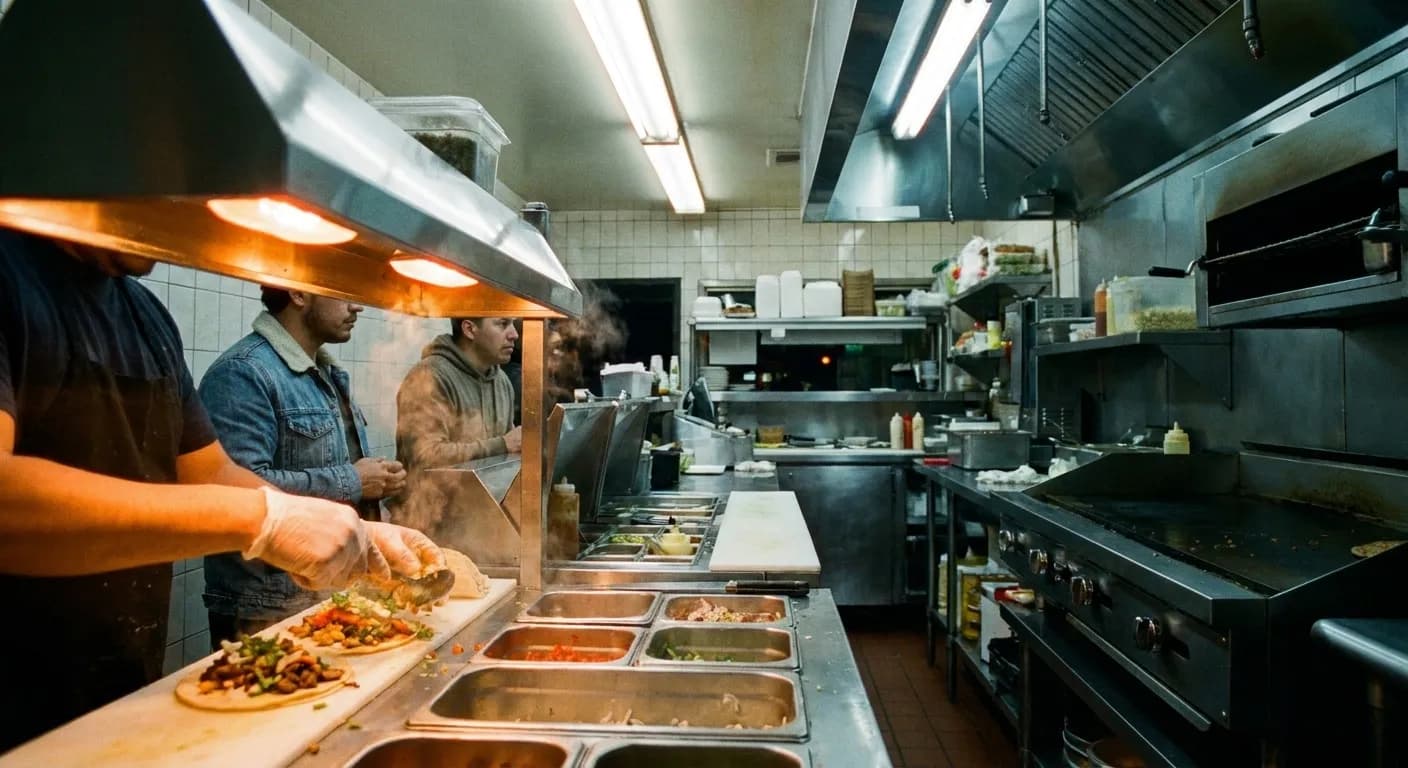
The second thing worth knowing is that several of these close their dining rooms well before the kitchen stops, so the meal is a takeaway on a cold pavement rather than a table. If you want to sit down, ask before ordering rather than after. The mistake is easy to make and hard to fix once you are holding food.
Chinatown and the Richmond run on a different clock
A small number of Chinese restaurants in Chinatown and along Clement and Geary run late, and they are the most underrated option in the city because they offer something the taquerias do not: a table, a big menu, tea, and enough space for six people who have just come out of a venue together. The late Cantonese rooms are the correct answer for a group, and almost nobody suggests them.
The caveat is that late here means one rather than three. The Chinatown late kitchens generally stop around one in the morning, which puts them just before the two-o'clock cliff rather than after it. As a plan, that means leaving the bar early rather than eating after it closes — a different evening, but a better meal.
The Tenderloin and lower Nob Hill
The densest concentration of genuinely late food in the city is in the Tenderloin, which is also the neighbourhood people are most reluctant to recommend. The practical situation is that the blocks around Larkin and Hyde have late Vietnamese, Thai, Indian and Middle Eastern kitchens, several open past two, and they are busy with people doing exactly what you are doing. Walk with the same attention you would use anywhere in a city at that hour and the calculation is straightforward.
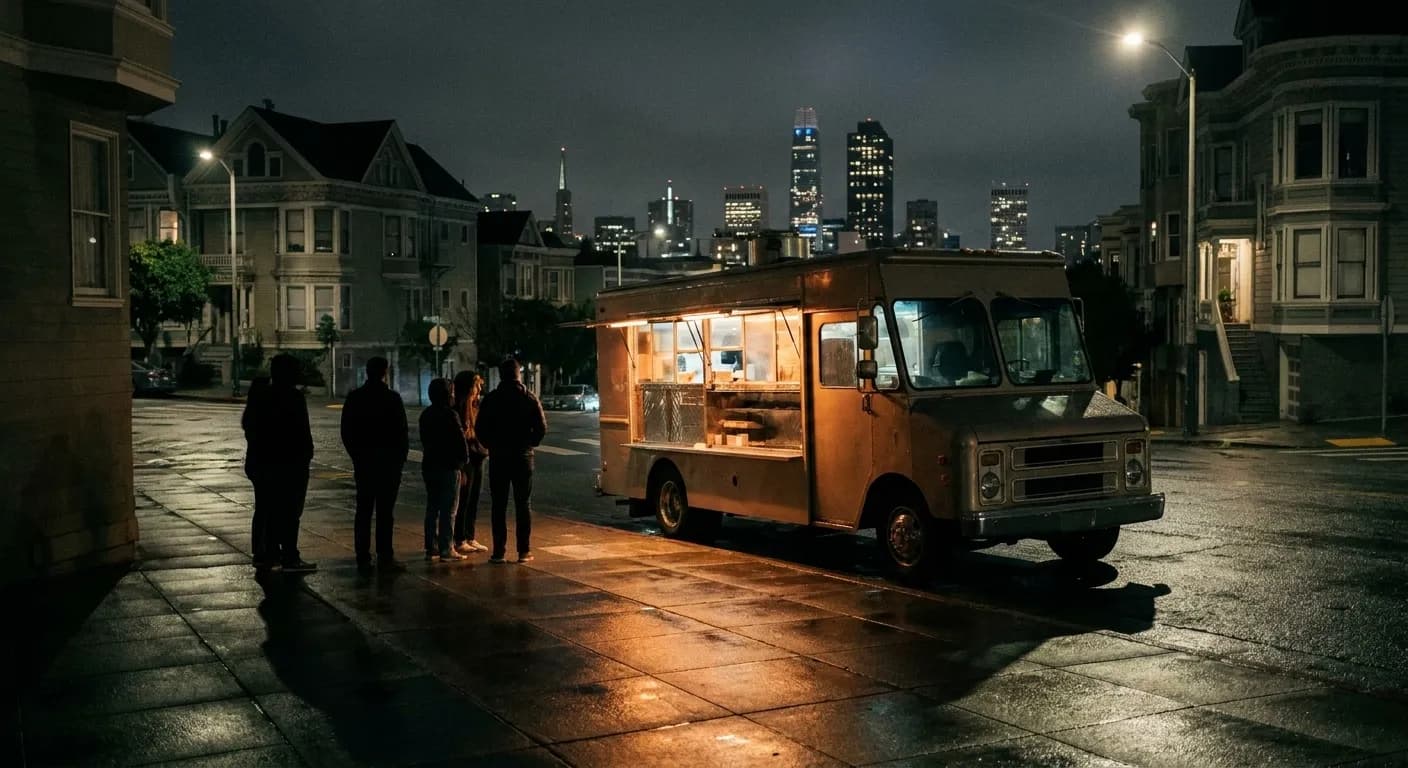
SoMa is the opposite. It has the venues that empty at two and almost nothing to absorb the people who come out of them, which is why the pavements there at two fifteen are full of people looking at their phones. If your night ends in SoMa, the honest plan is to have decided in advance where you are walking, because standing outside deciding is the slowest option available.
What actually works as a strategy
Order before you need to. The single most effective habit is to eat at half past midnight rather than at two, which sounds like a defeat and is in fact how most people who live here handle it. The city's food is better between eleven and one than it is after two, by a wide margin, and the queue is nonexistent.
Failing that, pick the neighbourhood before the last drink rather than after it. Nine times out of ten the failure mode is not that nothing was open — it is that the group spent forty minutes on a pavement negotiating, and by the time a decision emerged the kitchen that would have worked had closed. A destination chosen at midnight survives contact with two in the morning; one chosen at two does not.
The transit constraint nobody factors in
The other half of the late-night problem is getting home, and it shapes where you should eat more than most people allow. The subway stops running around midnight on weeknights and slightly later at weekends, which means an after-two meal in a neighbourhood far from where you sleep commits you to a car. That is a fifteen-to-thirty-dollar decision attached to a twelve-dollar burrito, and it is worth making deliberately rather than discovering afterwards.
The overnight bus network does run, and it is genuinely useful along a handful of trunk corridors — Mission, Geary, Market — which is another argument for the Mission being the default answer. Eating somewhere on a line that still runs converts the end of the night from a negotiation into a walk to a bus stop, and that is usually worth more than the marginal difference between two taquerias.
Tags: #SanFrancisco #LateNightSF #FoodOpenNow #SFEats #MissionDistrict #Taqueria #Chinatown #Tenderloin #AfterLastCall #SFNightlife #LateNightEats #BayArea #SFFood
All trademarks are the property of their respective owners.
Ask Karpo first
Ask Karpo which kitchens near you in San Francisco are still open right now, how late they take orders, and whether the dining room is still seating.