 Distillery Tour Near Me in Bushwick: New York Distilling Company
Weekend Plans
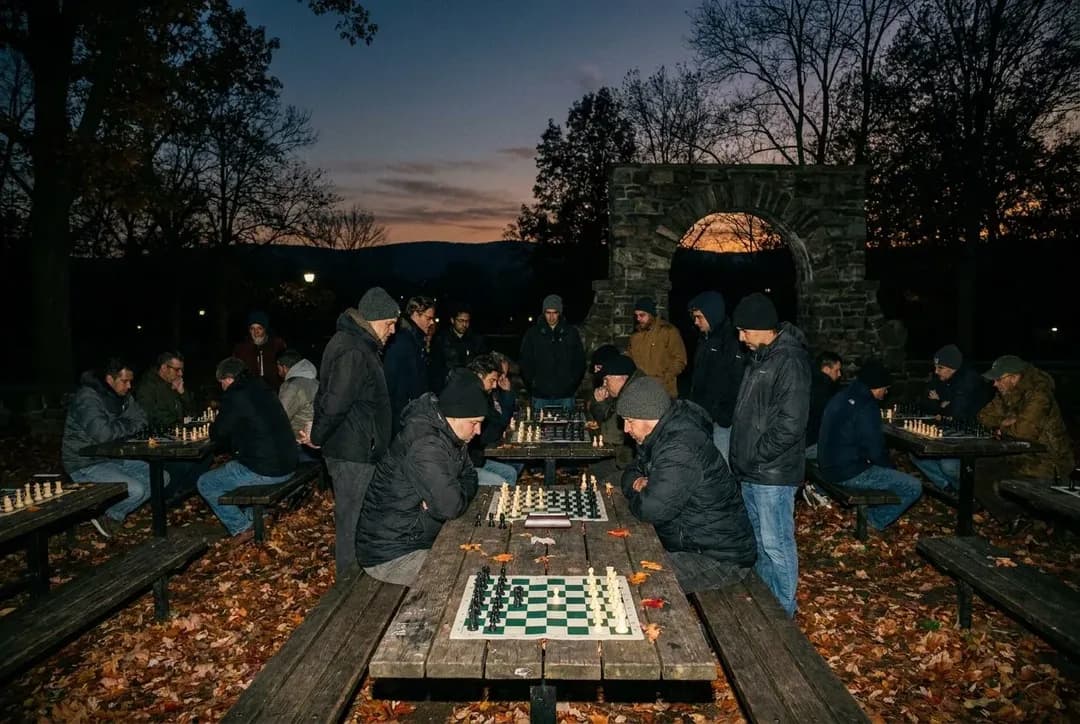
washington square park's chess tables on a weekday afternoon
The southwest corner chess plaza hits its stride on autumn afternoons when the regulars claim their tables, games run fast and loud, and benches fill with watchers as blitz rounds unfold under changing leaves.
The first clatter of a speed-chess clock carries differently in October. Maybe it's the thinner air or the way sound travels through bare branches, but by mid-afternoon the southwest corner of Washington Square Park becomes an amphitheater of trash talk, timer slaps, and the occasional groan when a queen blunder ends a game in twelve moves. This is not the romantic, contemplative chess of movie montages. This is fast, loud, and unforgiving—a weekday ritual that peaks when the light slants just right and the temperature hovers in that narrow band where you can sit on stone for hours without regret.
The magic window
Timing is everything. The southwest corner tables see the most activity between two and five p.m. on weekdays when school and work schedules align, when the college kids have finished their morning classes and the retirees have had lunch and the hybrid-schedule consultants are done with their Zoom calls. Tuesdays and Thursdays, in particular, draw the strongest players—some unspoken coordination among the regulars who know that's when the real competition shows up. Mondays are sleepy. Fridays taper early. But mid-week? The benches fill three deep.
The autumn light helps. Late October offers that low, golden wash that doesn't blind the players but makes every piece visible, every expression readable. The temperature matters too: cool enough that nobody's sweating over the board, warm enough that fingers stay nimble. It's the season for the longest sessions, the kind where a strong player might run the table for two hours straight, stacking bills in his jacket pocket while challengers keep lining up.
The table hierarchy
Not all fourteen stone tables hold equal weight. The ones closest to the path—the so-called main stage—are where the serious money and the largest spectator crowds gather. These are the tables you photograph, the ones that end up on Instagram with captions about authenticity and grit. Sit down there with five dollars and you're making a statement. You're saying you came to play, not to practice.
The tables farther back, near the benches under the honey locusts, are quieter. Still competitive, but the audiences are smaller and the stakes feel lower even when they're not. Newer players start there. Regulars who want to warm up before moving to the main stage cycle through. There's no official map, no printed guide to which table means what, but spend an afternoon watching and the geography reveals itself.
The cost of sitting down
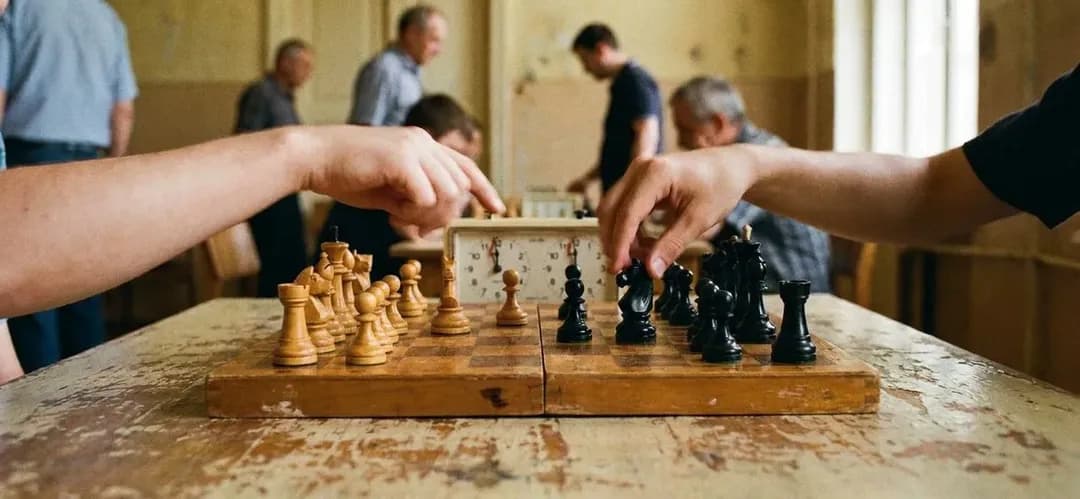
Games typically cost five dollars, with blitz rounds running three to five minutes per side. That's the standard rate, the handshake agreement. You put your bill on the edge of the table, the clock gets reset, and someone hits the button. Three minutes is barely enough time to think—it's all pattern recognition, muscle memory, the openings you've drilled so many times your hand moves before your brain catches up. Five minutes feels generous by comparison, almost leisurely, though it rarely plays out that way.
Lose and your five dollars stays on the table. Win and you pocket it, plus your opponent's. A strong player can clear sixty, eighty, a hundred dollars on a good afternoon. The exchange is cash-only, immediate, no apps or IOU's. It's one of the few truly transactional public experiences left in a city that has digitized nearly everything else, and that anachronism is part of the appeal.

Watching versus playing
Most people come to watch. The benches surrounding the tables offer one of the city's best free things to do—a live theater of skill, bluster, and occasional heartbreak that costs nothing but attention. You learn quickly that silence is not expected. Spectators shout advice, heckle bad moves, gasp at brilliant sacrifices. The players largely ignore it, or pretend to, though you'll catch a smile when the crowd reacts to a particularly vicious checkmate.
Watching teaches you the unwritten rules. You learn that kibbitzing is tolerated but touching the board is not. You learn which players are generous with post-game analysis and which walk away the moment the king tips. You learn that the guy in the Mets cap playing the Caro-Kann has been coming here for nineteen years and that the teenager with the Juilliard tote bag just earned her FIDE rating last spring. The social fabric is dense, cross-generational, and surprisingly welcoming if you show respect for the game.
What to bring besides money
Cash, obviously. Small bills. But also: patience, humility, and a willingness to lose in public. If you're sitting down to play, don't expect gentle treatment. The regulars will exploit every mistake, and the clock is nobody's friend. If you're watching, bring a jacket—those stone benches get cold as the afternoon wears on—and maybe a coffee from one of the cafés along the south edge of the park. A notebook is not a bad idea. You'll want to write down the lines you see, the traps that keep working, the endgames that looked hopeless until they weren't.
Leave your phone in your pocket during games. Taking a photo of the scene is fine, expected even, but filming an active game without asking tends to draw glares. The chess plaza operates on a peculiar mix of public spectacle and private focus, and navigating that balance is part of the etiquette.
The changing leaves, the constant game
By late afternoon the sycamore and oak leaves drift onto the boards, and someone always brushes them away with the edge of a hand before resetting the pieces. The park empties in waves—students heading to evening classes, office workers catching the train home—but the chess tables stay active until the light fails. Even then, a few diehards pull out phone flashlights and keep playing, the glow turning their faces ghostly and intent.
It's a scene that has played out for decades, with different faces and the same rituals. The city changes around it—rents climb, restaurants close, towers rise—but the southwest corner stays stubbornly itself. A place where five dollars and a decent Sicilian Defense can buy you an hour of pure focus, where watching costs nothing and teaches everything, where autumn afternoons feel like the exact right speed for life.
Practical notes
Washington Square Park is bounded by Waverly Place, University Place, West Fourth Street, and MacDougal Street in Greenwich Village. The chess tables are in the park's southwest corner, closest to the West Fourth Street entrance. Nearest subway: West Fourth Street–Washington Square (A, C, E, B, D, F, M, and PATH). Street parking is scarce; nearby parking garages may be available in Greenwich Village. The tables are used informally during daylight hours, weather permitting. The area is wheelchair accessible via paved park paths. Bring cash in small bills, layers for shifting temperatures, and an open afternoon.
Tags: #WashingtonSquarePark #NYCChess #GreenwichVillage #RightOnTime #AutumnInNYC #WeekdayAfternoon #BlitzChess #NYCParks #FallInTheCity #SpeedChess #VillageLife #PublicSpace #ChessHustle #UrbanRituals #CityLife
All trademarks are the property of their respective owners.
Ask Karpo for more information.
Keep reading
- Distillery Tour Near Me in Bushwick: New York Distilling Company
 Distillery Tour Near Me in Industry City: Fort Hamilton Whiskey Tasting
 Distillery Tour Near Me in Red Hook: Widow Jane Whiskey Tasting