The Walk You Don't Plan
The route starts at Industry City on the Sunset Park waterfront — a former industrial terminal that occupies thirty-five acres of repurposed warehouse buildings and open courtyard spaces along the harbor. Walk east from Industry City on 35th or 36th Street, turning away from the water and climbing inland. The streets here ascend quickly: this is one of the parts of Brooklyn where the glacial topography reasserts itself, and what looks like a flat block reveals a real grade within a hundred yards.
Between the waterfront and the cemetery gates is a working residential neighborhood that runs on grocery stores, small workshops, and its own sense of time. The blocks do not announce themselves. There are bakeries that open at six in the morning, hardware stores with their inventory on the sidewalk, the particular cadence of a block that is doing its actual work. The walk to the gate takes about fifteen minutes from Industry City. By the time you arrive at the Gothic archway on Fifth Avenue, you have passed through a version of Brooklyn the subway tends to skip.
The Gate
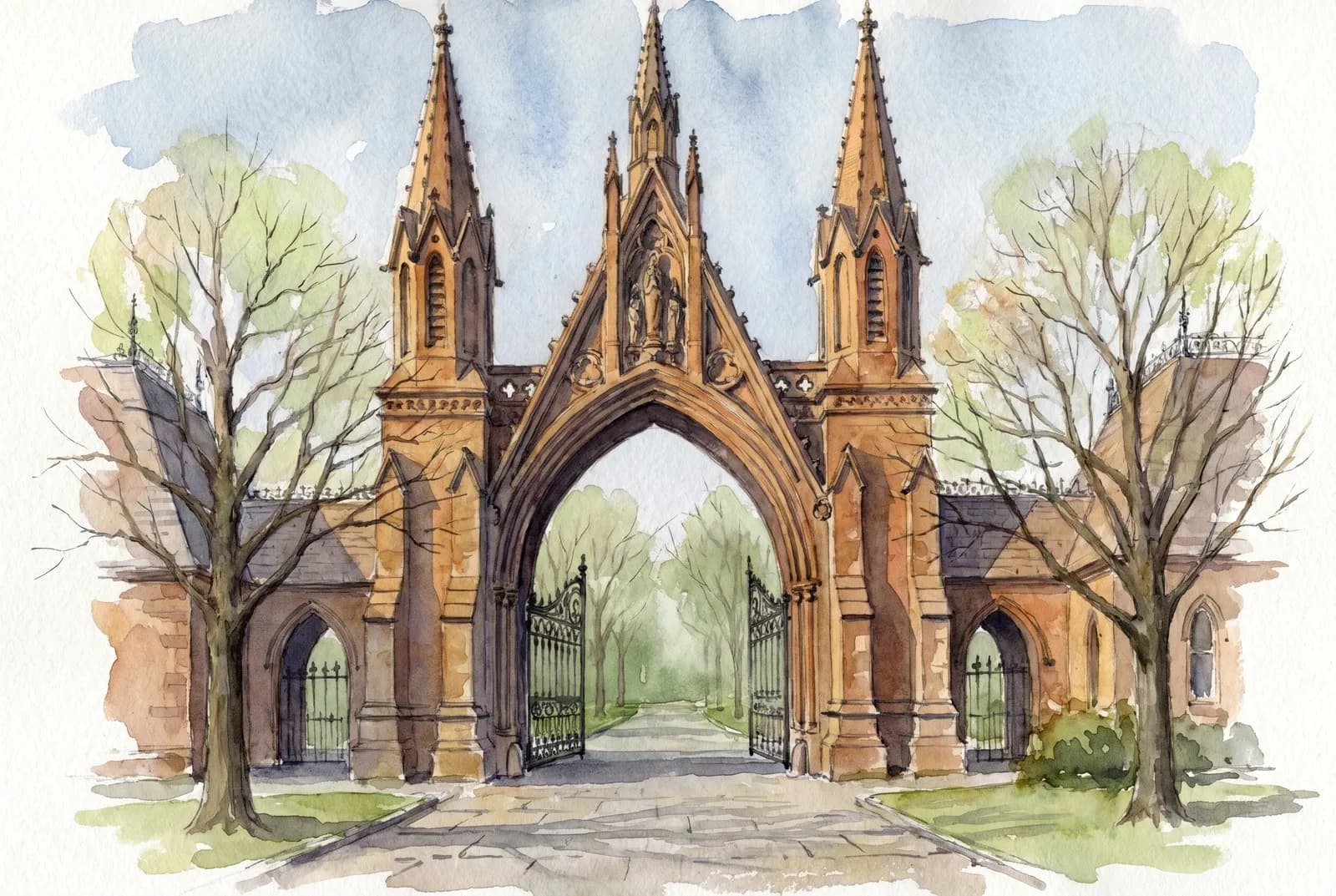
The main entrance at Fifth Avenue and 25th Street is one of the more underestimated pieces of architecture in the borough. The gatehouse and flanking towers were designed by Richard Upjohn — better known for Trinity Church on Broadway — and completed in 1861. Gothic Revival brownstone in clusters of pointed spires, ironwork that is substantial without being theatrical, the whole thing set slightly back from the avenue so it arrives as a composition rather than a wall.
What the gate actually does is frame a transition. The street outside is a working commercial block. Inside the gate, the path drops into a landscape that predates it by a generation: the tree canopy closes in, the grade shifts, and the temperature falls by a few degrees. That thirty-second crossing is one of the more effective threshold moments in the city — the kind you notice because you've gone from somewhere that is clearly the present into something that runs on a different clock.
The Company You Keep
Green-Wood was incorporated in April 1838, twenty years before Central Park was designed. By the early 1860s it was drawing half a million visitors a year — second only to Niagara Falls as an American tourist destination. This was not anomalous: rural cemeteries were the civic open space of their era, the places cities built before they understood they needed parks. Green-Wood's success helped make the argument for Central Park possible.
The 478 acres hold more than 600,000 permanent residents, and the names trace a rough history of the city in aggregate. Leonard Bernstein. Jean-Michel Basquiat — Brooklyn-born, returned to a Brooklyn hill. Louis Comfort Tiffany. Boss Tweed, who ran the city with considerable force for a decade before the city noticed. Horace Greeley. Charles Ebbets, who built the ballpark that no longer stands. They did not choose each other's company. They simply ended up here, over the span of nearly two centuries, which is its own form of document.
Battle Hill
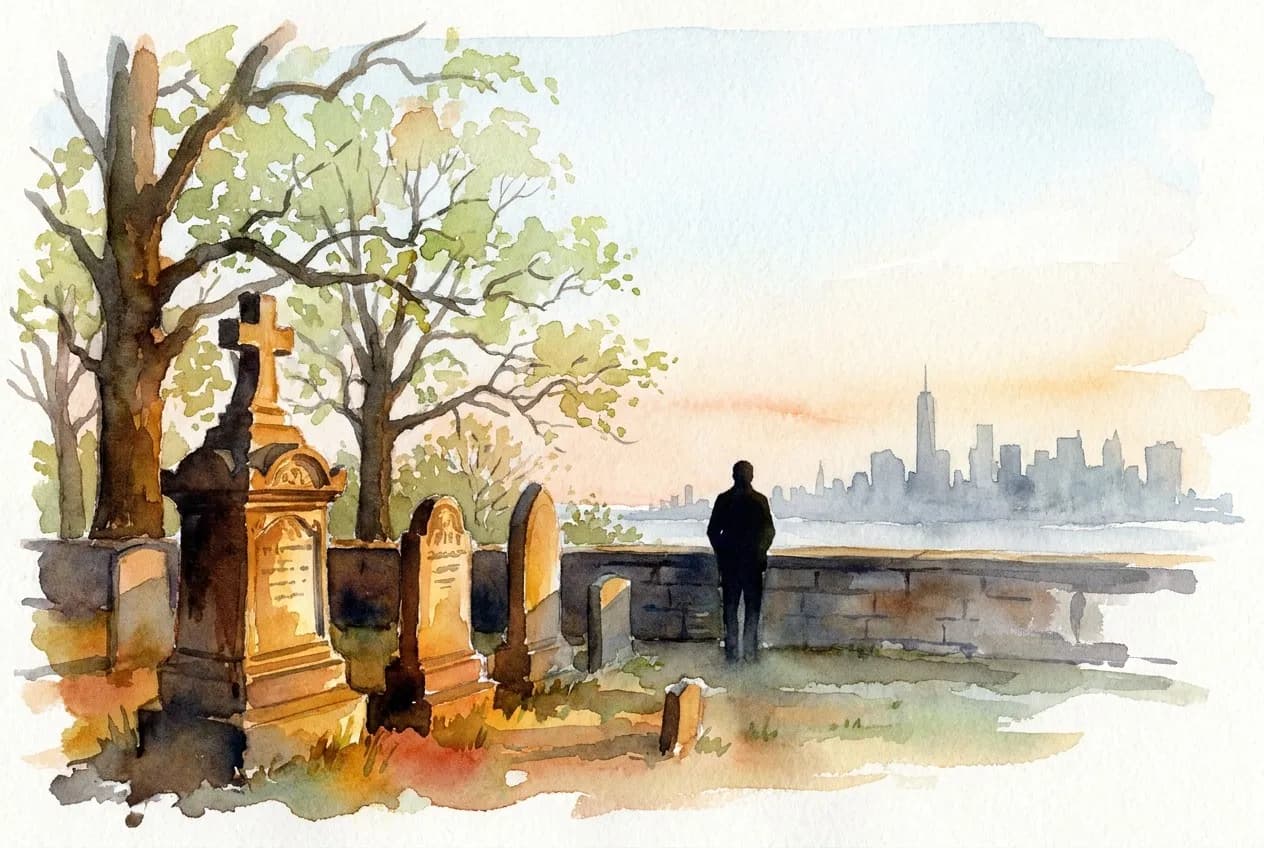
The cemetery's highest point is Battle Hill — also known historically as Gowanus Heights — rising to about 216 feet above sea level, making it the highest point in Brooklyn. On August 27, 1776, this ridge was where the Continental Army's rearguard held long enough to allow Washington's main force to escape across the East River. The Battle of Brooklyn was the largest engagement of the Revolutionary War by troop count, and this hill was the hinge.
At the summit there is a bronze statue of Minerva, placed so she faces southwest across the harbor toward the Statue of Liberty — which wasn't yet built when the statue was installed but which ended up precisely in her line of sight. The view from Battle Hill on a clear afternoon is one of the more honest harbor views in New York: unobstructed, unpaid for, and largely unattended, because most people who want harbor views in Brooklyn go to DUMBO and pay for the atmosphere. Here you share the view with the hawks, occasionally the monk parakeets that nest in the gatehouse eaves, and the people who found this spot the same way you did.
Practical notes
- Address: 500 25th Street, Brooklyn, NY 11232; main pedestrian entrance at Fifth Avenue & 25th Street
- Getting there: R/W train to 25th Street — the main gates are directly across from the station exit. D/N/Q to 36th Street also works and adds a longer approach through the neighborhood. From Industry City: walk east on 35th or 36th Street, about 15 minutes.
- Hours: Open daily 7am–7pm (closes earlier in winter; confirm at green-wood.com before going)
- Admission: Free for pedestrians; no reservation required for self-guided visits. Guided tours bookable at green-wood.com.
- Go for: The view from Battle Hill; the Richard Upjohn gateway; the Bloomberg Connects free audio guide
- Best window: Weekday afternoon, 2–4pm — the interior is nearly empty mid-week
- Walking solo: The Fifth Avenue entrance and main paths are open and well-trafficked during daylight hours; the older interior sections are very quiet after 4pm. Stick to the main routes if arriving near closing. The R/W 25th Street station is directly at the gate.
- What to do after: Walk south on Fifth Avenue into Sunset Park itself — the actual park, with benches and an unobstructed view of the bay — or take the R train back toward Industry City for food.
The point
The argument for spending an afternoon in a cemetery is not obvious. The argument for going the long way to get there — through the waterfront, up through the residential blocks, through the Upjohn gate — makes even less obvious sense from the outside. But Green-Wood is one of the places where the city's usual logic inverts. You go to be outside, without paying for the privilege, in a landscape that was well-designed before landscape design was a profession. You go for a hill with a harbor view that most New Yorkers don't know exists. You go for the particular quality of quiet that belongs to a place where 600,000 people are no longer in a hurry.
The walk from Industry City earns the hilltop. The neighborhood you pass through, the grade change, the threshold of the gate, and then the slow climb up to Battle Hill in the late afternoon with nobody telling you to move along — this is the sequence. New York has been going the long way home through this cemetery for 187 years. The view from Battle Hill has not gotten worse.
Tags: #greenwoodcemetery #greenwoodbk #brooklynwalks #sunsetparkbrooklyn #battlehill #thelongwayhome #nychiddengems #nycwalks #brooklynhistory #ruralcemetery #nycparks #walknyc #karpofinds #brooklynlandmark #historicnyc
Sources consulted: green-wood.com · wikipedia.org · untappedcities.com · asliceofbrooklyn.com · away.mta.info
All trademarks are the property of their respective owners.


