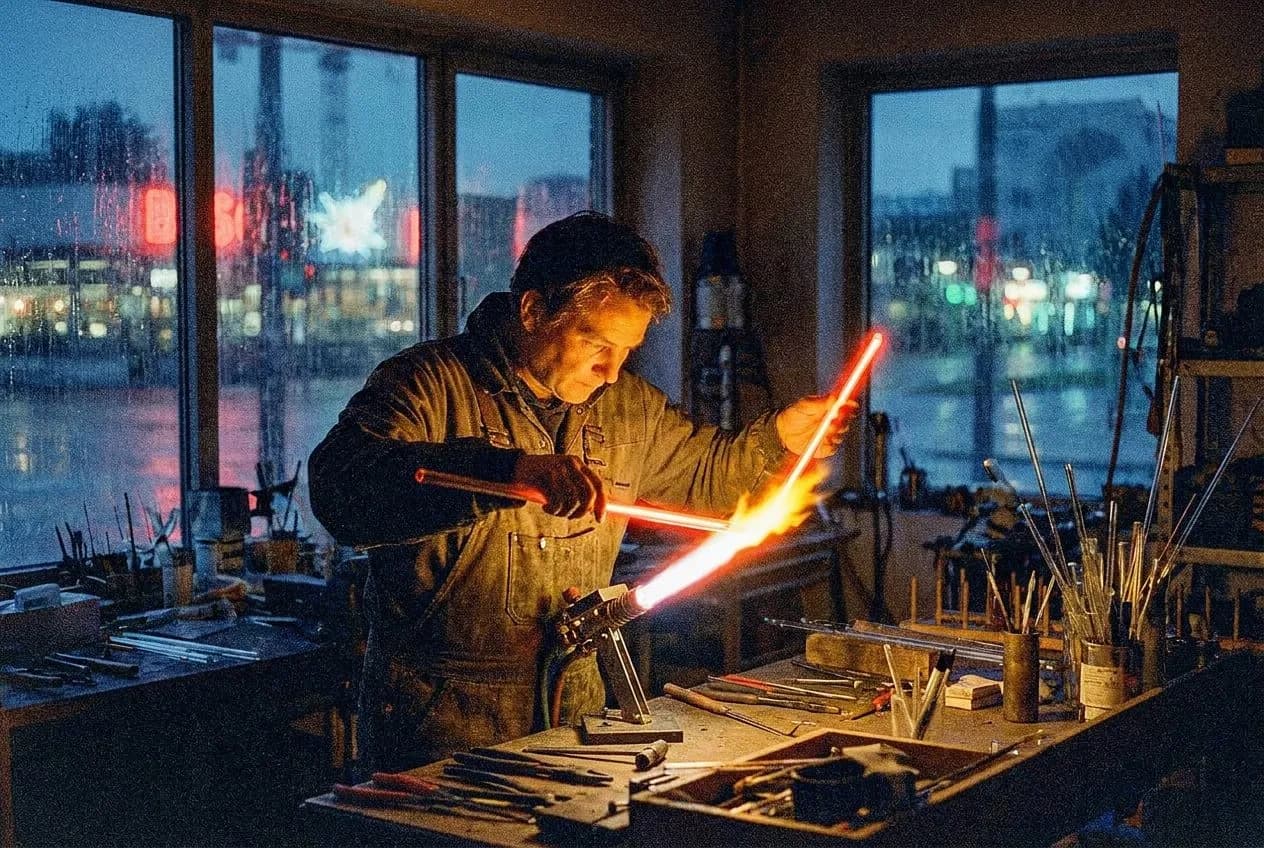
The ozone hits you first—sharp, electric, the smell of lightning bottled in an industrial loft. Then the heat shimmer above four ribbon burner stations, each one a tongue of blue flame waiting to soften borosilicate glass into curves and loops. This is not a museum. This is a working neon fabrication studio in Mott Haven, where a third-generation tube bender named Ray Costello shapes gas-filled glass using techniques his grandfather brought home from Times Square in the 1940s. The tools are vintage. The craft is uncompromising. The city guide crowd that stumbles in on Friday afternoons leaves with a new appreciation for what it takes to make light bend.
The Lineage
Ray learned to bend neon the old way: by watching his grandfather's hands. The elder Costello worked the marquee circuit when Broadway still glowed like a low-hanging constellation, back when every diner and dance hall needed a custom sign and craftsmen who could coax inert gas into readable script. Ray's father kept the trade alive through the lean decades when neon became shorthand for nostalgia or kitsch. Now Ray runs the studio with a quiet confidence that comes from knowing a skill most people assume is extinct.
The walls tell the story in fragments. Failed bends hang like sculpture—tubes that cracked during heating, welds that didn't seal, ambitious curves that collapsed under their own ambition. Electrode samples crowd a pegboard, organized by vintage and diameter. A collection of neon color charts from the 1950s and '60s shows hues that no longer exist, casualties of changing gas formulas and safety regulations. Ray keeps them as reference and reminder.
The Equipment
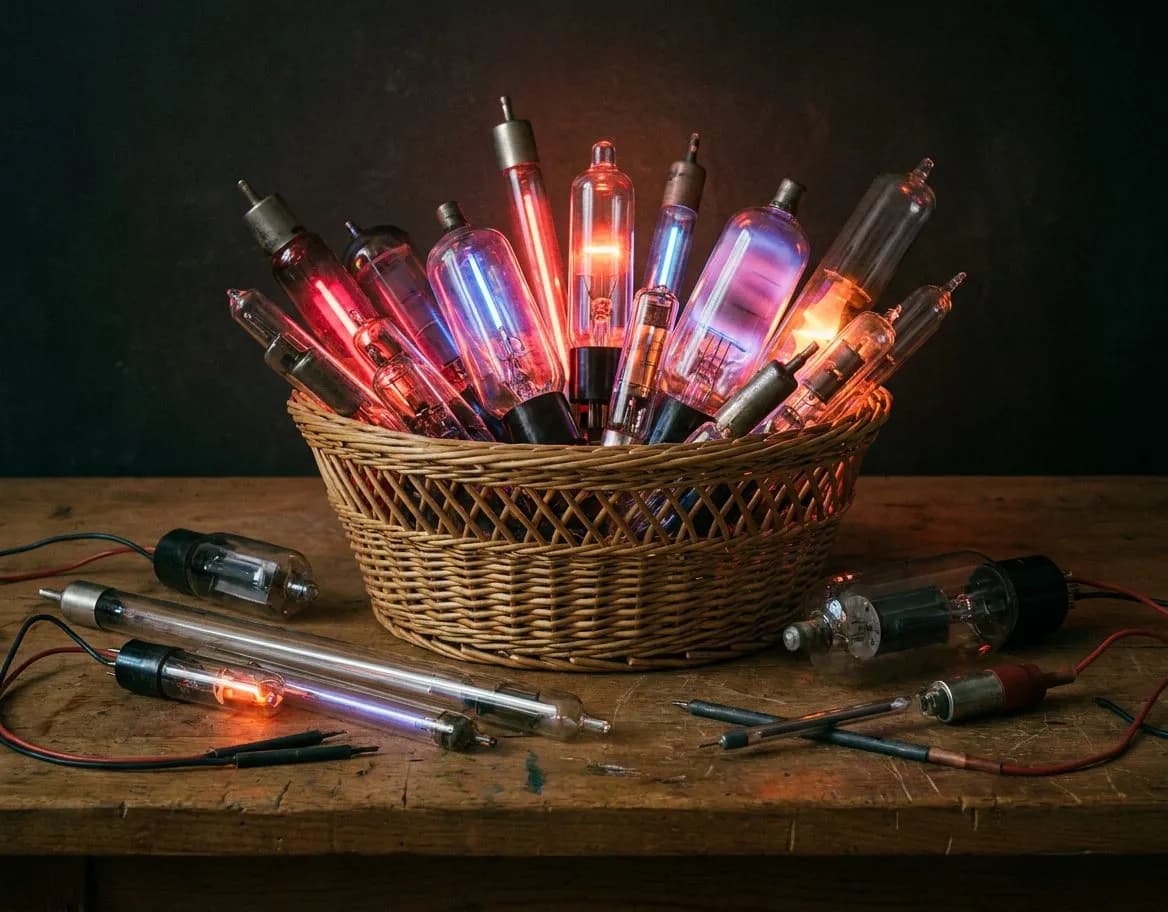
The studio operates four ribbon burner stations, each fed by a crossfire array that delivers precise, adjustable flame. A bombarding table occupies the back corner, crowned by a pair of original 1952 transformers that hum with a frequency you feel in your sternum. These transformers run hotter than modern equipment—a feature, not a bug. They require a twenty-minute warm-up cycle before electrode activation, a ritual Ray observes religiously. Rush the process and you risk cracking the glass-to-metal seal. Respect the timing and the electrodes fire clean, burning away impurities as gas ionizes into light.
The gas manifold is a bronze tree of valves supplying neon, argon, and mercury vapor. Each line is labeled in faded Dymo tape. The manifold feeds into a vacuum pump system that evacuates air from sealed tubes before the final fill. Watching Ray work the pumps and gauges is like watching a organist at a console—every move deliberate, every adjustment calibrated to decades of muscle memory.
The Mercury Question
One shelf holds the studio's most precious inventory: ampules of mercury vapor, all from pre-1980 stock. New mercury fills are restricted under environmental regulations, making vintage inventory essential for certain color temperatures—particularly the deep electric blues that defined mid-century signage. Ray rations the supply carefully, reserving mercury work for historically accurate restorations and clients who understand what they're asking for. The ampules glow faintly in their cardboard sleeves, waiting to be shattered inside evacuated tubes where vapor will coat the glass and shift the spectrum when current flows.
This isn't nostalgia. It's material reality. You cannot recreate a 1947 diner sign without the chemistry that made it glow in 1947. Ray has tried modern phosphor coatings and LED retrofits for clients who want the look without the liability. They never look right. Light has a memory, and mercury remembers.
Friday Open Hours
The studio unlocks Friday afternoons for open consultation hours—an informal tradition that has attracted a loyal following. Sign painters drop by with sketches and questions about letter spacing at scale. Theater prop masters arrive with reference photos from productions set in the 1950s and '60s, needing historically accurate neon for stage sets where every detail will be scrutinized under stage lights and close-ups. Ray listens, sketches, sometimes pulls a failed bend off the wall to illustrate why a particular curve won't hold or how gas pressure affects brightness. These sessions are free, though most visitors leave with a commissioned piece in the works and a two-month lead time locked in.
The open hours have become a minor scene. Cinematographers consult on color temperature. Graphic designers study letterforms that predate digital fonts. Occasionally someone wanders in from the neighborhood, curious about the glow visible from the street. Ray treats everyone the same—patient, direct, willing to explain but never to oversell. If a project is better served by LED, he'll say so. If it requires neon, he'll tell you why and what it will cost.
The Work
Current projects range from theater marquee restorations to custom film-set work. A ruby-red script for a Midtown steakhouse undergoing renovation sits on the finishing rack, awaiting final mounts. Across the room, Ray is halfway through bending a replica of a 1962 motel sign for a production designer who sent him a grainy Kodachrome slide as reference. The curves have to match exactly; the color has to read true on 35mm film stock. This is the work Ray prefers—projects with constraints, clients who care about accuracy over effect.
Commissions move slowly by design. Glass cannot be rushed. Bends require multiple heating passes. Electrodes must be sealed, evacuated, filled, bombed, aged, and tested. A single letter might take a day. A full sign can stretch across weeks. Ray works alone, though he has trained two apprentices who rotate through when large installations demand extra hands. The studio has no website, no Instagram presence. Work arrives by word of mouth, usually from someone who has stood in this space and watched light bend.
Why It Matters
Neon is fragile, obsolete by most measures, and utterly irreplaceable for certain kinds of light. It glows with a warmth LEDs cannot match. It hums at a frequency older than solid-state electronics. It breaks, and when it breaks, someone like Ray has to remake it by hand, tube by tube, bend by bend. Late 2026 finds the craft in an odd place—neither fully revived nor completely extinct, sustained by a small network of benders, collectors, and clients who refuse to accept substitutes.
Standing in the Mott Haven studio on a Friday afternoon, watching Ray soften glass over a ribbon burner until it glows tangerine and yields to slow, steady pressure, you understand that this is not about nostalgia. It is about light, chemistry, heat, and the irreducible fact that some things cannot be faked or downloaded or streamed. They can only be made, one tube at a time, by someone who knows how.
Practical notes
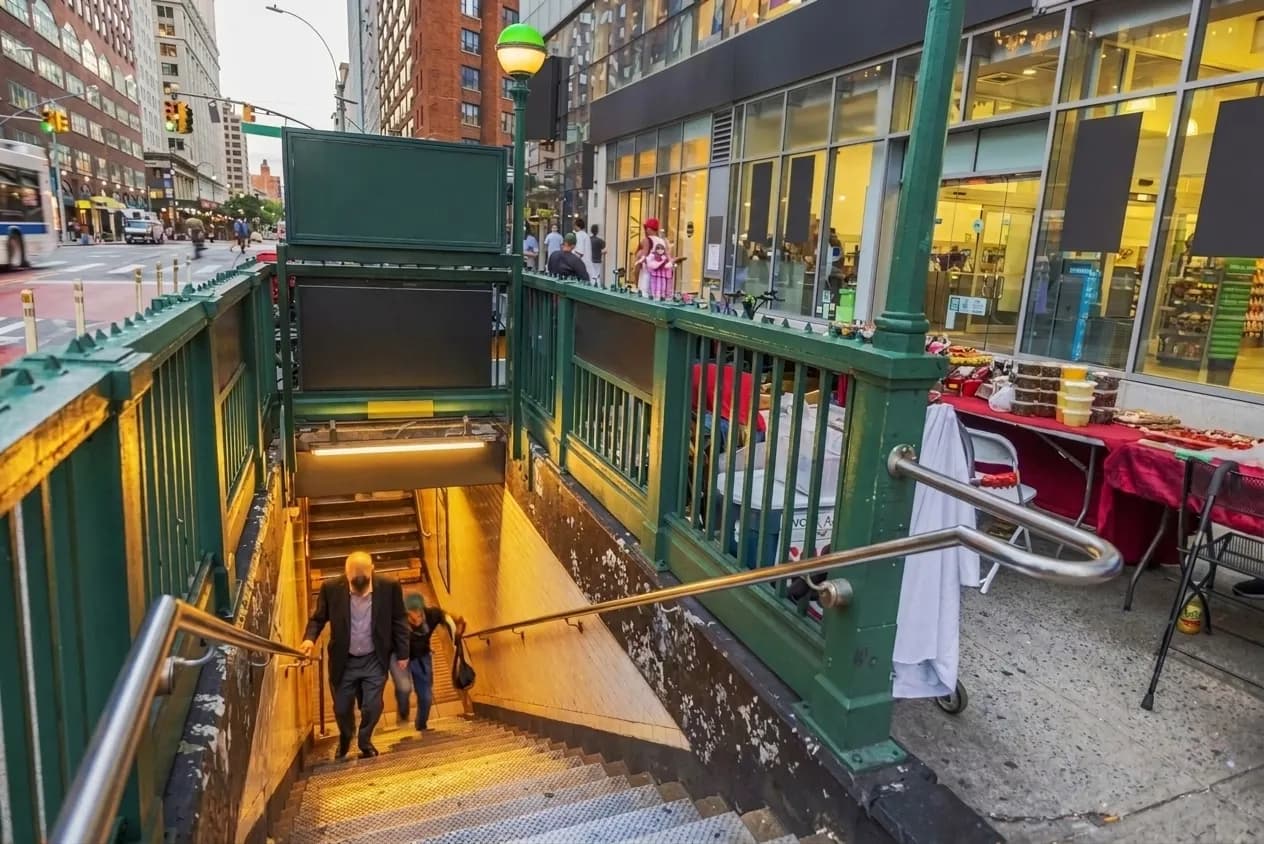
The studio is located in an industrial building in Mott Haven; verify the exact address and entry details directly, as the space shares entry with other workshops. Nearest subway: 6 train to Cypress Avenue, then a short walk from the station. Limited street parking available. Open studio hours are by appointment or during occasional open houses; call ahead to confirm. Custom commissions require a two-month lead time. The studio is located on the second floor; accessibility is limited by stairs. Bring reference images if consulting on a project. The space heats up considerably when burners are running—dress accordingly.
Tags: #VintageNeon #MottHaven #TheBronx #NYCCraftsmen #NeonSigns #TubeBending #TheOddEdit #IndustrialArt #NYCStudio #VintageEquipment #HandmadeLighting #NeonRestoration #NYCCityGuide #Summer2026 #HiddenWorkshops
Sources consulted: Neon Lighting · Mott Haven, Bronx · Bronx Parks · MTA Transit Info · NY Times NY Region
All trademarks are the property of their respective owners.