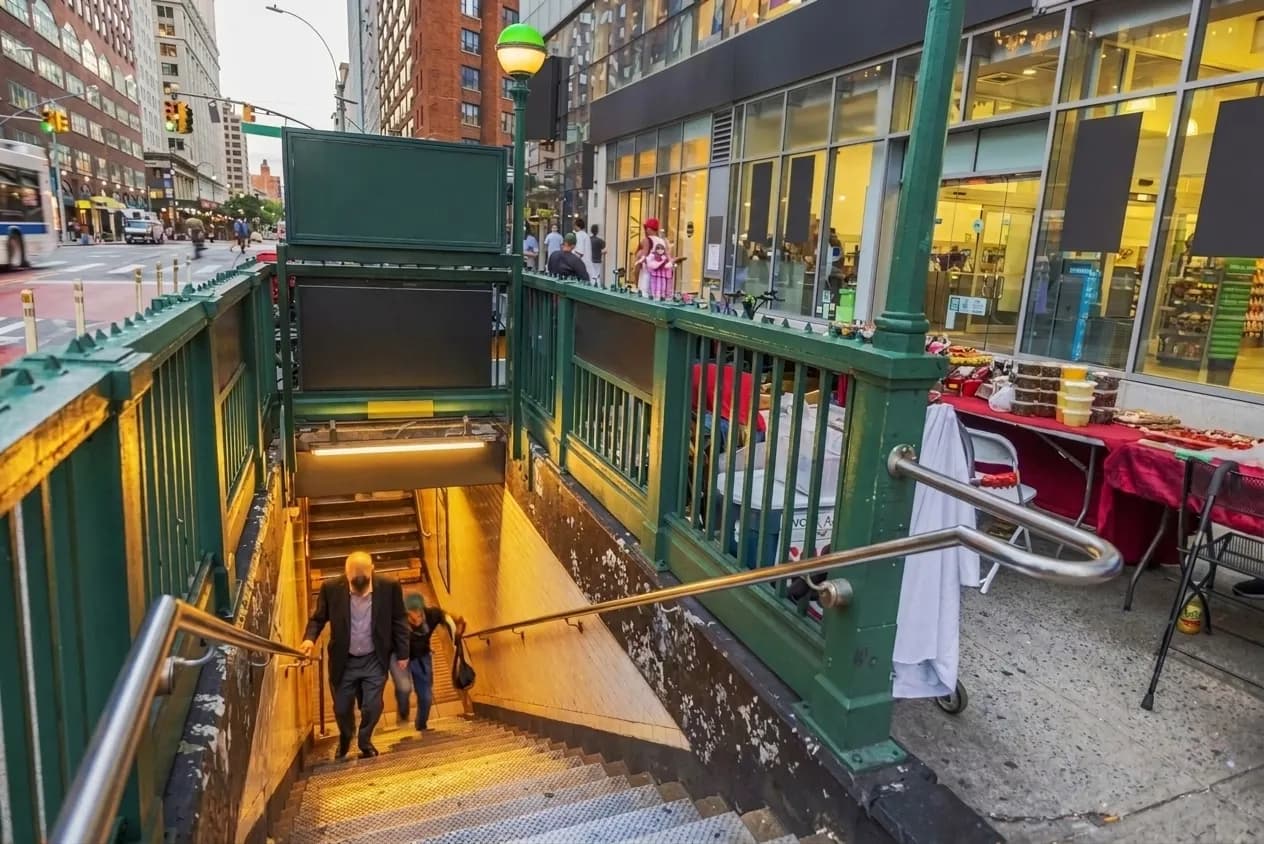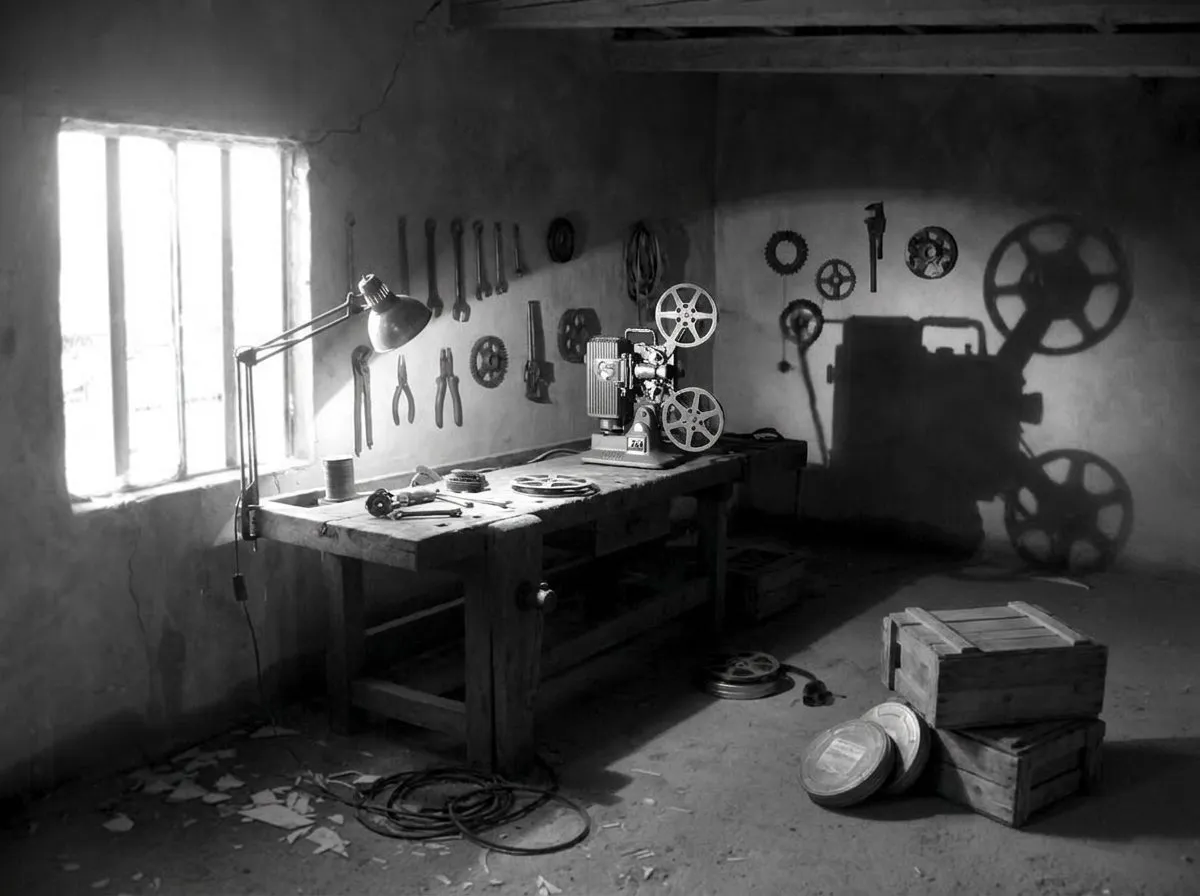
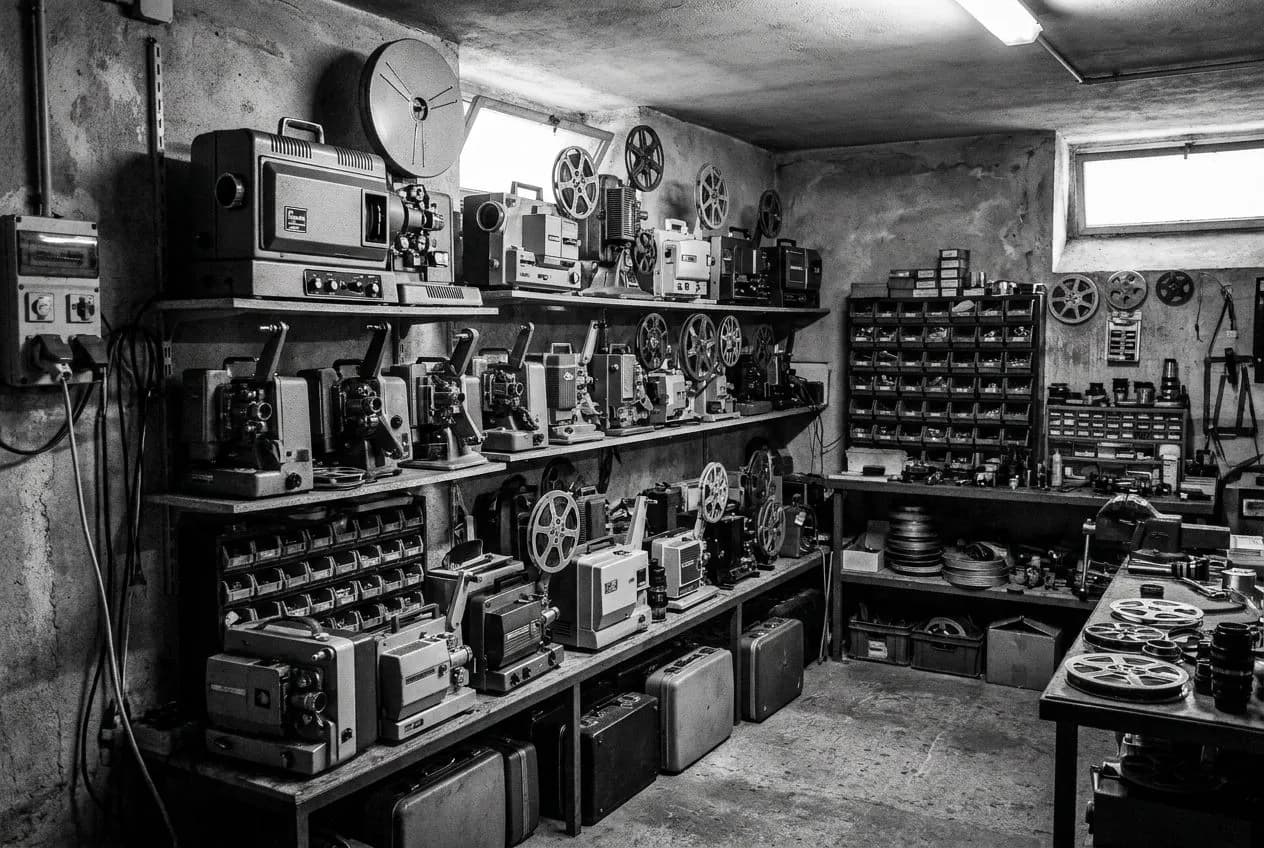
The stairs descend into a kind of institutional memory. Past the street-level door of a modest Sunnyside rowhouse, down thirteen steps, the basement opens into a workshop where Bell & Howell, Eiki, and RCA film projectors sit in various states of repair. The air carries machine oil and something sharper—ozone, the electric trace of carbon arc lamps. A workbench runs the length of one wall, its surface crowded with spools of replacement belts, carbon arc electrodes, and shallow drawers labeled with cryptic abbreviations: Geneva pins, gate springs, sound head shims. This is where analog cinema comes to live again, serviced by a technician who learned his trade in the last days before digital conversion emptied the projection booths.
The archive beneath the city
Against the far wall, metal shelving holds what amounts to a mechanical genealogy of New York exhibition. The workshop maintains a parts inventory salvaged from closed theaters including the Ziegfeld and Loews Paradise, organized by projector model and component type. Lamp housings from the Ziegfeld occupy one shelf; sprocket assemblies from the Paradise another. Each component is tagged with its provenance and condition, a catalog that reads like a requiem for the grand movie palaces.
The shelves tell you which theaters ran which equipment, which models survived longest, which parts failed first. Some components will never be used—obsolete formats, incompatible voltages—but they stay anyway, a reference library in steel and glass. When a microcinema arrives with a seized lamp house or a collector needs a replacement optical assembly, the technician knows exactly which shelf holds the donor machine. Provenance matters here, not for sentiment but for tolerances measured in thousandths of an inch.
Wednesday light shows
Wednesday afternoons often involve lamp house testing, briefly filling the basement with intense light as carbon arc electrodes are calibrated. The small casement windows at street level glow white for seconds at a time, visible from the sidewalk if you happen to be passing. Inside, the technician wears welding goggles and adjusts electrode spacing with micrometer precision, coaxing the arc into stable combustion. The test burns smell acrid and bright, a scent that anyone who worked projection in the arc lamp era recognizes immediately.
These calibration sessions serve dual purposes: verifying lamp house optics and training the occasional apprentice who shows up wanting to learn a vanishing skill. Most projectors arriving for service now use xenon lamps, but art installations and purist collectors still request carbon arc conversions for their specific flicker and color temperature. The work requires understanding not just mechanics but light itself—how it bends through condensers, how heat affects focus, how electrode composition changes the spectrum. It's chemistry as much as engineering.
The Geneva movement problem
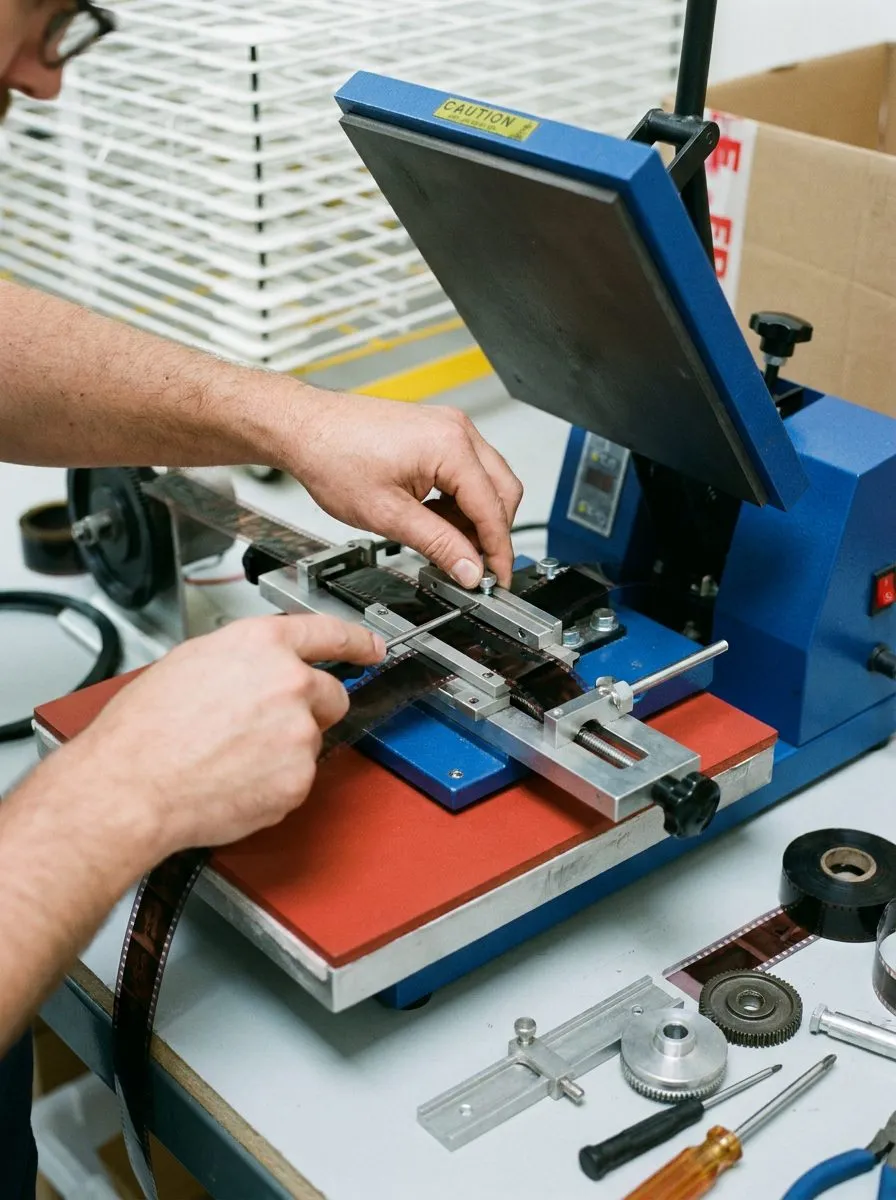
On the main workbench, a disassembled intermittent mechanism waits for attention. Geneva movement repairs require hand-fitting replacement pins to match worn film sprocket tolerances, taking six hours per mechanism. The technician works under magnification, filing salvaged pins to match the wear pattern of the existing cam, checking fitment with feeler gauges and test cycles. Too loose and the film registration drifts, creating visible frame jitter. Too tight and the mechanism binds, chewing sprocket holes and eventually jamming.
This is the repair that separates casual tinkerers from genuine technicians. The Geneva drive—that ingenious star-wheel mechanism that advances film frame-by-frame while briefly holding each image motionless in the gate—depends on tolerances that can't be approximated. Each pin must match not just the blueprint specification but the actual wear of the fifty-year-old components it mates with. The work is tedious, exacting, and utterly critical. A properly rebuilt Geneva movement will run another ten thousand hours without adjustment. A sloppy job destroys prints.
The technician learned these skills in a Midtown revival house projection booth in the 1990s, back when double features still meant physical reel changes and a scratched print could ruin an entire screening. He watched the digital conversion happen in real time—saw the projectors sold for scrap, the booths converted to storage, the knowledge dispersed. Now that knowledge has currency again, as microcinemas and art spaces rediscover the aesthetic qualities of film projection and collectors restore home cinema equipment from the golden age of optical engineering.
The wall of waiting machines
One corner holds projectors awaiting pickup, each tagged with a completion date and service summary. A Bell & Howell Filmsound from a Bushwick microcinema, gate realigned and sound head azimuth corrected. An Eiki SSL from a private collector in Westchester, motor rebuilt and lamp house resealed. An RCA 400 destined for a video art installation in Chelsea, modified for continuous loop operation. Turnaround runs two to four weeks depending on parts availability, longer if a Geneva movement needs rebuilding.
The opposite corner tells a different story: machines being parted out. Not every projector merits repair. Some arrive too damaged, too corroded, or too obsolete to justify the labor. These donate their components to the salvage shelves, their lamp houses and optical assemblies and motor mounts continuing the work in other bodies. There's something oddly dignified about this redistribution, a mechanical afterlife that keeps the whole ecosystem running. After a long session in the workshop, especially when the winter light fails early in late 2026 and the basement stays dark except for the workbench lamp, you understand these machines as what they are: precision instruments built to exceed their operators' lifespans, now outliving the industry that made them.
Who climbs the stairs
The clientele spans microcinema operators keeping weekly screenings alive, private collectors restoring home equipment, and video artists who need projectors for installations or performance work. Some arrive with clear diagnostics—a specific mechanical failure, an optical misalignment. Others bring machines that simply stopped working decades ago, their problems compounded by amateur repair attempts and improper storage. The consultation itself is instructive, as the technician explains what failed, why it failed, and what's required to restore function.
Occasionally someone arrives having just discovered a projector in an estate sale or theater liquidation, hoping for a valuation or restoration estimate. These conversations often end with referrals to archival organizations or museums, places better equipped to preserve equipment that belongs in collections rather than service. The workshop operates as repair facility, yes, but also as informal clearinghouse for knowledge about what survives, what's salvageable, and what matters. After a session here, you might find yourself walking Sunnyside's quiet blocks thinking about infrastructure—not the digital kind everyone discusses over dinner at nyc restaurants, but the mechanical substrate that kept images moving for a century before the pixels arrived.
Practical notes
The workshop operates in a basement beneath a Sunnyside rowhouse, a short walk from the 46th Street station on the 7 train. Services run Wednesday through Friday afternoons; contact ahead to arrange equipment drop-off or consultation. Street parking is generally available along residential blocks. The basement has limited wheelchair access. Repairs take two to four weeks depending on parts availability and scope of work. Bring documentation if available—original manuals, service records, any prior repair history. The workshop handles 16mm and 35mm equipment; format referrals available.
Tags: #VintageFilmProjector #SunnysideNYC #16mmFilm #35mmFilm #AnalogCinema #FilmProjection #Microcinema #ProjectorRepair #TheOddEdit #NYCWorkshops #CinemaHistory #MechanicalRestoration #QueensNYC #Winter2026 #FilmPreservation
Sources consulted: Movie Projector · 35mm Film · Sunnyside, Queens · NYC Film Industry · Film in NYC
All trademarks are the property of their respective owners.