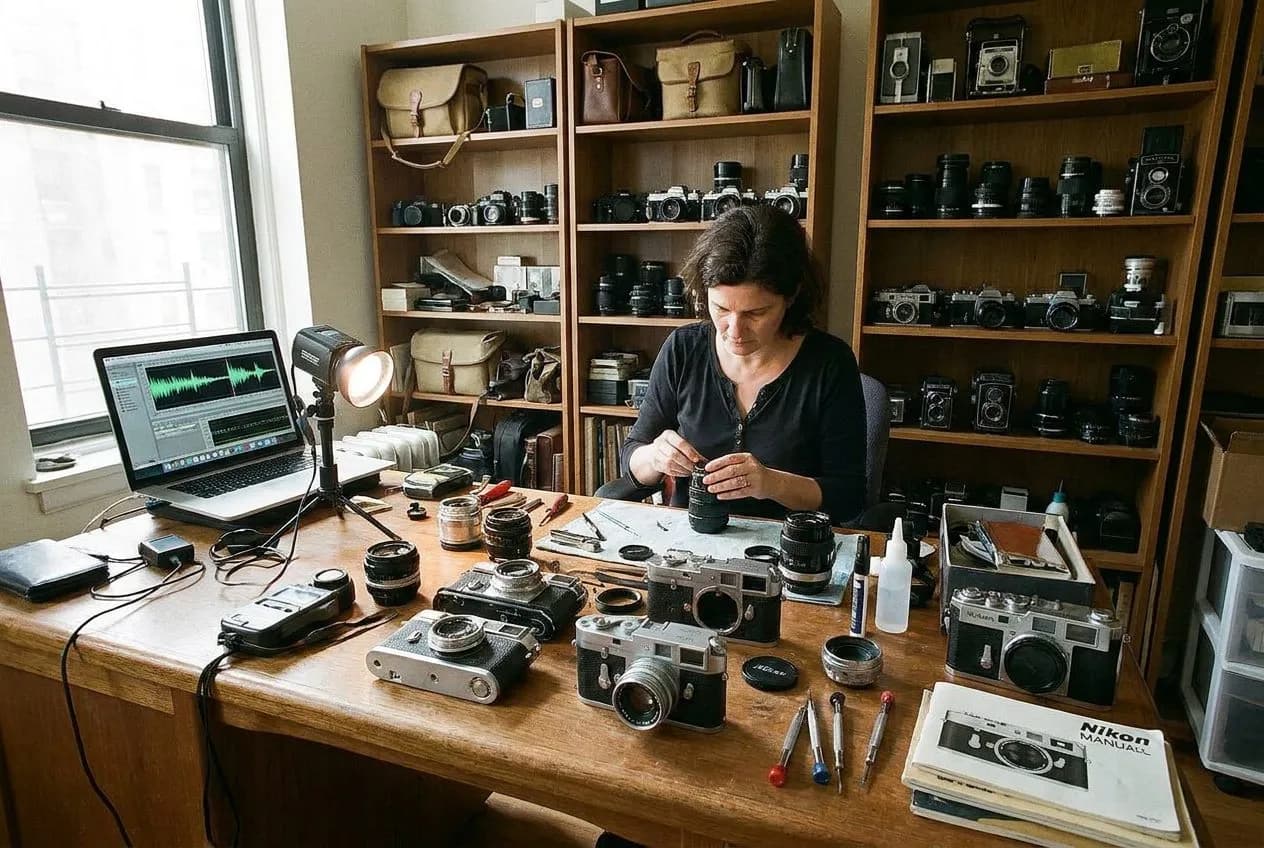
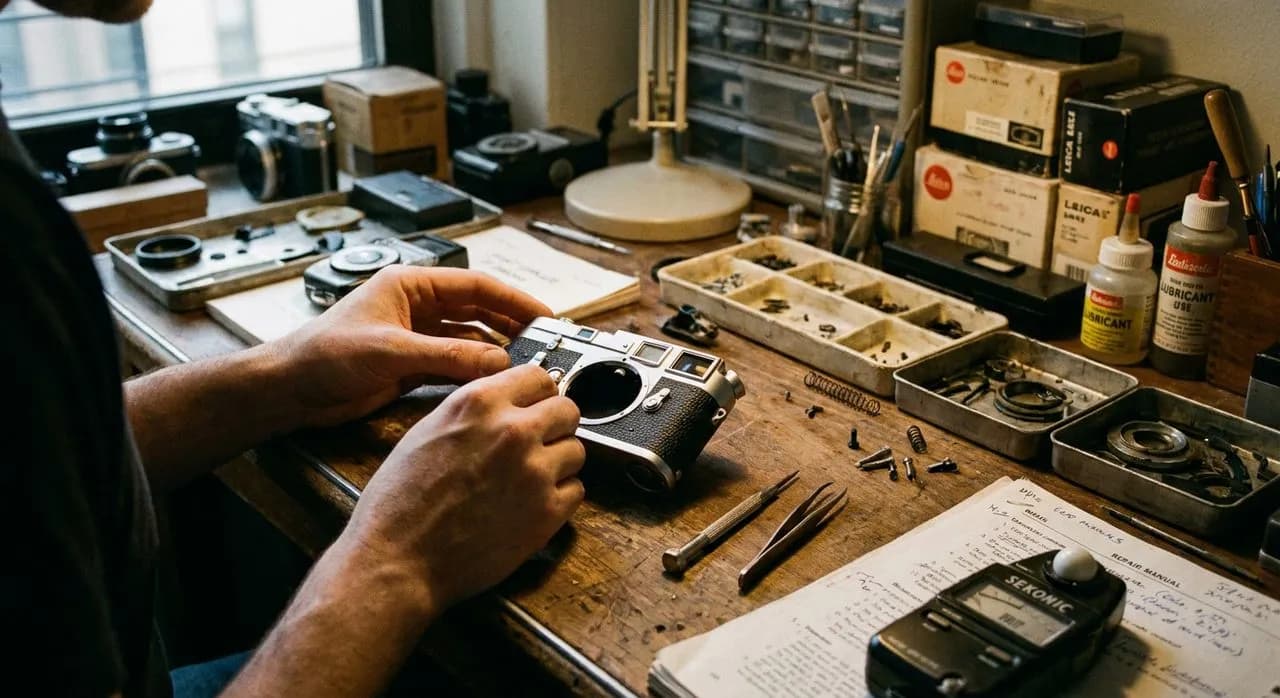
The door opens on the third floor to reveal a worktable covered in microfiber cloths, each supporting a disassembled camera body. Leica rangefinders sit with their top plates removed, exposing brass gears and cloth shutters. A Nikon F body rests nearby, its mirror box cradled in a foam holder. Strobe lights flash at intervals as the technician tests shutter curtains. The air smells faintly of naphtha and metal polish. This is not a storefront or a commercial repair lab. It is a Stuyvesant Town studio apartment, rent-stabilized and converted after hours into one of the city's most trusted destinations for mechanical film camera repair. Appointments are made by text. Drop-off and pickup happen in the building lobby. The work itself happens here, under task lighting, with calibrated standards and audio analysis software running on a decade-old laptop.
The Workspace
The studio is small but meticulously organized. Shelves hold parts bins labeled by decade and manufacturer: light seals, shutter ribbons, mirror bumpers, rangefinder cams. A jeweler's loupe sits beside a set of precision screwdrivers. The technician works at a height-adjustable desk positioned near the window, catching late afternoon light when it cooperates. One corner is dedicated to optical work, with lens elements arranged in order of disassembly, marked with painter's tape to preserve orientation.
On the top shelf, a Nikon F2 sits in a place of honor. It is the technician's personal camera, used to test replacement parts and demonstrate shutter sound differences to clients before repair. The soft thwack of a well-adjusted cloth shutter versus the louder slap of a deteriorated one becomes immediately clear when heard side by side. It is a teaching tool and a benchmark. Some clients request that their cameras be tuned to match its timing. Others simply want theirs to work reliably again before summer travel, before the next trip where film matters.
The Calibration Process
Shutter speed calibration is the most common request. Mechanical cameras drift over time; springs weaken, lubricants thicken, escapements lose their edge. The technician uses a combination of strobe photography and audio analysis software to measure actual exposure times against the engraved dial markings. A camera set to 1/500th might be firing at 1/350th. The difference matters. Shutter speed calibration costs sixty-five dollars for mechanical bodies. It takes patience and incremental adjustment, tensioning springs by fractions of a turn until the timing aligns.
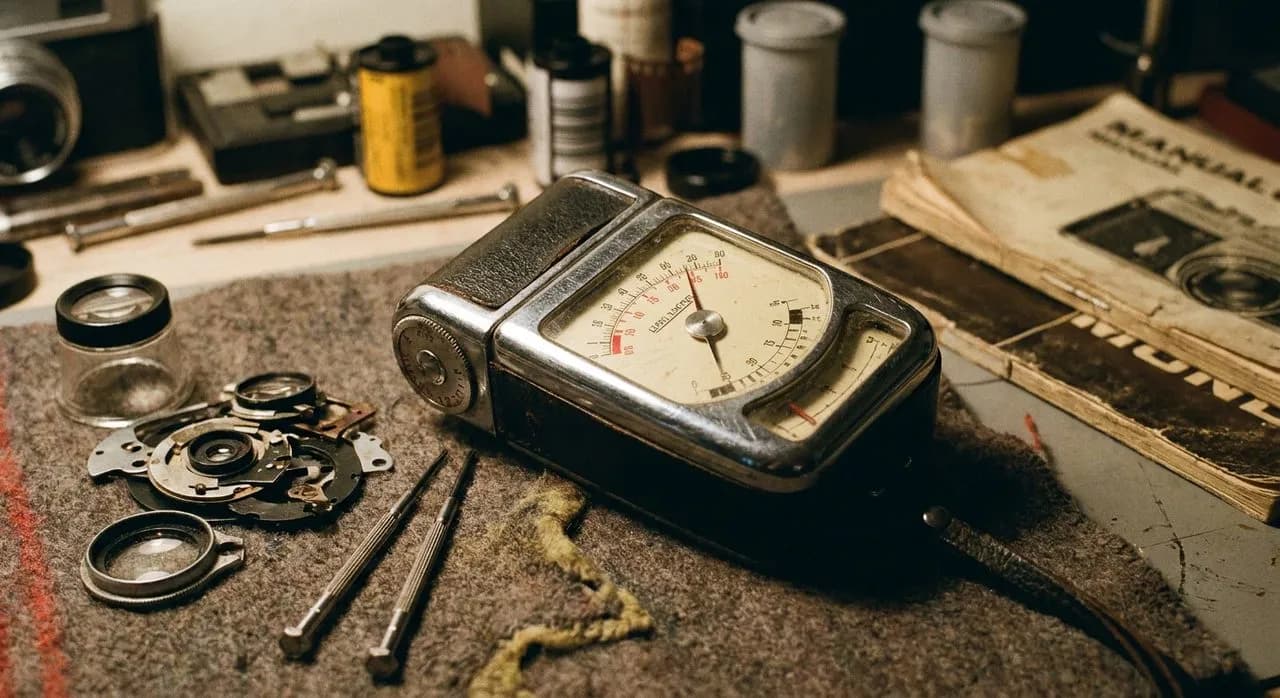
Light meter calibration follows a similar discipline. The technician uses a calibrated standard, a stable light source with known luminance, to test meter accuracy across the exposure range. Many cameras that seem to underexpose by a stop are simply reading the scene two decades out of tune. The repair involves adjusting resistor values or cleaning corroded contacts. For some older selenium-cell meters, recalibration is impossible; the cell itself has degraded. In those cases, the technician recommends a handheld meter or shooting sunny-sixteen. Honesty is part of the service.
Light Seals and Lens Fungus
Light seal replacement adds thirty dollars to the bill. The original foam has usually turned to black tar, leaking onto film pressure plates and leaving streaks on negatives. The technician cuts new seals from sheet stock, shaping them to fit door channels and hinge gaps. The work is tedious but transformative. A camera that has been leaking light for years becomes tight again.
Lens fungus cleaning adds forty dollars per element group. Fungus grows between lens elements in humid storage, etching the coatings if left unchecked. The technician disassembles the lens barrel, separates the elements, and cleans each surface with diluted ammonia and cotton swabs. Not all fungus damage is reversible. Light coatings can be polished away, but deep etching remains. The technician photographs the lens before and after, so clients understand what has been saved and what was lost to time.
Scheduling and the Day Job
The technician works a day job in software. Camera repair happens after hours and on weekends. Weekday evenings between six and eight p.m. are the most reliable appointment slots. The technician gets home around six, eats something quick, and sets up for the evening's work. Weekend mornings are reserved for complex rangefinder adjustments, the kind that require undistracted focus and multiple rounds of testing. Leica rangefinders, in particular, demand precision. Vertical alignment, horizontal alignment, and cam timing must all converge. It can take three hours to dial in a single body.
Clients text to schedule. The technician responds within a day, usually with a few options. Drop-off happens in the lobby; the client leaves the camera with the doorman or meets briefly at the elevator. Turnaround is typically one to two weeks, depending on the repair queue and parts availability. Rush jobs are possible for an additional fee, though rarely necessary. Most clients are patient. They have waited years to get these cameras serviced. Another week is tolerable.
Who Brings Cameras Here
The clientele skews younger than you might expect. Many are in their twenties and thirties, shooting film as a deliberate counterpoint to digital ubiquity. They buy cameras at estate sales and thrift stores, inherit them from grandparents, or find them at the back of closets. The cameras often need work. Shutters stick. Meters are dead. Lenses are hazy. They arrive with questions: Is this fixable? Is it worth it? The technician answers both with the same measured honesty that defines the rest of the operation.
Some clients are older, returning to film after decades away. They bring cameras they shot with in the eighties, bodies that have been sitting unused since the switch to digital. The light seals are gone, the lubricants have gummed, but the bones are good. A few hours of work and the cameras are sharp again. There is a quiet satisfaction in bringing something back, in making it whole enough to use.
Why It Works Here
The rent-stabilized studio makes the economics viable. A commercial storefront in Manhattan would require higher throughput, faster turnarounds, and less patient work. Here, the overhead is low. The technician can afford to spend three hours on a rangefinder alignment, to take apart a lens twice if the first cleaning was not enough. The work is careful because it can be. The apartment setting also creates a certain intimacy. Clients see the workspace, the tools, the personal camera on the shelf. There is transparency in the process. Trust builds naturally when the work happens in front of you, when you can hear the shutter fire before and after adjustment.
Practical notes
The service operates by appointment only, scheduled via text. The building is in Stuyvesant Town; the exact address is provided upon booking. Nearest subway: L train to 1st Avenue or 6 train to Astor Place, both roughly a ten-minute walk. Street parking is possible but metered. Building entry requires clearance; clients typically meet in the lobby for drop-off and pickup. Bring the camera, any accessories, and a description of the issues you have noticed. Payment is cash or Venmo. Turnaround is one to two weeks; verify current lead time when scheduling. The technician does not maintain a website.
Tags: #VintageFilmCameraRepair #StuyTown #LeicaRepair #NikonF #FilmPhotography #LightMeterCalibration #MechanicalCameras #FilmCameraService #NYCRepair #TheOddEdit #FilmShooters #AnalogPhotography #CameraRestoration #FilmRevival #StuyTownNYC
Sources consulted: Leica Camera · Stuyvesant Town–Peter Cooper Village · Nikon Official Site · Time Out New York · Rangefinder Camera
All trademarks are the property of their respective owners.