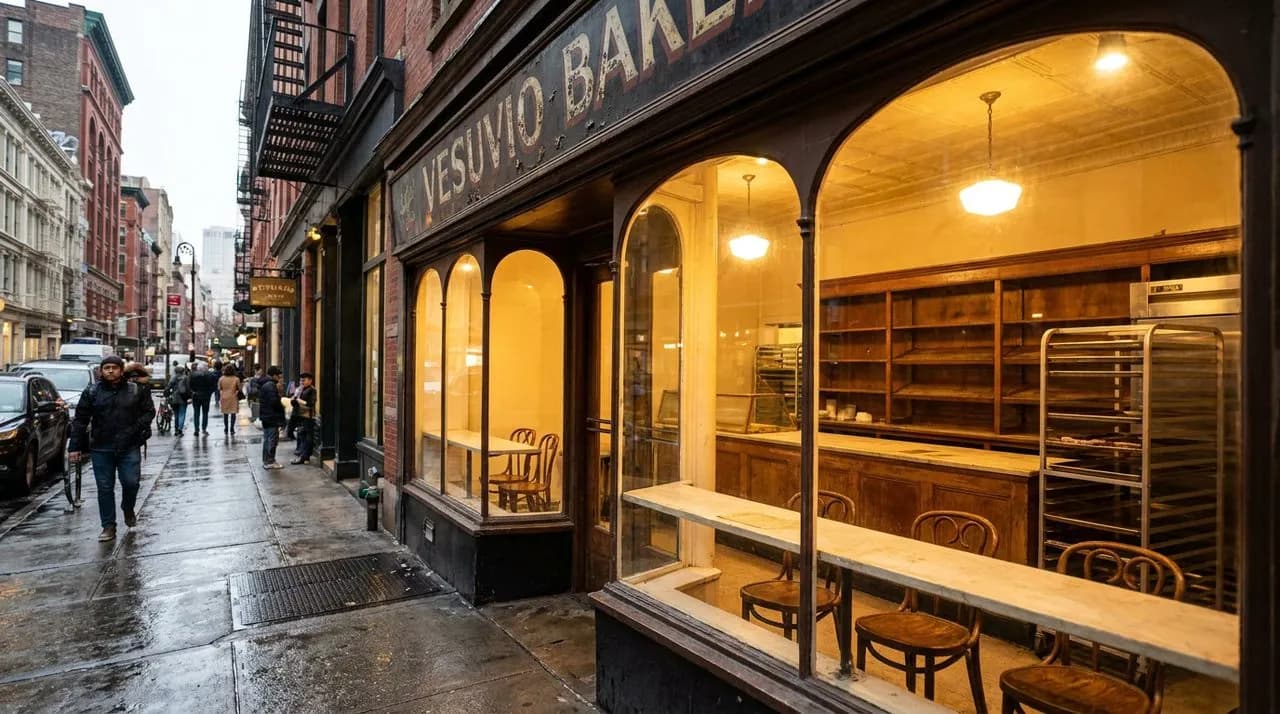
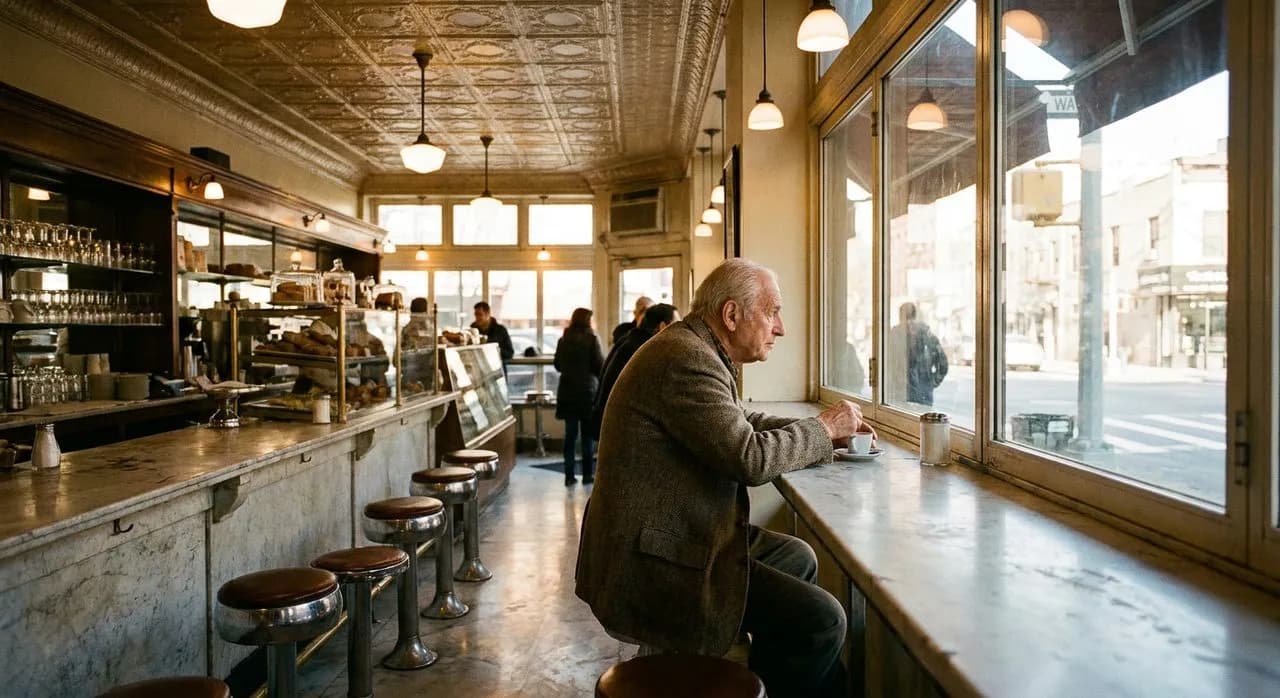
The brass door handle at 160 Prince Street still turns, even though Vesuvio Bakery closed in 2012. Inside, the tin ceiling catches the same light it did when this was a neighborhood bakery feeding longshoremen and artists who couldn't yet afford to leave. The ovens are cold. The flour is long gone. But the marble counter runs the length of the storefront, four stools are bolted to the floor, and every morning the space opens as a cafe counter without a kitchen, a register, or a single thing to sell.
A storefront that refuses to disappear
Vesuvio's Romanesque facade—arched windows, hand-painted gold lettering, the kind of craftsmanship that stopped being economical sometime around 1950—survived because 160 Prince Street became a film-location darling. It stood in for old New York in enough productions that preserving the exterior became more valuable than replacing it. When the space was converted to storefront seating in 2022, the intervention was surgical: keep the bones, add coffee.
The result is one of the city's quieter experiments in adaptive reuse cafes, though no one markets it that way. There's no Instagram handle for the counter itself, no branded signage beyond the original Vesuvio script. It simply exists, a semi-public room where you can sit if you bring your own cup.
How the delivery window works
Birch Coffee operates nearby on Prince Street, and between seven and eleven in the morning, they'll deliver directly to the Vesuvio counter. You order at Birch, give them the Vesuvio address, and a runner brings your drink while you claim a stool. After eleven, the delivery courtesy ends and you carry it yourself—a one-minute walk that feels longer when you're balancing a cortado and a pastry bag.
The system is informal, reliant on morning regulars who understand the rhythm. There's no menu at the counter, no bell to ring. You're borrowing the space, not renting it, and the unspoken compact is that you'll buy something next door and not overstay once the lunch crowds start pressing in.
The corner stool and the morning sun
Seating strategy matters here. The corner stool on the right side catches morning sun from eight-thirty to nine forty-five and frames the crosswalk that leads to Fanelli Cafe, the 1847 tavern that anchors the opposite corner. It's the best seat for people-watching: dog walkers, gallerists opening up, the occasional film crew scouting locations. The light through the old glass is soft, faintly warped, the kind that makes even a phone screen feel like an intrusion.
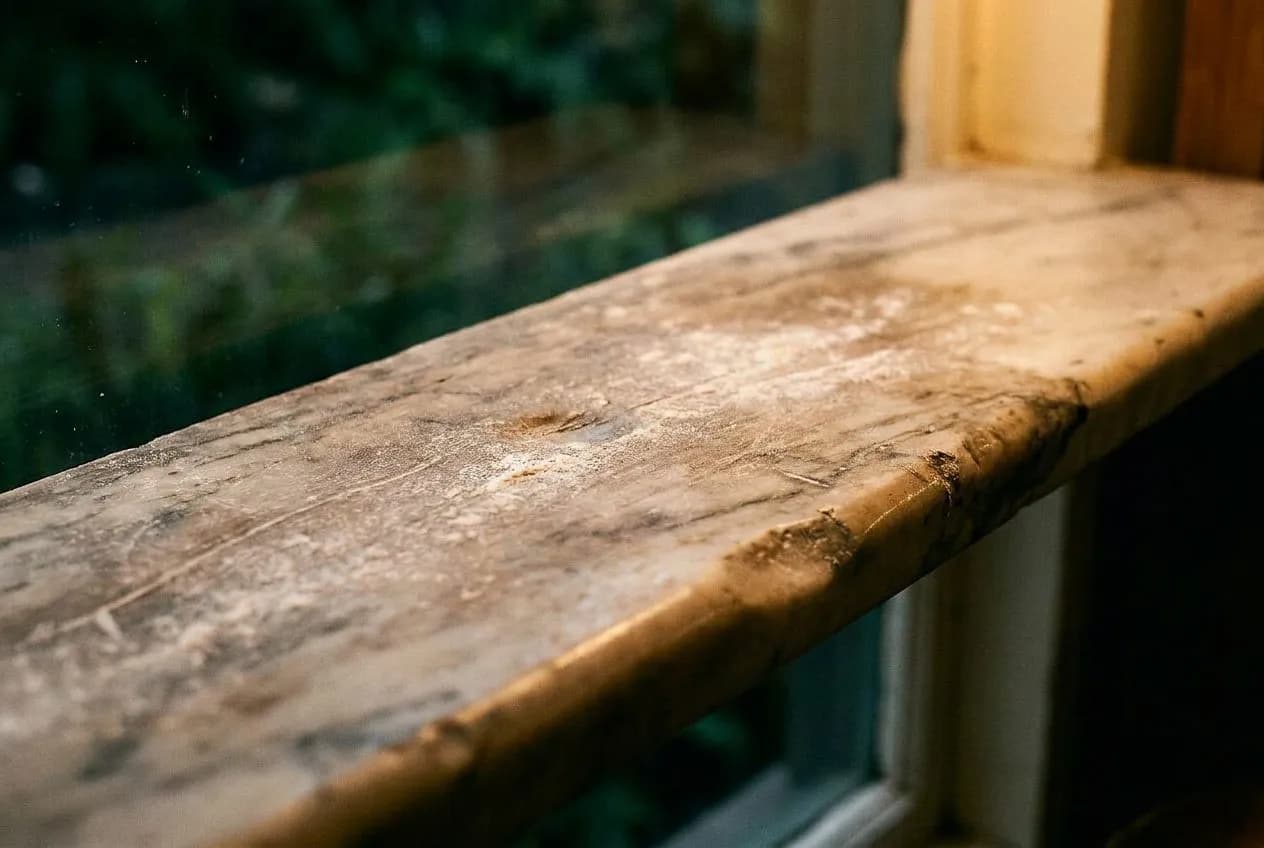
The other stools face Prince Street straight-on, better for reading or zoning out. The marble stays cool year-round, pleasant in summer, less so in January. A previous tenant left a stack of vintage New Yorkers on the narrow shelf behind the counter; no one polices whether you read them or contribute to the pile.
The waiting room
Locals have taken to calling the counter 'the waiting room,' and the nickname fits. It's the quietest perch in SoHo on weekday mornings before ten, a strange pocket of calm in a neighborhood that spent the past two decades toggling between luxury retail and influencer photo safaris. You're still in the scrum—Prince Street is never truly quiet—but the century-old glass and the tin ceiling create just enough acoustic distance that conversations outside become texture rather than distraction.
By mid-morning the waiting room fills: someone killing time before a gallery appointment, a freelancer who burned out on the WeWork aesthetic, tourists who wandered in thinking it's still a bakery and decided to stay anyway. The turnover is organic. No one lingers past an hour. The space doesn't encourage it.
What remains, what's gone
The ovens are still visible behind a low partition, massive iron chambers that haven't held fire in more than two decades. The tile work around them—cream and hunter green, chipped at the edges—is original. So is the wooden shelf that once held cooling loaves, now empty except for the occasional forgotten paperback. The smell of bread is long gone, replaced by espresso and, faintly, the plaster-dust scent of old buildings that no longer sweat from daily heat.
What's new is minimal: the stools, a small speaker playing jazz at low volume, a QR code taped to the counter linking to Birch's menu. The hand-painted Vesuvio sign remains untouched, gold leaf on forest green, the kind of sign that would cost fifteen thousand dollars to recreate and still wouldn't look right. Preservationists won this round by accident.
Why it works in late 2026
The counter thrives because it asks almost nothing of you. No membership, no minimum spend enforced at the threshold, no staff monitoring how long you've been sitting. In a city that increasingly monetizes every square foot, a semi-public room with century-old light and no upsell feels like contraband. It's not free—you're expected to buy coffee next door—but the transaction is displaced, softened, easy to forget once you're on the stool watching SoHo wake up.
It also works because it's small. Four stools mean the space can't be overrun, can't become a coworking lounge or a popup venue. The scale enforces intimacy. You're aware of the person two seats down, the couple debating which gallery to hit first, the runner delivering someone's oat-milk latte. It's a shared space that never feels crowded, a trick of proportion and light.
Practical notes
Vesuvio counter, 160 Prince Street (between Thompson Street and West Broadway). Nearest subway: Spring Street (C, E) or Prince Street (N, R, W). The counter is accessible from street level; the space is narrow and stools are fixed. Open daily, morning through early evening, though hours follow Birch Coffee's rhythm—verify directly if you're planning around the early delivery window. Bring your own reading material or just your phone; there's no Wi-Fi password posted, and cell signal does the job. Street parking is a fantasy; plan on the subway or a cab.
Tags: #VesuvioBakery #SoHoMornings #PrinceStreet #StorefrontSeating #BirchCoffee #AdaptiveReuseCafes #QuietSoHo #NYCHiddenGems #PullUpAChair #VintageNewYork #NeighborhoodCoffee #ManhattanMornings #OldSoHo #CityCounters #NYCCafeLife
Please drink responsibly. Must be of legal drinking age.
Sources consulted: SoHo, Manhattan · Vesuvio Bakery · NYC SoHo Guide · Time Out New York SoHo
All trademarks are the property of their respective owners.