At the end of a jetty in the San Francisco Marina small-boat harbor, behind the Palace of Fine Arts and past the yacht club, there is a free public artwork that you can only experience properly on a specific schedule. It has no signage larger than a plaque. It has no opening hours. It has no tickets. And it only really works, as the sculpture its creators intended, for a few hours a day around high tide.
It is called the Wave Organ. It was built in 1986. It is free, always, forever. And it is one of the most rewarding forty-five-minute detours on the San Francisco waterfront, on the condition that you show up at the right time.
What it is
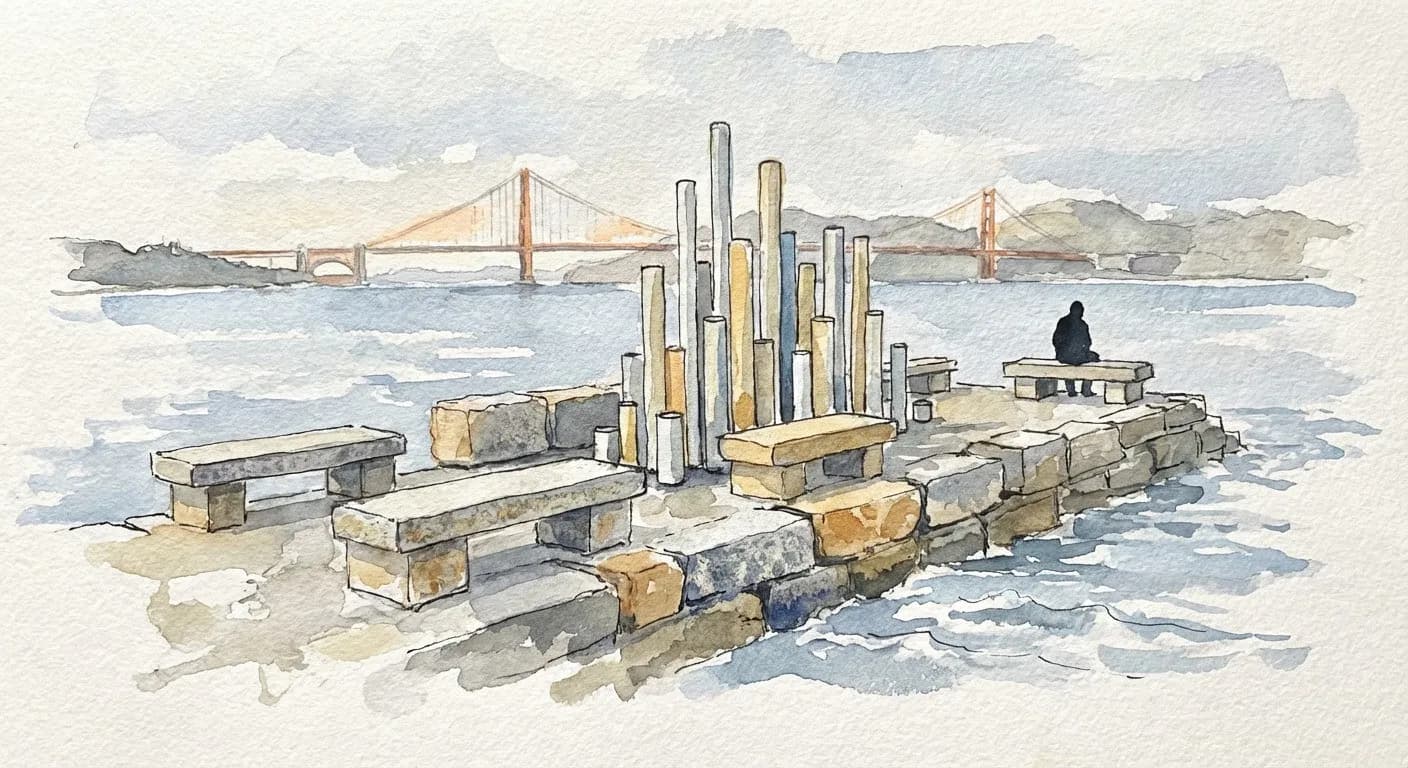
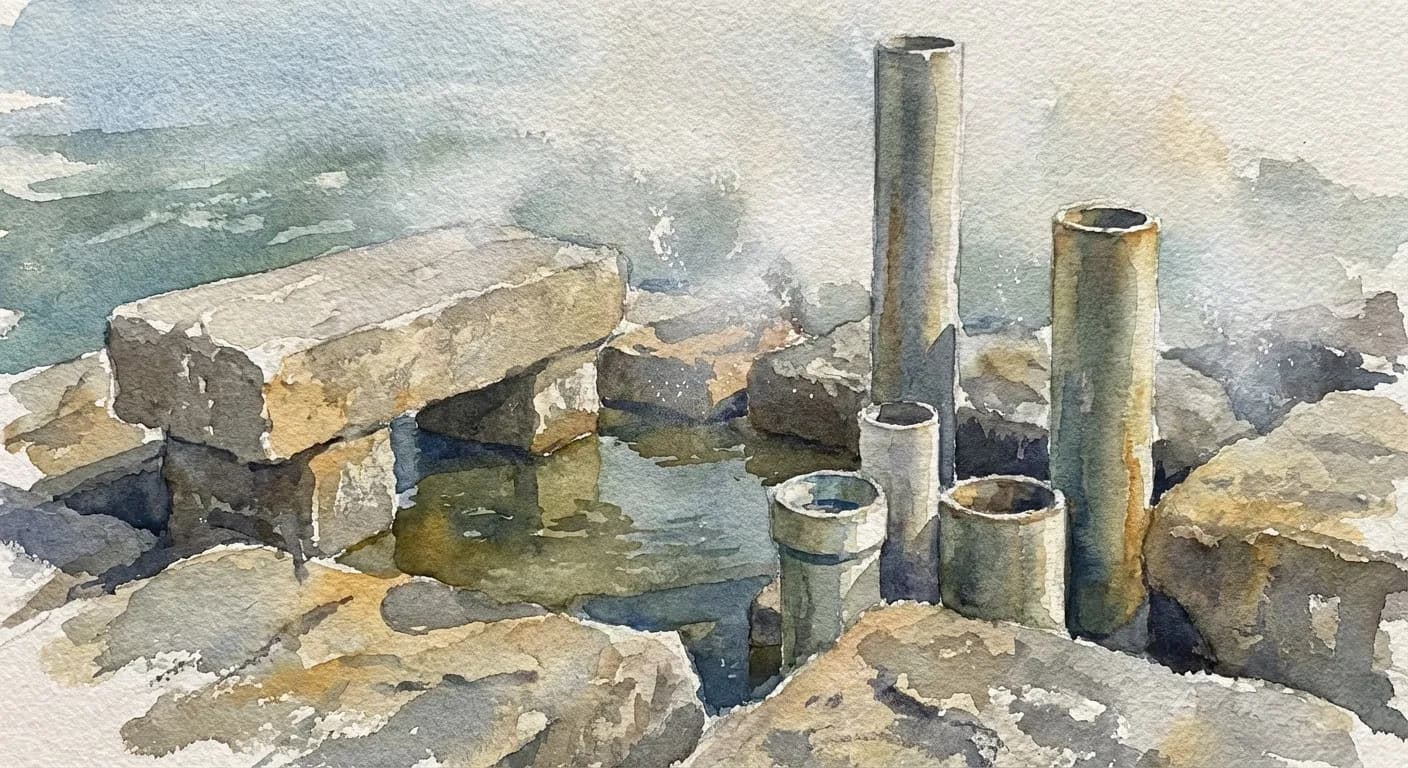
The Wave Organ is a wave-activated acoustic sculpture installed at the tip of a small jetty that forms the western edge of the San Francisco Marina Yacht Harbor. It consists of 25 organ pipes, made from PVC and concrete, installed at various elevations along the jetty — some at low-tide level, some at mid-tide, some above the typical high-water line. As the tide moves in and out, and as waves slosh against the jetty, air is pushed through the pipes and back, producing a collection of low, breathy, irregular sounds — gurgles, rumbles, occasional whale-like long notes — that have no pitch in any conventional musical sense but are unmistakably the sound of the bay talking to itself through 25 tubes.
You listen by walking out to the end of the jetty and sitting on one of the stone benches carved into the structure. The pipe openings are arranged at seat-height and ear-height, so you can lean against a tube and literally hear the bay breathing through concrete.
Who built it
The Wave Organ was created by Peter Richards and master stonemason George Gonzalez, both then artists-in-residence at the Exploratorium, San Francisco's hands-on science museum. The project took nearly five years of site work. Construction involved hundreds of volunteers. It was completed in May 1986 and dedicated in June 1986 to the memory of Frank Oppenheimer, the physicist who founded the Exploratorium.
The stone benches and the architectural framing around the pipes are made from reclaimed granite, marble, and sandstone salvaged from the demolition of the Laurel Hill Cemetery, which had been cleared from the Richmond District in the mid-twentieth century. Which means the Wave Organ is, among other things, a piece of San Francisco urban history recycled into a piece of San Francisco public art — Victorian-era cemetery stone, repurposed as listening benches on a tidal sculpture, forty years ago.
Why timing matters
Here is what most first-time visitors to the Wave Organ miss: at low tide, the Wave Organ does almost nothing. The pipes are exposed above the waterline. Air is not being pushed through them by wave action. You walk out to the end, sit on the benches, and hear nothing but wind and distant traffic, and conclude that the artwork is broken or over-hyped.
The Wave Organ is not broken. It is an acoustic sculpture powered by tidal water, and if the tidal water is not there, it does not sound.
The correct visit is timed to high tide, ideally within 60 minutes of high tide on the Bay side. Tide tables for San Francisco are published daily by NOAA and by every marine weather app. Consult one before you leave. The difference in experience between high tide and low tide is the difference between a functioning artwork and an empty stone structure.
A secondary variable is wave action. A calm, windless day produces less sound than a day with moderate bay chop. You do not want a storm — the jetty becomes unsafe — but a light westerly wind, high tide, and some boat wake is the ideal combination.
What it sounds like
The first surprise is that the Wave Organ is not loud. It produces sounds at conversational volume. You have to be within a metre or two of a pipe to hear it clearly. Which means the artwork is, by design, intimate — you cannot stand at the entrance to the jetty and experience it; you have to walk to the end and sit close.
The sounds themselves are what acousticians would call tonal noise — low frequencies mostly, with occasional higher whistles. Different pipes produce different sounds depending on their length and elevation. As the tide changes in real time during your visit (tide heights can shift noticeably in 30 minutes), the sound composition also changes. A pipe that was silent when you arrived may begin sounding twenty minutes later as the water rises to its intake.
It is not a performance. It is a listening environment. The comparable experience, if you have travelled much, is an aeolian harp or a singing ruin — a place that produces sound as a function of physics rather than intention, and rewards quiet time in roughly the way a Zen rock garden rewards quiet time.
Practical notes
- Location: end of the jetty at the San Francisco Marina Small Craft Harbor, accessible via Yacht Road, behind the Palace of Fine Arts.
- Hours: open 24 hours. There is no gate, no staff, no signage beyond a small plaque. Access is free and unrestricted.
- Cost: free. Always.
- Best window: within 60 minutes of high tide, in mid-morning or late afternoon, ideally with light wind and moderate boat traffic. Avoid storm conditions — the jetty has no railing and waves can wash over it in high seas.
- How to check the tide: the NOAA San Francisco station forecasts (Station 9414290) are the standard reference; any marine weather app will do. Aim for a visit starting 30 minutes before predicted high tide and staying through 30 minutes after.
- How long to stay: 30 to 60 minutes on the jetty itself. Longer visits reward you with noticeable shifts in the sound as the tide continues to move.
- Walking solo: the Marina waterfront is one of the safer walking environments in San Francisco during daylight — well-trafficked by joggers, cyclists, tourists, and Marina residents; the Palace of Fine Arts adjacent plaza is continuously occupied. Cautions for the jetty itself: (1) the walk out to the end of the jetty is about 300 metres with no railings on parts of the path — in wet conditions the stone is slippery; (2) avoid solo visits after sunset (no lighting on the jetty); (3) do not visit during storm surf regardless of time of day. Daytime solo visits are common and appropriate.
- Getting there: the 30-Stockton or 28-19th Avenue Muni lines stop near the Palace of Fine Arts; from there it is a 10-minute walk north through the Yacht Harbor. A Lyft drop at the Palace of Fine Arts is the most efficient option for a short visit.
What to do nearby:
- Palace of Fine Arts — 5 minutes walk. The 1915 Pan-Pacific Exposition relic. Free to wander the grounds.
- Crissy Field / Golden Gate Bridge overlook — 20 minutes walk west. Continuous views.
- Marina Green — flat picnic-lawn with Bridge views, 5 minutes east.
The point
Most free public artworks in San Francisco reward a five-minute visit and a photo. The Wave Organ is built for a slower and more specific kind of attention. You need to check the tide. You need to walk out to the end of a jetty. You need to sit close to a concrete pipe. You need to stay long enough for the sound to change.
In return, you get a forty-year-old artwork built from reclaimed cemetery stone, funded by public art money, dedicated to the founder of the Exploratorium, sitting on a jetty at the mouth of San Francisco Bay, playing the bay itself back to you, for free, on the right tide. It is exactly the kind of patient, unglamorous, rewarding detour that the NICE BUT FREE column exists to document.
The Wave Organ is not hiding. It is, specifically, not hiding. It is simply arranged such that most travellers arrive at the wrong hour and mistake the silence for the work.
Tags: #WaveOrgan #SanFrancisco #FreeSF #PublicArt #Exploratorium #NiceButFree #KarpoFinds #Vol4
Sources consulted: exploratorium.edu · en.wikipedia.org · tidesandcurrents.noaa.gov · atlasobscura.com
All trademarks are the property of their respective owners.