 Mediterranean Food Near Me in Fort Greene: Miss Ada's Garden and Hummus
Neighborhood Guides
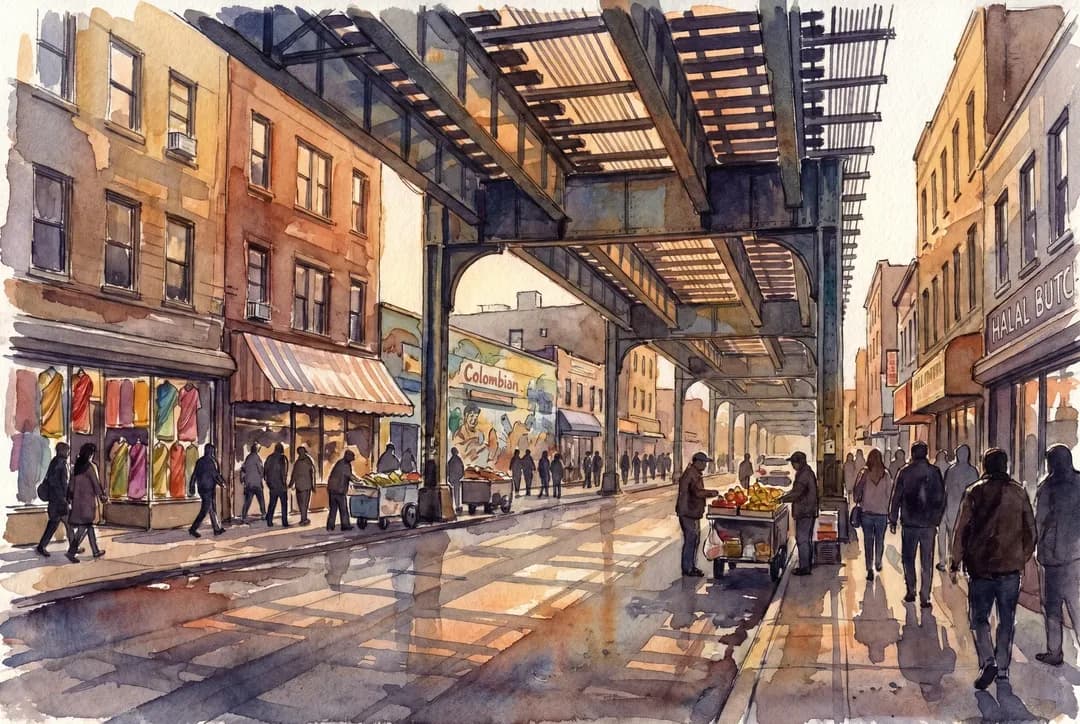
The Two-Hour Walk That Crosses Five Countries Without Leaving Queens
Jackson Heights is the most linguistically dense neighborhood in the United States — 167 languages in a few dozen blocks between two elevated subway lines. The walk from the 74th Street station east along Roosevelt Avenue to 82nd Street takes about two hours if you stop, less if you don't. The recommendation is to stop. Bring cash.
The City That Built Itself Here
Jackson Heights wasn't always this. When the Queensboro Corporation bought 325 acres of Queens farmland in 1909 — naming the land after John C. Jackson, a descendant of one of the original Queens families — their vision was a planned garden community for middle-class Manhattanites seeking space. The Queensboro Bridge had opened that year; the 7 train extended through in 1917. A commuter suburb within city limits seemed achievable.
The Queensboro Corporation built one of the first cooperative housing plans in the United States here in 1920. They modeled the development after Ebenezer Howard's Garden City principles: courtyard-centered co-ops, private gardens, design covenants for aesthetic harmony. By 1930, the neighborhood's population had grown roughly 1,300%, from about 3,800 in 1923 to over 44,500 residents. The planners had built something that took on a life of its own.
The Immigration Act of 1965 changed the composition of that life. New arrivals from South Asia, Latin America, and Southeast Asia found in Jackson Heights what the original developers had advertised to different buyers: affordable housing, transit access, community. By the 1980s, Colombians displaced by conflict at home had established what would become known as Little Colombia along Roosevelt Avenue. By 1992, Mayor David Dinkins officially named the 74th Street corridor "Little India." The Jackson Heights Historic District received landmarked status in 1993 — for its garden apartments, not yet for its cultural geography, though that case would be equally compelling.
Starting Point: 74th Street
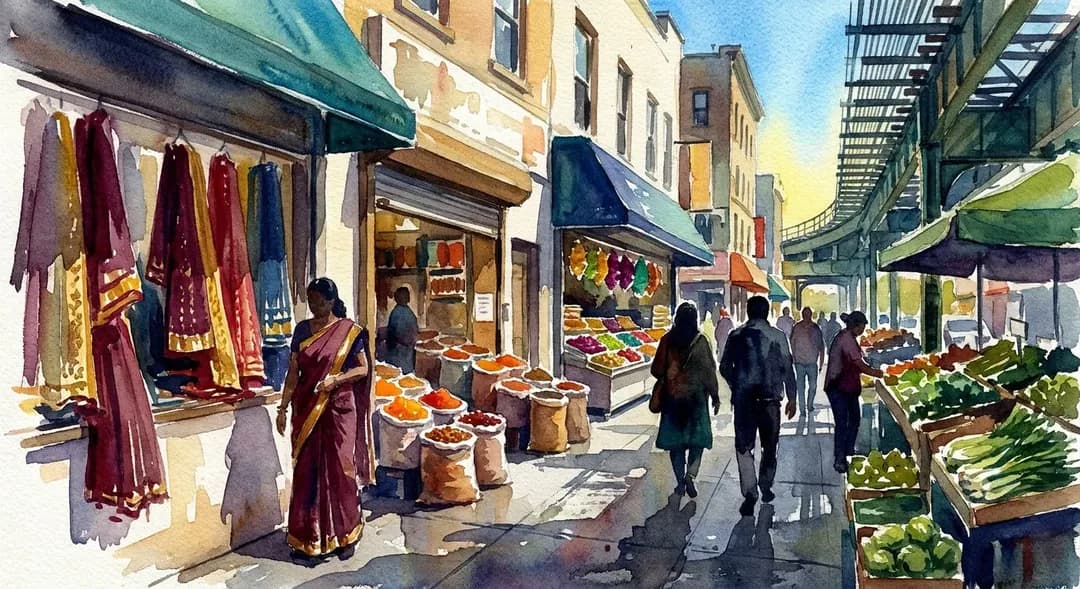
Come out of the 74th Street-Broadway station on the 7, E, F, M, or R trains and head north. The immediate block announces itself through smell before vision: spice shops, a bakery running the oven in the afternoon, the distinct warm-oil note of Indian street food. The three-block corridor to 37th Avenue constitutes one of the largest South Asian retail districts in the country, well beyond any other city's Desi commercial cluster.
Patel Brothers occupies a full storefront on the east side of the block — among the largest Indian grocery chains in North America, with over 50 stores nationwide, it started in Chicago in 1974. Around it, sari shops display fabric in every register of color, gold shops do a steady business at the counter, and sweet shops sell mithai by the piece. The elevated train structure frames everything from above: rusted iron and shadow overhead, jewel-toned textiles at eye level.
The Shift on Roosevelt Avenue
Turn right at Roosevelt Avenue and the register changes immediately. The avenue runs under the elevated 7 train for most of its length — a structure that creates a perpetual dusk at ground level and, paradoxically, makes the businesses beneath it feel more concentrated. To the east, the storefronts shift from South Asian to Latin American without a visible seam: a Colombian bakery, a Peruvian ceviche counter, a Mexican taqueria with the menu chalked on a board outside.
The Arepa Lady, Maria Cano, has been a fixture on Roosevelt Avenue for decades. She started as a street vendor, selling Colombian arepas from a cart, and built a following that eventually became a brick-and-mortar restaurant. The dish hasn't changed: corn cakes stuffed with white cheese, grilled over a flat iron. The context has — she's been written about in every major food publication in the city — but the arepas cost the same as they did when she was working from a folding table.
82nd Street: The BID Corridor
Continue east to 82nd Street. The corridor runs north from Roosevelt Avenue through the center of the neighborhood, bordered by a Business Improvement District that encompasses over 160 active businesses on a formally landmarked commercial strip. The mix on a single block can include a Tibetan momo restaurant, an Argentine bakery, a Bangladeshi grocery, a Colombian clothing shop, and a nail salon with Korean-language signage.
Frederick Wiseman shot his 2015 documentary In Jackson Heights entirely in this neighborhood — 197 minutes of unnarrated footage covering a Muslim school, a Jewish cultural center, a City Council meeting, the local LGBT community advocacy group, and the offices of Make the Road New York. The film doesn't interpret; it observes. The neighborhood is the argument.
Practical Notes
- Start: 74th St-Broadway (7, E, F, M, R trains)
- End: 90th St-Elmhurst Ave (7 train) or loop back to 74th St
- Distance/duration: About 1.5 miles, 2 hours with stops
- Budget: $25–35 per person covers chaat, arepas, momos, and a drink
- Cash: Essential for street vendors and smaller counters; most sit-down spots take cards
- Best day: Saturday or Sunday afternoon — street vendors are fullest on weekends between 74th and 82nd Streets
- Eat in order: Start with chaat or samosa on 74th St, move to Colombian or Peruvian on Roosevelt Ave, finish with momos or bubble tea near 82nd
- Walking solo: Roosevelt Avenue under the elevated tracks is well-lit and busy well past midnight on weekends; the residential side streets north of 37th Avenue are quieter after 9pm. Keep your phone charged and note that the 7 train (74th St-Broadway) is always within a few minutes if you want to cut the walk short.
The Point
Jackson Heights is frequently described in terms of its statistics: 167 languages, 64% foreign-born, the most diverse zip code in the country. The statistics are accurate but they don't explain what it feels like to walk through. What it feels like is ordinary life at an unusual density — people getting groceries, eating lunch, meeting friends, going to the fabric shop — but in five languages and through five culinary traditions within a four-block radius. The Queensboro Corporation wanted to build a cohesive community. They succeeded, just not with the community they had in mind. The walk from 74th Street to 82nd Street is the result. Two hours. No passport required.
Tags: #jacksonheights #queensnyc #rooseveltavenue #littleindia #diversitynyc #nycwalk #queenswalk #longwayhomenyc #walkingnyc #nycfoodwalk #streetfoodnyc #nycneighborhoods #queensfood #urbanwalk #hiddentransit
Sources consulted: wikipedia.org · jhbg.org · 82ndstreet.org · eatandtravelwithus.com
All trademarks are the property of their respective owners.
Ask Karpo for more information.
Keep reading
- Mediterranean Food Near Me in Fort Greene: Miss Ada's Garden and Hummus
 Places To Eat Near Me in Chelsea: The Market Fills a Nabisco Factory
 Seafood Near Me in the East Village: The Mermaid Inn's Dollar Oysters