Start at Gantry Plaza Before the Crowds Thin Out
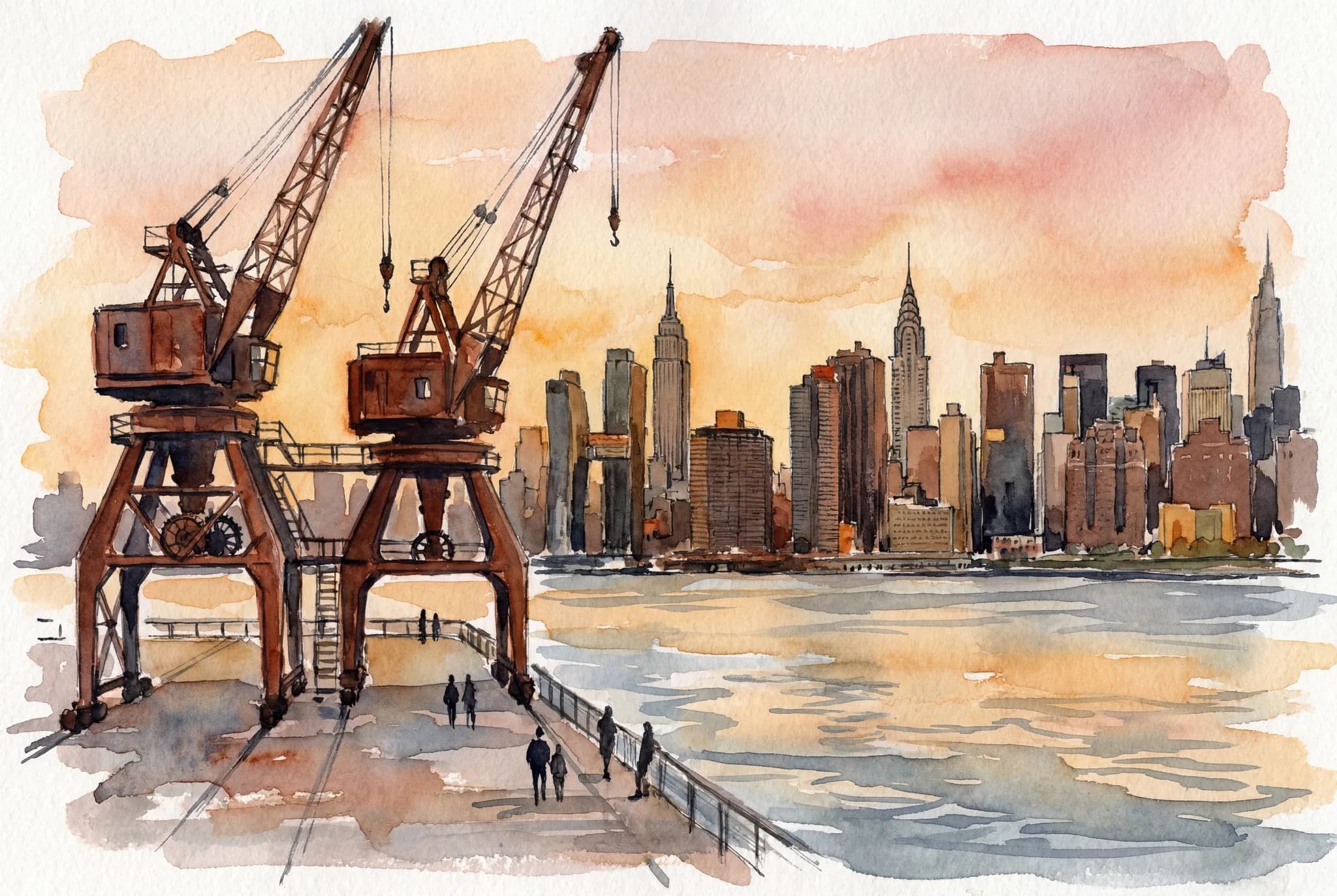
Gantry Plaza State Park sits on the LIC waterfront between 48th and 50th Avenues, where the land was once a ferry terminal and industrial loading dock. The gantries — two of them, tall and orange-red — were used to transfer railcars from barges to land, a now-obsolete technique called car float service that ran the East River until the 1960s. The city preserved them when the park opened, and they now frame a view of Midtown that includes the UN building, the Chrysler Building, and the Empire State Building in rough alignment.
The park is twelve acres, and it connects seamlessly to Hunters Point South Park to the south, another ten acres of riverside green space with kayak launches and a promenade. The two parks feel continuous — you don't notice where the city park ends and the state park begins. Start here, walk the pier, and watch the afternoon light hit the Chrysler's eagle-head gargoyles before you leave.
The Pepsi-Cola Sign, and Then North
Just north of Gantry Plaza, along Center Boulevard and then Vernon Boulevard heading toward the Queensboro Bridge, you'll pass the Pepsi-Cola sign — a giant neon vintage sign that hung over a bottling plant from 1936 until the plant closed, was preserved, and now sits on the riverfront as an unofficial LIC landmark. It's privately maintained but publicly visible. The sign is harder to miss than most things in the neighborhood.
From there, Vernon Boulevard is the spine of the walk. There is a dedicated path and the East River is visible to the west through gaps between residential towers and the occasional warehouse. This middle stretch, between the parks, is the least curated part of the walk — this is where the city is still figuring out what to do with the waterfront. Walk it anyway. The Manhattan skyline through the chain link and the gaps is somehow better than the designed viewpoints.
Socrates Sculpture Park, Which Shouldn't Be Free But Is
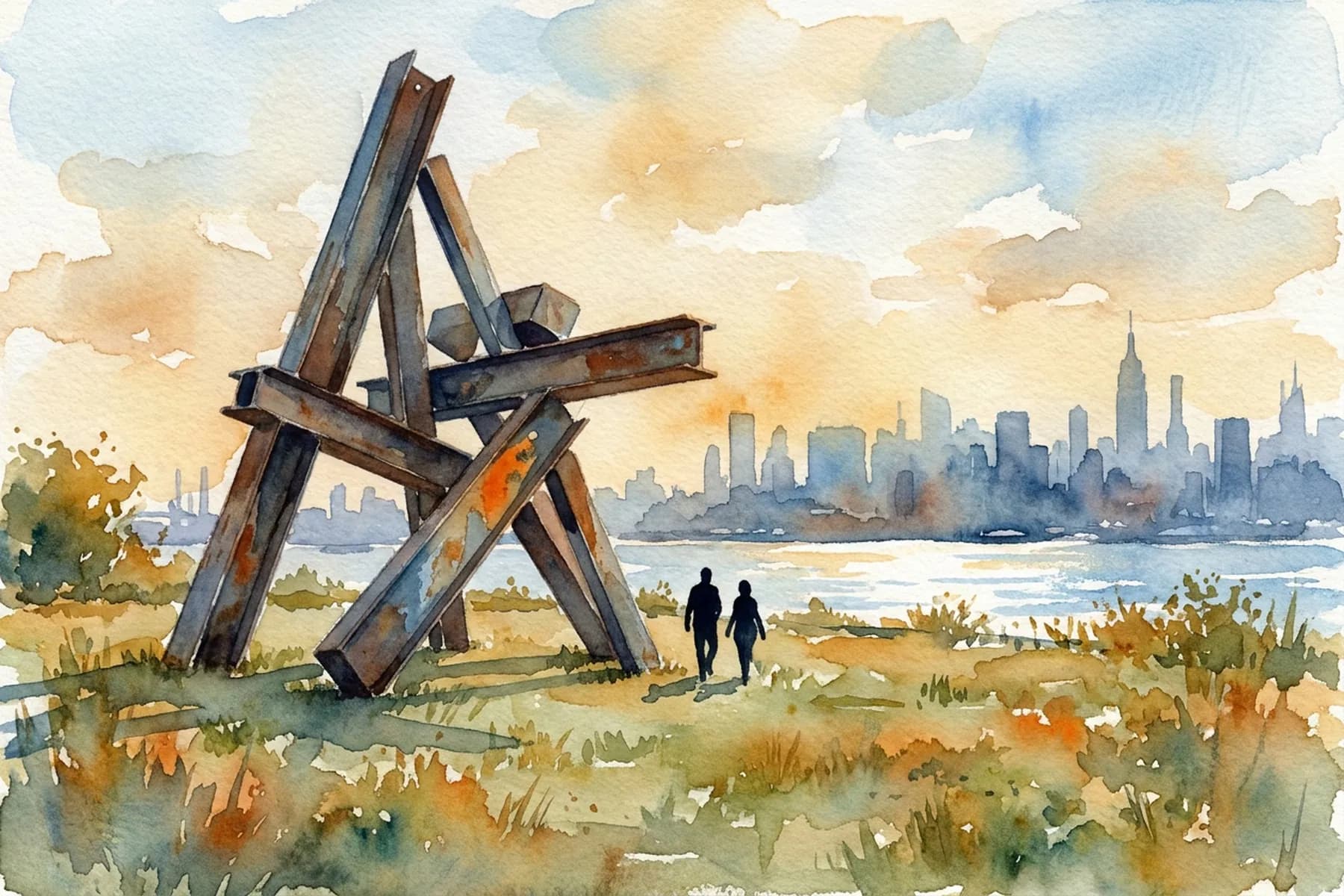
At the north end of the Vernon Boulevard corridor, the walk arrives at Socrates Sculpture Park — a 4.5-acre outdoor sculpture museum that in 1986 was an illegal dumping ground. Artist Mark di Suvero, who had a studio nearby, formed a coalition with local residents and converted the landfill into a park named both after the Greek philosopher and as a nod to the historically Greek population of Astoria. With the help of neighboring sculptor Isamu Noguchi, di Suvero secured a lease from the city. In 1998, after a developer tried to build luxury apartments on the site, the park received permanent city status.
The sculptures rotate. What's there now will be different from what was there last year. The park charges nothing, is open 365 days a year, and is the largest outdoor space in New York City dedicated to sculpture. The view of Manhattan from the lawn is unobstructed. Two blocks east, the Isamu Noguchi Museum — which opened in 1985 in the sculptor's former Long Island City studio — is worth an hour if you have it.
Rainey Park, and the Last Mile to Astoria
From Socrates, the waterfront continues north through a quieter stretch. Rainey Park, a few blocks up, offers a waterfront esplanade and views of the RFK Bridge's southern approach — the bridge was completed in 1936, engineered by O.H. Ammann and designed by architect Aymar Embury II. The park is smaller than the others and typically uncrowded on weekdays.
The last section of the walk, from Rainey Park into Astoria Park proper, runs under the RFK Bridge's approach ramps. It's a specific Queens experience — the highway infrastructure overhead, the park continuing underneath. From the bridge's shadow you emerge into Astoria Park's open waterfront lawn.
Astoria Park and the Bridge That Came First
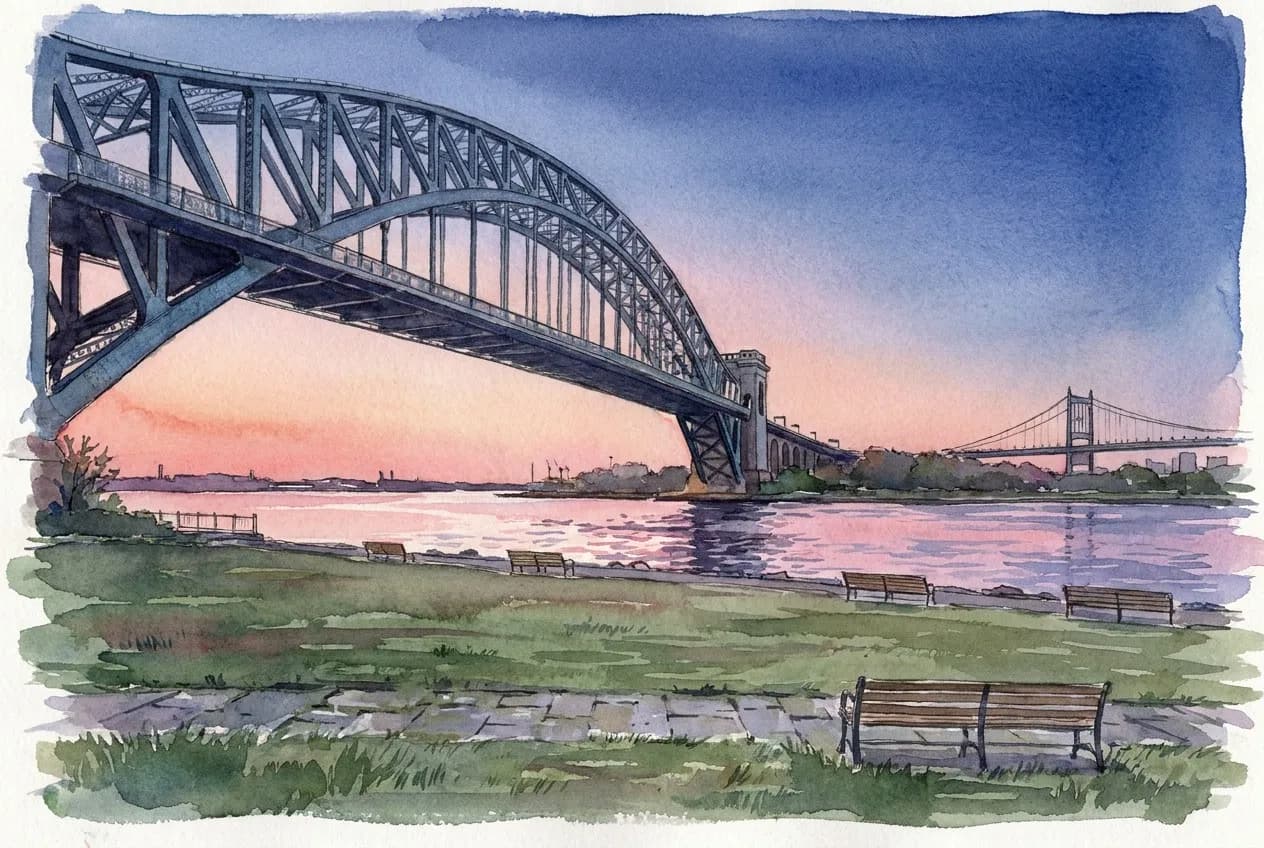
Astoria Park sits between two bridges. The RFK (Triborough) is to the south, 1936, the motor vehicle bridge most people recognize. The Hell Gate Bridge to the north is the earlier and stranger one: a massive steel arch completed in 1916, designed by engineer Gustav Lindenthal and architect Henry Hornbostel, carrying Amtrak's Northeast Corridor tracks across the East River. When it opened, the Hell Gate arch was the longest steel arch bridge in the world.
The park has sixty acres, tennis courts, a bandstand, and the pool — the Astoria Pool, opened July 2, 1936, designed under the Works Progress Administration by John Hatton, 330 by 165 feet, the largest outdoor public pool in New York City. The diving platform is no longer used competitively, but the pool hosted the US Olympic swimming and diving trials in 1936, 1952, and 1964. Admission is and has been free.
Walk to the benches along the shoreline. Face south toward Manhattan, face north toward Hell Gate. This is what an hour of dusk looks like from the Long Island side of the East River.
Practical notes
- Starting point: Gantry Plaza State Park, 4–5 Center Blvd, Long Island City, NY 11101 (entrance from 48th or 49th Ave and Vernon Blvd)
- Endpoint: Astoria Park, Shore Blvd at 19th St, Astoria, NY 11105
- Getting there (start): 7 train to Vernon Blvd–Jackson Ave (5 min walk to park); NYC Ferry Astoria Line to Gantry Park Landing
- Getting back (end): N/W train at Astoria–Ditmars Blvd (3 min walk from Astoria Park's north end)
- Distance / time: ~4 miles, 2–2.5 hours walking at a comfortable pace with stops
- Best window: Weekday, starting 3:30–4:00 PM — gives you golden hour at the gantries and dusk at Astoria Park
- Socrates Sculpture Park: Open daily, free, no hours barrier; current exhibitions vary by season
- Noguchi Museum: Closed Mondays and Tuesdays; $12 admission for adults; last entry 1 hour before close
- Astoria Pool: Open during NYC Parks summer season (late June–Labor Day), free; check nyc.gov for opening dates
- Walking solo: Vernon Boulevard between the parks is well-lit and has steady foot traffic through early evening; the stretch under the RFK Bridge ramps in north Astoria is quieter after 8 PM. Stick to the main promenade and keep the N/W train at Ditmars within reach — three minutes from Astoria Park's north entrance — if you want to exit early.
- What to do after: Astoria has a dense stretch of restaurants and bars on 31st Street heading toward Broadway. The walk from the park takes about twelve minutes.
The point
Four miles of Queens waterfront between two parks, with an illegal-dumping-ground-turned-sculpture-museum in the middle and a 1916 railroad bridge framing the end. Manhattan is always visible, always on the wrong side of the river, always making the walk feel like an escape that isn't quite an escape. That's the logic of the Long Way Home: you're not going in the efficient direction, and you're better off for it.
Tags: #licwaterfront #astoriapark #queensnyc #queenswaterfront #longwayhome #karpofinds #gantryplaza #socratessculpturepark #hellgatebridge #eastriverwalk #nycparks #longislandcity #astorianyc #nycwalk #nycwaterfront
Sources consulted: parks.ny.gov · socratessculpturepark.org · nycgovparks.org · boweryboyshistory.com
All trademarks are the property of their respective owners.


