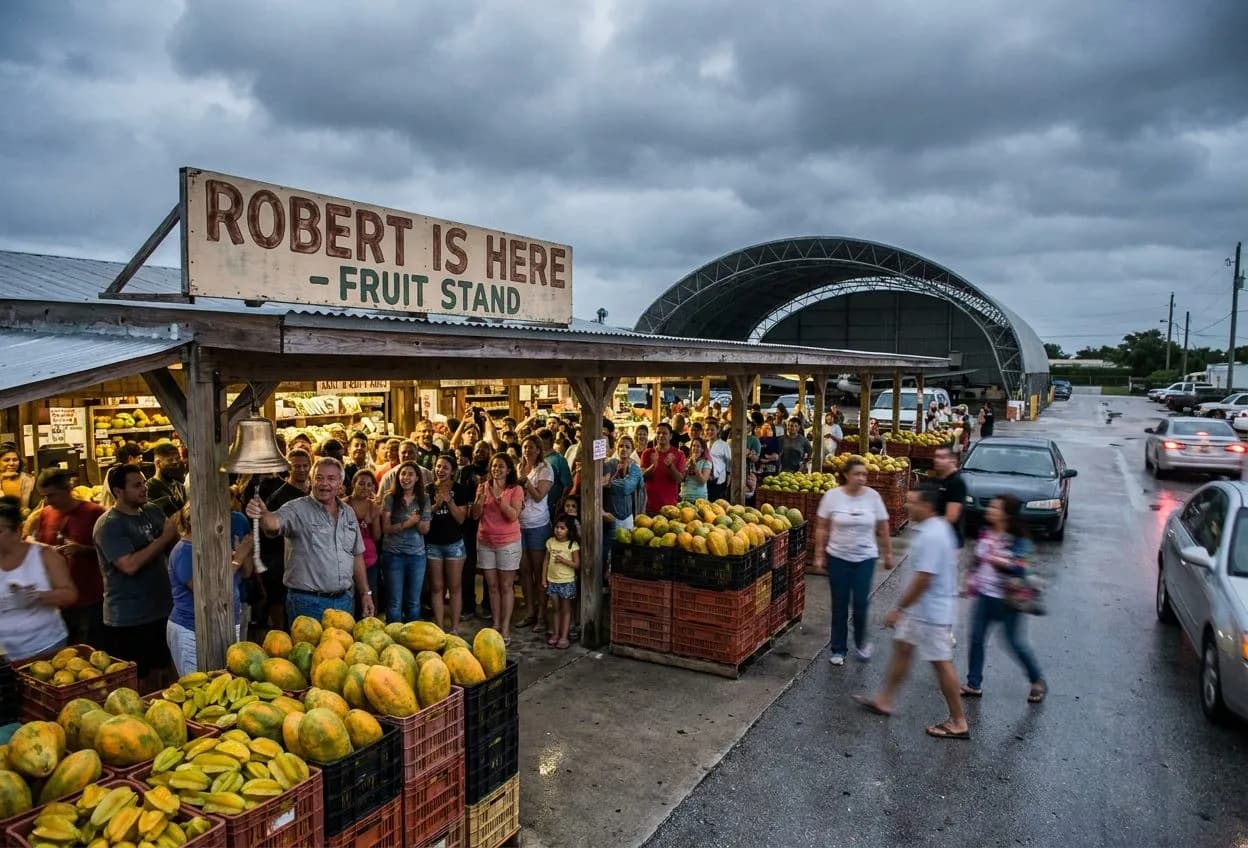
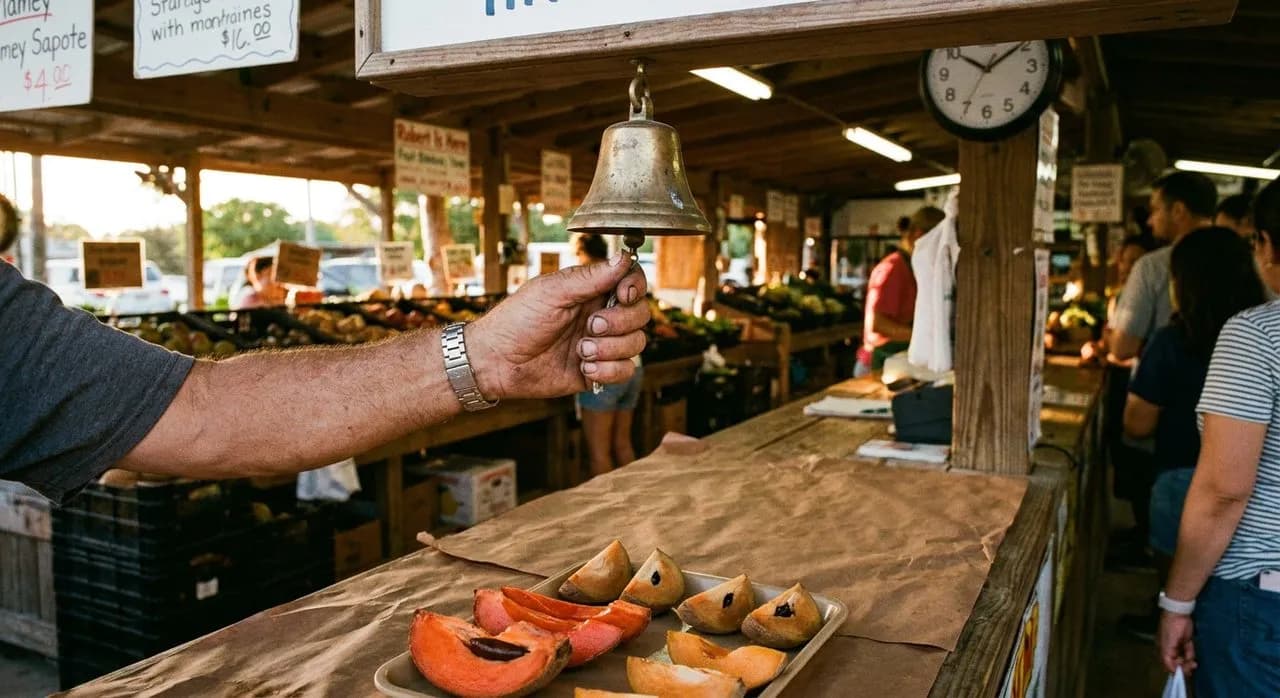
The hand bell is brass, tarnished at the handle, and when Robert Moehling rings it at ten o'clock on Tuesday mornings, the sound carries across the gravel lot and into the open-air shed where carambola sits in wooden crates and mamey sapote glows rust-orange under the corrugated roof. It's a farm-stand ritual that predates the highway widening, the Instagram geotag, the tour-bus circuit. The bell means samples are ready. It means something came in ripe that morning. It means Robert decided you should taste it.
Sixty years, one stand, one family
Robert Is Here opened in 1959, when Robert Moehling was a child and his father set him on the roadside with a crate of cucumbers and a hand-painted sign. The stand survived Hurricane Andrew, the citrus-greening crisis, and the long creep of suburban sprawl down US-1. Today it's a landmark, the kind of place where retirees drive forty minutes for finger limes and families stop on the way back from the Everglades. Robert—now in his early seventies—still works the sample table most mornings, especially Tuesdays.
The stand itself is low-slung and sun-faded, with a big wooden sign out front and a parking lot that turns to dust in the dry season. Inside, the air smells like overripe mango and wet earth. Wooden bins hold dragonfruit, longan, lychee in season, key limes year-round. There's no script, no uniformed staff. Just produce, prices on chalkboards, and a line at the milkshake counter that starts to coil by eleven-thirty.
The Tuesday morning window
Tuesday between ten and eleven is the sweet spot, the hour when tropical fruit timing matters most. The delivery trucks have already rumbled out, leaving behind flats of whatever the growers in Redland brought in at dawn. The tour buses from Everglades National Park—twenty minutes north—haven't yet arrived with their loads of sneaker-clad visitors clutching bottled water. The stand feels unhurried, almost private. You can hear the parrots squawking in the back enclosure and the low hum of the walk-in cooler.
This is when Robert sets up the sample table under the eaves, a folding card table covered with a vinyl cloth and a cutting board scarred by decades of knife work. He doesn't announce what he's serving. It depends on the morning, the season, the whim of the crop. Black sapote. Sugar apple. Sapodilla with its brown-sugar granules. If you want the inside track, ask for 'whatever Robert's tasting today' at the sample table—he cuts rare fruits like black sapote and sugar apple only when the crop is right, and he won't waste a knife stroke on anything underripe.
What the bell announces
The ten o'clock bell is Robert's signal, not a corporate jingle or a recorded chime. He picks it up from the counter, rings it three times, and sets it back down. Regulars know to arrive just before. First-timers look around, confused, until someone hands them a toothpick and a wedge of something they've never seen before. The samples are generous—thick slices, not the timid slivers of a supermarket demo. The fruit is cold from the cooler, wet with juice, sometimes so ripe it threatens to fall apart in your hand.
Robert doesn't lecture. He'll tell you the name if you ask, maybe where it came from—Homestead, Redland, his own grove—but he's not selling. The samples sell themselves. By ten-fifteen, people are walking back to the bins with purpose, filling paper bags, asking questions about ripeness and storage. The register rings. The rhythm picks up.
The key lime milkshake (and the Mason jar you keep)
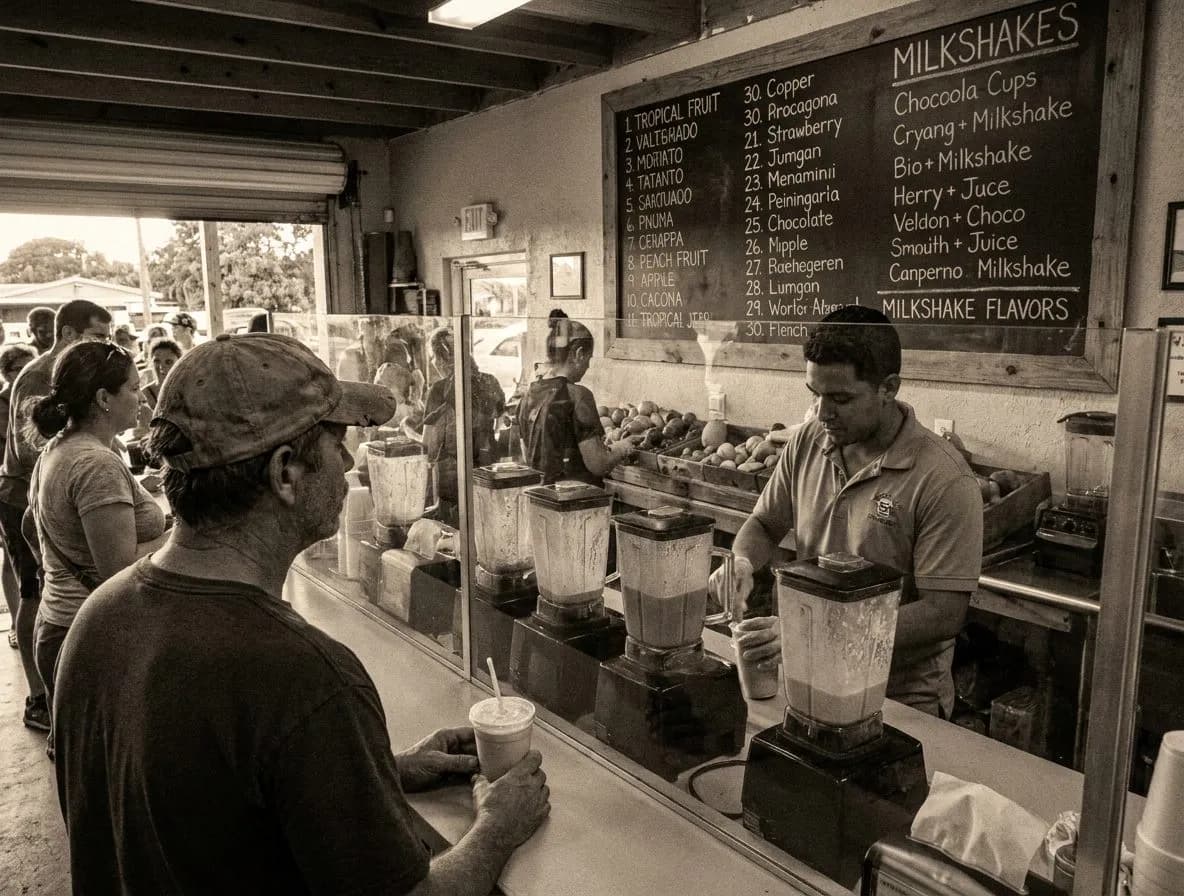
The milkshake counter sits at the back of the main shed, next to the cooler and a chalkboard listing two dozen flavors. Mango. Guanabana. Passion fruit. Mamey. The key lime is the signature, and for good reason: the fruit comes from the grove behind the stand, the same trees Robert's father planted in the seventies. The shake is tart and creamy, pale yellow-green, with enough sugar to balance the acid but not enough to bury it.
Order it in a Mason jar for an extra dollar and keep the glass. The jars are heavy, clear, stamped with the Robert Is Here logo in red. They fit in a cup holder. They become kitchen staples, desk pencil holders, talismans of a specific kind of Tuesday morning. The milkshake itself is thick enough to require a spoon for the last third. Drink it slowly, before the line forms. By eleven-thirty, you'll wait twenty minutes.
The petting zoo in back
Behind the fruit shed, past the picnic tables and the banana trees, there's a small menagerie: goats, emus, a tortoise the size of a coffee table, a few chickens. The petting zoo is cash-only—a couple of dollars for a handful of feed pellets dispensed from a rusted machine. Kids love it. Adults find it oddly soothing, the way the goats nose your palm and the emu watches you with a look of profound skepticism.
It's not manicured. The enclosures are patched wood and chain-link, the ground is dirt and straw, and the whole setup has the improvised charm of a roadside attraction that grew organically, one animal at a time. The tortoise, according to a sun-bleached sign, is over fifty. No one seems to doubt it.
Why late 2026 is the right time
Miami's farm-to-table conversation has moved south in the past two years, and Homestead—long overlooked as the region's agricultural engine—is finally getting its due. Chefs are sourcing directly from Redland groves, food writers are making the pilgrimage, and Robert Is Here has become shorthand for authenticity in a city that sometimes mistakes newness for quality. The stand hasn't changed to meet the moment. The moment has simply caught up.
Tuesday mornings remain what they've always been: a chance to taste something rare, cut by someone who knows exactly when it's ready, in a place that has no interest in becoming anything other than what it is.
Practical notes
Robert Is Here Fruit Stand, 19205 SW 344th Street, Homestead. Open daily 8am to 7pm; verify hours directly in off-season. No Metrorail service this far south; plan to drive. Ample free parking in the gravel lot. The stand is mostly open-air and accessible, though the petting-zoo area has uneven ground. Bring cash for the zoo and small purchases; cards accepted at the main register. Arrive Tuesday between 10 and 11am for samples and short lines. The key lime milkshake in a Mason jar costs vary by size; verify current pricing. Expect warm, humid conditions year-round.
Tags: #RobertIsHere #HomesteadFL #MiamiFood #TropicalFruit #FarmStandLife #RightOnTime #TuesdayRituals #SouthFloridaEats #FruitStandCulture #RedlandAgriculture #KeyLimeShake #MiamiDayTrip #FloridaRoadTrip #HiddenMiami #EatLocal
Please drink responsibly. Must be of legal drinking age.
Sources consulted: Homestead, Florida · Tropical Fruit · Robert Is Here Fruit Stand · Miami Herald · Time Out Miami
All trademarks are the property of their respective owners.