Why Dering Street, and Not the Ritz
Mayfair runs on performance. The hotels perform grandeur. The galleries perform taste. Bond Street performs price. Dering Street — a narrow, slightly overlooked lane connecting Bond Street to Conduit Street — performs nothing. The shopfronts are small. The foot traffic is incidental. It is exactly the kind of address a serious tea shop should occupy.
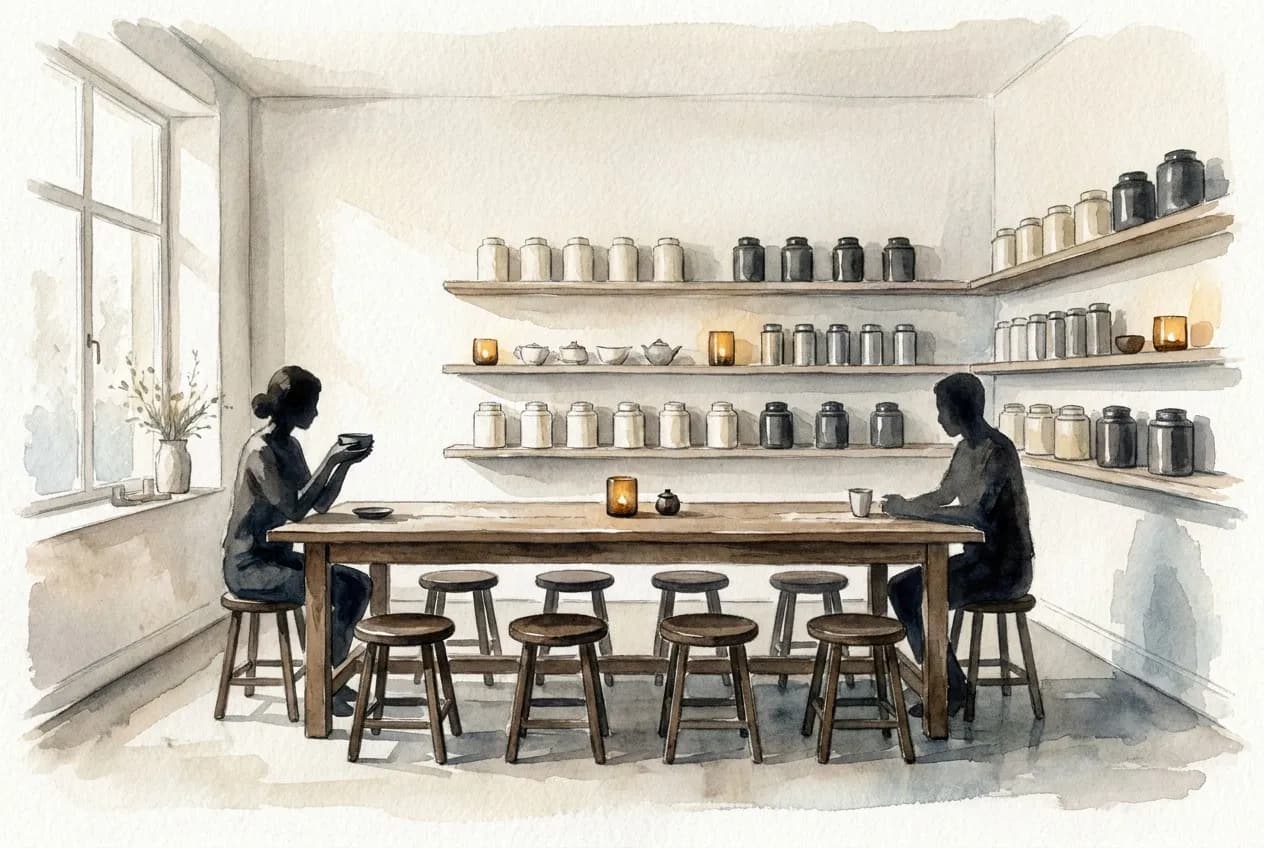
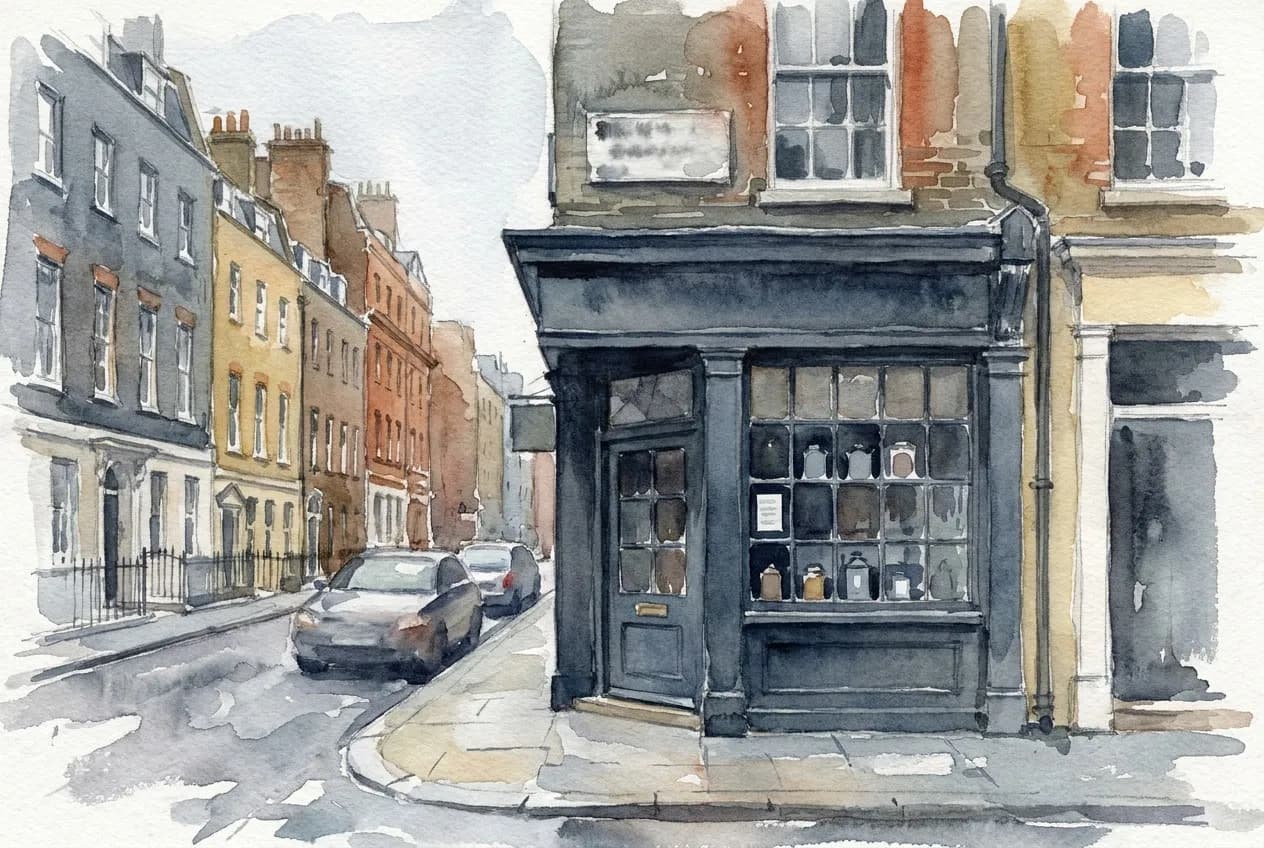
Postcard Teas sits at number 9, behind a dark-painted shopfront that does not advertise what it is. You push the door open and step into a room that is the size of a good sitting room — not a hotel lobby, not a concept space. Just a room with shelves of tea canisters, a basement that hosts rotating art exhibitions, and a single large wooden table with ten stools around it. There is no counter seating, no alcove, no window booth. There is the table, and there is the stool. Pull one up.
The Only Table in the Room
Most tea rooms in London treat their furniture as background. At Postcard Teas, the communal table is the design principle. You sit alongside whoever else is there — a buyer from a restaurant group, a tourist who wandered in, a regular who comes twice a week and already knows which Japan green she wants. The conversation is not mandatory. The silence, when it happens, is comfortable.
Timothy D'Offay, or one of his team, will take your order at the table. The act of sitting down is the beginning of being served: they bring the cup to you, explain what's in it, where the farm is, who the farmer is, what the elevation of the plot was at harvest. This is not performance. It is the way D'Offay has believed tea should work since 2005, and the communal table makes that conversation happen at human scale.
Timothy D'Offay's Kyoto Theory
D'Offay's relationship with tea began in Kyoto, where he lived for a period before returning to London in the late 1990s. Japan taught him a particular approach to agricultural provenance — the belief that the identity of the maker matters as much as the quality of the product, and that small-scale production is structurally better for flavor, for the people doing the work, and for the land being worked.
Back in London, he co-founded East Teas at Borough Market with tea expert Alex Fraser. Then, in 2005, he opened Postcard Teas on Dering Street. The name reflects the travels: sourcing tea for the shop requires going to Japan, China, India, Korea, Taiwan, and Vietnam. The postcards are the trips. The teas are what come back.
The World's First Named Tea
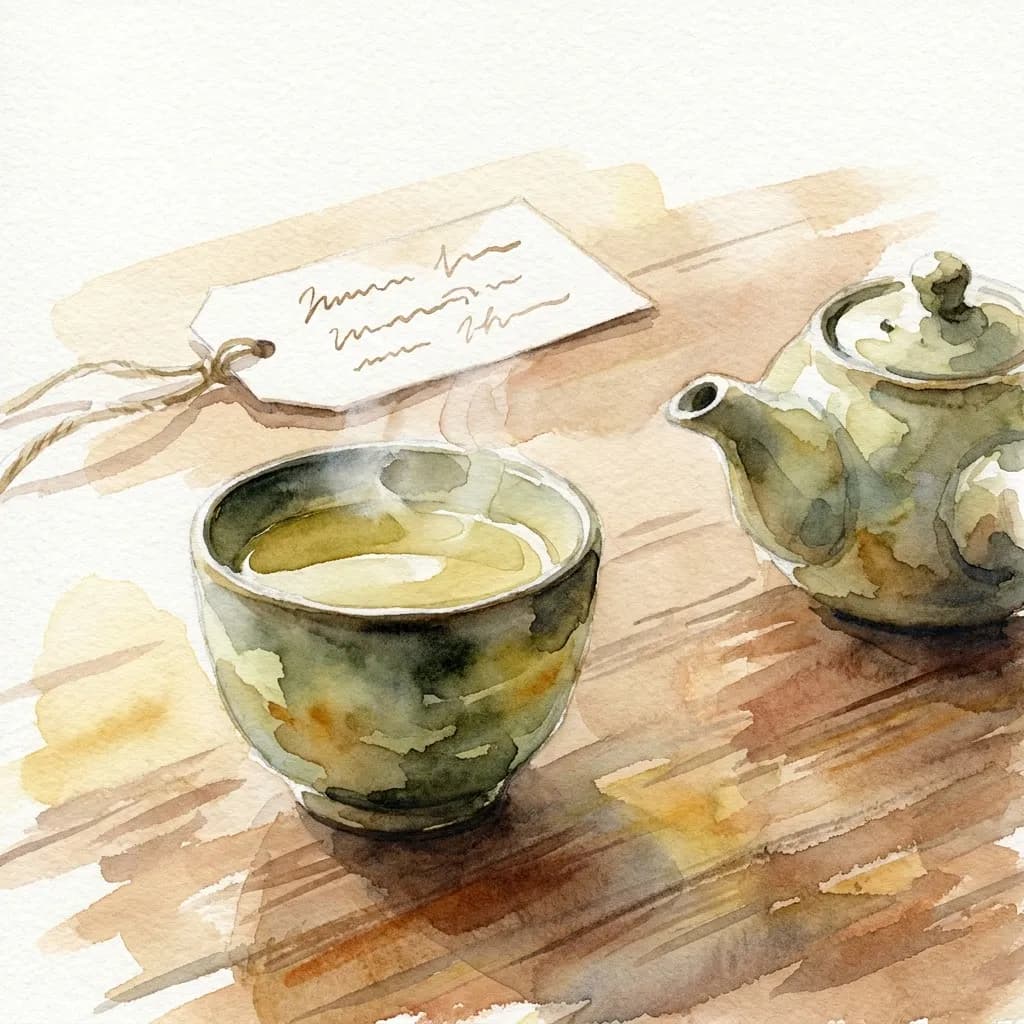
In 2008, Postcard Teas became the first tea company in the world to put the maker's name and location directly on their teas. Not just "Darjeeling first flush" or "Dragon Well" — but the farmer's name, the farm's coordinates, the specific lot. This was not a marketing move. It was an accountability structure: if you know who grew the tea, you know who benefits when you buy it, and you know who to ask about the next harvest.
In 2012, D'Offay went further, discontinuing all plantation-sourced teas. The shop now sources exclusively from micro farms averaging about five acres. The decision was explicit: small producers are better for people, for local economies, and for the environment. Postcard Teas supplies teas to fine UK and European restaurants and shops, including Michelin-starred kitchens that use their brewing methods for soft pairings. The stool at the communal table puts you directly in the same supply chain.
What You Actually Drink
The shop carries over seventy teas, organized by type and origin. Green teas from Japan and Korea. Oolongs from Taiwan. Black teas from Darjeeling and Assam. White teas from Fujian. Puerh from Yunnan. The selection changes with harvest seasons; what's on the table in April will not be there in October.
The service uses water at the correct temperature for each tea — a detail that most London cafés ignore and that changes the cup entirely. The teaware is ceramic and small: Japanese-style yunomi bowls, not oversized mugs. The volume of tea you receive is deliberately modest. This is not a place to nurse a large latte through a laptop session. It's a place to drink three small cups of something exceptional and leave knowing you understand one more tea than you did before.
Timing the Visit
The shop opens at noon, Monday to Saturday, and closes at 6:30 PM. Sundays and bank holidays: closed. Midweek afternoons — Tuesday through Thursday between 1 and 4 PM — are the quietest stretches. The communal table has room for ten; on a slow Wednesday you might have it largely to yourself. Saturday midday gets busier, and the energy shifts toward people buying tins to take home rather than sitting down to drink. If you want the stool experience — cup in hand, D'Offay or a colleague talking you through the teas — come on a Tuesday.
If you want to send tea somewhere else entirely, the shop offers "Tea Mail": select a tea, write a postcard from their selection, and they post it from a dedicated postbox inside the shop to anywhere in the world. The postcard arrives with the tea. It is, in its own quiet way, as specific as the farmers' names printed on the tins.
Practical notes
- Address: 9 Dering Street, London W1S 1AG (just off New Bond Street)
- Hours: Mon–Sat 12:00 PM–6:30 PM; closed Sundays and bank holidays
- Getting there: Bond Street Underground (Central/Jubilee lines), 4 min walk; Oxford Circus (Central/Victoria/Bakerloo), 6 min walk
- Go for: Ask for the guided selection — let the staff choose based on what you usually drink; green or oolong from Japan is reliably extraordinary
- Best window: Tuesday to Thursday, 1–4 PM — the communal table is quietest and conversation with staff is most possible
- Tea Mail: Pick a tea, write a postcard in-shop, and they post it from their dedicated postbox to any address worldwide
- What to do after: Conduit Street and Savile Row are two minutes north; the walk through to Carnaby Street via Kingly Court takes about ten minutes
The point
The stool at Postcard Teas is not a reservation. It's not a table for two. It's one seat at a communal table, freely taken, briefly held, and completely yours for as long as the cup lasts. In a neighborhood that charges for the privilege of sitting down, Postcard Teas invites you in for the price of a tea and the willingness to listen to where it came from. That's the chair worth pulling up.
Tags: #postcardteas #londonteashop #specialtytea #mayfairlondon #teaexperience #deringstreet #londonmayfair #independentlondon #hiddenlondon #pullupachair #karpofinds #teaprovenance #londonafternoon #communaltable #londonindependent
Sources consulted: postcardteas.com · theshopkeepers.com · raphaelmartin.co.uk · weekendnotes.co.uk
All trademarks are the property of their respective owners.