 Distillery Tour Near Me in Bushwick: New York Distilling Company
Weekend Plans
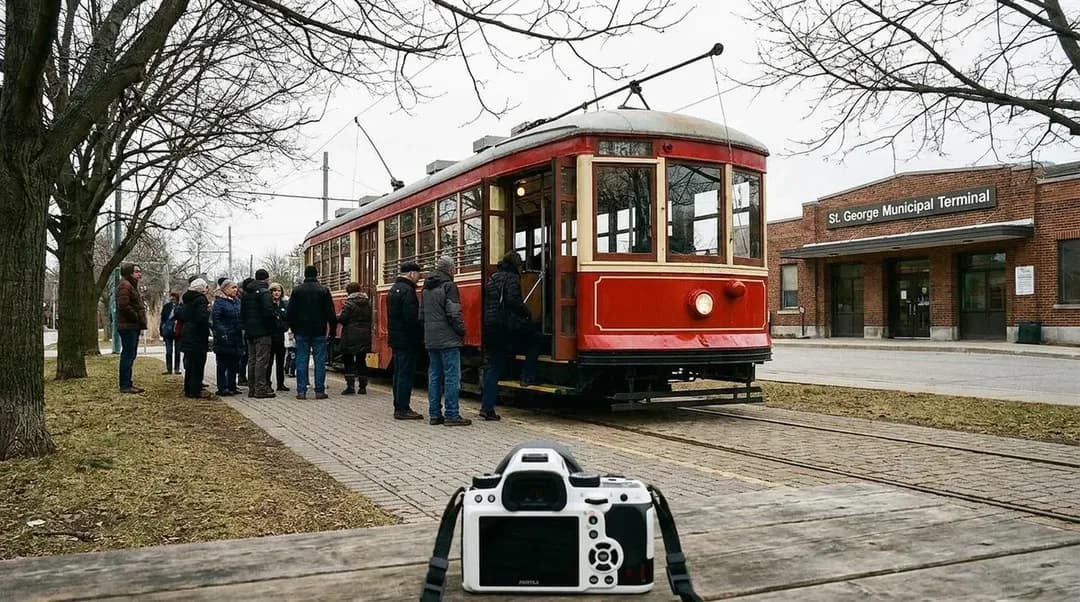
the staten island railway's museum stop when the vintage trolleys run on sundays
At the St. George terminus, volunteers restore 1920s-era trolley cars and run them on a short loop on summer Sundays—a slow-travel ritual that layers ferry, commuter rail, and rolling history into one unhurried afternoon.
There's a particular kind of travel that values the accumulation of modes over speed: the free ferry across the harbor, the utilitarian commuter line, and then—if you time it right—a trolley car older than most of the city's subway fleet, trundling along a short stretch of restored track near the water. The Staten Island Trolley Museum sits near the St. George Ferry Terminal, a volunteer-run operation that brings a handful of vintage trolleys back to life on select Sunday afternoons from late spring through early fall. It's not a theme park. It's not a parade. It's a ten-minute loop on a piece of rolling stock that once carried daily commuters, now maintained by a rotating crew of regulars who show up because someone has to keep the wheels turning.
The geometry of getting there
The journey is the architecture. You board the Staten Island Ferry at Whitehall Terminal—still one of the city's genuinely free things to do, with its orange benches and commuter fatigue and that slow pivot past the Statue of Liberty—and twenty-five minutes later you're walking off at St. George. The museum is a short walk from the ferry terminal, which means the total trip from Manhattan clocks in around forty minutes before you even see the trolleys. That layering is part of the appeal: you've already switched contexts twice, passed through the churn of weekend crowds and the diesel hum of the railyard, and now you're standing in front of a low building with a hand-painted sign and a clutch of older men in safety vests waving you toward a boxy car with wooden slatted seats.
It's multi-modal in the way a pilgrimage is multi-modal—on foot, by water, by iron—and the cumulative effect is a kind of decompression. By the time you board the trolley, you're already operating on a different clock.
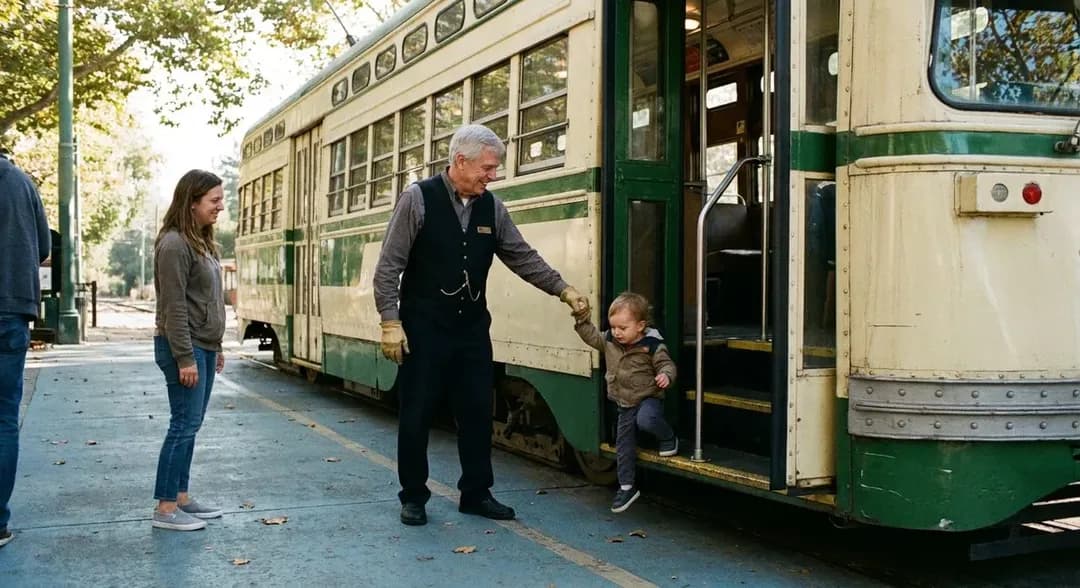
The short loop and its operators
The ride itself lasts between five and ten minutes, tracing a section of restored track near the museum building. There's no destination in the conventional sense; the experience is entirely about the vehicle. The trolley rocks on its springs, the wooden floor creaks, and the motorman—often a retiree who spent decades working for the MTA or a transit enthusiast who learned the trade here—calls out imaginary stops with dry affection. The windows are open in warm weather. The air smells faintly of oil and old varnish.
What you're riding is a 1920s or 1940s car, depending on which one the volunteers have running that day. The fleet rotates based on what's been restored, what needs work, and who's available to operate it. Some Sundays it's a Baltimore car; other weeks it's a Newark trolley that rattled through New Jersey suburbs before ending up here. The volunteers will tell you the provenance if you ask, and they will absolutely tell you the technical specs if you let them.
The loop deposits you more or less where you started. You can ride again immediately, or you can wander into the small museum building to see the restoration bays and the diagrams and the shoe boxes full of old transfer slips. The whole operation has the pleasant, improvised feel of a model-train club scaled up to full size.
The Sunday regulars
There's a tiny, loyal community that treats this as weekend plans in the least aspirational sense: people who come because it's Sunday, because the trolley runs, because it's a ritual that asks very little and gives back a strange, quiet satisfaction. Families with young kids who've outgrown the novelty but not the habit. Older couples who remember when streetcars were just part of the grid, not a heritage attraction. The occasional rail photographer with a telephoto lens and a folding chair.
They nod at the volunteers. They know which car is which. They don't treat it as nostalgia so much as maintenance—of memory, of knowledge, of a version of the city that still exists if you're willing to take three forms of transit to find it.

When the trolleys actually run
The museum operates on select Sundays roughly from May through October, typically between one and five in the afternoon, though the schedule hinges entirely on volunteer availability. There's no app, no real-time updates, and the website—when it's current—lists the season in broad strokes. You can call ahead, or you can show up and take your chances, which is its own form of slow travel: the acceptance that some Sundays the trolleys won't be running, and that's fine, because you got the ferry ride and the walk and the metallic light off the harbor.
Spring 2026 will likely follow the same loose rhythm—service starting sometime in May, running through the warm months, tapering off by mid-October. The museum occasionally hosts special events or extended hours, but the Sunday afternoon window is the constant.
What else is at St. George
The terminal itself is a hub in the old sense: ferries, buses, the Staten Island Railway heading south down the island's spine. There's a small plaza, a few benches with views of the harbor, and the usual scatter of food vendors. You can catch the SIR to other points on the island if you're inclined—Snug Harbor Cultural Center is a worthwhile detour—but most people who come for the trolleys treat St. George as the terminus in both directions.
The neighborhood around the terminal is more functional than picturesque: municipal buildings, a courthouse, a few older commercial blocks that still carry the architectural weight of when Staten Island's waterfront mattered differently. It's not polished. It's not trying to be. That's part of the point.
Why it works as a destination
Because it's not trying to be one. The trolley museum succeeds precisely because it's small, volunteer-run, and unpretentious. It doesn't oversell the romance of the ride or package the experience into something frictionless. You have to work a little to get there. The schedule is vague. The loop is short. And somehow that makes it better—a pocket of the city that operates on its own terms, where the journey is cumulative and the destination is just a ten-minute rattle on a wooden seat with the harbor light slanting through open windows.
It's the kind of thing you do once out of curiosity and then, if it catches you right, you do again because it's become part of your own internal map of the city—a dot on the edge of the ferry route, a Sunday tradition, a way to spend an afternoon moving slowly through layers of transit history that are still, improbably, in motion.
Practical notes
The Staten Island Trolley Museum is located at 100 Richmond Terrace, Staten Island. Take the Staten Island Ferry (free) from Whitehall Terminal in Manhattan; the museum is a short walk from the ferry arrival point. Trolley operations run select Sundays during the season; confirm current Sunday hours directly with the museum., but confirm directly via the museum's website or phone before planning your visit, as schedules depend on volunteer availability. Admission is free, though donations are encouraged. The site has limited accessibility; contact ahead for specific mobility needs. Bring water, sunscreen in summer, and patience. Street parking is available near the terminal; verify hours directly.
Tags: #TheLongWayHome #StatenIsland #NYC #SlowTravel #VintageTrolley #TransitHistory #FreeThingsToDo #WeekendPlans #HeritageTourism #SummerInNYC #FerryRide #UrbanExploration #HiddenNYC #Spring2026 #RollingStock
All trademarks are the property of their respective owners.
Ask Karpo for more information.
Keep reading
- Distillery Tour Near Me in Bushwick: New York Distilling Company
 Distillery Tour Near Me in Industry City: Fort Hamilton Whiskey Tasting
 Distillery Tour Near Me in Red Hook: Widow Jane Whiskey Tasting