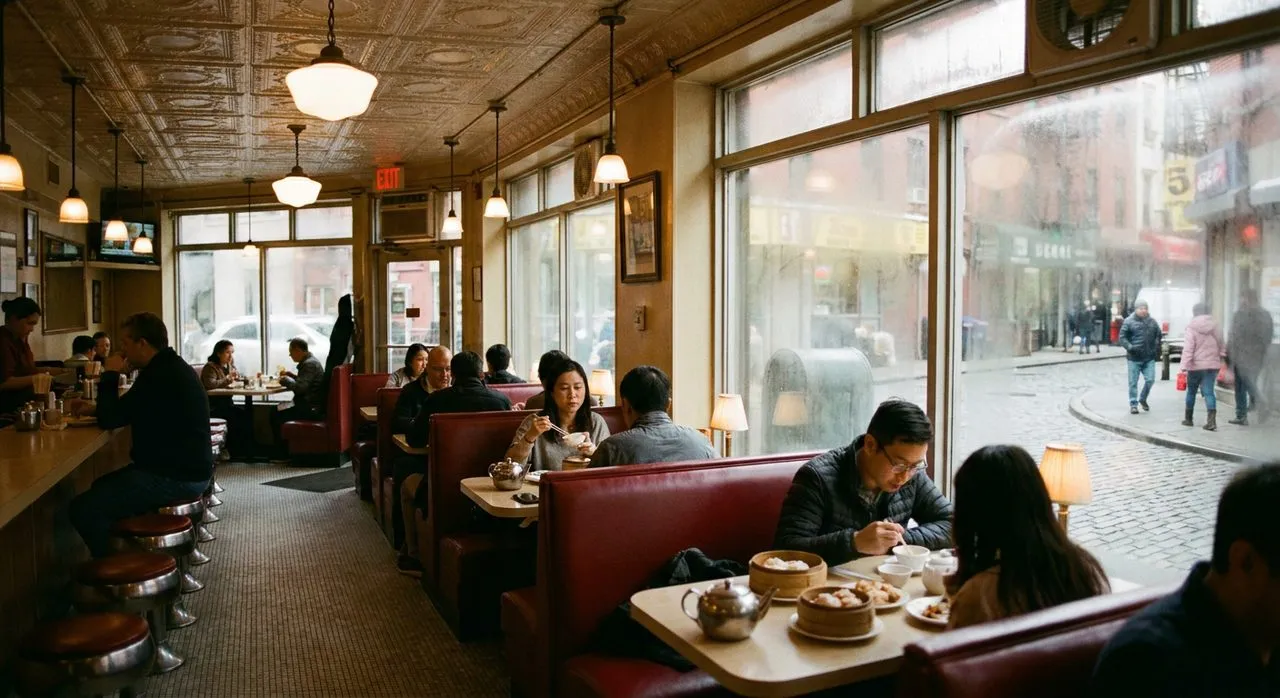
Doyers Street bends like a broken elbow in the heart of Chinatown, and Nom Wah Tea Parlor has occupied that crook since 1968. The red vinyl booths and pale Formica counter predate the dim sum cart by decades, back when everything arrived on trays and nobody needed a menu translated into English. This is not a heritage dining room that has been carefully restored for nostalgic effect. The banquettes are patched with matching vinyl. The fluorescent tubes hum the same note they hummed in 1975. The tile floor carries a century of foot traffic, and the tea arrives in white porcelain cups without handles, poured before you ask.
The geometry of the Bloody Angle
Doyers Street earned its nickname—the Bloody Angle—during the Tong Wars of the early twentieth century, when the sharp bend created a fatal blind spot. Ambushes were inevitable. Nom Wah opened its doors in the aftermath, a quiet place for tea and rice rolls while the neighborhood rebuilt itself around new allegiances and old grievances.
The parlor sits precisely at the vertex of that angle, its front window and corner booth offering a sightline down both arms of the street. It is a position of strategic clarity, and whether that mattered in 1920 or simply made good business sense for watching foot traffic, the location has anchored the space ever since. The alley outside remains narrow enough that morning delivery trucks pause, back up, negotiate.
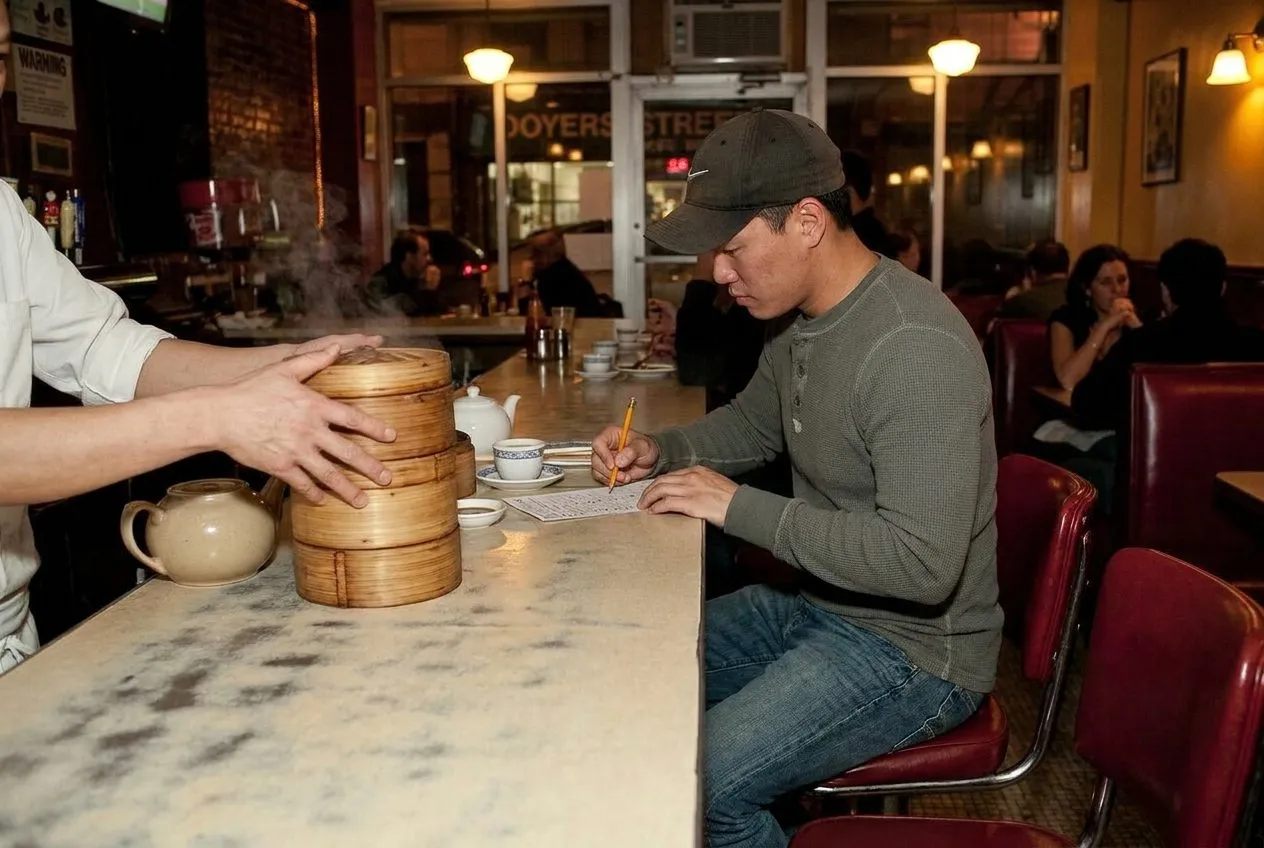
Table three and the light
The corner booth—table three to the staff, though no number appears on the laminate—faces the full bend of Doyers Street through a wide pane of glass. Between nine and ten in the morning, before the alley drops into shadow, winter and spring light cuts across the table at an angle that makes the tea glow amber and turns the vinyl a warmer shade of crimson. By ten-thirty the buildings have reclaimed the sun, and the booth returns to its usual dim coolness.
It is the best seat in the house, not for privacy but for orientation. You can see everyone who enters, everyone who leaves, and everyone who pauses outside to check their phone or light a cigarette. Regulars know this. They do not linger past ten-thirty.
The counter and the numbered order
Dim sum counters like Nom Wah's operate on a logic that predates menus. You point at the trays behind the glass. You call out numbers if you know them. The staff nods, plates appear, and a running tally is kept on a slip of paper that will be totaled at the counter when you leave. There is no ceremony, no explanation of ingredients or technique. The har gow are translucent, the shu mai are topped with a dot of roe, and the char siu bao come three to an order, their tops cracked open like small volcanoes.
This is the rhythm that survived when dim sum carts became fashionable elsewhere in the 1980s, then faded again in the 2000s. Nom Wah never adopted the cart. The kitchen is small, the dining room smaller, and trays work better than wheels on a floor that has settled into itself over a century.
Number eighteen and the old menu
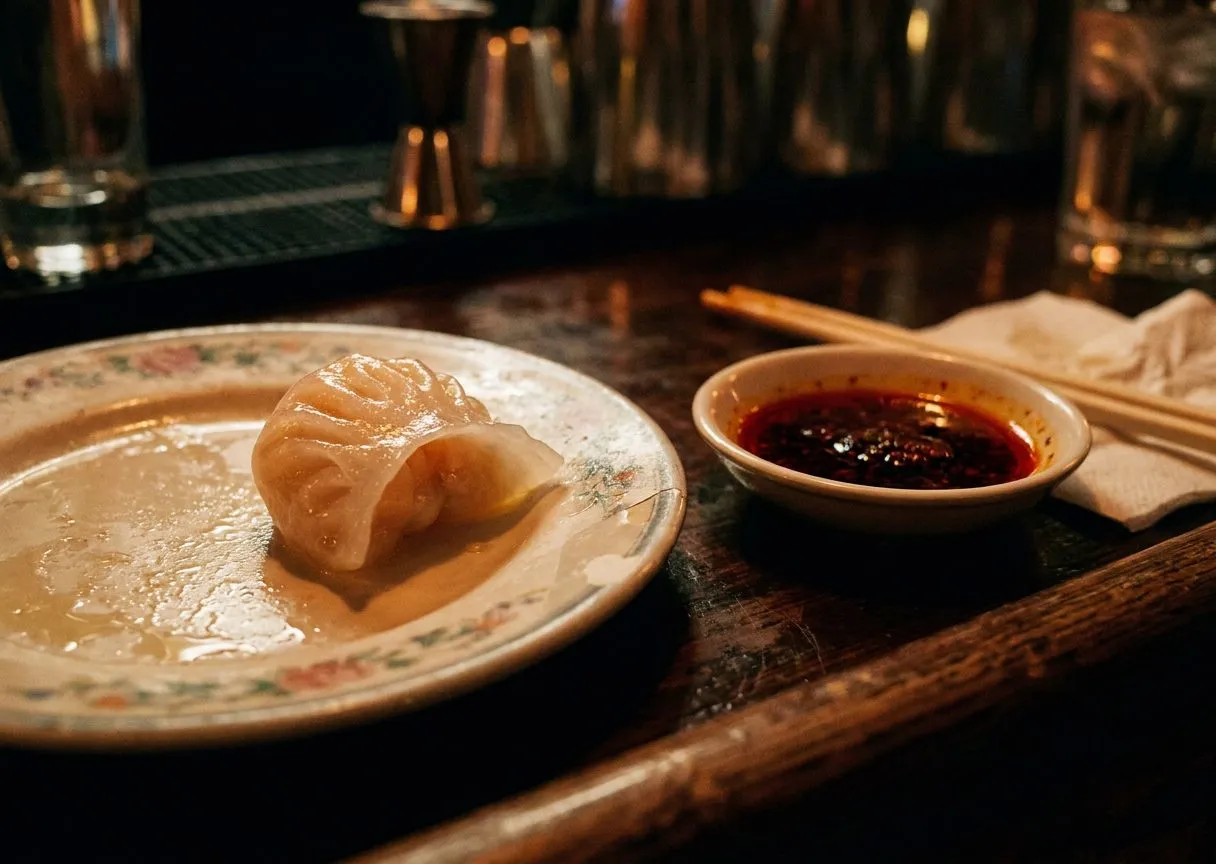
Order the original rolled rice noodle—number eighteen—and the staff will nod without writing anything down. It is not on the laminated menu that tourists receive, nor on the wall-mounted board that lists specials in Cantonese and English. It is a pre-1980s item, a plain rice noodle rolled by hand and served with soy sauce and scallion oil, nothing more. The texture is slippery, faintly sweet, and gone in three bites.
Regulars order it as a palate reset between heavier dishes, or as breakfast on its own with tea. It costs less than anything else on the menu, and it tastes like the kind of thing someone would eat at six in the morning before a shift at the fish market. Which is exactly what it was.
The early window
Arrive before ten-thirty on a weekday morning and the dining room is half-empty. The tea is poured without asking, hot enough to scald, and refilled whenever the cup dips below halfway. Checkout happens at the counter near the door, where a handwritten receipt is tallied in pen and you pay in cash or card with equal indifference from the staff. By eleven the line has formed outside, tourists with cameras and families with strollers, and the rhythm changes. The early window is when Nom Wah still belongs to the people who have been coming since before it was notable.
The late-2026 resurgence of interest in older Chinatown establishments has not altered this pattern. The morning crowd remains local, Cantonese-speaking, efficient. They finish their tea, settle their check, and leave before the first food blogger arrives.
What endures
Nom Wah has no interest in becoming a museum. The vinyl cracks, the counter wears, and nothing is preserved for the sake of aesthetic appeal. What endures is the repetition: the same trays, the same tea, the same corner booth catching the same brief window of light every morning. There is no manifesto here, no mission statement about authenticity. There is only the steady accumulation of ordinary mornings, one dumpling at a time.
The red booth at table three will seat you, the light will arrive and depart, and the tea will be poured before you finish settling into the vinyl. This is not a moment engineered for Instagram. It is simply what happens when a place has been doing the same thing, in the same way, for more than a century.
Practical notes
Nom Wah Tea Parlor, 13-15 Doyers Street (entrance at the bend). Nearest subway: Canal Street (J, Z, N, Q, R, W, 6). Street parking is nearly impossible; use a nearby garage on Centre or Bowery. Hours vary, but the restaurant is generally open by 10 a.m. on weekdays; verify directly before planning an early visit. The dining room is on one level with a shallow step at the entrance; restroom is narrow. Bring cash for ease, though cards are accepted. Expect to spend $12–$20 per person for a full dim sum breakfast. No reservations.
Tags: #NomWahTeaParlor #DoyersStreet #ChinatownNYC #DimSumCounters #PullUpAChair #HeritageDiningRooms #CantoneseCuisine #LowerManhattan #EarlyMorningNYC #RedBoothChronicles #BloodyAngle #ClassicNYCEats #DumplingsAndTea #CityQuirks #Winter2026Finds
Sources consulted: Nom Wah Tea Parlor · Doyers Street · Dim Sum · Chinatown Dining · Manhattan Neighborhoods
All trademarks are the property of their respective owners.