A Room Built to Hold the World's Rarest Books
Pierpont Morgan began commissioning his library in 1902. He hired Charles McKim of McKim, Mead & White — the same firm behind Pennsylvania Station and Columbia University's Low Library — to build a structure adjacent to his home at Madison Avenue and 36th Street. Morgan told McKim he wanted "a gem." The result is a Tennessee pink marble palazzo fitted so precisely that the stone blocks required virtually no mortar.
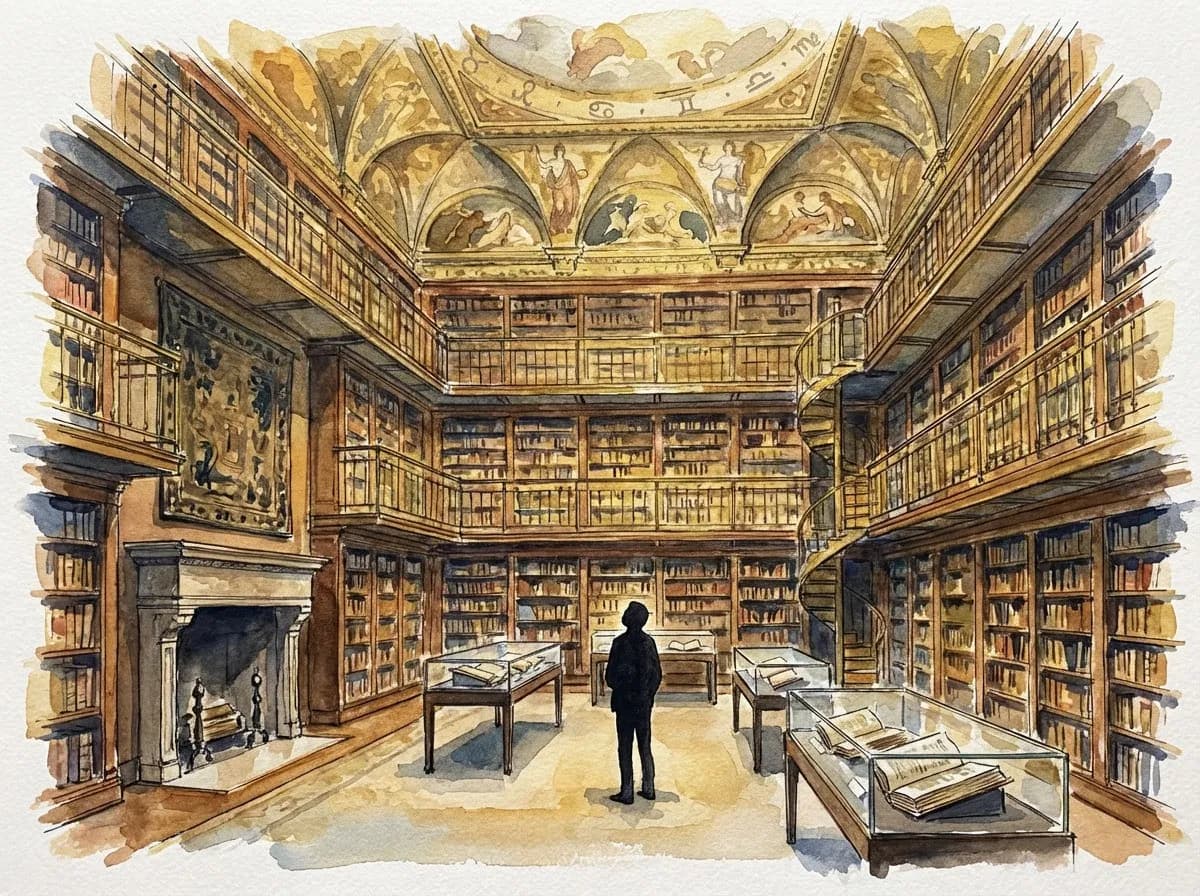
The East Room, the largest space in the original building, was designed as a treasury for Morgan's rare printed books. The walls reach thirty feet and are lined floor to ceiling with triple tiers of bookcases fashioned from inlaid Circassian walnut. The library was completed in 1906, opened to the public in 1924, and designated a National Historic Landmark in 1966.
What McKim Actually Built
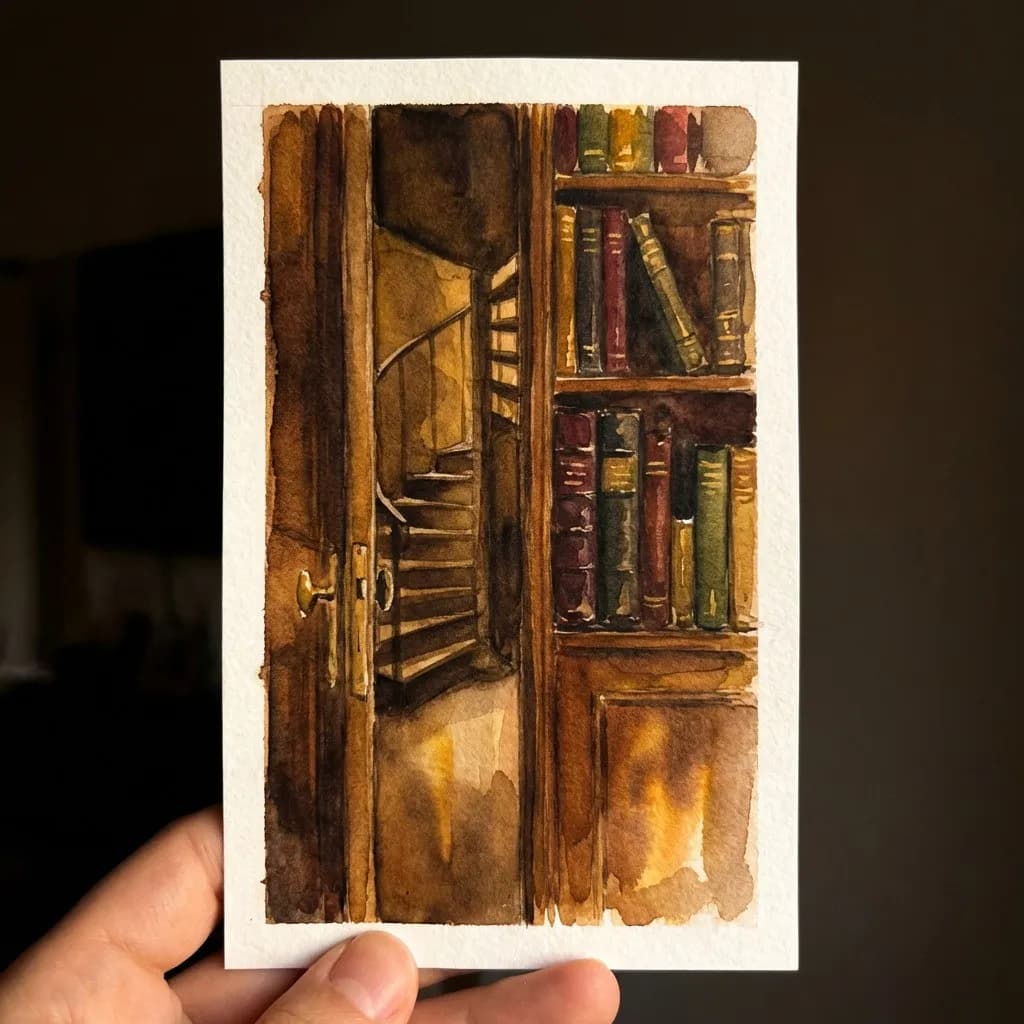
The walnut bookshelves that cover the East Room's walls are not purely decorative. Several panels are actually doors — identifiable only by small brass handles — that open to reveal narrow spiral staircases providing access to the second and third tiers. A book elevator sits inside a hidden compartment in the southwest corner, designed for transporting oversized volumes between floors. These passages are still used by librarians today.
The proportions of the room are closer to a cathedral than a reading library. The space was built for private use — one man and his curators — and it scales awkwardly to a public museum. There are too few seats for the size of the room. This is, inadvertently, what makes it worth visiting.
The Ceiling, the Tapestry, and the Book on Display
Harry Siddons Mowbray completed the gilded ceiling murals in 1906. The painted figures represent the arts and sciences, including Socrates, Galileo, Botticelli, and Michelangelo. The twelve signs of the zodiac appear along the lower register — Morgan was an Aries and a member of the Zodiac Club, a private dining society that capped its membership at twelve, one per sign. Above the fireplace hangs a 16th-century tapestry from a series depicting the Seven Deadly Sins — this one the Triumph of Avarice — hung, intentionally or otherwise, in a room built to house one of the largest concentrations of private collecting in American history.
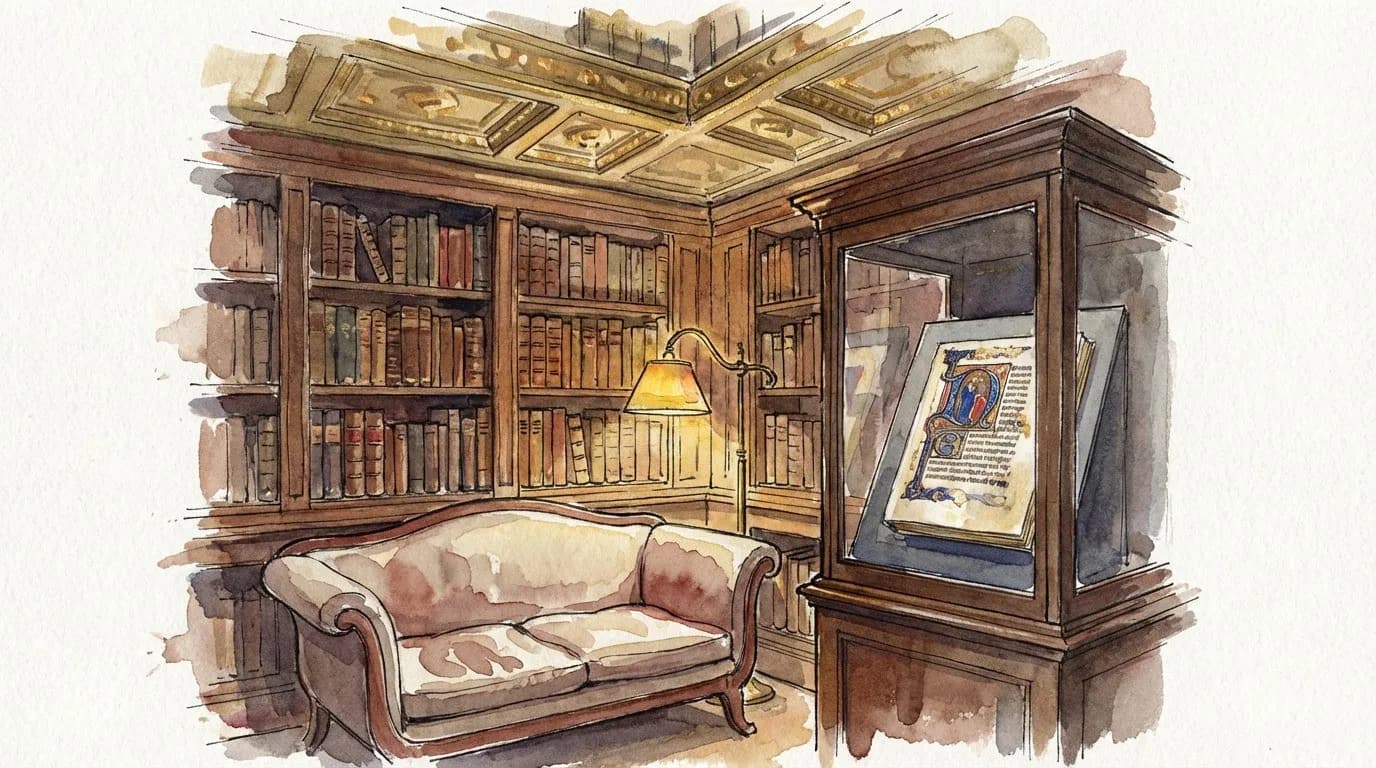
One of the Morgan's three copies of the Gutenberg Bible (printed in Mainz around 1455) is always on display in the East Room. The roughly 49 complete copies known to survive worldwide make this an unusually dense holding. The display case is easy to approach on weekday afternoons, and the glass gives a close enough view of the typeface and hand-applied color to understand why these books have the status they do.
The Seat Worth Sitting In
The East Room has a sofa area near the center of the floor. It is not prominently signed. Visitors tend to pause in the space, photograph the ceiling, photograph the bookshelves, and move on in under five minutes. The few who sit down tend to stay longer than they planned.
This is the chair worth pulling up. The light in the East Room — warm, diffuse, coming mostly from the display cases and the ornate lamps — is better for sitting in than for photographing. The bookshelves at thirty feet read differently from a seated position than from standing. The Mowbray ceiling is easier to actually look at without craning your neck. The tapestry makes more sense when you've stopped moving.
The Free Window Nobody Mentions
General admission to the Morgan is $13 for adults. The McKim rooms — which include the East Room — are free on Tuesdays from 3 to 5pm, Fridays from 7 to 9pm, and Sundays from 4 to 6pm. The Friday evening window is the least crowded of the three: the museum stays open until 8pm on Fridays, and arriving at 7pm means roughly an hour in the room after the main visitor wave has passed.
The East Room has no windows. The interior light is constant regardless of the hour outside. The only variable is how many other people are standing in the room, and the Friday 7–8:30pm slot is, consistently, the answer to that problem.
Practical notes
- Address: 225 Madison Avenue (at 36th St), Murray Hill, New York, NY 10016
- Hours: Tuesday–Thursday 10:30am–5pm; Friday 10:30am–8pm; Saturday–Sunday 10:30am–5pm; closed Monday
- Admission: Adults $13; children under 12 free with adult
- McKim rooms free: Tuesday 3–5pm; Friday 7–9pm; Sunday 4–6pm
- Getting there: 4/5/6 at 33rd St (3-min walk); B/D/F/M/N/Q/R at 34th St–Herald Square (8-min walk)
- Best window: Friday 7–8:30pm during the free McKim rooms window. Noticeably quieter.
- What to look for: The Gutenberg Bible display case. The hidden bookcase doors with brass handles on the north and south walls. Socrates is roughly above the center of the room on the Mowbray ceiling.
- What to do after: Walk north on Madison to the 40s and catch the Lexington Ave subway, or walk west through Midtown toward Bryant Park.
The Point
The East Room was built for Pierpont Morgan's personal use. It was not designed for crowds, timed-entry tickets, or the particular relationship visitors now have with rooms that are this beautiful — which is to photograph them and leave. The sofa is still there. Nobody is usually in it. That is, straightforwardly, your advantage.
Tags: #morganlibrary #morganlibrarynyc #eastroom #readingroom #nycmuseums #murrayhill #madisonavenue #nyc #gildedageinterior #historicnyc #pullupachairkarpo #slowmuseumday #gutenbergbible #rarebooks #karpofinds
Sources consulted: themorgan.org · themorgan.org/eastroom · en.wikipedia.org · untappedcities.com · privatemuseumtours.com
All trademarks are the property of their respective owners.