 Best Trick or Treating Neighborhoods Near Me: Park Slope
Neighborhood Guides

the Q train's elevated curve into brighton beach when the ocean appears
A thirty-second spectacle on the Q train: the moment the subway bursts from tunnel to elevated track and the Atlantic suddenly fills the frame. Regulars know the choreography—front car, right window, summer afternoon—for this fleeting piece of transit theater.
Most subway rides are forgettable, a blur of fluorescent light and tile. But the Q train heading toward Brighton Beach offers something else entirely: a thirty-second reveal that transforms the commute into theater. It happens in the space between underground and sky, when the train climbs from the tunnel onto elevated track and the ocean appears, sudden and enormous, filling the windows with a wash of blue that has no business being there. If you know where to stand, it's a piece of choreography you can time to the second.
The tunnel-to-sky transition
The magic begins just before Avenue U, where the Q climbs from the darkness of the subway into open air. One moment you're in the tunnel, the next you're twenty feet above street level, the train curving eastward on elevated steel. Light floods the car. Buildings drop away. The shift is abrupt enough to make you blink, and then the Atlantic is there, framed between brick apartment blocks and water towers, stretching toward the Rockaways.
This is the reveal: the full ocean view arriving in the stretch between Avenue U and Brighton Beach stations, a geography lesson compressed into half a minute. The elevated structure puts you high enough to see over rooftops but low enough to catch the texture of the neighborhood—laundry lines, fire escapes, the occasional rooftop garden. And beyond it all, that improbable blue. The view shifts with the seasons and the light: winter afternoons bring sharp clarity and steely gray water, while summer offers haze and shimmer, the horizon line dissolving into pale sky.
The front-window choreography
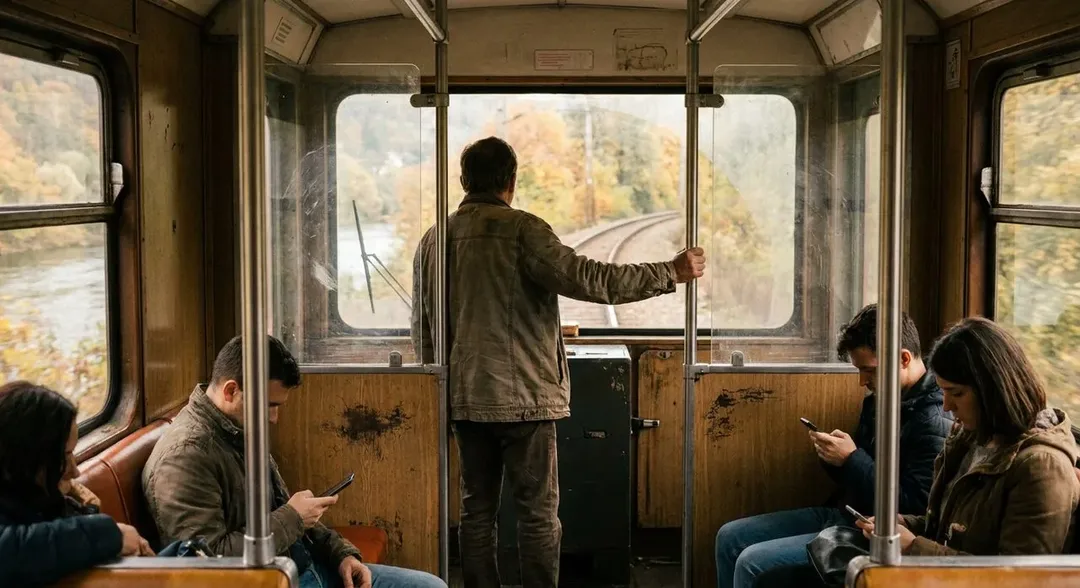
Regulars know the drill. The view is best from the very first car, front window, on the right side as the train curves eastward from the tunnel portal near Ocean Parkway. It's a specific geometry: you need the curve to frame the ocean properly, the elevation to clear the buildings, the forward motion to feel the reveal as it unfolds. Stand anywhere else and you get glimpses, fragments. But from that front right corner, you get the full panorama.
There's a small fraternity of riders who make this pilgrimage regularly, positioning themselves at the front of the platform at DeKalb or Atlantic Avenue, knowing exactly which door will put them in range. They're not tourists—they're people who've learned to extract small luxuries from the mundane architecture of daily transit. The front window becomes a kind of shared resource, a micro-economy of glances and yielded space. Some carry cameras, trying to capture the moment, though photographs never quite convey the kinetic pleasure of the experience—the way movement and surprise combine into something larger than the sum of views.
Summer travel and the contested window
Timing matters. On weekday mornings, the front car is often empty enough that you can claim your spot without negotiation. But weekend mid-afternoon trains in summer carry beach-goers—families with umbrellas and coolers, teenagers with towels slung over shoulders—and suddenly that front window becomes contested real estate. You're competing with people who have the same idea, who've also learned that the Q offers more than transportation.
The summer rhythm changes the subway's texture entirely. Salt air drifts through open windows. Wet bathing suits drip onto vinyl seats. The trains fill with that particular exhausted contentment that comes from a day spent horizontal in the sun. Sand accumulates in the corners of the cars, a gritty reminder of where everyone's been. The ocean view, in this context, becomes a kind of preview or epilogue, depending on which direction you're traveling. Either way, it announces itself: you are leaving the city, or you are returning to it, and here is the threshold.

What the view teaches you
There's something clarifying about watching a landscape assemble itself at twenty miles per hour. The ocean doesn't arrive all at once—it builds, framed first by narrow gaps between buildings, then widening as the train curves and the sightlines open. You become aware of the city's edge, the place where concrete yields to sand and water. For thirty seconds, you're reminded that New York is a coastal city, not just a vertical one, and that the subway system occasionally remembers to show you that fact.
The elevated curve also reveals the neighborhood in cross-section: the density of Southern Brooklyn, the Soviet-era immigrant architecture, the boardwalk infrastructure that appears in flashes. It's urban planning as spectacle, the way a single transit decision—to run the line elevated rather than buried—creates a moment of involuntary tourism for everyone aboard. The infrastructure itself becomes part of the show: the riveted steel of the elevated structure, the way the rails curve in a graceful arc, the industrial poetry of a system built to move millions but occasionally offering them something to see.
Brighton Beach below: the neighborhood in flashes
As the train completes its curve and approaches Brighton Beach Station, you descend back into the texture of street life. Below, Brighton Beach Avenue runs directly under the elevated tracks, creating a shadowed corridor of commerce that feels transplanted from another latitude. Storefronts advertise in Cyrillic. Produce stands overflow onto the sidewalk. The smell of smoked fish and fresh bread rises even to the train level on certain days.
This is the other half of the journey's reveal: after the ocean's grand gesture comes the intimate density of immigrant Brooklyn. The neighborhood has absorbed waves of arrivals—Russian, Ukrainian, Georgian, Uzbek—each leaving their mark on the commercial landscape. From the elevated platform at Brighton Beach, you can see the whole ecosystem at once: the beach to the south, the dense residential blocks to the north, and directly below, the covered market street that serves as the neighborhood's spine. The transition from ocean vista to urban close-up happens in seconds, a compression of scales that mirrors the immigrant experience itself—vast horizons narrowing to specific streets, particular blocks, chosen homes.
The boardwalk appears in flashes between buildings as the train slows: a wooden ribbon separating land from sea, populated by walkers and fishermen, bodybuilders using the outdoor gym equipment, older men playing cards at permanent tables. It's a social infrastructure as vital as the transit system, a place where the neighborhood goes to remember itself. And the Q train, rising and falling on its elevated track, provides the perfect vantage point to witness how all these layers—ocean, boardwalk, commercial street, residential blocks—stack together to form a place.
The regulars and the ritual
Talk to anyone who rides this stretch regularly and they'll have a story about the first time they noticed the view, the moment they realized this wasn't just another subway segment. Some remember it from childhood, pressed against the window on the way to Brighton Beach with grandparents. Others discovered it by accident, glancing up from a phone at exactly the right second. The common thread is the surprise—that the subway, usually so determinedly utilitarian, would offer anything approaching beauty.
By late 2026, as the city continues its uneven recovery and reinvention, these small rituals matter more than they used to. The front window of the Q train isn't a destination, exactly, but it's a waypoint worth marking. A reminder that the long way home sometimes offers rewards the express route doesn't.
Practical notes
The Q train runs from Manhattan through Brooklyn to Coney Island–Stillwell Avenue, with the elevated curve approaching Brighton Beach Station (Brighton Beach Avenue at Coney Island Avenue, Brooklyn). The ocean view sequence happens between Avenue U and Brighton Beach stops, approximately 40 minutes from Midtown Manhattan. Trains run 24/7 with reduced overnight frequency. The front car is accessible from the south end of the northbound platform and the north end of the southbound platform. Brighton Beach Station has elevator access. Summer weekend afternoons see the heaviest beach traffic; weekday mornings offer quieter viewing. Verify current service and schedules via MTA.info before traveling.
Tags: #TheLongWayHome #QTrain #BrightonBeach #NYCSubway #HiddenNYC #TransitSpectacle #BrooklynBound #SubwayViews #AtlanticOcean #SummerInTheCity #NYCInsider #KarposFinds #UrbanChoreography #ElevatedLine #CoastalNYC
Sources consulted: Q train (Wikipedia)) · NYC Subway - MTA · Brighton Beach · Brighton Beach - NYC Parks · NYC Hidden Gems - Atlas Obscura
All trademarks are the property of their respective owners.
Ask Karpo for more information.
Keep reading
- Best Trick or Treating Neighborhoods Near Me: Park Slope
 Best Trick or Treating Neighborhoods Near Me: Carroll Gardens
 Best Trick or Treating Neighborhoods Near Me: West Village