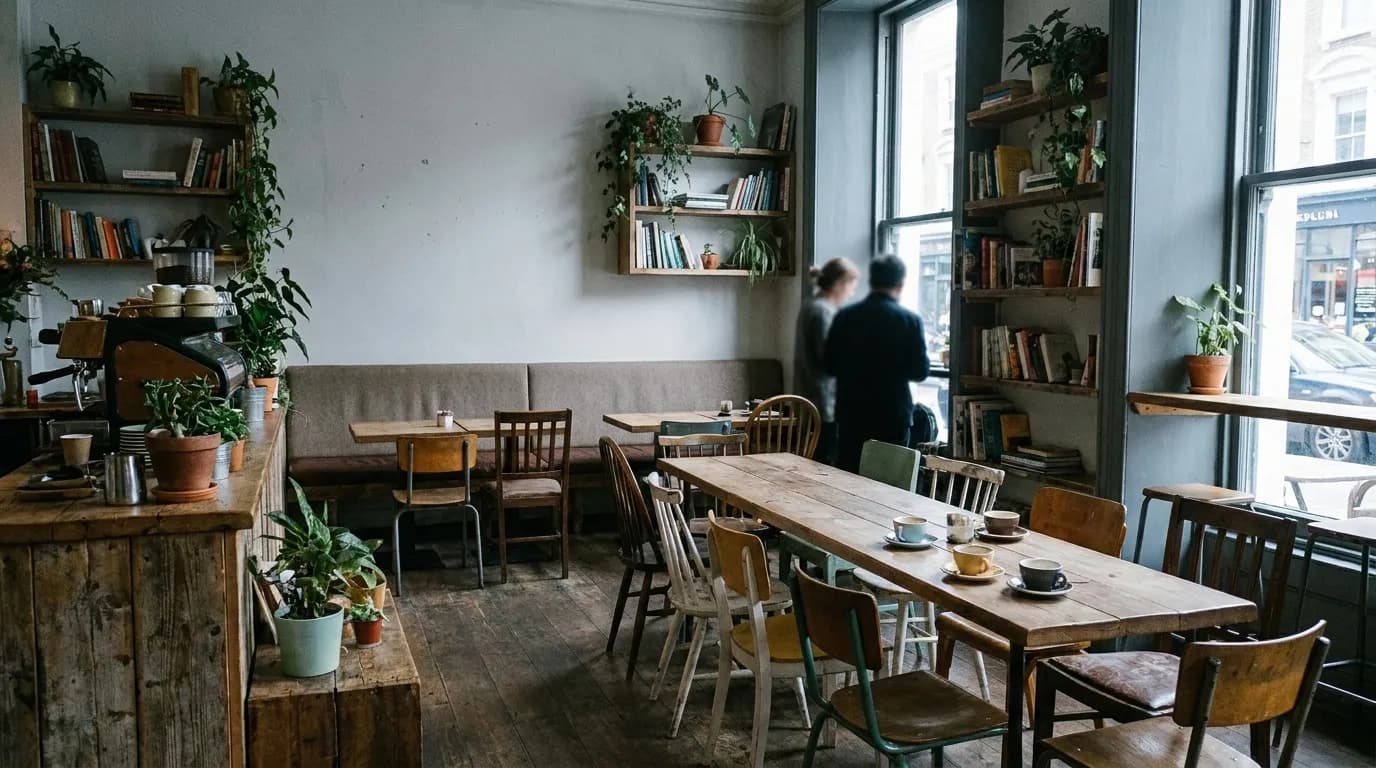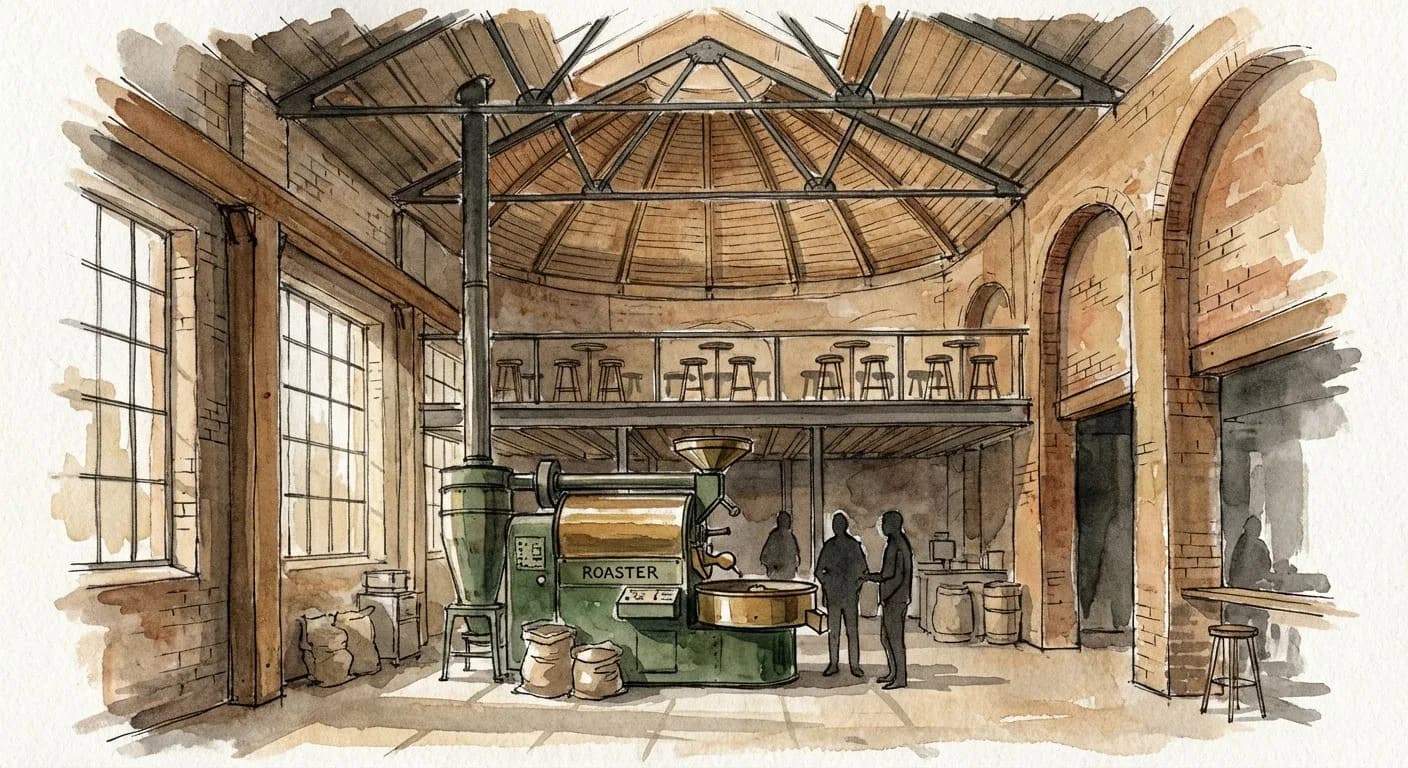
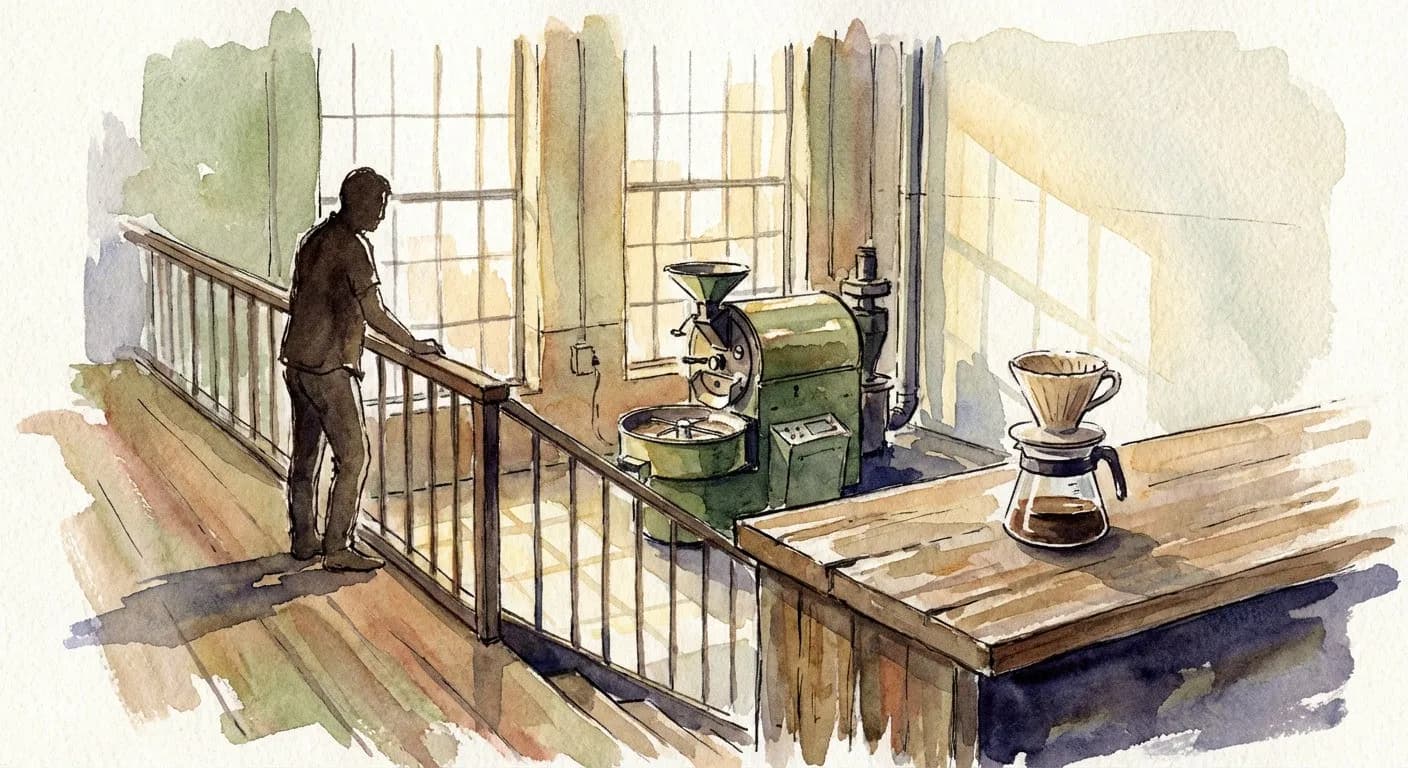
Walk into Sightglass Coffee at 270 7th Street on a weekday morning and the first thing you notice is that the room is not oriented toward the bar. It is oriented toward the roaster. There is a bar, yes — a long one, along the south wall — but the architectural center of gravity is a 1969 vintage Probat drum roaster standing on the ground floor in full view, and above it, a mezzanine of wooden stools and rails from which you can look down on it.
You order a flat white or a pour-over at the counter, climb the staircase, and sit. The chair faces the roaster. The roaster faces you. That is the whole proposition.
This is a different kind of "pull up a chair" from a neighborhood espresso bar. The chair at Sightglass is pulled up to a machine, not a counter — and the machine is older than the café is by roughly four decades.
The 1914 warehouse under the coffee
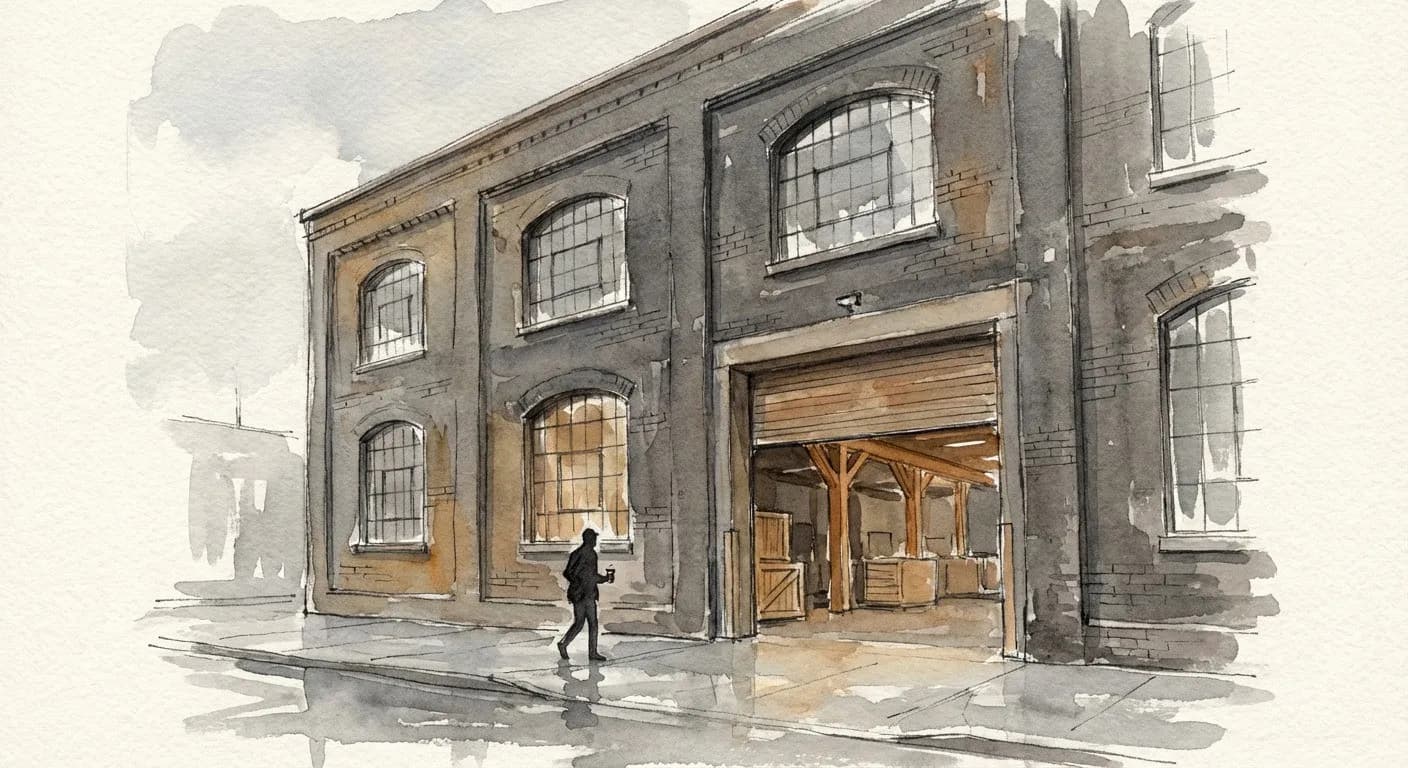
The building itself was built around 1914 as a SoMa industrial warehouse, and for most of the twentieth century it did warehouse things — storage, light manufacturing, the kind of unremarked commercial infrastructure that South of Market has always quietly housed. Brothers Jerad and Justin Morrison, who founded Sightglass from a service cart in SoMa in 2009, took the space over in 2010 as the company's flagship roastery-café.
What they did with it is worth noting. They kept the two-story bi-level shell. They kept the industrial-style windows running along the street. They exposed the original roof trusses and lined the domed ceiling with restored timber slats. They painted the exterior a distinct charcoal grey. And they installed the Probat — a 1969 German-built drum roaster, older than most specialty coffee companies in the United States — on the ground floor, in front of the street-facing garage door, so that anyone passing on 7th Street could see, through the open roll-up door on roasting days, the single most important piece of equipment the business owns.
The mezzanine was then built above it. Which means the seat you're sitting in was designed, from first principles, to let you watch the roaster at work.
Why the chair works
Specialty coffee cafés in the last twenty years have mostly organized themselves around the bar-as-theater model — the barista at the espresso machine is the performer, you sit at the bar, the drink is built in front of you, and the social geometry points at the drink. Sightglass quietly does something different. The bar is functional but not the show. The show is a 1.5-ton piece of cast-iron machinery with a German serial plate and fifty years of patina, and the seat is positioned so you are not looking at the barista but looking at — and slightly down on — the roaster.
This has an effect on how long you stay. A bar seat you vacate when your drink is done. A mezzanine seat facing a roaster is a seat you stay in for the roast. And the roast — a batch of green coffee dropped into the drum, turning from green to pale yellow to cinnamon to first crack, the room gradually filling with the specific tight grassy smell of coffee volatiles being driven off — takes between twelve and fourteen minutes. Which is roughly the length of one well-paced flat white.
If you arrive on a roasting morning — typically weekday mornings before about 10am, though hours vary — the chair earns its keep. The Probat spins. A roaster in an apron periodically pulls a sample tray, checks it against the light, returns it, and makes a small note on a clipboard. The bag hopper gets refilled. The bean cooling tray fills and empties. You drink your drink and read a machine.
What "pull up a chair" actually means in a third-wave room
Most Pull Up A Chair recommendations in this column have been about cafés where the chair is positioned to read other people — the regulars, the neighborhood, the window onto a street. Sightglass 7th Street is unusual because the chair is positioned to read a single industrial object. It is a different mode of café-sitting: less observational, more meditative, closer in spirit to watching a bread oven than to watching a crowd.
What makes it a genuine "chair" moment rather than a "stop and gawk" moment is the length. You can sit here for forty-five minutes — second drink, a pastry, maybe a laptop — and the roaster is still doing interesting things in your peripheral vision. It is a café that rewards staying.
The coffee itself
This article has been mostly about architecture, so a brief coffee note: Sightglass has been, since roughly the early 2010s, one of the most consistently well-regarded roasters in California. The house espresso blend is their Blueboon, widely considered among the most balanced city-roast espressos in the country. The single-origin pour-overs rotate weekly and tend to include East African and Central American lots. The milk drinks are technically excellent — the flat white is the reference point most baristas in the city calibrate against.
In short: you are not sitting in an architecturally interesting café that also happens to serve coffee. You are sitting in an architecturally interesting café whose coffee is a reason to go back even once the architectural novelty wears off.
Practical notes
- Location: 270 7th Street, San Francisco (between Folsom and Howard), SoMa.
- Hours: opens 7am weekdays, 8am weekends; check current closing time on the official site.
- Best window: weekday mornings before 10am, for the chance of catching a roast on the Probat. Saturday mornings also work, though the room is busier.
- What to order: one espresso-based drink (cappuccino or flat white) plus a single-origin pour-over, ideally split across two sittings. The pour-over is brewed at the dedicated slow bar; budget an extra 8 minutes.
- Where to sit: the mezzanine. Downstairs is fine but the chairs were designed for the upper level.
- How long to stay: 40–60 minutes if the roaster is running; 20–30 if it is not.
- Walking solo: SoMa is a mixed neighborhood and 7th Street between Folsom and Howard is a specific microblock — the immediate stretch is well-trafficked during daylight hours with reliable sightlines and active street life from the café itself plus adjacent design-industry tenants. Solo café-sitting is common and unremarkable on a weekday morning. For a safer route, arrive and depart via Folsom (west) rather than Howard (north); ride-share pickups drop directly in front of the café; avoid arrival after dark if walking from a transit stop. Muni Civic Center BART is roughly a 10-minute walk; SF Powell BART is closer to 15.
- What to do after: the SF MOMA (10-minute walk north via 7th and Mission) or the Contemporary Jewish Museum (8-minute walk) pair well for a coffee-plus-museum morning. For lunch, Yerba Buena's food options are 12 minutes on foot.
The point
There are cafés in San Francisco with better views of the street. There are cafés with better views of other customers. Sightglass 7th Street is the one with the best view of a coffee roaster, and the mezzanine chair is positioned with enough care that you can watch the roaster for an entire morning without it ever feeling like a stunt.
You do not go for Instagram. You go to sit, quietly, in a 1914 warehouse, facing a 1969 Probat, drinking a 2026 flat white, and letting three separate decades share a room.
Tags: #Sightglass #SFCoffee #SoMa #PullUpAChair #SanFrancisco #SpecialtyCoffee #KarpoFinds #Vol4
Sources consulted: sightglasscoffee.com · en.wikipedia.org · sfchronicle.com · eater.com
All trademarks are the property of their respective owners.