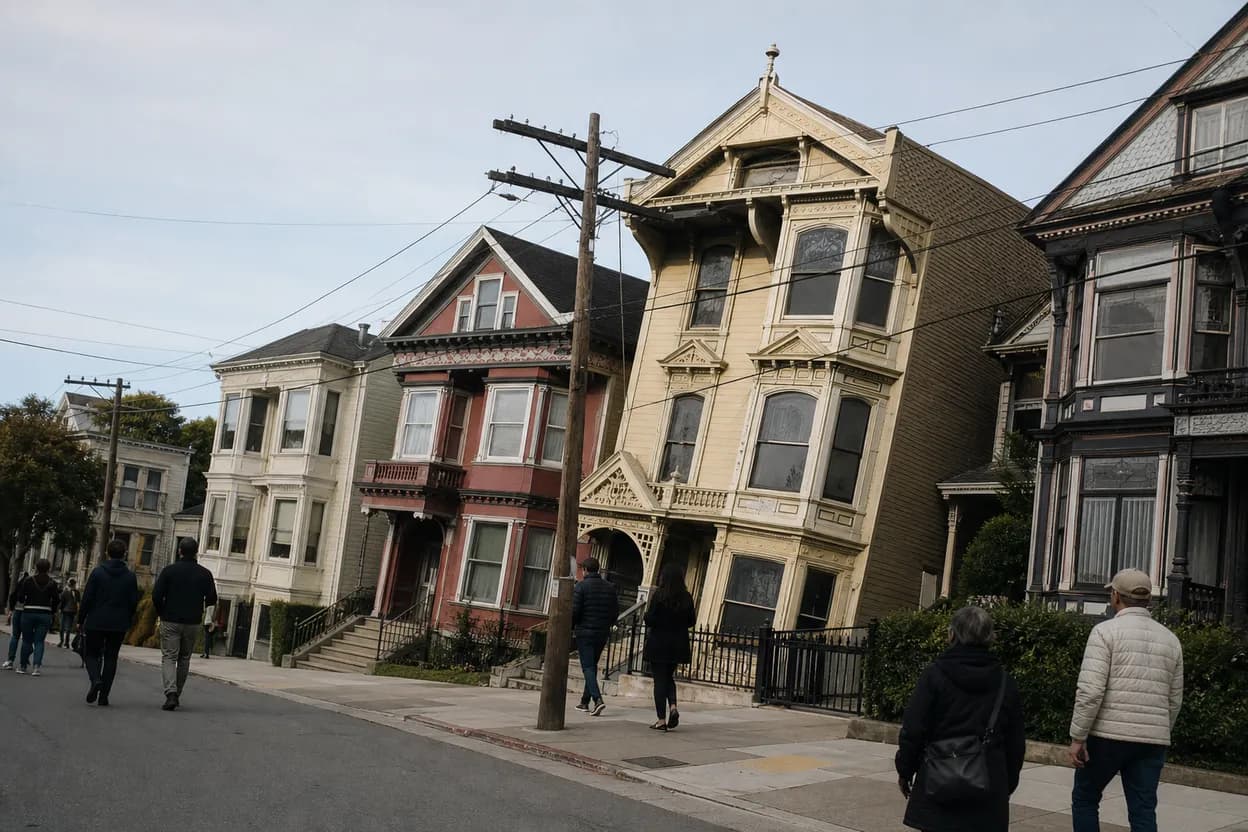
San Francisco has a particular way of turning history into a neighborhood detail you can actually walk past. This free route follows the last house idea into Duboce Triangle and the Inner Sunset, where post-1906 survivor cottages still shape blocks of ordinary streets. The point is not hidden access or inside tours. It is to stand on sidewalks, read rooflines and additions, and notice how a disaster-era housing fix became part of the city’s fabric. On a cool foggy or mild-sun late afternoon, this is easy, low-cost, and best with a history-loving friend.
Want a tighter route map and transit fallback for this exact SF walk? Text Karpo before you head out, and get a quick check on the best start point, the best stop, and the day’s service risk.

Duboce Park and Scott Street
Start at Duboce Park, where the city says the park was established in 1900 and became a tent city after the 1906 earthquake. That makes it a strong anchor for this walk: public, flat, and historically legible without any need to enter private property. Use the park edge to reset your eye. The scale here matters, because the cottages you are chasing are small enough to disappear unless you slow down and compare them with later infill.
The practical tradeoff is that Duboce Triangle is busy enough to feel lively but not quiet. Keep the route sidewalk-only and do not treat any cottage as a point of entry. From this first stop, you are looking for compact massing, older roof pitches, and homes that seem stitched into larger blocks rather than built as one big composition. If the park is crowded, keep moving; the walk works best as a sequence of glances, not a linger-and-stare hunt.
Church and Duboce on the N Judah
For transit and pacing, the N Judah is the cleanest backbone. SFMTA lists Duboce Ave & Church St and Duboce Ave & Noe St as stops on the line, and it runs 24 hours daily. That gives you a simple entry and exit on the western edge of Duboce Triangle, especially if you want to avoid a longer uphill return. It also makes the walk flexible if weather shifts from fog to sun or if your companion wants an easier finish.
The failure mode here is assuming every delay is local. N Judah service can be busy, and the route page is the thing to verify before you leave, not after you are already at the platform. If the line feels crowded or off cadence, use the walk as a short neighborhood loop rather than a point-to-point commute. The alternate-service page also gives you a backup if only the N is running unevenly or not at all.
Carl Street and the Inner Sunset ridge
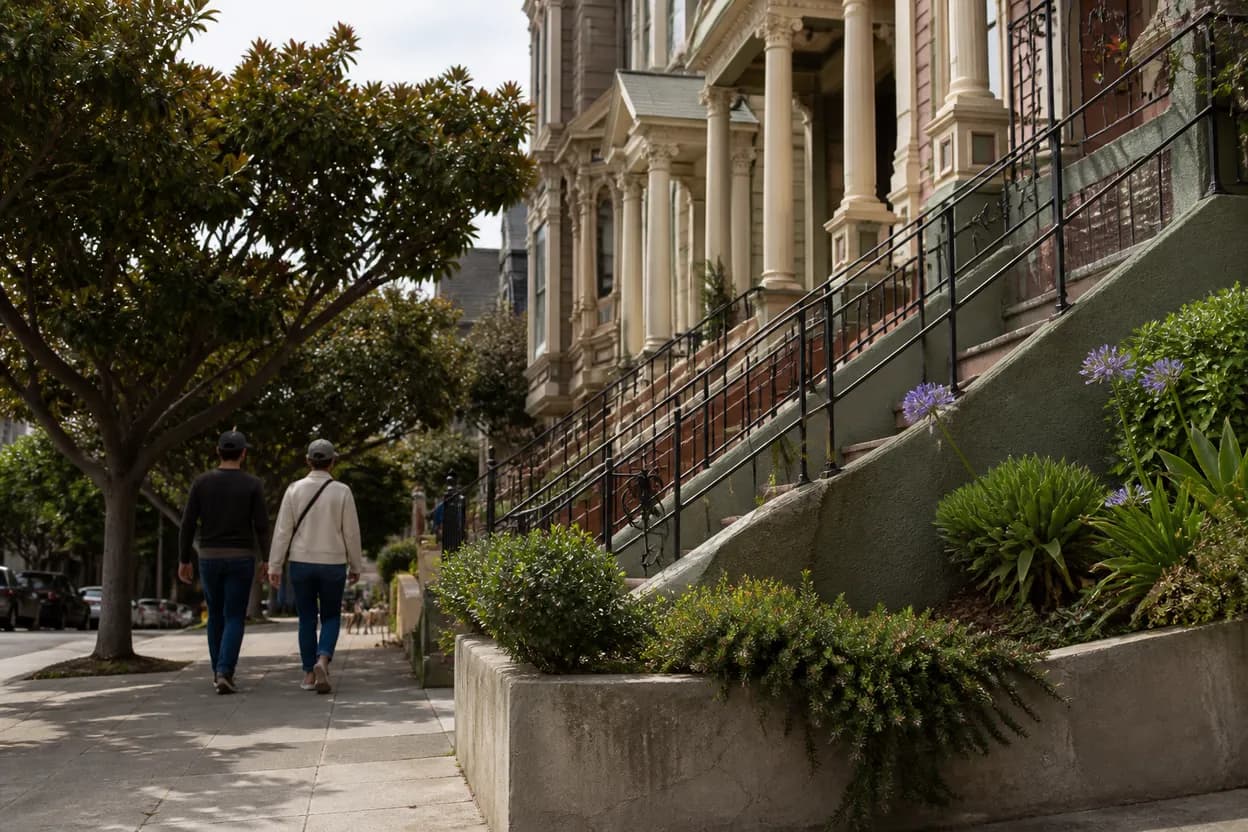
The Inner Sunset end of the route gives the walk its best contrast. SFMTA’s N Judah page shows the line serving Irving St & Arguello Blvd and the nearby Carl Street stops, while the alternatives page points riders toward 6 Haight/Parnassus or 7 Haight/Noriega for Inner Sunset fallback. That matters because the neighborhood reads differently from Duboce Triangle: broader lots, more daylight, and fewer reasons to rush. It is the better place to study how old cottages sit inside later street life.
For readers who like structure, this is where the walk becomes a comparison exercise. Look for cottages that seem undersized next to neighboring buildings, then note whether additions have lowered or obscured the original form. From the sidewalk, you are reading persistence, not perfection. If you are moving west on the N, do not overextend into a long detour. The point is to keep the route easy enough that the historical details stay vivid instead of turning into a slog.
Irving Street and 9th Avenue blocks
The middle stretch around Irving and 9th Avenue is where the walk feels most like neighborhood observation instead of monument hunting. SFMTA lists Irving St & 8th Ave, Irving St & 5th Ave, and Judah St & 9th Ave among N Judah stops, so you can flex the route around your energy level. This is useful in San Francisco, where cool fog can make a short, flat block feel far longer than it looks on a map.
The best reading strategy is to compare one house at a time against its neighbors. Survivor cottages often reveal themselves through narrow proportions, irregular rooflines, or the way a larger home seems assembled around an older core. Do not expect labels or plaques on every block. If the weather shifts to a damp, dim late afternoon, use that to your advantage: the softer light makes shape differences easier to notice from across the street.
Sidewalk clues on survivor cottages
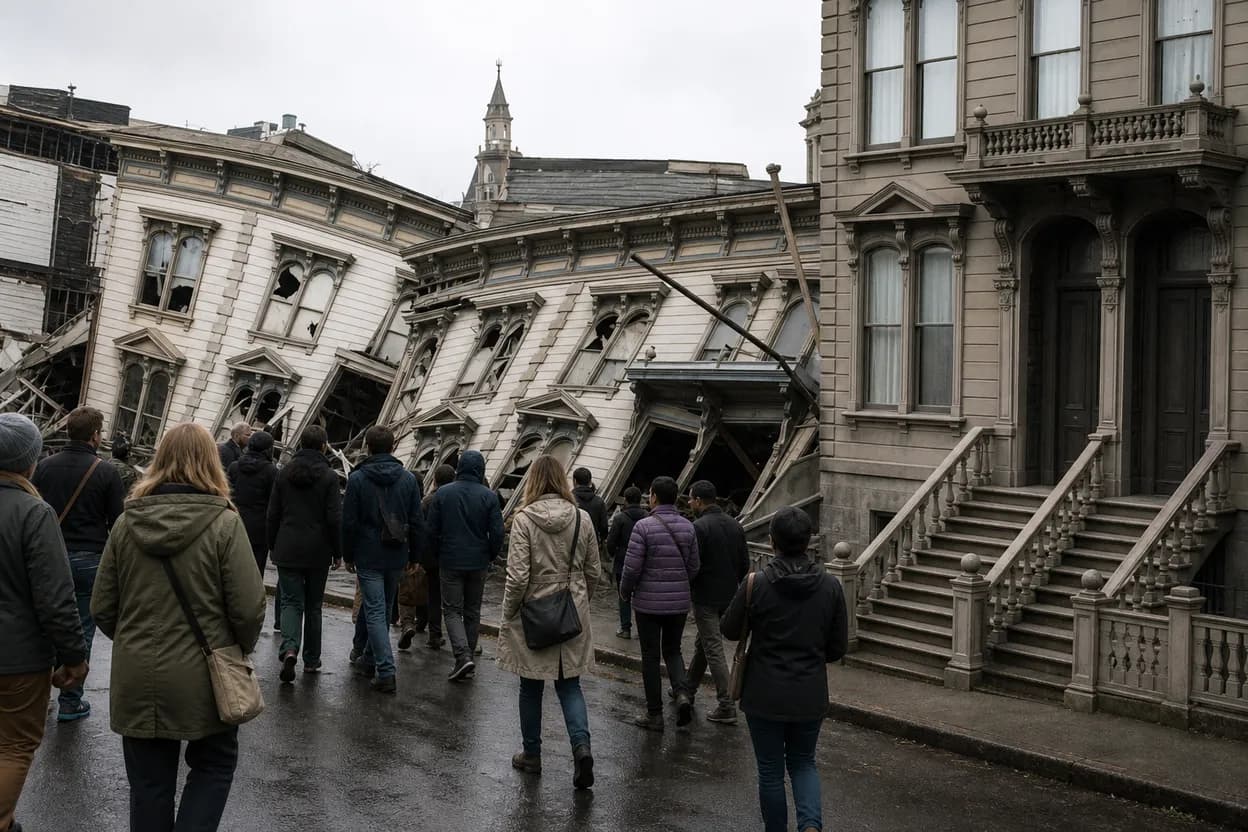
The strongest clue is not a sign; it is scale. SF Heritage notes that 1227 24th Avenue contains three earthquake relief cottages, and the Chronicle’s current map of surviving shacks focuses on homes visible from public places. That is the right mindset for this walk: look for buildings that seem too compact, too low, or too pieced together for their lot. From the sidewalk, you are checking composition, not proving a pedigree.
A good rule is to treat every likely cottage as a hypothesis. The last house idea works because these homes survived by adaptation, and later remodels can hide the original bones. That means one block may show an obvious survivor while another only hints at one through window rhythm or a roof that breaks from the street wall. If a house looks too altered, move on; uncertainty is part of the route, not a flaw in it.
Duboce Triangle to Inner Sunset backup logic
If the day gets colder, or if you want a shorter loop, the backup is simple: stay on the most legible blocks near the N Judah and skip anything that pulls you deep into residential side streets. SFMTA’s Duboce Triangle alternatives list F Market & Wharves eastbound, 6 Haight/Parnassus, 7 Haight/Noriega, 22 Fillmore, and Church Station connections. Those options let you compress the outing without losing the historical thread.
That flexibility matters because the utility of this walk is in its low friction. A route that depends on perfect weather, perfect transit timing, or perfect attention will fail most people. A route that can shrink to forty minutes and still deliver one or two strong cottage reads will actually get used. If you only have a narrow window before dinner, keep the outing to two anchor blocks and make the return decision before you start the second half.
One last verification before you go
Before leaving, check three things in order: N Judah service, weather, and park hours. The SFMTA route page is the live transit check, Duboce Park lists hours, and SF Planning’s survey page is a reminder that the city reads historic places through fieldwork, research, and evaluation. That is your cue to be equally careful. If a detail matters to your timing, verify it again the same day rather than relying on memory or a saved screenshot.
For the actual finish, stop with one final look back at the street wall and ask whether the cottage signal still reads from public space. That is the right closing test for this walk: no trespass, no assumptions, no romanticized certainty. If the block still feels a little eerie in the late-afternoon light, the route has done its job. Confirm the transit home, then let the neighborhood be enough.
Tags: #SanFrancisco #DuboceTriangle #InnerSunset #EarthquakeCottages #FreeThingsToDo #WalkSF #HistoricSF #NJudah #SFMTA #SFHeritage #NPS #CityWalk #AskKarpo #BeforeYouGo
Sources consulted: Source 1: nps.gov · Source 2: sfrecpark.org · Source 3: sfmta.com · Source 4: sfmta.com · Source 5: sfplanning.org · Source 6: sfheritage.org
All trademarks are the property of their respective owners.
Ask Karpo first
Tell Karpo your date, group size, budget, and starting point. We’ll check current access, timing, transit, and the cleanest San Francisco plan for Duboce Triangle and Inner Sunset earthquake cottage walk before you head out.