 Wine Tasting Near Me: Inside Williamsburg's Working Winery
Creative Workshops
The Instrument Luthier in Spanish Harlem Carving Cuatro Bodies
A walk-up workshop; the tonewoods dry on the fire escape two seasons before carving
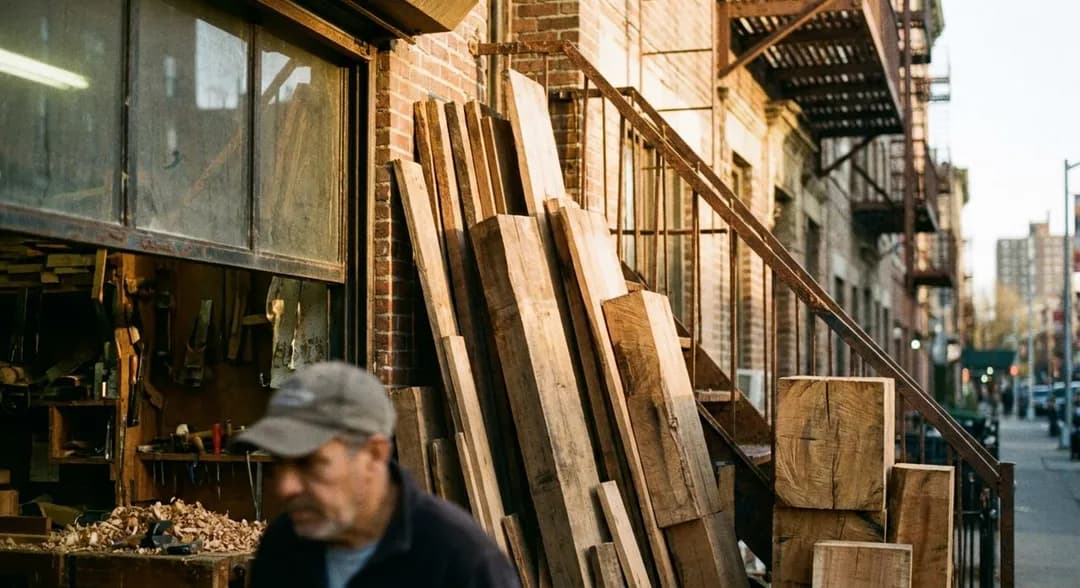
You climb three flights above a bodega on East 116th Street where the stairwell smells like café con leche and decades of radiator paint, and there's Héctor Maldonado's workshop — door propped open with a mahogany offcut, sawdust drifting into the hallway like pollen. Through the window grates, cuatro tonewoods lean against the fire escape in neat rows, seasoning in the Harlem weather. Two full winters and two summers before Héctor even thinks about touching them with a blade.
The Fire Escape Becomes the Drying Room
Héctor sources his wood from a timber merchant in the Bronx who deals in tropical hardwoods — mostly Puerto Rican laurel and Dominican mahogany that arrive as rough planks. He stacks them on the fire escape facing the courtyard, each piece separated by thin wooden spacers he cuts from scrap cedar. The wood sits there through August humidity and February ice, slowly acclimating to New York's schizophrenic climate. You can see the progression if you look closely: the newest arrivals still show saw marks and fresh color, while the two-year veterans have weathered to silvery gray on the exposed surfaces. Héctor says the fire escape method isn't romantic tradition — it's necessity. His workshop is too small and too warm for proper seasoning, and commercial kiln-dried wood sounds dead when you tap it. He needs the grain to relax naturally, the cellular structure to stabilize on its own time. On Thursdays around 2pm, he rotates the entire stack, flipping each board to ensure even exposure. The super stopped complaining about it years ago.
Inside Where the Radio Plays Jíbaro Music

The workshop itself measures maybe 400 square feet, every inch claimed by some stage of instrument construction. A workbench runs the length of the western wall beneath windows that haven't opened since the Clinton administration. Héctor keeps a paint-splattered radio tuned to WADO, and when jíbaro music plays, he times his planing strokes to the cuatro melodies coming through the speaker — a private joke about matching rhythm to the instrument's eventual voice. Templates hang from ceiling hooks, each one a different cuatro model he's developed over thirty years. The Borinquen has a deeper body. The Criolla sits shallower. The Navideño is built specifically for aguinaldo season, brighter in the upper register. He doesn't label them — he knows each template by the nail holes and pencil marks accumulated across decades. The smell in here is complex: fresh wood shavings over old varnish over the ghost of someone's previous tenancy, maybe a seamstress or a bookkeeper, their work long dissolved into the floorboards.
The Carving Happens in Absolute Silence
Once the tonewood has earned its two-year residency on the fire escape, Héctor brings it inside and lets it acclimate to the workshop temperature for another month before the first cut. He works the body carving in complete silence — radio off, door closed, even the street noise seems to respect the process. The cuatro body emerges from the solid block through a series of increasingly fine gouges and chisels, Héctor's hands moving in patterns he's repeated so many times his muscles remember better than his brain. He carves the sound chamber walls to exactly 3.2 millimeters at the thinnest point, checking with calipers but mostly trusting the flex when he presses his thumb against the wood. Too thin and the instrument sounds bright but fragile. Too thick and it loses the cuatro's characteristic sweetness. The shavings that come off during this stage are translucent, curling into shapes that catch the afternoon light. He saves them in a cardboard box — his daughter's art class uses them for a project every spring.
The Neck Joint That Nobody Sees

Héctor's signature detail lives in the neck joint, the place where the neck meets the body in a mortise-and-tenon configuration that he cuts entirely by hand. He refuses to use the router for this joint, says the tear-out from the bit compromises the acoustic coupling. Instead, he chisels the mortise in the body block over the course of an afternoon, testing the fit with the tenon every few minutes until the neck slides in with what he calls "the right amount of wrong" — meaning it requires firm pressure but no mallet. Once glued, this joint carries all the string tension, and Héctor's instruments are known among players for necks that never shift, never require resetting even after decades of tuning stress. He learned this method from his uncle in Caguas, who learned it from someone else, the lineage stretching back to instrument makers who worked by candlelight. You'll never see this joint on a finished cuatro — it disappears under the fretboard extension — but Héctor says it's the difference between an instrument and furniture shaped like an instrument.
The Binding is Actual Tortoiseshell from 1970
The decorative binding that runs around the body edge comes from Héctor's stash of genuine tortoiseshell — not the plastic imitation, but real hawksbill turtle shell he acquired in the 1970s before CITES restrictions made it illegal to trade. He bought enough back then to last his career, storing it in a climate-controlled case he keeps under the workbench. The shell arrives in flat plates that he softens in a electric skillet set to exactly 240 degrees, then bends around the cuatro's curves while it's still pliable. The smell during this process is distinctive and slightly unpleasant, like burning hair mixed with old glue. Once cooled and set, the binding glows with an amber depth that plastic can never replicate, and it ages beautifully, darkening slightly each year. This detail alone adds $800 to the instrument's price, but players who understand what they're getting never complain.
The Wait List Runs Fourteen Months Now
Héctor completes maybe nine cuatros per year, sometimes ten if winter is mild and he doesn't lose work days to frozen fingers. Each instrument takes roughly six weeks of actual hands-on time, spread across four or five months to allow for glue curing, finish settling, and his own quality review period where he plays the instrument daily to ensure it's singing properly. The wait list sits in a spiral notebook on the workbench, names and deposit dates in ballpoint pen, no computer system. Current wait time hovers around fourteen months, though Héctor tells new customers to expect eighteen just to be safe. He requires a $600 deposit, cash or check only, and the balance — typically between $2,800 and $4,200 depending on ornamentation — comes due when he calls you for pickup. No shipping, no exceptions. You come to the workshop, you play the instrument, you carry it home yourself.
Practical Notes
The workshop is technically open Tuesday through Saturday, 10am to 6pm, but Héctor takes lunch from 1pm to 2:30pm at the Dominican restaurant downstairs and sometimes runs errands that extend into the afternoon. Best bet is calling ahead (his number is posted on a hand-lettered card in the bodega window) or showing up Tuesday or Thursday mornings when he's most reliably present. The building is at 344 East 116th Street between First and Second Avenues, third floor, apartment 3C though the C is missing from the door. Take the 6 train to 116th Street, walk east three blocks. There's no appointment system for browsing — if the door's open, you can come up and watch him work. He doesn't mind questions during binding or finishing stages, but respect the silence during carving. If you're serious about commissioning an instrument, bring a recording of yourself playing or the name of the musician you're buying for. Héctor wants to know who's going to be making music with his work.
Tags: #CuatroGuitar #SpanishHarlem #InstrumentMaker #LuthierLife #EastHarlem #TonewoodSeasoning #HandmadeInstruments #PuertoRicanCulture #TraditionalCrafts #NYCWorkshops #El116 #MusicianLife #TheOddEdit #ArtisanCulture #HarlemCraftsmen
Sources consulted: atlasobscura.com · timeout.com · nytimes.com
All trademarks are the property of their respective owners.
Ask Karpo for more information.
Keep reading
- Wine Tasting Near Me: Inside Williamsburg's Working Winery
 Handmade Pasta Near Me: Misi's Glass-Walled Kitchen On The Waterfront
 Cooking Class Near Me: Chelsea's Carriage House Cooking School, Explained