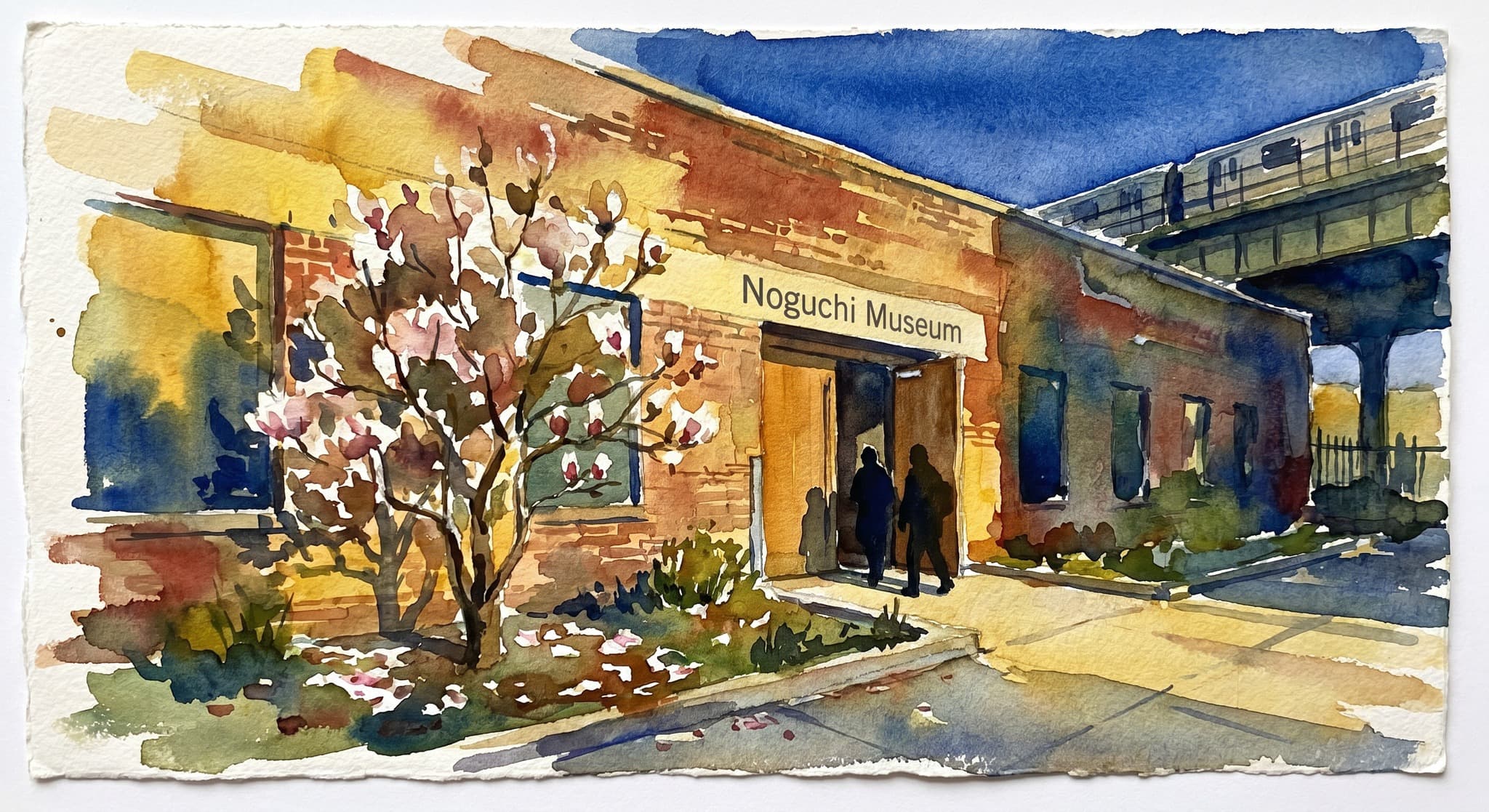
On the first Friday of every month, the Noguchi Museum in Long Island City — one of the country's most quietly serious sculpture museums, founded by Isamu Noguchi in 1985 in a former gas station and photo-engraving shop he bought outright — opens its doors for free from 5pm to 8pm. The stop on the 7-train is Broadway, Queens. Two stops further east on the same 7-train is Citi Field, where on May visiting weekends Mookie Betts and the Dodgers will be in town. Same train, same evening, two completely different versions of a Friday in New York. This one costs nothing.
The Museum
The Noguchi Museum is a 27,000-square-foot former industrial building at 9-01 33rd Road in Long Island City, four blocks north of the Socrates Sculpture Park and three blocks east of the East River. The artist bought the building in 1974 and converted it, mostly with his own hands, into a permanent home for his work. The collection on the floor today — roughly 250 pieces of sculpture, models, drawings, and Akari light sculptures — is the most complete single-artist museum in New York that is not a Frank Lloyd Wright house.
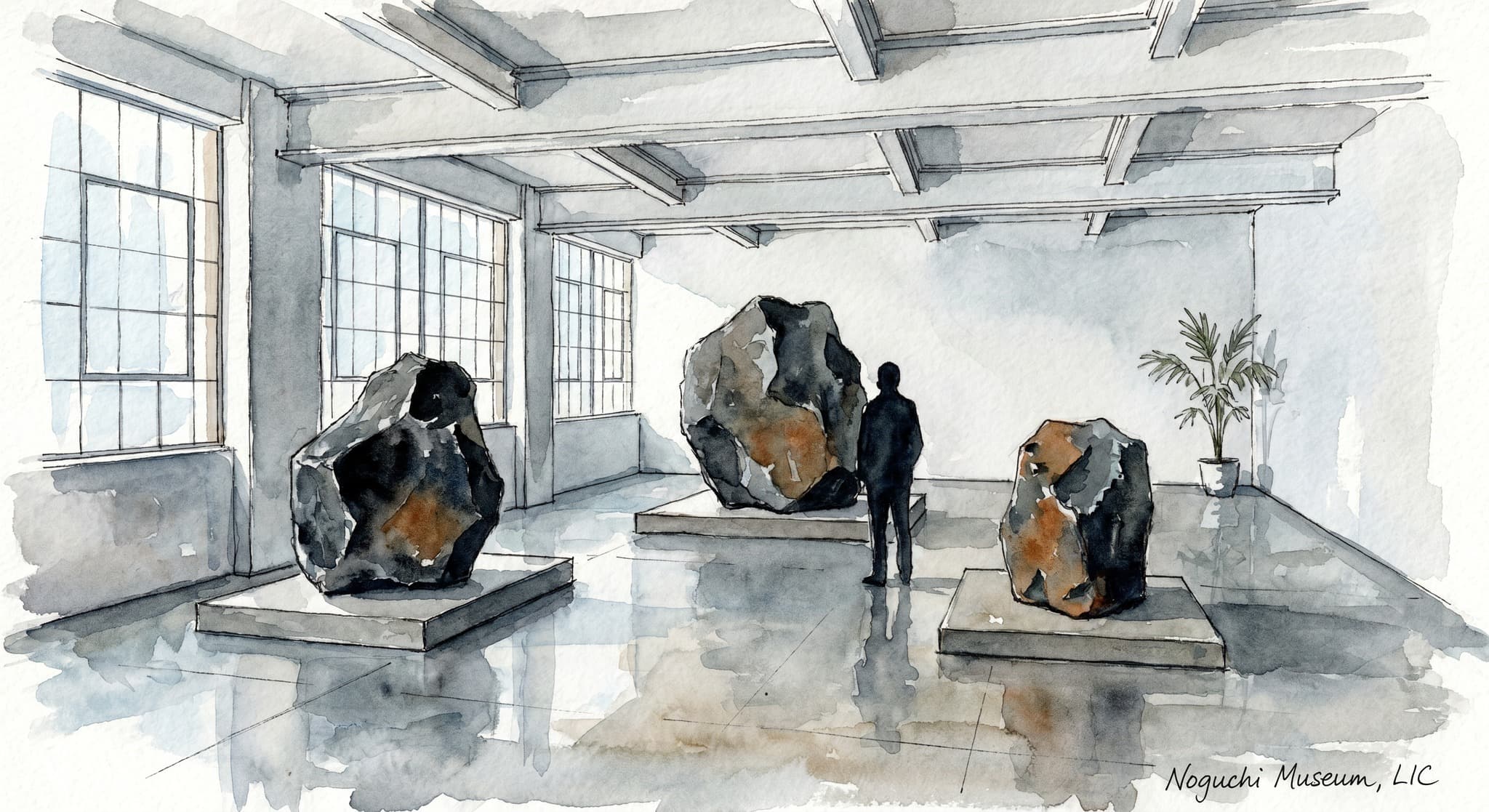
The building is structurally unusual. The galleries are arranged around a central outdoor garden of Noguchi's own design, planted with bamboo, ginkgo, and three large basalt pieces that you walk past on the way between indoor rooms. The galleries themselves are mostly unheated, mostly daylit through industrial north-facing windows, and almost completely silent. The concrete floors register every footstep. The room temperature in the indoor galleries on a May Friday evening is roughly the room temperature outside, which is the building's deliberate point.
Why Free Friday Works
The standard admission is $20 — a fair price for a museum of this density and scale, and the museum collects it cheerfully Wednesday through Sunday at the door. The first-Friday-of-the-month free evening is an explicit democratization of the institution, and it does what the column keeps arguing for: it removes the cost barrier and reveals which museums in New York are actually worth your time at any price.
The Noguchi pays off. The first-Friday window is 5pm to 8pm — three hours, free, with the same docent staffing and the same garden access as any paid day, and with the added structural benefit of golden-hour-into-blue-hour light coming through the gallery's north windows during the slot. The crowd on the free Friday is busier than a normal weekday but still well under capacity. The museum is built to absorb visitors silently. The room does not feel crowded even when the room is full.
What to See First
Three things in three rooms.
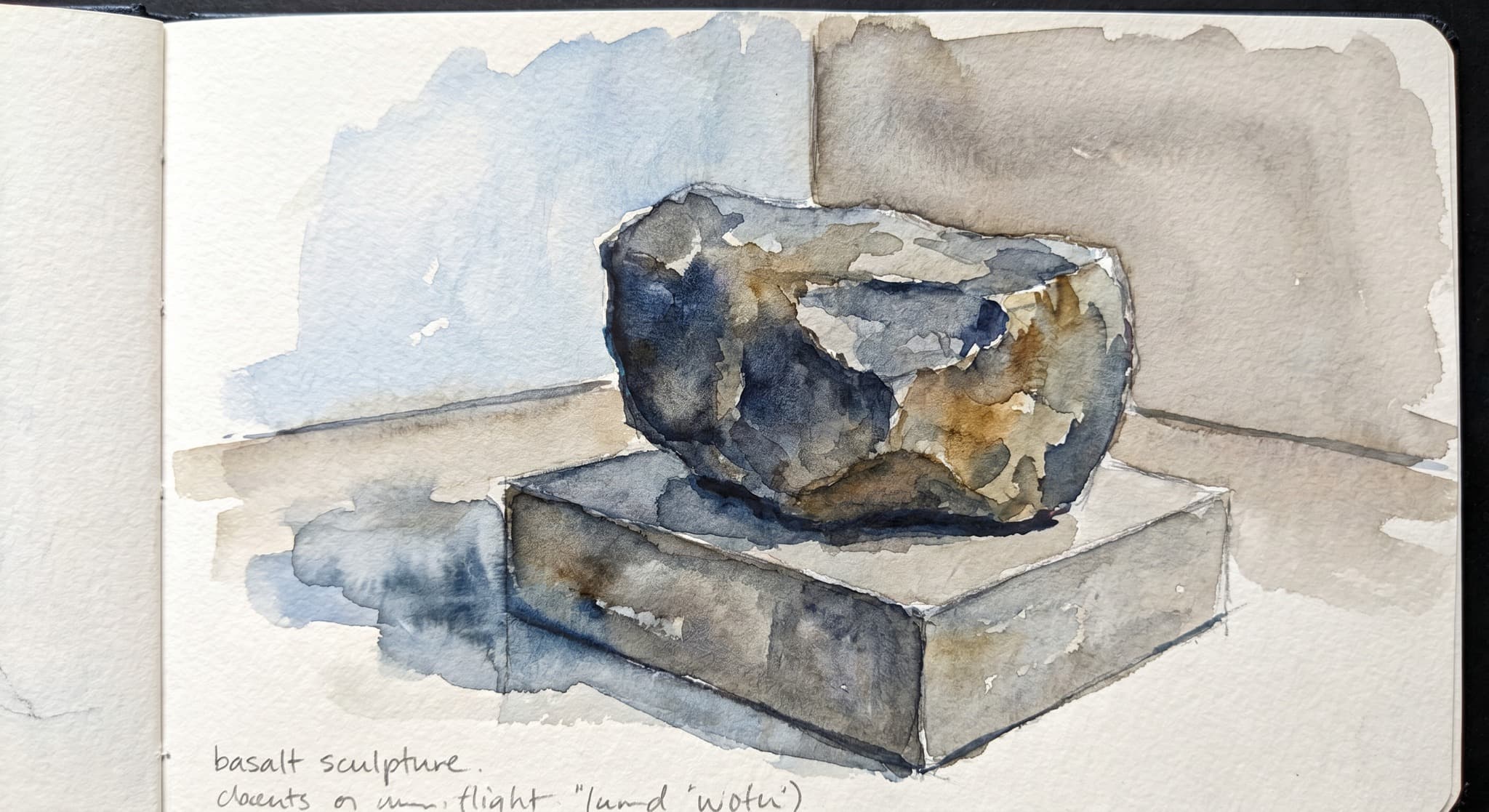
The first thing is **the basalt-and-bronze room** (Area 1, ground floor, immediate left of the entrance). Five large basalt pieces, polished on one face and rough on the other, are arranged in a triangle on raw concrete. The room is lit only by the high north-facing window. Noguchi was working through the question of what a stone shows when you only polish half of it. Stand in front of the largest piece (untitled, basalt, 1982) for two full minutes. That is the experience the museum is built to deliver.
The second thing is **the garden**. Walk straight out the back through the rotating exhibition room and into the open-air courtyard. The garden has a single bamboo grove, three additional sculptures arranged informally on gravel, and a low stone bench that is itself a sculpture. May evenings put the bamboo at peak green and the garden temperature at the most comfortable five degrees of the building.
The third thing is **the Akari room** on the second floor. Roughly twenty of Noguchi's paper-and-bamboo light sculptures, hung from the ceiling at varying heights, glow on a low setting. Noguchi designed the Akari series in 1951 specifically to be affordable, mass-produced, and beautiful — the museum sells working Akari lamps in the gift shop at the bottom of the stairs for $90 to $700, and the lamps in the gift shop are the same as the lamps in the gallery. The democratization is the work.
The Subway Math
The Noguchi Museum is, technically, a difficult subway trip — the N/W to Broadway in Astoria deposits you a fifteen-minute walk from the door, and there is no closer subway stop. The free Q103 bus runs along Vernon Boulevard and gets you within a block. The Citi Bike dock at 30th Avenue and 21st Street is a six-minute ride.
The trip is worth the friction. The friction is also the reason the museum stays as quiet as it does. The Long Island City sculpture-and-art corridor — Noguchi Museum, Socrates Sculpture Park three blocks south, MoMA PS1 fifteen minutes south by foot, and SculptureCenter — does not get the foot traffic that Chelsea or the Met Mile generates because it requires a fifteen-minute walk that most New Yorkers will not commit to. The walk is the filter, and the filter is the reason a free Friday evening at one of the most important sculpture collections in the country still feels uncrowded at 6pm.
What to Pair It With
The two adjacent free or near-free pieces of the first-Friday plan:
**Socrates Sculpture Park**, three blocks south on Vernon Boulevard, is free every day, year-round, and has a rotating roster of outdoor sculpture installed on a five-acre East River-facing lot. May has the spring planting at its peak. The sunset over the East River from the Socrates lawn is one of the city's underbooked golden-hour views, and the park stays open until sunset.
**M. Wells Steakhouse**, eight minutes' walk south on 49th Avenue, is the post-museum dinner reservation. It is not free. But the bar runs a Friday happy hour 5–6:30 with $9 cocktails and $7 burgers, and if you time the museum exit at 7:30 and walk straight south, you arrive at the bar just inside the happy-hour cutoff.
Or, if you came for the Mets, you stay on the 7-train at Broadway Queens and ride three stops east to Mets-Willets Point. The Noguchi closes at 8pm. First pitch is at 7:10. You will miss the first inning. The trade-off is up to you.
Why It Works as "Free and Fine"
The argument this column keeps making is that the best free things in New York are not the famous free things. The Staten Island Ferry is free. The Brooklyn Bridge is free. Central Park is free. All three are excellent and all three are also already known. The advantage of a free first-Friday evening at the Noguchi is that it is structurally invisible — listed on the museum's website, not in the city press, not in the tourist guides, not on the local-influencer reel — and it is one of the highest-quality three hours of free art in the city, every month, year-round, no advance booking required.
The "fine" half of the column's name is the part the Noguchi delivers without trying. The institution is a single-artist museum built by the artist on his own dime. The galleries are unheated industrial space converted by hand. The garden was designed by Noguchi himself. The Akari lamps were Noguchi's working democratic-design project. The whole museum, from the door to the gift shop, is the artist's deliberate argument that good design and serious art should be available to everyone. The free Friday is the institutional version of that argument. The argument has been holding for forty-one years.
Practical notes
- Location: The Noguchi Museum, 9-01 33rd Road at Vernon Boulevard, Long Island City, Queens.
- Free Friday: First Friday of every month, 5pm–8pm. No advance booking required. Standard admission $20 otherwise (Wed–Sun, 11am–6pm).
- Getting there: N/W to Broadway (Queens) — 15-minute walk west on Broadway to Vernon, then north. Or 7-train to Broadway — same 15-minute walk. Q103 bus drops at Vernon and 33rd Road. Citi Bike to 9th Street.
- Best window: 5:30pm–7:30pm — golden hour through the north windows, garden at best temperature, crowd at half capacity.
- Cost: $0 for the first-Friday evening. $90 for the smallest Akari lamp if you want to take the museum home.
- What to skip: Wheeled luggage and large bags (no check); flash photography; loud calls (the building registers every sound).
- What to bring: A light jacket — the galleries are not heated. A sketchbook is welcomed. Reading glasses for the wall labels.
- What to do after: Socrates Sculpture Park for sunset (three blocks south, free, year-round). M. Wells Steakhouse happy hour (five blocks south, ends 6:30pm). Or 7-train three stops east for Mets first pitch at 7:10 — accepting that you miss the first inning.
The point
A free museum night usually means a crowded museum night. The Noguchi is the structural exception. It is free three hours a month, the building is built to absorb visitors quietly, the artist's whole forty-year project was about making serious art available without barrier, and on a May Friday evening one subway stop west of where Mookie Betts is taking batting practice, the basalt-and-bronze room is empty enough to stand in front of a single 1982 stone for two full minutes without anyone walking through the frame. That is the free fine evening. That is what the column is for.
#noguchimuseum #freeandfine #freemuseumnyc #longislandcity #licart #queensartwalk #firstfriday #isamunoguchi #nycart #freethingsnyc #queensnyc #akarilamps #sculpturepark #mookiebetts #nycculture
Sources consulted: noguchi.org · socratessculpturepark.org · eater.com · nytimes.com · mta.info
All trademarks are the property of their respective owners.