 Best Trick or Treating Neighborhoods Near Me: Park Slope
Neighborhood Guides
Watching the Cross-Harbor Rail Barges from Bay Ridge's Shore Road Park
The last operational rail-car ferry system in New York Harbor floats freight trains across the Narrows on barges—a piece of living industrial infrastructure most New Yorkers have never heard of, best watched from Brooklyn's waterfront benches.
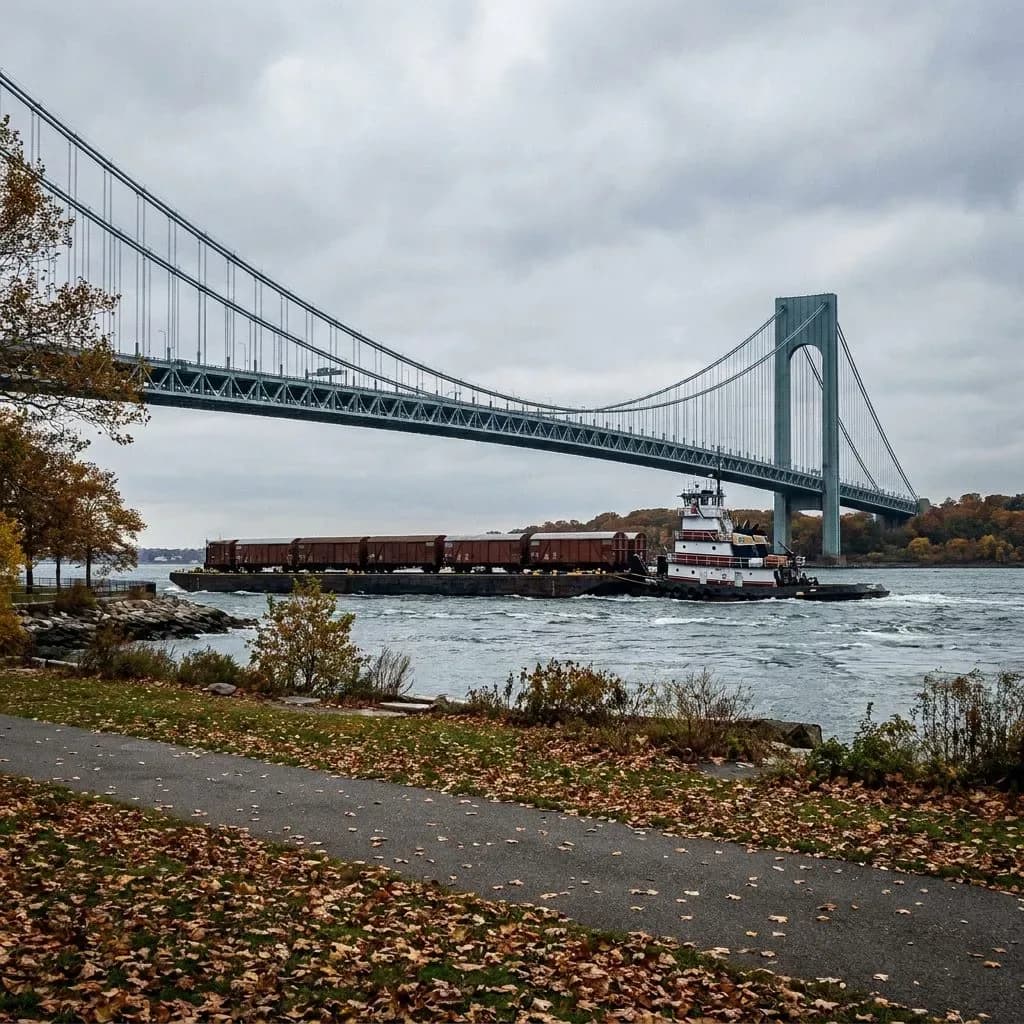
Every few hours, a squat tugboat nudges a rust-orange barge loaded with freight cars across the Narrows, moving at the pace of a determined tortoise. No fanfare, no horn blast—just the patient hum of diesel and the slap of wake against pilings. This is the Cross Harbor Railroad's car-float operation, the last of its kind in New York Harbor, a daily ritual that predates the subway system and soldiers on because the promised freight tunnel under the harbor was never built. Most New Yorkers have never seen it. The handful who gather on the benches at Shore Road Park in Bay Ridge have made it part of their weekend liturgy.
The View from 69th Street Pier
Shore Road Park stretches for miles along Brooklyn's western edge, but the 69th Street Pier section offers the clearest sightlines to the Bush Terminal rail yard across the water, where the barges load and unload. From the benches here, you can watch the whole slow-motion choreography: the tug maneuvering into position, the barge sliding into its slip, the eventual rumble of a locomotive pulling cars onto land. The pier juts just far enough into the Narrows to give you an unobstructed theater seat, with the Verrazzano-Narrazano Bridge strung across the backdrop and Staten Island's green hills beyond.
The light here changes everything. Late-afternoon sun in autumn gilds the barge's weathered steel and turns the wake into hammered bronze. Overcast mornings lend the whole scene a daguerreotype quality, as if you've stumbled into a documentary from 1952. Regulars bring binoculars, though the barges pass close enough that you can read the graffiti tags on the boxcar sides and watch the deck crew moving along the narrow catwalks. It's industrial spectacle stripped of romance—just logistics, dogged and unhurried.

The Irregular Schedule of Freight
Barge crossings are irregular and depend on freight schedules, but weekday mid-mornings and early afternoons see the most activity, roughly two to four crossings per day. There's no published timetable, no app to track the next departure. You show up, claim a bench, and wait. Sometimes the wait is ten minutes. Sometimes it's an hour, filled with the small pleasures of watching cormorants dive and container ships inch toward the Kill Van Kull.
The unpredictability is part of the appeal for the regulars—a handful of retirees, freelancers with flexible schedules, and the occasional rail enthusiast with a camera rig that costs more than a used car. Conversations strike up easily here, lubricated by the shared absurdity of dedicating a Saturday morning to watching trains float. One regular, a former longshoreman, can identify the tugboats by silhouette and recite the history of every rail line that once terminated in Brooklyn. Another keeps a dog-eared notebook logging barge times, a private dataset he'll never publish but updates with monastic devotion.
Why the Barges Still Run
The car-float system exists because New York never finished connecting its freight rail network. Brooklyn and Queens have tracks; so do New Jersey and the mainland. But the two halves don't meet. A tunnel was proposed in the 1920s, again in the 1960s, and periodically since. Each time, the cost and political will evaporated. So the barges persist, a 19th-century workaround in the 21st century, moving chemicals and scrap metal and the occasional load of lumber across a mile of water at seven knots.
It's wildly inefficient compared to a tunnel, and yet there's something stubbornly elegant about it—a refusal to let geography dictate terms, even if the solution involves strapping train cars to floating platforms and hoping the weather holds. The system handles a fraction of the freight it once did, but it endures, kept alive by contracts and the inertia of infrastructure. Watching it, you're witnessing not just a logistics operation but a civic decision deferred for a century.
The Waterfront Walk and Its Neighbors
Shore Road Park doubles as a segment of the Brooklyn Waterfront Greenway, so the benches at 69th Street share space with joggers, cyclists, and families pushing strollers toward the playgrounds farther south. The bike path is smooth and well-maintained, a ribbon of asphalt threading between the residential blocks of Bay Ridge and the seawall. On weekends, the park hums with low-grade activity—pickup soccer games, fishermen testing their luck off the rocks, someone's portable speaker leaking salsa into the salt air.
Bay Ridge itself remains one of the city's more grounded neighborhoods, a mix of longtime Italian and Norwegian families, newer Chinese and Middle Eastern immigrants, and the usual trickle of younger arrivals priced out of brownstone Brooklyn. The avenues inland are lined with family-run bakeries, no-frills diners, and bars that haven't updated their décor since the Reagan administration. It's not a neighborhood that makes it into many city guide roundups, which is partly why the barge-watchers prize it—you can still find a quiet bench on a Sunday morning without fighting for it.
What to Bring, What to Expect
Bring patience, first of all. Bring a thermos of coffee if it's a cool morning, or water if it's summer and the sun is bouncing off the harbor without mercy. Binoculars help, though they're not essential. A book or a sketchpad turns the waiting into something productive, though half the point is to let the mind idle while the tug inches closer. The benches are exposed to wind off the Narrows, so a windbreaker in spring or fall is wise. There's no concession stand at this section of the park, no restrooms nearby—this is utilitarian waterfront, not a manicured esplanade.
By late 2026, the operation may look much the same as it has for decades, though there are perennial rumors of infrastructure upgrades or, less likely, the tunnel finally breaking ground. For now, the barges keep crossing, and the regulars keep watching, a small fellowship united by appreciation for the city's most overlooked moving parts. It's a reminder that New York's infrastructure isn't just tunnels and towers but also these odd, anachronistic systems grinding along in the margins, visible only if you know where to look.
Practical Notes
Shore Road Park runs along Shore Road in Bay Ridge, Brooklyn; the 69th Street Pier section is accessible from the 69th Street/Shore Road area via the park entrances nearby. The R train to Bay Ridge–95th Street is the closest subway stop for the southern end of Shore Road Park, while 77th Street or 86th Street may be closer for the 69th Street Pier area, then a ten-minute walk west through the residential blocks to reach the park. Street parking is usually available along the residential streets. The park is open year-round from dawn to dusk. The waterfront path is paved and accessible, though the pier itself has some uneven surfaces. Bring layers and sun protection; the waterfront is exposed. Verify barge schedules by showing up mid-morning on a weekday for your best chance.
Tags: #ShoreRoadPark #BayRidgeBrooklyn #CrossHarborRailroad #NYCWaterfront #CarFloatBarges #IndustrialHeritage #BrooklynGreenway #HiddenNYC #TheLongWayHome #NYCCityGuide #VanderbiltBridge #FreightRail #OutdoorNYC #Fall2026 #UrbanExploration
Sources consulted: Car Float · New York New Jersey Rail · Shore Road Park · NY DOT Rail Division · NY Times: NY Region
All trademarks are the property of their respective owners.
Ask Karpo for more information.
Keep reading
- Best Trick or Treating Neighborhoods Near Me: Park Slope
 Best Trick or Treating Neighborhoods Near Me: Carroll Gardens
 Best Trick or Treating Neighborhoods Near Me: West Village